Rotator cuff pain location diagram: Where each muscle hurts
A rotator cuff pain location diagram maps where each of the four cuff muscles se...

Last Updated: Oct 12, 2026
The belly press test for shoulder assessment tells you whether the subscapularis can still hold the arm in internal rotation. The patient presses a flat palm into the stomach and keeps the elbow in front of the trunk. A wrist that folds forward, or an elbow that slides back behind the trunk, is a positive result.
That points to a torn or badly weakened subscapularis. Getting the call right matters, because a missed tear changes the repair and the rehabilitation that follows it.
You will find the technique, the interpretation, what the published accuracy supports, and when to switch to the lift-off or bear hug.

The belly press test loads the upper portion of the subscapularis, so it cannot rule out a lower-portion tear on its own.
A positive result is wrist flexion, or the elbow drifting behind the trunk, during the palm press.
Reported sensitivity runs from roughly 25% to 88%, while specificity holds between 68% and 99%.
The test is the practical choice when a patient cannot reach behind the back for a lift-off test.
Record the test name, the side, the result, and the sign you saw, or the note will not support the referral.
The belly press test is an orthopedic special test that looks for tears or marked weakness in the subscapularis muscle and tendon.
Clinicians also call it the Napoleon test, after the familiar image of Napoleon Bonaparte with his hand tucked inside his coat. It needs no equipment, works standing or seated, and takes seconds.
The mechanism is simple. Pressing the palm into the stomach with the elbow forward asks the subscapularis to hold the shoulder in internal rotation against resistance.
If the tendon is torn, the patient cannot generate that force from the shoulder. So they borrow it, either by flexing the wrist or by pulling the elbow backwards to recruit the shoulder extensors.
That borrowed movement is the whole finding. Watch the wrist and the elbow, not the hand.
The subscapularis is the largest and strongest of the four rotator cuff muscles. It runs from the subscapular fossa, on the front surface of the scapula, to the lesser tubercle of the humerus. It rotates the arm inward, adducts the glenohumeral joint, and holds the humeral head forward in the socket.
It also sits deep and anterior, tucked between the scapula and the ribs. You cannot palpate it the way you can the supraspinatus. The only way to judge it is to load the muscle and watch what the patient does instead.
The tendon has an upper and a lower component, and that split drives the whole testing strategy. Electromyography work by Tokish and by Chao found that the belly press preferentially loads the upper portion.
The lift-off is the test that stresses the lower portion. Running only one of them leaves part of the tendon unexamined.
Use the belly press whenever the history or the screening exam points at the subscapularis. Anterior shoulder pain with weak internal rotation is the classic trigger, and so is restricted passive external rotation.
It belongs early in the shoulder battery, not as an afterthought once imaging has already been ordered.
That last one is the reason this test earns its place. The Gerber lift-off needs the patient to put a hand behind the lower back and rotate the shoulder inward. Plenty of painful or stiff shoulders simply will not go there.
The belly press asks for a much easier position, so you still get a subscapularis reading on the patients who need it most.
Because so much of this hangs on available movement, measure and record the range first. A printable shoulder range of motion chart gives you the baseline to compare against at the next visit.
Technique decides the result here more than in most special tests. Small changes in elbow position, starting wrist posture, or how you phrase the instruction will flip a finding. The sequence below follows the method described in peer-reviewed clinical skills resources.
Have the patient stand or sit upright with the arm relaxed. Ask them to lay the palm flat on the stomach, roughly at the level of the navel. The elbow bends to about 90 degrees and stays in front of the trunk, not out to the side.
That forward elbow position is the landmark the whole test hangs on. If the elbow drops behind the trunk during the press, that movement is itself part of the positive sign.
Stand facing the patient on the side you are testing. Check the wrist and the elbow first, because you need the starting posture to compare against. Then give the instruction and watch for the two compensations.
Then repeat the whole sequence on the other shoulder. Test the uninvolved side first, so the patient learns the movement before you load the painful one.
Two compensations count, and either one on its own makes the test positive. A negative test is a firm press held with the wrist neutral or extended and the elbow kept forward for the whole hold. That pattern says the subscapularis is doing its job.
A positive result raises the suspicion of a tear. It does not confirm one. MRI or arthroscopy is what settles the diagnosis, and the test result belongs alongside the history, the imaging, and the rest of the battery.
Published accuracy for the belly press swings widely between studies. Three factors drive that spread. Studies differed in how they defined a positive sign, in whether MRI or arthroscopy was the reference standard, and in which patients they recruited.
The reported figures below come from a systematic review that pooled seven studies of subscapularis special tests.
Read those two rows together and the clinical rule falls out. Specificity stays high across every study, while sensitivity collapses in some of them. So a positive belly press moves you toward imaging, and a negative one moves you almost nowhere.
The per-study figures are set out in the systematic review of subscapularis special tests on PubMed Central. When you write to a referring clinician, quote the range rather than a single number, and say which reference standard the study used.
Run all three subscapularis tests, not just the one you like. The belly press and the bear hug both load the upper tendon, so the lift-off is what covers the lower portion. Combining them lifts accuracy only marginally, so treat a cluster of negatives as support for your clinical judgment rather than proof.
Every limitation below has the same practical consequence. It pushes the test toward a false negative, which is exactly where the sensitivity figures come from. Knowing them stops you treating a negative result as an all-clear.
So a negative belly press on its own never rules out subscapularis pathology. A cluster of negatives, across the belly press, the bear hug, and the lift-off, is much stronger evidence against a meaningful tear.
Three tests share this job: the belly press, the lift-off, and the bear hug. They differ in which part of the tendon they load and in what they ask the patient’s shoulder to do. The second difference is usually what decides which test you can run on the day.
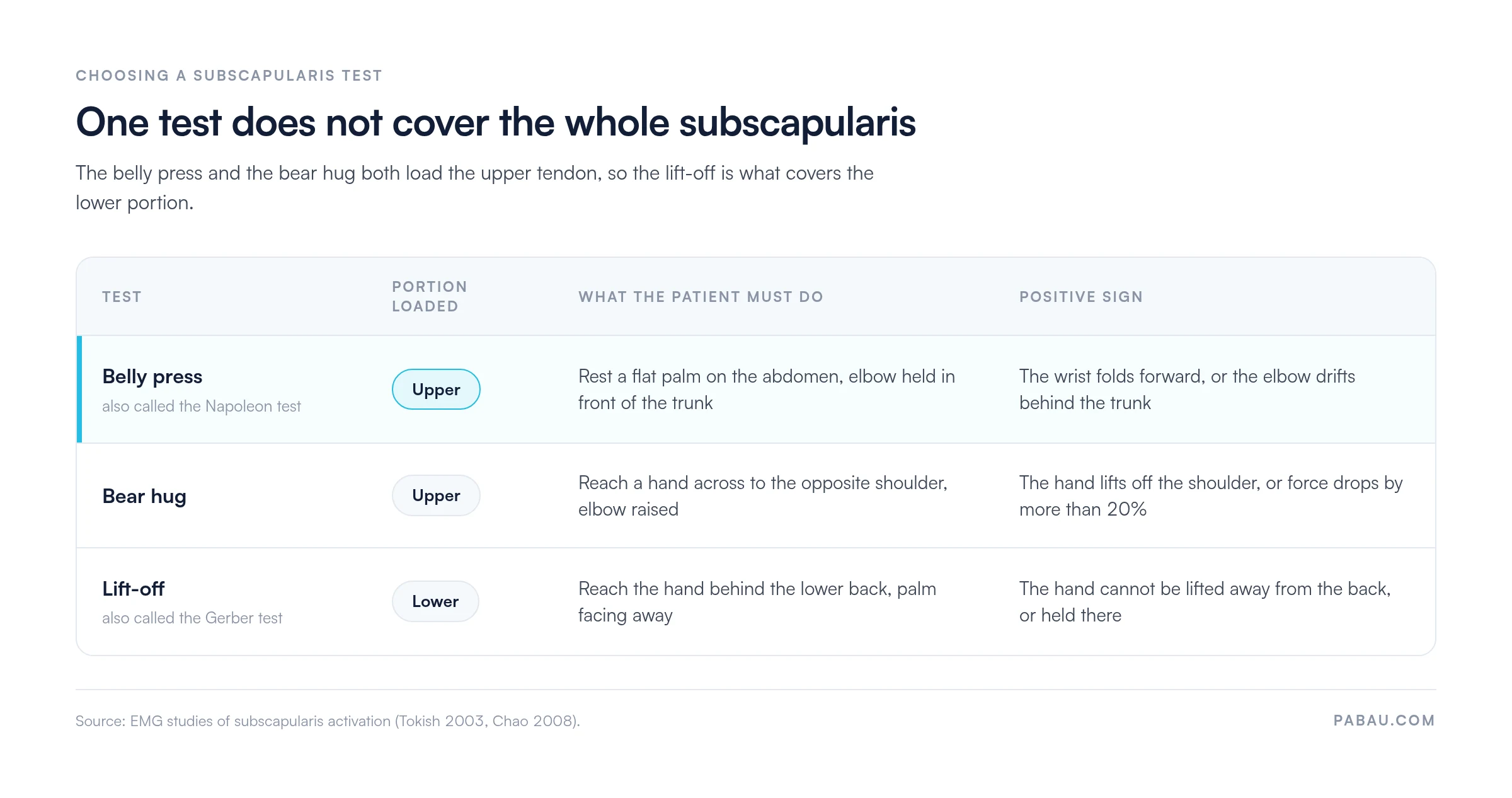
The Gerber lift-off test loads the lower subscapularis through active internal rotation. The patient puts a hand behind the lower back, palm facing away, then lifts it off against gravity or your resistance. Failing to lift off, or failing to hold the lifted position, is positive.
Its weakness is the starting position. Patients with restricted internal rotation, acute pain, or a stiff shoulder cannot get the hand behind the back at all. That is the moment to switch to the belly press.
For the bear hug, the patient places a hand on the opposite shoulder with the elbow raised. You try to lift the hand away while they resist. A positive sign is losing the hand position, or a force deficit greater than 20% against the other side.
Because it also stresses the upper tendon, it does not substitute for the lift-off. Think of the bear hug as a second look at the upper portion, useful when the belly press is equivocal or pain limits the press.
The belly press answers one question about one muscle. Knowing where it sits in the sequence stops you repeating tests that load the same tendon. It also stops you missing the supraspinatus, infraspinatus, or teres minor altogether.
A workable order for anterior shoulder pain with suspected cuff pathology runs like this. Neer sign, Hawkins-Kennedy, empty can, drop arm, belly press, bear hug, then Speed’s test for the biceps tendon. That sweeps the whole cuff and clears the common confounders before anyone orders an MRI.
An entry reading “shoulder pain, query rotator cuff” will not support a referral, justify imaging, or defend you later. The test is quick, and so is recording it properly. What trips teams up is inconsistency. Two clinicians in the same practice describe the same finding in different words.
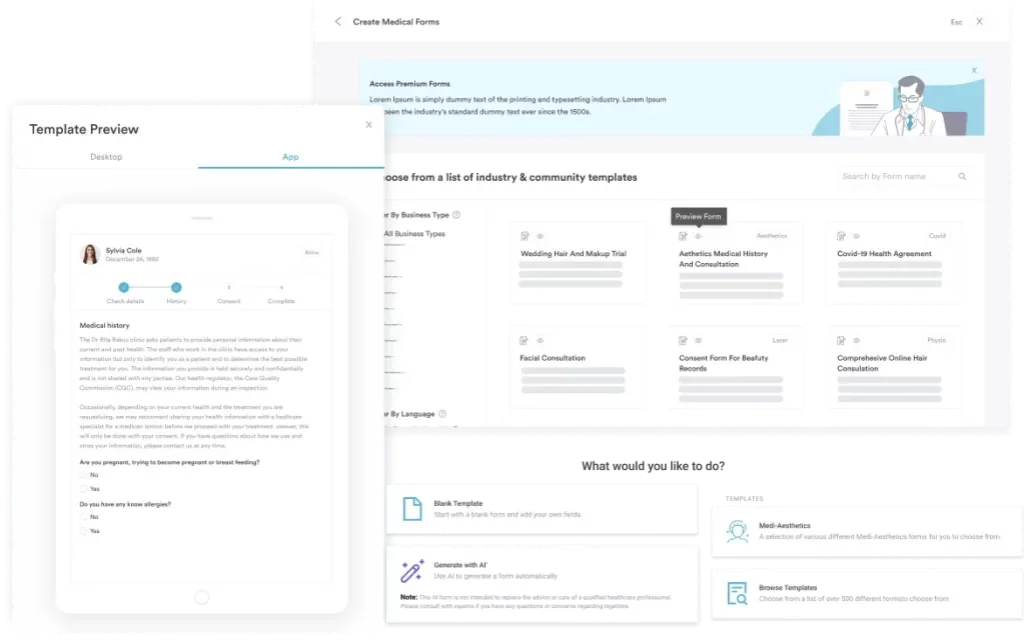
A shoulder assessment template inside your physical therapy EMR fixes that, because the fields do the remembering instead of the clinician. Run through this list before you close the note.
Coding follows the diagnosis, not the test. In ICD-10-CM, subscapularis pathology sits in the M75 shoulder lesions category. M75.1 covers rotator cuff tear or rupture, not specified as traumatic. It splits further into M75.11 for an incomplete tear and M75.12 for a complete one. The final digit carries laterality.
M75.3 covers calcific tendinitis of the shoulder, which is a common alternative once imaging comes back. Codes change every October, so check the current ICD-10-CM files from CMS before you submit rather than trusting a cheat sheet.
On the procedure side, a shoulder examination normally falls under evaluation and management coding, and the level depends on the setting and the payer. Your billing team is the right check there, not a blog.
Most practices still record special tests in free text. The wording drifts between clinicians, the side gets left out, and six months later nobody can find the note that mattered. Rebuilding the picture then takes longer than the original appointment did.
Practice management software like Pabau replaces that with a structured form you build once. The shoulder assessment template carries fields for the test, the side, the result, and the sign observed. The same information reaches the record whoever is in the room.
Those findings then sit in patient record management alongside the appointment they came from. The next clinician opens the record and sees what changed since the last visit. You can track a subscapularis over six weeks instead of guessing.
Pabau Scribe, our AI scribe, can also draft the assessment note from your spoken summary. You review it before it saves.
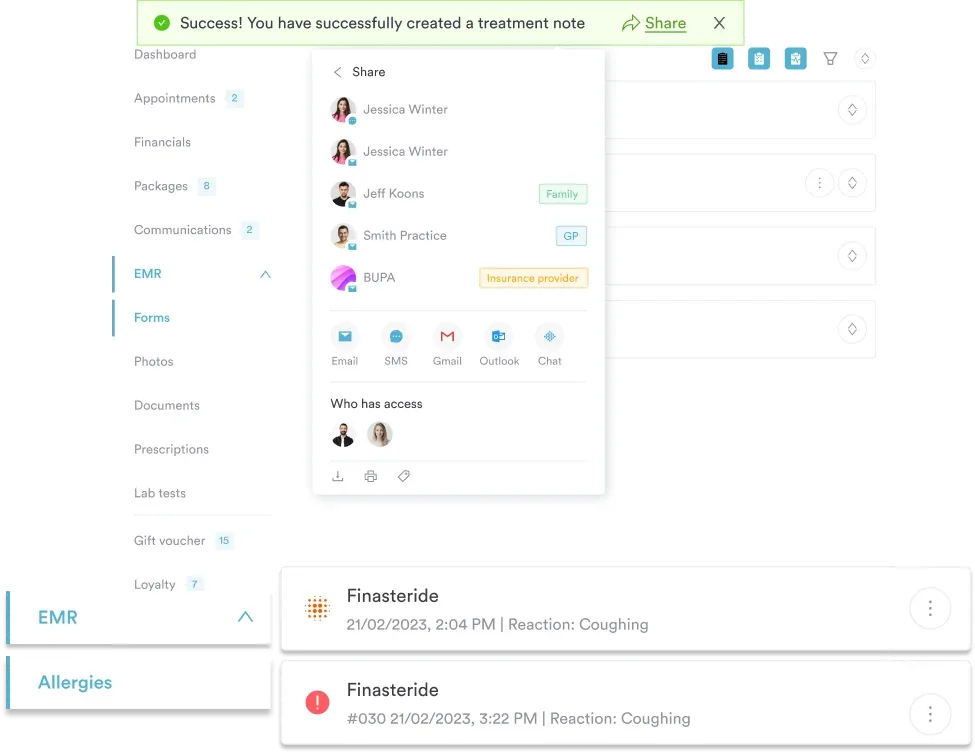

Pabau gives physical therapy and sports medicine practices structured digital forms, AI-assisted clinical notes, and searchable patient records. Every special test result lands in the right place and stays findable at the next visit.

Treat the belly press as a rule-in test and it will serve you well. Specificity is high across the literature, so a clear wrist fold or a drifting elbow is worth escalating. Sensitivity is not, so a clean press proves very little on its own.
The bigger shift is remembering which part of the tendon you examined. The belly press and the bear hug both report on the upper subscapularis. Skip the lift-off and the lower portion goes unchecked, which is how isolated lower-pole tears reach the surgeon undiagnosed.
The trade-off worth holding onto is speed against certainty. The test takes seconds, and that is the point, as long as the note that follows carries the side, the sign, and the effort. Book a demo to see how Pabau turns a shoulder assessment into a structured record your whole team can read.

Need to check the lower portion of the tendon? Lift-off test walks through the position, the resistance, and what a positive result means.
Working through the rest of the rotator cuff? Infraspinatus test covers the external rotation side of the same assessment battery.
Need a printable range chart for the shoulder? Shoulder range of motion template gives you a baseline to measure against at the next visit.
Tightening up your clinical documentation? Physiotherapy compliance requirements sets out what your records need to show and why.
Setting up a new practice? Opening a physiotherapy clinic covers the operational and documentation groundwork before you see patients.
It should not be. The press is isometric and the arm stays in a comfortable position, so most patients tolerate it easily. Anterior shoulder discomfort is common with subscapularis pathology, though. Pain that stops the patient pressing firmly makes the result unreliable. Record the pain rather than the weakness, then repeat the test once symptoms settle.
Follow the surgeon’s protocol rather than a fixed timeline. Resisted internal rotation pulls directly on the repair, so protocols hold it back for several weeks after surgery. Once resisted internal rotation has been cleared, the belly press gives a quick side-to-side check on how the tendon is recovering.
No. The test points to subscapularis weakness, and plenty of causes of that respond to rehabilitation. Imaging decides the next step. Tendinopathy and small partial tears are usually managed conservatively, while a full-thickness tear in an active patient is more likely to be referred.
Yes, and start with the uninvolved side. It sets the patient’s normal and shows them the movement before you load the painful shoulder. Subscapularis weakness is far easier to spot as a difference between sides than as an absolute finding, so record both results.