Pabau GO app

The new Pabau GO is heredownload on the App Store

Download on the App Store
Book a demo Book a demo
Clinical guides

Shoulder special tests: Technique, sensitivity, and interpretation

Avatar photo Maja Popovska
Last Updated: August 31, 2026
Reviewed by: Avatar photo Lucy Galloway
Key takeaways

Key takeaways

A shoulder special test isolates a specific anatomical structure or pathology during clinical examination.

No single shoulder special test is diagnostic on its own, so a battery approach improves accuracy.

Sensitivity and specificity values guide which tests to prioritize, but read them alongside history and imaging.

Digital forms in practice management software like Pabau keep shoulder special test findings consistent across appointments.

Most shoulder pain presentations arrive without a clear diagnosis attached. Clinicians spend valuable appointment time working through a mental checklist of possible structures, and an unstructured examination wastes that time. A well-sequenced shoulder special test approach cuts through the uncertainty by isolating specific tissues, generating objective findings, and guiding the next clinical decision.

This guide is written for physical therapists, sports medicine clinicians, osteopaths, and orthopedic practitioners who examine shoulders regularly. It covers the most clinically validated tests across six pathology categories. For each one you get step-by-step technique, positive sign definitions, and reported accuracy values, plus guidance on combining tests for a stronger diagnostic picture.

Found our content helpful?

What is a shoulder special test and when should you use one?

A shoulder special test is a standardized examination procedure that stresses one specific anatomical structure. The aim is to provoke or reproduce the symptoms of a known pathology. Each test targets one region, whether that is the rotator cuff, the labrum, the biceps tendon, the acromioclavicular (AC) joint, or the glenohumeral capsule.

Special tests come at the end of the examination sequence, not the beginning. The structured order matters:

  • History: Mechanism, onset, location, aggravating factors
  • Inspection: Asymmetry, wasting, scapular position, swelling
  • Palpation: Tenderness over specific landmarks (greater tuberosity, AC joint, bicipital groove)
  • Range of motion: Active then passive, comparing bilaterally
  • Special tests: Targeted to structures implicated by the history and ROM findings

Running tests before completing palpation and ROM reduces their diagnostic value. The history shapes which test categories are relevant, and ROM findings narrow the list further before you apply manual stress. A printable shoulder range of motion chart gives you the baseline angles to compare against at the next visit.

Understanding sensitivity, specificity, and how to use them clinically

Two numbers appear repeatedly in shoulder special test literature: sensitivity and specificity. They measure different things and serve different clinical purposes.

Metric What it tells you Clinical use
Sensitivity How often the test is positive when pathology is present A highly sensitive test rules OUT pathology when negative (SnNout)
Specificity How often the test is negative when pathology is absent A highly specific test rules IN pathology when positive (SpPin)
LR+ (positive likelihood ratio) How much a positive test increases the probability of pathology LR+ above 5 is clinically meaningful
LR- (negative likelihood ratio) How much a negative test decreases the probability of pathology LR- below 0.2 is clinically meaningful

No shoulder special test has both high sensitivity and high specificity. The Hawkins-Kennedy test, for example, reports roughly 79% sensitivity for impingement syndrome but only about 59% specificity. That makes it useful for ruling impingement out when negative, while a positive result alone does not confirm it. Sorted by specificity, the pattern across the common tests is hard to miss.
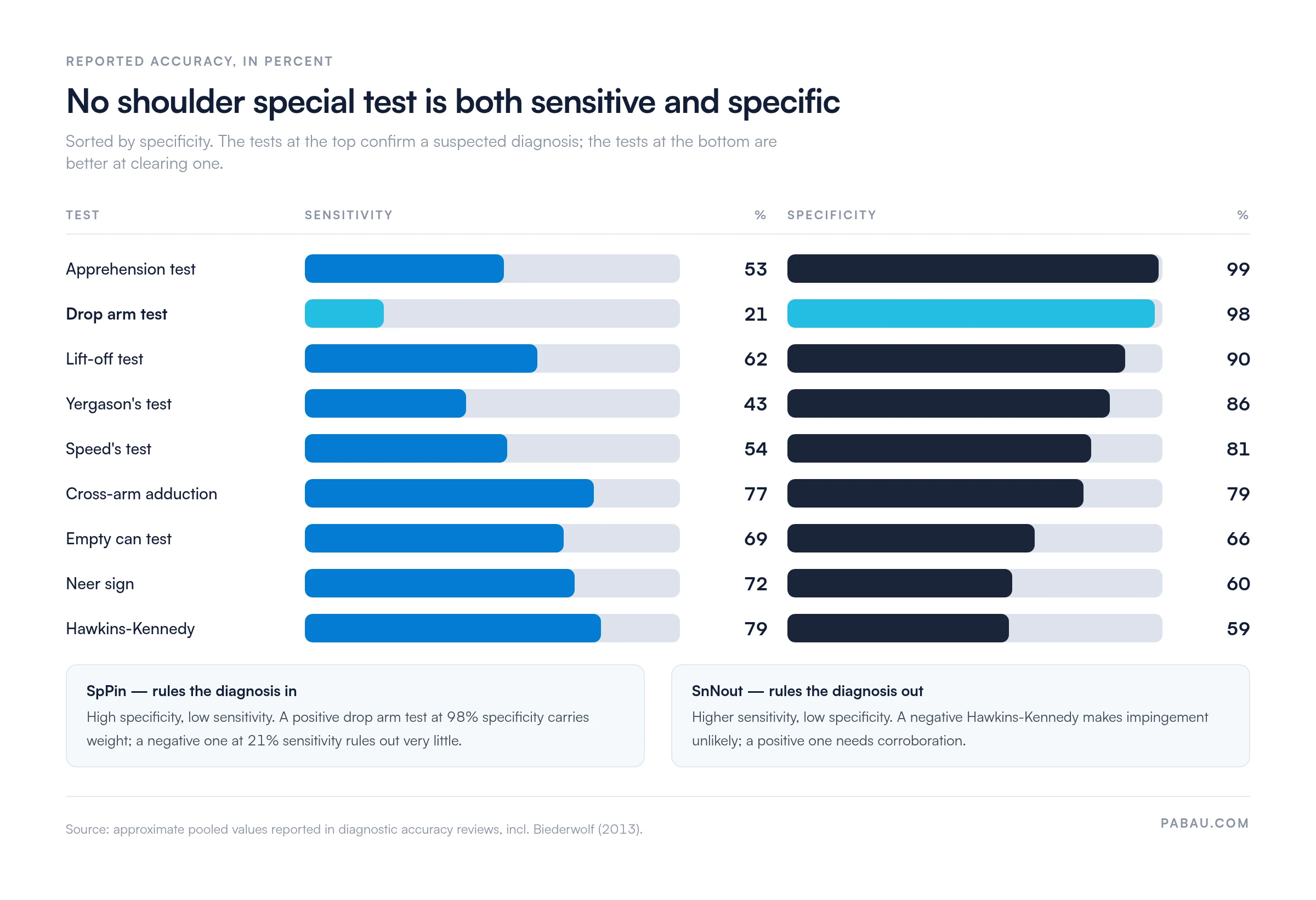
Paired bar chart of shoulder special test accuracy: apprehension 53% sensitivity and 99% specificity, drop arm 21% and 98%, lift-off 62% and 90%, Yergason's 43% and 86%, Speed's 54% and 81%, cross-arm adduction 77% and 79%, empty can 69% and 66%, Neer 72% and 60%, Hawkins-Kennedy 79% and 59%
The tests that confirm a diagnosis are the ones that miss it most often, which is the whole argument for clustering. Values as reported in diagnostic accuracy reviews, including Biederwolf (2013).

This is why combining tests matters. A cluster of two or three positive tests in the same pathology category produces a far stronger diagnostic picture than any single result. Practitioners record clusters rather than individual positives, and a purpose-built physical therapy EMR keeps that reasoning visible in the note.

Impingement shoulder special tests: Neer and Hawkins-Kennedy

Impingement syndrome involves mechanical compression of the supraspinatus tendon and subacromial bursa beneath the acromion. Two tests dominate clinical practice for this category, and our full guide to Neer’s test covers examiner positioning in more depth.

Neer impingement sign

  • Patient position: Seated or standing, arm relaxed
  • Examiner action: Internally rotate the arm, then passively forward flex to end range while stabilizing the scapula
  • Positive sign: Pain in the anterior or anterolateral shoulder, typically in the arc between 70 and 120 degrees
  • Sensitivity/specificity: Approximately 72% / 60% for impingement, reported across multiple meta-analyses
  • Interpretation: Pain should reproduce the patient’s complaint. A negative test is more useful clinically than a positive one, given the moderate specificity

Hawkins-Kennedy test

  • Patient position: Seated, elbow at 90 degrees, shoulder at 90 degrees of forward flexion
  • Examiner action: Internally rotate the shoulder by pushing the forearm downward
  • Positive sign: Pain in the anterior shoulder or subacromial region
  • Sensitivity/specificity: Approximately 79% / 59% for impingement syndrome
  • Interpretation: The more sensitive of the two impingement tests, so it is useful for screening. A positive result still needs corroboration from other findings

Rotator cuff shoulder special tests: supraspinatus and subscapularis

Rotator cuff pathology is the most common source of shoulder pain in clinical practice. Four shoulder special tests cover the primary cuff tendons, with each targeting a different structure or function.

Empty can test (Jobe’s test)

  • Patient position: Standing or seated, arm elevated to 90 degrees in the scapular plane, internally rotated (thumb pointing down, as if emptying a can)
  • Examiner action: Apply downward resistance to the forearm while the patient resists
  • Positive sign: Weakness or pain with resistance
  • Sensitivity/specificity: Approximately 69% / 66% for supraspinatus tears
  • Interpretation: Weakness, not pain, is the more reliable positive finding. Pain alone may reflect impingement rather than a structural tear

Full can test

  • Patient position: Arm at 90 degrees in the scapular plane, externally rotated (thumb pointing up)
  • Examiner action: Apply downward resistance to the forearm
  • Positive sign: Weakness or reproduction of pain
  • Key difference from empty can: External rotation reduces subacromial impingement of the tendon, so pain is less likely to confound the finding
  • Interpretation: The full can test is often better tolerated when impingement pain is present, and it may produce fewer false positives for structural tears

Drop arm test

  • Patient position: Standing, arm passively abducted to 90 degrees by the examiner
  • Examiner action: Ask the patient to slowly lower the arm to their side
  • Positive sign: The arm drops suddenly, or the patient cannot control the lowering movement
  • Sensitivity/specificity: Approximately 21% / 98% for full-thickness rotator cuff tears
  • Interpretation: Low sensitivity means many tears will be missed. A positive result is a strong indicator of a full-thickness tear and warrants prompt imaging referral

Because a positive result changes the management plan immediately, the drop arm test is worth a technique review before you rely on it.

Lift-off test (Gerber’s test)

  • Patient position: Standing, hand placed behind the back at lumbar level, palm facing outward
  • Examiner action: Ask the patient to lift the hand away from the back against resistance
  • Positive sign: Inability to lift the hand off, or marked weakness
  • Target structure: Subscapularis, the anterior rotator cuff tendon
  • Interpretation: The lift-off test is specific for subscapularis pathology. Patients with stiffness or pain-limited internal rotation may not reach the position, making the test inconclusive

Labral and SLAP shoulder special tests: O’Brien’s and anterior slide

Superior labrum anterior to posterior (SLAP) tears and broader labral pathology are common in overhead athletes and after traumatic shoulder events. Two shoulder special tests are most widely used for this category, though their accuracy varies considerably across studies.

O’Brien’s active compression test

  • Patient position: Standing, arm at 90 degrees of forward flexion, 10-15 degrees of horizontal adduction, elbow fully extended
  • Examiner action: Apply downward pressure with the arm internally rotated (thumb down), then repeat with the arm externally rotated (thumb up)
  • Positive sign: Pain or clicking in the thumb-down position that is reduced or absent thumb-up
  • Pain location matters: Deep shoulder pain suggests SLAP pathology, while pain at the AC joint suggests AC joint pathology
  • Interpretation: The test has useful dual diagnostic utility, but reported accuracy varies widely. Always interpret it alongside history and further testing

Anterior slide test

  • Patient position: Standing or seated, hand on ipsilateral hip
  • Examiner action: One hand stabilizes the scapula, the other applies an anterosuperior force through the elbow
  • Positive sign: Anterior shoulder pain, popping, or pain at the bicipital groove region
  • Interpretation: Used as a supplementary SLAP test. Evidence for standalone accuracy is modest, so it works better as part of a labral cluster

Instability shoulder special tests: apprehension, posterior apprehension, and sulcus sign

Glenohumeral instability ranges from subtle hypermobility to frank recurrent dislocation. The apprehension-relocation sequence remains the most clinically validated shoulder special test for anterior instability.

Anterior apprehension and relocation test

  • Patient position: Supine, shoulder at 90 degrees abduction, elbow at 90 degrees flexion
  • Apprehension phase: Externally rotate the shoulder progressively. The positive sign is apprehension, a sense of impending dislocation, rather than pain alone
  • Relocation phase: Apply a posterior force to the proximal humerus while maintaining external rotation. Relief of apprehension is the positive relocation sign
  • Clinical note: Apprehension, not pain, is the reliable positive sign here. Pain without apprehension is a non-specific finding

Posterior apprehension test

  • Patient position: Supine, shoulder at 90 degrees flexion and internal rotation
  • Examiner action: Apply an axial load through the humerus in a posterior direction
  • Positive sign: Apprehension or reproduction of posterior instability symptoms
  • Use case: Indicated when the patient reports pain or instability with the arm across the body, or during push-ups

Sulcus sign

  • Patient position: Seated, arm relaxed at the side
  • Examiner action: Apply inferior traction to the arm at the elbow or wrist
  • Positive sign: A visible or palpable groove below the acromion, graded 1+ (under 1 cm), 2+ (1-2 cm), or 3+ (over 2 cm)
  • Interpretation: Indicates inferior capsular laxity. A grade 3+ sulcus that persists with external rotation is associated with multidirectional instability

AC joint shoulder special test: cross-arm adduction

AC joint pain typically localizes to the top of the shoulder and is aggravated by cross-body movements. One test has become the clinical standard for provoking this structure.

Cross-arm adduction test

  • Patient position: Seated or standing
  • Examiner action: Elevate the arm to 90 degrees, then passively adduct across the body toward the opposite shoulder
  • Positive sign: Pain localized to the AC joint
  • Differentiating detail: Glenohumeral pain is felt more diffusely in the joint, while AC joint pain is focal and superior. The same distinction helps you read an O’Brien’s result

Biceps tendon shoulder special tests: Speed’s and Yergason’s

Biceps tendon pathology produces anterior shoulder pain that can mimic rotator cuff and labral presentations. That includes tendinopathy, partial tears, and instability in the bicipital groove. Two shoulder special tests target this structure specifically.

Speed’s test

  • Patient position: Standing, elbow extended, forearm supinated, arm forward flexed to approximately 60-90 degrees
  • Examiner action: Apply downward resistance to the forearm while the patient resists forward flexion
  • Positive sign: Pain localized to the bicipital groove
  • Interpretation: Moderate sensitivity for biceps tendon pathology. Pain anywhere else does not count as a positive result

Yergason’s test

  • Patient position: Seated, elbow at 90 degrees flexion, forearm pronated, arm at the side
  • Examiner action: Resist supination and elbow flexion simultaneously while the patient attempts the movement
  • Positive sign: Pain or tenderness in the bicipital groove
  • Comparison with Speed’s: Yergason’s isolates the biceps through a rotational stress rather than a flexion stress. The two are commonly paired to improve diagnostic yield

Scapular dysfunction: an underexamined component of the shoulder special test sequence

Scapular control directly affects rotator cuff function, impingement mechanics, and labral loading. An examination that stops at the glenohumeral joint leaves that contribution unmeasured. Addressing scapular dysfunction often changes the rehabilitation plan entirely, even when the rotator cuff tests are also positive.

Wall push-up test for serratus anterior

  • Patient position: Standing facing a wall, hands at shoulder height, elbows slightly flexed
  • Examiner action: Watch the medial border and inferior angle of the scapula as the patient performs a slow wall push-up
  • Positive sign: The medial border lifts away from the thoracic wall, or the inferior angle rotates medially rather than laterally
  • Clinical significance: Indicates serratus anterior weakness from long thoracic nerve involvement or inhibition. It correlates with impingement presentations and overhead athlete symptoms

Visual scapular dyskinesis assessment

  • Method: Observe scapular motion bilaterally during active forward flexion and abduction. Look for premature elevation, excess anterior tilting, or asymmetric rhythm
  • Positive finding: Visible asymmetry or altered scapulohumeral rhythm compared to the unaffected side
  • Note: This is an observational finding, not a pass/fail test. Let it shape your rehabilitation focus rather than generate a binary diagnosis

Adding scapular assessment to your shoulder special test sequence costs very little examination time. It is increasingly expected in evidence-based musculoskeletal practice.

Pro Tip

Run the scapular dysfunction assessment before your rotator cuff tests, not after. Altered scapular position changes subacromial space dimensions and affects the sensitivity of impingement tests. Seeing abnormal scapular control first gives you the context to interpret a borderline Neer or Hawkins-Kennedy result more accurately.

Quick-reference shoulder special test summary table

Use this table as a rapid clinical reference during or after examination to cross-check findings across pathology categories.

Test Target structure Positive sign Sensitivity Specificity
Neer sign Subacromial impingement Anterior shoulder pain on passive flexion ~72% ~60%
Hawkins-Kennedy Subacromial impingement Pain on internal rotation at 90 degrees ~79% ~59%
Empty can test Supraspinatus Weakness or pain with resisted abduction ~69% ~66%
Drop arm test Full-thickness rotator cuff tear Arm drops; unable to lower slowly ~21% ~98%
Lift-off test Subscapularis Inability to lift hand from lumbar spine ~62% ~90%
O’Brien’s test SLAP / AC joint Deep pain thumb-down, relieved thumb-up Variable Variable
Apprehension test Anterior instability Apprehension (not pain) on external rotation ~53% ~99%
Cross-arm adduction AC joint Pain localized to AC joint ~77% ~79%
Speed’s test Biceps tendon Bicipital groove pain on resisted flexion ~54% ~81%
Yergason’s test Biceps tendon Bicipital groove pain on resisted supination ~43% ~86%

Sensitivity and specificity values are approximate figures drawn from peer-reviewed reviews, including Biederwolf (2013). Values vary by study population, examiner experience, and reference standard used. Interpret them as guides, not fixed benchmarks.

Using a shoulder special test battery rather than a single test

No single shoulder special test is sufficient to confirm or exclude a diagnosis. A battery approach, using two or three tests per suspected pathology category, substantially improves clinical decision-making. According to Biederwolf (2013), clustering tests for the same pathology generates higher positive likelihood ratios than any individual test.

Recommended clusters by pathology category:

  • Impingement: Neer sign plus Hawkins-Kennedy, where two positives raise post-test probability substantially
  • Supraspinatus tear: Empty can plus full can plus drop arm, where a positive drop arm alone warrants imaging
  • Subscapularis: Lift-off test plus internal rotation resistance test
  • SLAP lesion: O’Brien’s plus anterior slide, since neither test alone is sufficient
  • Anterior instability: Apprehension plus relocation, sequenced as a pair
  • AC joint: Cross-arm adduction plus the pain location from O’Brien’s
  • Biceps tendon: Speed’s plus Yergason’s, paired routinely

When two or more tests in a category are positive, refer for imaging and adjust your management plan accordingly. Ultrasound or MRI is usually the next step. When a high-sensitivity test is negative and clinical suspicion is already low, that category can reasonably be deprioritized.

How to document shoulder special test findings in clinical records

Documentation of shoulder special test results is a core professional responsibility, and it is the area clinical audits flag most often. Poor documentation creates medico-legal risk, limits continuity of care, and makes outcome tracking impossible.

A complete record for each shoulder special test should include:

  • Test name: Use the standardized name, so Hawkins-Kennedy test rather than impingement test
  • Result: Positive or negative, with the specific finding recorded (for example, pain in the anterior shoulder at end-range internal rotation)
  • Side: Left or right, with bilateral comparison noted where performed
  • Patient response: Whether the test reproduced the patient’s chief complaint
  • Clinical interpretation: What the finding suggests in the context of the full examination

A SOAP structure keeps shoulder special test findings separate from subjective history and treatment decisions. Subjective carries the mechanism and the aggravating movements. Objective carries the test names and the results. Assessment carries the reasoning that ties the cluster to a working diagnosis.

How Pabau keeps shoulder examination records consistent

Free-text notes are where shoulder examination detail usually ends up. The wording drifts between clinicians, the side examined gets left out, and comparing this visit to the last one means rereading paragraphs.

Practice management software like Pabau replaces that with a structured form. You build a shoulder examination template once, with a field for each test. A dropdown records positive or negative, and a free-text box holds the positive sign you observed.

Pabau digital clinical form with structured fields for recording examination findings
Pabau’s digital forms turn your shoulder examination into fixed fields, so every test result is recorded the same way at every visit.

Those entries land in a structured client record, so the next appointment opens with the previous examination already visible. Referral letters pull the same fields, which means the surgeon reads the results you actually recorded.

The outcome is a shoulder examination you can audit, compare across visits, and hand to a colleague without a phone call. Every subscription includes the forms builder and the client record, so nothing here sits behind a higher tier.

Standardize your shoulder examination documentation

Pabau gives physical therapists, sports medicine clinicians, and osteopaths structured digital forms for shoulder special test findings. Record positive signs and test clusters in one client record, then share them with referring practitioners.

Pabau clinical documentation for shoulder examination

Conclusion

Shoulder pain rarely announces its source. A systematic sequence, grouped by pathology category and read as a battery, separates a confident decision from an educated guess. Scapular assessment is the component most likely to change your rehabilitation direction, and it takes under a minute.

Getting the examination right is only half the job. A record that says exactly what you found, in a form a colleague can read, carries the other half. Book a demo to see how a shoulder examination template records test results, clusters, and clinical reasoning in one place.

Continue your research

Continue your research

Need the technique detail on the classic impingement test? Neer’s test covers examiner positioning, the positive sign, and the errors that produce false positives.

Relying on one test to confirm a cuff tear? The drop arm test explains why its high specificity matters far more than its sensitivity.

Assessing anterior shoulder pain that may be biceps in origin? The biceps load test gives you a recording form for the labral and biceps examination.

Seeing scapular crepitus alongside impingement signs? The snapping scapula syndrome test adds a structured scapular assessment to your examination.

Running a musculoskeletal practice on paper notes? Physiotherapy practice management software compares the platforms that handle scheduling, notes, and billing together.

Frequently asked questions

What is a shoulder special test?

A shoulder special test is a standardized examination procedure that applies a specific mechanical stress to one anatomical structure. The target is usually the rotator cuff, labrum, biceps tendon, or AC joint. No single test is diagnostic on its own, so read the result alongside history, ROM findings, and imaging.

What is the most accurate shoulder special test for rotator cuff tears?

The drop arm test has the highest specificity for full-thickness rotator cuff tears at roughly 98%. A positive result therefore points strongly to a significant tear. Its sensitivity is only around 21%, so a negative result does not rule a tear out. Combining the empty can, full can, and drop arm tests gives a more complete picture.

What does a positive Hawkins-Kennedy test mean?

A positive Hawkins-Kennedy test means the patient felt pain in the anterior or subacromial shoulder during internal rotation at 90 degrees of flexion. That suggests possible subacromial impingement syndrome. Specificity is only about 59%, so impingement is likely rather than confirmed. Pairing the result with the Neer sign and the history strengthens the picture.

What special tests are used for SLAP tears?

The O’Brien’s active compression test and the anterior slide test are the most commonly used tests for SLAP lesions. O’Brien’s is positive when deep shoulder pain appears with the arm internally rotated and eases with external rotation. Neither test is accurate enough in isolation. Use both as a labral cluster and correlate with MRI arthrogram where suspicion is high.

What does a positive empty can test indicate?

A positive empty can test indicates likely supraspinatus involvement, either a tear or significant tendinopathy. The positive finding is weakness or pain on resisted abduction in the scapular plane with the arm internally rotated. Weakness is the more reliable indicator of a structural tear. Pain without weakness may reflect impingement rather than a cuff defect.

How do you document shoulder special test findings?

Record each test by its standardized name, the result, the specific finding observed, and the side examined. Note whether the test reproduced the patient’s chief complaint. Add a brief clinical interpretation in the assessment section of your SOAP note. Digital forms with structured dropdown fields reduce omissions and keep wording consistent across practitioners.


Found our content helpful?
×