All about me worksheet for adults
An all about me worksheet for adults is a guided self-reflection form that maps ...

2
Last Updated: Oct 14, 2026

The Who Am I worksheet is a structured identity-exploration tool that helps therapy clients examine their values, strengths, roles, beliefs, and goals.
Most clinicians use it as a session-by-session workbook or a homework assignment that deepens self-awareness and supports treatment planning.
The worksheet is effective for both adults and teens, though developmental adjustments improve engagement with younger clients.
Anchor each review of the worksheet to one treatment goal, so identity insights become documented progress rather than loose notes.
Practice management software like Pabau delivers the worksheet to clients and files their answers in the clinical record.
Six sections of prompts covering identity statements, personal values, character strengths, life roles, core beliefs, and goals. Print it for in-session use, or send it home as a homework assignment.
Download templateA Who Am I worksheet gives a therapy client a structured way to describe their own identity. It asks who they are, what they value, what they are good at, and where they are heading. The form works in individual therapy, in group counseling, and with clients moving through a major life transition.
Anyone who already runs a psychiatric evaluation template will recognize the logic. A fixed set of prompts keeps assessment consistent from one client to the next.
This page covers what the worksheet contains, how to run it across a session, and how to turn a client’s answers into documented treatment progress.
A Who Am I worksheet is a facilitated self-exploration tool that asks clients to describe their identity across several dimensions. It presents prompts or fill-in-the-blank statements about who they are, what matters most to them, and how they see themselves inside their roles and relationships.
In practice, therapists use it as both an assessment aid and an intervention. Clients complete it to develop self-awareness, clarify values, identify personal strengths, and articulate life goals.
The answers show a clinician how the client perceives themselves. That perception shapes treatment planning and makes identity-related progress easier to track over months.
The worksheet serves several populations across mental health and wellness settings. It suits clients working through identity concerns, self-esteem problems, life transitions, or existential questions.
Therapists working in therapy practice management commonly use it with adolescents and young adults. It also suits professionals mid-career change, and clients recovering from trauma or loss.
It also fits existential and humanistic modalities, where identity is the work rather than a side effect of it. Educational settings, coaching engagements, and wellness programs use the same prompts for personal development.
The core prompts work across age groups, but adjustments to language and complexity improve engagement. Adults get more from nuanced questions about authenticity, legacy, and meaning. Teens respond better to shorter, concrete questions about identity, peer relationships, and emerging autonomy.
Younger clients often need to hear that there are no right answers, because honest self-exploration is the point rather than performance.
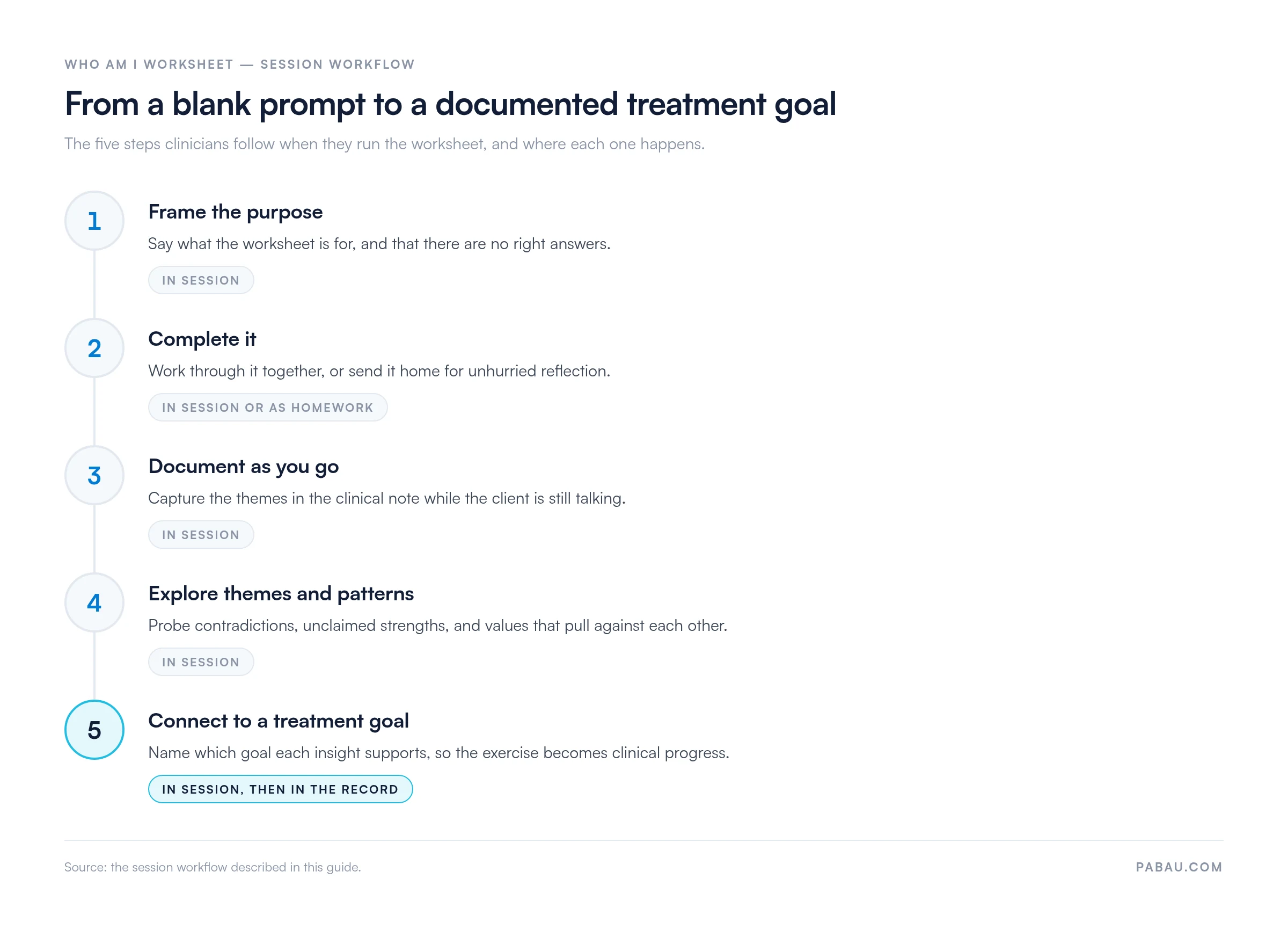
Effective use begins with a safe, non-judgmental therapeutic frame. The five steps below track the worksheet from the moment you introduce it to the point where it changes the treatment plan.
Clients develop self-awareness, which here means the ability to name aspects of identity that were previously vague or unexamined. That clarity often reduces existential anxiety and builds confidence in decision-making.
The structured format also simplifies documentation. A completed sheet gives you a dated record of a client’s identity statements, values, and goals. Across a full caseload, that record cuts the effort of recalling each client’s context and speeds up treatment planning.
Self-directed exercises also lift engagement, because clients invest more in insights they articulated themselves. Clients who complete identity-focused work tend to show a stronger therapeutic alliance, since the conversation starts from their wording rather than the clinician’s summary. When a client feels understood, the alliance holds under pressure later in treatment.
Five habits make the difference between a filled-in form and a useful clinical conversation.
The final session is the strongest moment to revisit that first sheet. When you are closing a case, the client can see for themselves how their values and priorities shifted.
Deliver the worksheet digitally where you can, using the forms built into your practice management system. That cuts paper clutter, keeps answers organized, and puts responses in the client record the moment they are submitted.
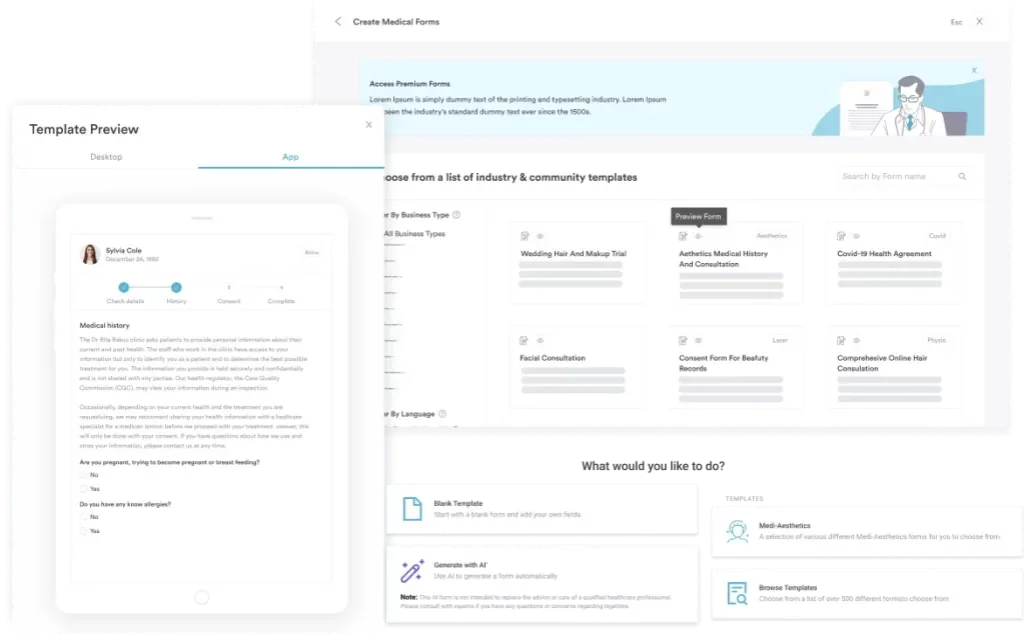
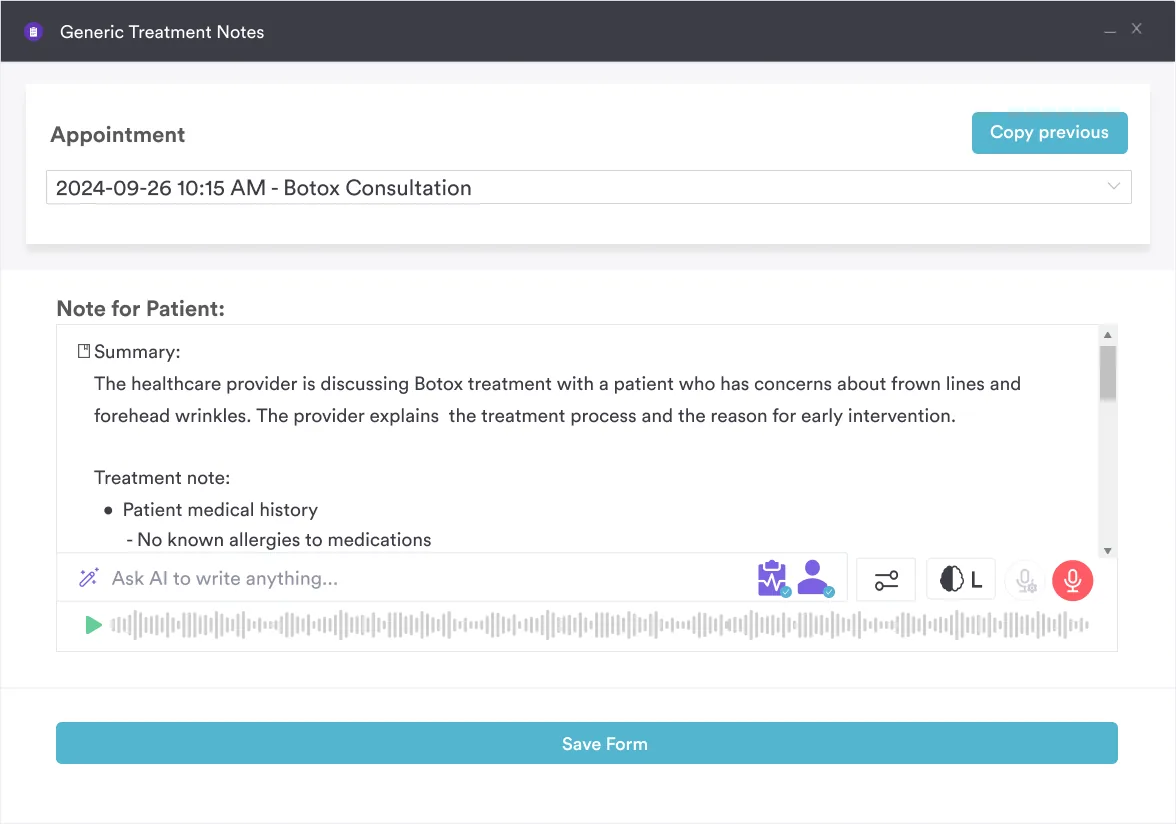
Therapy practices increasingly pair worksheets with an AI medical scribe that turns a spoken session into a structured clinical note. When a client fills in the worksheet inside a digital platform, the answers land in their record without anyone retyping them.
That setup also makes identity progress easy to track. Reading an early worksheet next to a current one shows growth, shifting priorities, and hard-won clarity. Those comparisons strengthen the therapeutic narrative and demonstrate treatment efficacy to clients and payers alike.
A common setup is to email the worksheet as a PDF and retype the answers afterward. The file sits in a downloads folder, and the client forgets to send it back. The therapist then chases it on the morning of the next session. The exercise still works, but the admin around it eats the time you wanted for the conversation.
Practice management software like Pabau removes those steps. You build the worksheet once as a digital form and send it from the client’s record. Their answers file themselves back into that record on submission, so there is no retyping step and no loose attachment to chase.
From there, Pabau Scribe, our AI scribe, drafts the session note while you review the answers with the client. The worksheet, the note, and the treatment goal all sit in one client record. The next session can then start from what the client actually wrote, rather than from your memory of it.

Pabau sends digital forms from the client record and files every answer straight back into it. Your worksheets, session notes, and treatment goals stay in one place.

The worksheet earns its place when the answers go somewhere. A client who fills in six pages and never hears about them again has done homework, not therapy.
So decide one thing before you hand it over: the treatment goal you expect it to inform. Judge the exercise against that goal, revisit the sheet a few sessions later, and the client reads their own progress in their own handwriting.
The trade-off is time. Running it well costs part of a session plus a documentation habit you have to keep up. Book a demo to see how Pabau sends the worksheet, files the answers, and drafts the note for you.

Want a shorter reflection exercise to pair with this one? Self-reflection worksheet gives clients a lighter set of prompts for weekly check-ins.
Ready to turn insight into a plan? Change plan worksheet helps clients commit to specific steps once they have named what matters to them.
Working with low self-esteem? Self-worth worksheet targets the beliefs that stop clients from claiming their own strengths.
Running this exercise in a group? Group therapy informed consent covers what to agree with members before any shared disclosure.
Feeling the weight of a full caseload? Therapist burnout signs and prevention sets out the early warnings and what to change first.
A Who Am I worksheet is a structured self-reflection tool that guides clients through several dimensions of identity. It covers values, strengths, roles, beliefs, and goals. Therapists use it to understand how a client sees themselves, and to deepen that client’s own self-awareness. Clients can complete it during a session or at home, depending on session time and clinical preference.
It works for adolescents and adults across mental health settings. The best fits are clients exploring identity questions, managing life transitions, processing trauma, or rebuilding self-esteem. Coaching, education, and wellness programs use it too. Adjust the language for younger clients, since shorter and more concrete prompts work better for teens.
Most versions cover personal identity statements, values, character strengths, life roles, core beliefs, and goal-setting. Some add relationships, spirituality, or future aspirations. The structure is flexible, so adapt it to your client population and treatment focus.
Start by framing the purpose, making clear that no answer is wrong. Complete it together or assign it as homework. Document the themes as they emerge, explore the patterns you notice, then connect each insight to a treatment goal. That last step turns the exercise into a clinical record of identity development.
Clients gain clarity about their identity, values, and direction, and can name what they previously left vague. The structured format also gives you a dated record of client self-perceptions, which speeds up treatment planning. Clients tend to engage more with insights they articulated themselves, and that supports the therapeutic alliance.
Yes, with developmental adjustments. Adults handle nuanced prompts about authenticity and meaning. Teens respond better to shorter, concrete questions about identity, peers, and emerging autonomy. Younger clients also need reassurance that their answers are personal and that no answer is wrong.