All about me worksheet for adults
An all about me worksheet for adults is a guided self-reflection form that maps ...

2
Last Updated: Oct 14, 2026

A values test is a structured assessment that ranks what matters most to a client, so treatment goals can follow those priorities.
The Schwartz framework behind most validated tools sorts personal values into 10 types, from achievement and benevolence to self-direction and stimulation.
Values clarification is a core intervention in Acceptance and Commitment Therapy, where clients name their values first and then commit to matching action.
The printable form takes 15 to 20 minutes, and a card sort alternative runs 10 to 15 minutes.
Practice management software like Pabau stores the completed form in the client record, so the results stay available for later goal reviews.
A structured values assessment your client can complete in 15 to 20 minutes. It surfaces the priorities behind their decisions, so you can set treatment goals against the values they name rather than the ones you assume.
Download templateA values test asks a client to rank the principles that drive their choices, then hands you a short list to work from. It takes 15 to 20 minutes, and it changes what a treatment goal can be built on.
The template above is free to print and distribute. Below is how to introduce it, how to read a completed profile, and how to keep the results in play once the session ends.
A values test is a structured assessment that identifies a person’s core values, meaning the principles and priorities that matter most to them. Personality tests describe how someone behaves. A values assessment gets at what drives that behavior.
Most validated tools trace back to Shalom Schwartz’s theory of basic human values. That is why the same 10 value types keep appearing across therapy, coaching, and workplace assessments.
The payoff is clarity. Once a client can name their top values, you can see where their decisions come from and where daily life pulls against them. For clinicians, that makes patient-centered care concrete. You can pitch a recommendation at what the client cares about, rather than what you assume they should.
Values clarification is a clinical intervention, not a self-help exercise. Acceptance and Commitment Therapy (ACT) puts it at the center of treatment. Clients identify their core values first, then commit to behavior change that runs with those values rather than against them.
Building the assessment into intake or an early review turns it into a documented, repeatable step rather than a one-off exercise. Most software for therapy practices can attach the completed form to the client record. The results are then waiting the next time you open the file.
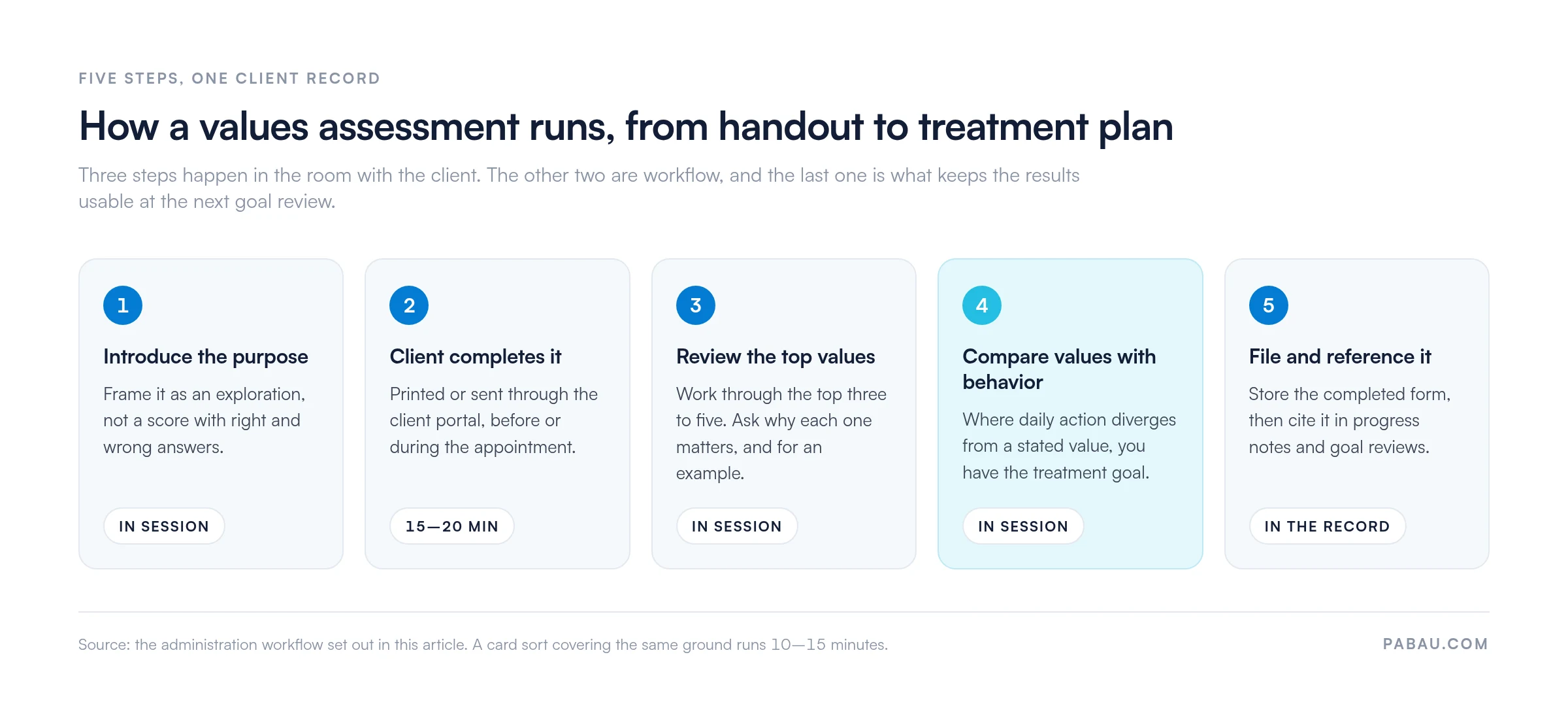
The PDF is built for handing out and getting back. The flow below shows where each step happens, and the numbered list has the detail.
The Schwartz framework identifies 10 value types, and most validated assessments rank all of them. Five come up most often in practice, and the table gives the working definition for each.
Clients rank or rate each dimension. What comes back is a profile showing which values drive decisions and which sit in the background. If a full ranking feels like too much for a first session, the core values exercise narrows a long list down to a handful instead.
Read the ranking from the top. The first three to five values are the client’s non-negotiables, and the rest are context. Three things are worth checking before you say anything about them.
Mismatches on that last point are the useful part. They show where a client’s week has drifted from what they say matters, which is where the work usually starts.
Then document it. Instead of a goal like “reduce anxiety”, write “reduce anxiety so you can spend more time with family, your top-ranked value”. The American Psychological Association ties the effect of ACT to values clarity, so a sharper list gives the client more to commit to.
The same form works on staff. Use it during onboarding so a new hire can see how their own priorities line up with the practice’s.
A team workshop is the other option. Everyone completes it, then you compare the results together. If the top values cluster, you have evidence of cultural fit. If they scatter, you learn how differently each role reads the practice’s mission.
Either result is useful. Practices that hire and develop around shared values tend to report lower turnover and higher engagement. Keeping the responses with your other team management records makes them easy to revisit at review time.
Some clients stall on a written ranking. A card sort gives them a physical version instead. Cards naming each value get sorted into three piles: matters to me, doesn’t matter, not sure.
Card sorts suit ACT work well. Handling and arranging objects bypasses overthinking, and clients who are less verbal often respond more openly than they would to a form. A guided session runs 10 to 15 minutes and tends to generate more discussion than the written version.
You can cut the printable PDF into cards, or make your own with index cards and value labels. If your client would rather see a target than a list, the ACT bullseye worksheet plots the same values against current action.
In most practices the completed values form ends up as paper in a folder, or a scan attached to a note nobody opens again. Months later the treatment plan still reads “reduce anxiety”, and the values that were meant to anchor it are out of sight.
Practice management software like Pabau handles this differently. You build the values test as a digital form and send it through the client portal before the appointment. The responses land in the client record as structured data, not as an attachment. The top-ranked values then sit next to the notes and the treatment plan.
That pays off at the review. When you reopen a client’s file to check progress, their values are already on screen, so goal-setting stays anchored to them. Team assessments work the same way, stored against staff records instead of a shared drive.

Send the values test as a digital form through the client portal, and Pabau files the responses straight into the client record. The top-ranked values sit beside your notes, so every treatment goal you write can point back at them.

A values test earns its 20 minutes when the results survive the session. Producing the ranking is the easy part. What decides whether it changes the work is whether you write it into the treatment plan and read it back at the next review.
One caveat is worth remembering. A values profile records what a client says matters on one particular day. Treat it as the start of a conversation you return to, rather than a fixed result.
Print the template, run it with your next three clients, and see how differently their goals read afterward. Book a demo to see how Pabau turns the values test into a digital form that files itself in the client record.

Want a shorter exercise for a first session? Personal values worksheet walks a client through naming and ordering their values without a full ranking.
Need to cover life domains as well as values? Life values inventory maps what matters across work, relationships, health, and community.
Working through avoidance in ACT? Choice point worksheet helps a client see when they move toward their values and when they move away.
Client stuck on the thoughts behind the behavior? Cognitive defusion explains the ACT techniques that loosen a thought grip before values work starts.
Running a psychology practice on paper forms? Psychology practice software shows how assessments, notes, and treatment plans stay in one client file.
A values test is a psychological assessment that identifies your core personal values, the principles and priorities that drive your behavior and decisions. It presents a range of values, such as achievement, security, and benevolence, and asks you to rank them by importance. The result is a personalized profile of your top values, which can guide therapy goals, career decisions, and life priorities.
Research identifies 10 universal value types: achievement, benevolence, stimulation, universalism, security, conformity, tradition, hedonism, power, and self-direction. In healthcare and therapy, benevolence, self-direction, and security come up most often. Individual profiles vary widely, and there is no right set of values.
Use the free template above. Spend 15 to 20 minutes ranking the values it lists, then look at your top three to five. You can also think back to moments when you felt most alive, since the values at work in those moments are usually core ones. A therapist or coach can guide that reflection with targeted questions.
Intrinsic values come from within and reflect what you care about for its own sake, such as family, growth, or helping others. Extrinsic values are external drivers like money, status, or approval. Research links intrinsic values more strongly to wellbeing and life satisfaction. A values test mostly measures the intrinsic set and helps separate it from outside pressure.
Yes. The printable template at the top of this page is free, and you can distribute it to as many clients and staff as you like. Several online platforms offer free web-based versions too, though their approach and accuracy vary. Pick the one that fits your clinical framework.
In Acceptance and Commitment Therapy (ACT), values clarification is a core intervention. Clients name their values early, then commit to behavior change that matches them. Coaches use the same assessment to guide career and life decisions toward what the client cares about. Either way, it anchors the work in the client’s own priorities rather than outside pressure.