

HCPCS code E0198: Water pressure pad billing guide
HCPCS code E0198 is a water pad for a standard mattress HCPCS code E0198 is the ...

Last Updated: Oct 13, 2026
Billable Code Specific Code
S50.862D is the billable ICD-10-CM code for insect bite (nonvenomous) of left forearm, subsequent encounter.
Let Pabau's smart automation suggest the right codes, reduce claim denials, and keep your practice compliant—effortlessly.
Automate repetitive tasks and focus on what matters most—your patients.
Reduce coding errors and ensure compliance with the latest regulations.
Clean claims, fewer denials, and faster reimbursements.
Powerful insights and reporting to help your practice thrive.
HIPAA compliant SOC 2 certified GDPR-compliant Trusted by 4,000+ clinics worldwide

ICD-10 Code S50.862D is the billable code for a nonvenomous insect bite of the left forearm at a subsequent encounter.
The 7th character D means the patient is receiving active aftercare after initial treatment, not presenting for the first time.
Submitting S50.862A at a follow-up visit is the error that drives most denials on this code.
S50.862 on its own is not billable, because the 7th character is mandatory.
Practice management software like Pabau submits the coded claim electronically and tracks the remittance in one place.
S50.862D is valid for fiscal year 2026, effective October 1, 2025 through September 30, 2026. The table below summarizes the essential billing attributes for this code.
Every character in S50.862D encodes a specific clinical detail. Reading the string left to right tells you the body region, the injury type, the side, and the encounter type.
The 6th character is where many laterality errors originate. When a coder documents the right forearm instead of the left, the code becomes S50.861D. The CDC/NCHS ICD-10-CM web tool allows coders to verify laterality encoding directly against the official tabular list.
ICD-10-CM defines three encounter types for traumatic injuries, and each carries a distinct clinical meaning. The character you pick describes the phase of care, not the severity of the bite.
The 7th character reflects the type of encounter, not the provider’s familiarity with the patient. A specialist seeing a patient for the first time, for active wound management of a bite from days earlier, still uses the A suffix.
S50.862D applies only once the initial treatment phase is complete and routine care has taken over. The chart below runs that judgment as two questions.
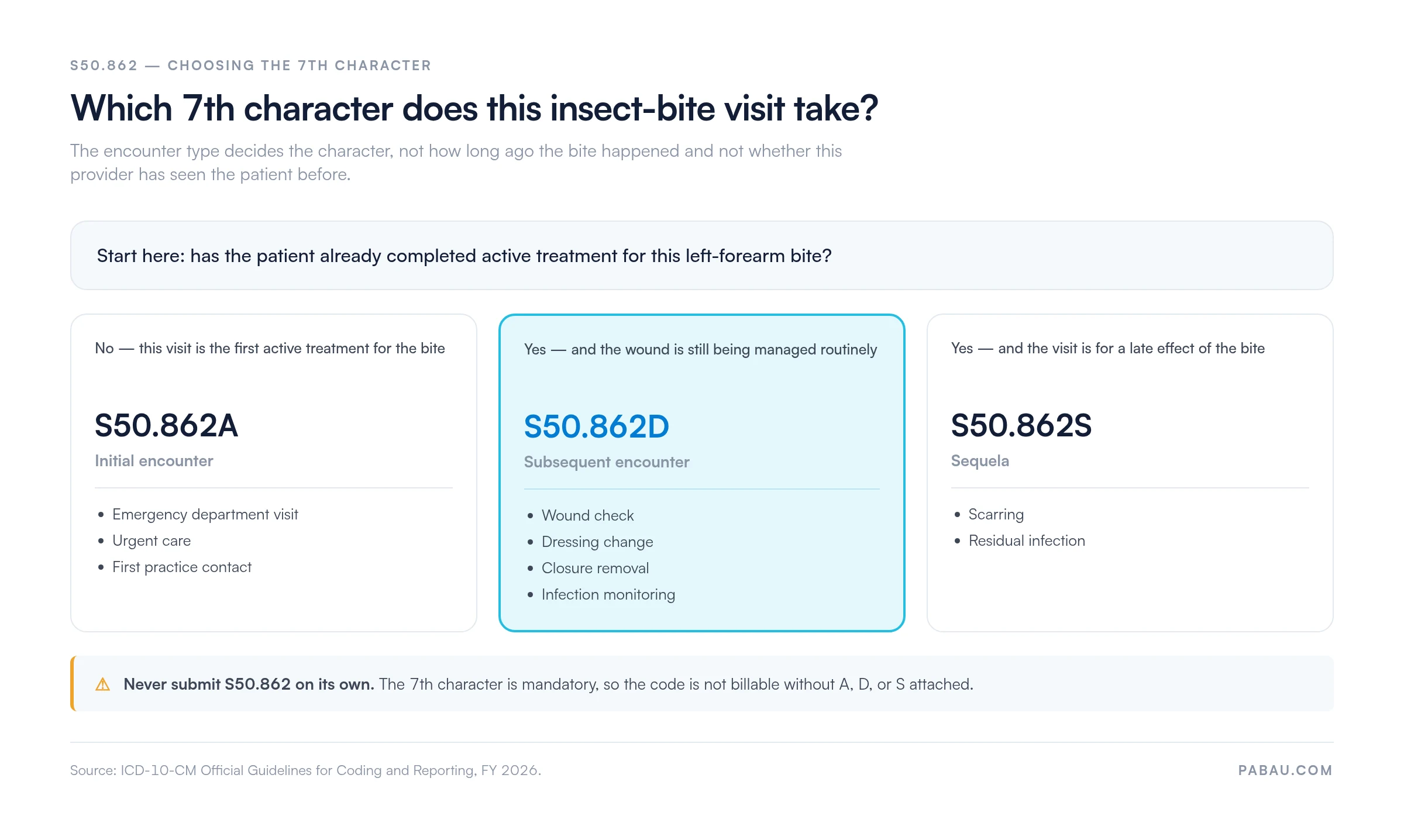
S50.862D is appropriate for follow-up visits where the insect bite on the left forearm has already received initial treatment. Common qualifying scenarios include:
None of these visits qualify as an initial encounter. Each represents the patient receiving active aftercare following completed primary treatment, which is the defining criterion for the D suffix under CMS ICD-10-CM coding guidance.
Document the encounter type explicitly in the provider note. A note reading ‘patient returns for wound check following insect bite treated on [date]’ defends the D suffix during a payer audit. Vague notes that never say whether this is initial or follow-up care are what trigger post-payment review.
The A-versus-D error is the main driver of claim rejections for nonvenomous insect bite codes. Payers apply automated edits to injury codes carrying the A suffix. Those edits compare the claim date against the documented injury date and reject a late A.
For additional context on managing these submissions, the AAPC Codify ICD-10-CM lookup provides coding notes and clinical guidelines for the S50 code family.
S50.862D sits within the S50 superficial injury of elbow and forearm category. Understanding the hierarchy helps coders navigate sibling codes for laterality corrections and parent codes for unspecified scenarios.
S50.869D should only be used when laterality genuinely cannot be determined from the clinical record. If documentation specifies the left forearm, S50.862D is required. Using the unspecified code when laterality is documented is a coding error under ICD-10-CM Official Guidelines and may trigger a query or audit.
S50.862D is a billable code valid for HIPAA-covered transactions throughout fiscal year 2026. Understanding medical billing fundamentals is essential before submitting injury codes, because payer policies on subsequent-encounter coding vary.
Practices submitting S50.862D electronically can route claims through practice management software like Pabau, which offers electronic claims via Claim.MD. That route reaches thousands of US payers and supports real-time eligibility verification alongside 837P claim submission.
For practices building out their claims workflow, the clearinghouse submission process guide covers how claims route from the EHR to the payer. Tracking electronic remittance advice after submission helps flag denial patterns early, before they accumulate across a billing cycle.
Practices looking to strengthen their end-to-end workflow can explore Pabau’s claims management software, which submits clean claims for injury diagnosis codes. It connects directly to the Claim.MD clearinghouse. Understanding revenue cycle management then shortens the lag between the visit and the payment on codes like S50.862D.
These are the four errors that appear most frequently in insect bite subsequent-encounter submissions. Each one can trigger a denial or a post-payment audit.
Practices with recurring denials on subsequent-encounter injury codes benefit from structured denial management workflows. Categorizing each denial by code and encounter type makes the pattern visible within a billing cycle instead of at year end. Ensuring clean claim submission from the outset also cuts the volume of corrected claims you have to chase.
The clinical note must support the subsequent-encounter designation. Payers look for specific documentation elements during pre-payment review and audit.
Maintaining thorough records also supports medical billing compliance for injury codes. A superbill that captures the ICD-10 code and the matching CPT procedure at the point of service reduces claim mismatches later in processing.
Add a templated phrase to your wound care encounter note. Use ‘This is a subsequent encounter for [site] injury first treated on [date]. Aftercare today included [intervention].’ One line makes the D suffix defensible and cuts the time you spend answering an audit.
A follow-up bite visit often crosses two systems. The coder reads the note in the EHR, then re-keys S50.862D and the visit code into a separate clearinghouse portal. Each re-key is another chance to drop the 7th character.
Pabau keeps the note and the claim in one record. The coded charge moves from the treatment note to Claim.MD as an 837P submission, so nobody retypes the diagnosis. Pabau checks eligibility and insurance details first, which catches the administrative rejections a coder never sees.
Remittances land back in the same place, so a denial on S50.862D is visible against the visit that produced it. That turns a 7th character error into a same-week correction rather than a year-end write-off.

Pabau’s claims management software integrates with Claim.MD to send ICD-10-coded claims to thousands of US payers. It checks eligibility and claim details before submission, then tracks remittances in one place.

S50.862D is not a difficult code. It gets denied because the choice between A and D is made from habit rather than from the note. It also gets denied because the note itself never says which visit this is.
The fix is a documentation habit, not a coding lookup. Write the phase of care into the assessment line, and the 7th character picks itself. Do that once and the same discipline carries across every S-code your practice touches.
Pabau’s claims management integration with Claim.MD routes 837P claims to thousands of US payers and flags eligibility and claim-detail issues before submission. Book a demo to see how it handles your follow-up injury claims.

Need to understand how claims reach payers? Medical claims clearinghouse guide explains how clearinghouses validate and route ICD-10 coded claims to payers.
Looking to reduce denial rates across injury codes? Denial codes in medical billing covers the most common CARC denial codes and how to respond to them.
Want to verify insurance eligibility before submitting? Insurance eligibility verification outlines how real-time eligibility checks reduce rejected claims for injury aftercare visits.
S50.862D is a billable ICD-10-CM diagnosis code for insect bite (nonvenomous) of the left forearm, subsequent encounter. It is valid for fiscal year 2026, from October 1, 2025 through September 30, 2026. Use it for follow-up visits once initial treatment for the bite is complete.
The D suffix indicates a subsequent encounter, meaning the patient is receiving active aftercare following initial treatment. This applies to wound checks, dressing changes, suture removal, and infection monitoring visits, as defined in the ICD-10-CM Official Guidelines for Coding and Reporting.
S50.862A is for the initial encounter when the patient first receives active treatment. S50.862D is for subsequent encounters when the patient returns for routine aftercare. S50.862S is for sequela, used when the patient presents with a late effect or complication from the original bite rather than the bite wound itself.
Use S50.862D once the initial treatment phase is complete and the patient returns for follow-up care. If the patient is presenting for the first time for active treatment, use S50.862A. That holds regardless of how many days have passed since the injury.
Yes, S50.862D is a billable and specific ICD-10-CM code valid for HIPAA-covered transactions in fiscal year 2026. Pair it with an appropriate CPT procedure code, because a diagnosis code alone does not generate a reimbursable claim.
The S50.86 series covers nonvenomous insect bites of the forearm. It runs S50.861 for the right forearm, S50.862 for the left, and S50.869 for an unspecified forearm. Each of those takes an A, D, or S in the 7th character position. Category W57 is the matching external cause code, and it also takes a 7th character.



