Pabau Engage inbox

Pabau Engage is here: every patient conversation in one inbox.

Learn more
Book a demo Book a demo
☰
HCPCS Code

HCPCS code V5244 – Digitally programmable analog monaural CIC hearing aid


Code Definition

V5244 is the HCPCS Level II code for one hearing aid that is digitally programmable analog, monaural and completely in the canal (CIC). One unit covers one ear. A bilateral fitting is billed per side with RT and LT, or under the binaural code V5250 where the payer requires it.

Original Medicare excludes hearing aids by statute, so V5244 claims go to Medicaid, Medicare Advantage and commercial plans. Billers most often slip on three points: units per ear, the analog-versus-digital split with V5254, and prior authorization.

Level
Level II
Category
V — Vision, hearing and speech-language pathology services
Code range
V5120-V5267 Hearing aids
Code also known as
CIC hearing aid, completely-in-canal hearing aid, digitally programmable analog hearing aid
Save time. Improve accuracy. Get paid faster.
Automate coding with Pabau

Let Pabau's smart automation suggest the right codes, reduce claim denials, and keep your practice compliant—effortlessly.

  • AI-powered code suggestions
  • Real-time compliance checks
  • Faster claims, fewer denials
Why practices choose Pabau
Save hours every week

Automate repetitive tasks and focus on what matters most—your patients.

Improve accuracy

Reduce coding errors and ensure compliance with the latest regulations.

Get paid faster

Clean claims, fewer denials, and faster reimbursements.

Grow with confidence

Powerful insights and reporting to help your practice thrive.

HIPAA compliant SOC 2 certified GDPR-compliant Trusted by 4,000+ clinics worldwide

Key takeaways

Key takeaways

HCPCS code V5244 describes one hearing aid that is digitally programmable analog, monaural and completely in the canal (CIC), so one unit covers one ear.

For a bilateral fitting, bill one V5244 line per side with RT and LT. Some payers require the binaural CIC code V5250 instead.

Original Medicare excludes hearing aids under Social Security Act §1862(a)(7) and 42 CFR 411.15(d), so V5244 coverage comes from Medicaid, Medicare Advantage or commercial plans.

V5254 is the fully digital monaural CIC code, so the aid’s signal processing, analog or digital, decides between V5244 and V5254.

Pabau, a practice management platform, keeps the audiogram, authorization number and fitting notes on one patient record, so each V5244 claim goes out complete.

HCPCS code V5244: Official descriptor breakdown

HCPCS code V5244 is the Level II code for one hearing aid that is digitally programmable analog, monaural and completely in the canal (CIC). It sits in the hearing aid range of HCPCS Level II, the code set CMS maintains for items and supplies outside CPT. Each descriptor element narrows which device the code fits, so check all four against the aid you dispense.

Descriptor elementMeaningBilling implication
Hearing aidA wearable device that amplifies sound for a person with hearing lossExcluded from original Medicare by statute, so coverage depends on Medicaid, Medicare Advantage or a commercial plan.
Digitally programmable analogAn analog amplification circuit whose settings are adjusted through fitting software or a programming deviceAn aid that processes sound digitally bills under the digital family instead. For a monaural CIC aid, that code is V5254.
MonauralOne hearing aid, fitted to one earOne unit of V5244 covers one ear. A bilateral fitting needs two lines with RT and LT, or the binaural code V5250, depending on payer policy.
CIC (completely in the canal)A custom-made aid that sits fully inside the ear canalIn-the-canal (ITC), in-the-ear (ITE) and behind-the-ear (BTE) styles have their own codes: V5245, V5246 and V5247 in this family.

The phrase “digitally programmable analog” describes an older circuit design. Most aids dispensed today process sound digitally, so confirm the manufacturer’s spec sheet before you choose an analog-family code. If you file through error-checking claims software, update its code library with each annual HCPCS release. You can check the descriptor against the AAPC V5244 code entry or the ASHA list of hearing aid HCPCS codes before filing.
Pabau claims and billing screen for sending insurance claims
Pabau’s claims tools send insurance claims electronically from the patient’s billing record, which cuts re-keying on hearing aid lines like V5244.

What HCPCS code V5244 covers and excludes

HCPCS code V5244 reports the device for one ear. The dispensing fee, the ear impression and the batteries each carry a code of their own.

Included under V5244

  • One digitally programmable analog CIC hearing aid, fitted to one ear
  • The second aid of a bilateral CIC fitting, billed as its own V5244 line with the opposite side modifier, where the payer accepts per-ear billing
  • A replacement for a lost or damaged aid of the same type, under the payer’s own replacement rules and modifiers

Excluded from V5244

  • ITC, ITE and BTE styles, which bill under V5245, V5246 and V5247 in the same family
  • Fully digital CIC aids, which bill under V5254 (monaural) or V5258 (binaural)
  • Analog CIC aids without digital programming, which bill under V5242
  • A bilateral CIC fitting billed as one binaural item, which maps to V5250
  • The dispensing fee, which bills under V5241 for a monaural aid or V5160 for a binaural fitting
  • Ear impressions (V5275), batteries (V5266) and ear molds or inserts (V5264), which are separate accessory codes

The most consequential coding decision for a CIC aid is V5244 versus V5254. Both describe one completely-in-canal hearing aid for one ear. The difference is signal processing. V5244 is digitally programmable analog, and V5254 is fully digital.

CodeDescriptorStyleLateralityTechnology
V5242Hearing aid, analog, monaural, CICCICMonaural (one ear)Analog
V5244Hearing aid, digitally programmable analog, monaural, CICCICMonaural (one ear)Digitally programmable analog
V5245Hearing aid, digitally programmable analog, monaural, ITCIn-the-canalMonaural (one ear)Digitally programmable analog
V5246Hearing aid, digitally programmable analog, monaural, ITEIn-the-earMonaural (one ear)Digitally programmable analog
V5247Hearing aid, digitally programmable analog, monaural, BTEBehind-the-earMonaural (one ear)Digitally programmable analog
V5250Hearing aid, digitally programmable analog, binaural, CICCICBinaural (both ears)Digitally programmable analog
V5254Hearing aid, digital, monaural, CICCICMonaural (one ear)Digital
V5260Hearing aid, digital, binaural, ITEIn-the-earBinaural (both ears)Digital

The practical test is how the aid processes sound. Most digital aids also connect to fitting software, so programmability alone does not separate the two codes. If the spec sheet describes digital signal processing, V5254 applies. If it describes an analog circuit with digital programming, V5244 applies. Keep that spec sheet in the record, because it substantiates the code at audit. The diagram below maps each processing type to its CIC code and matching dispensing fee.
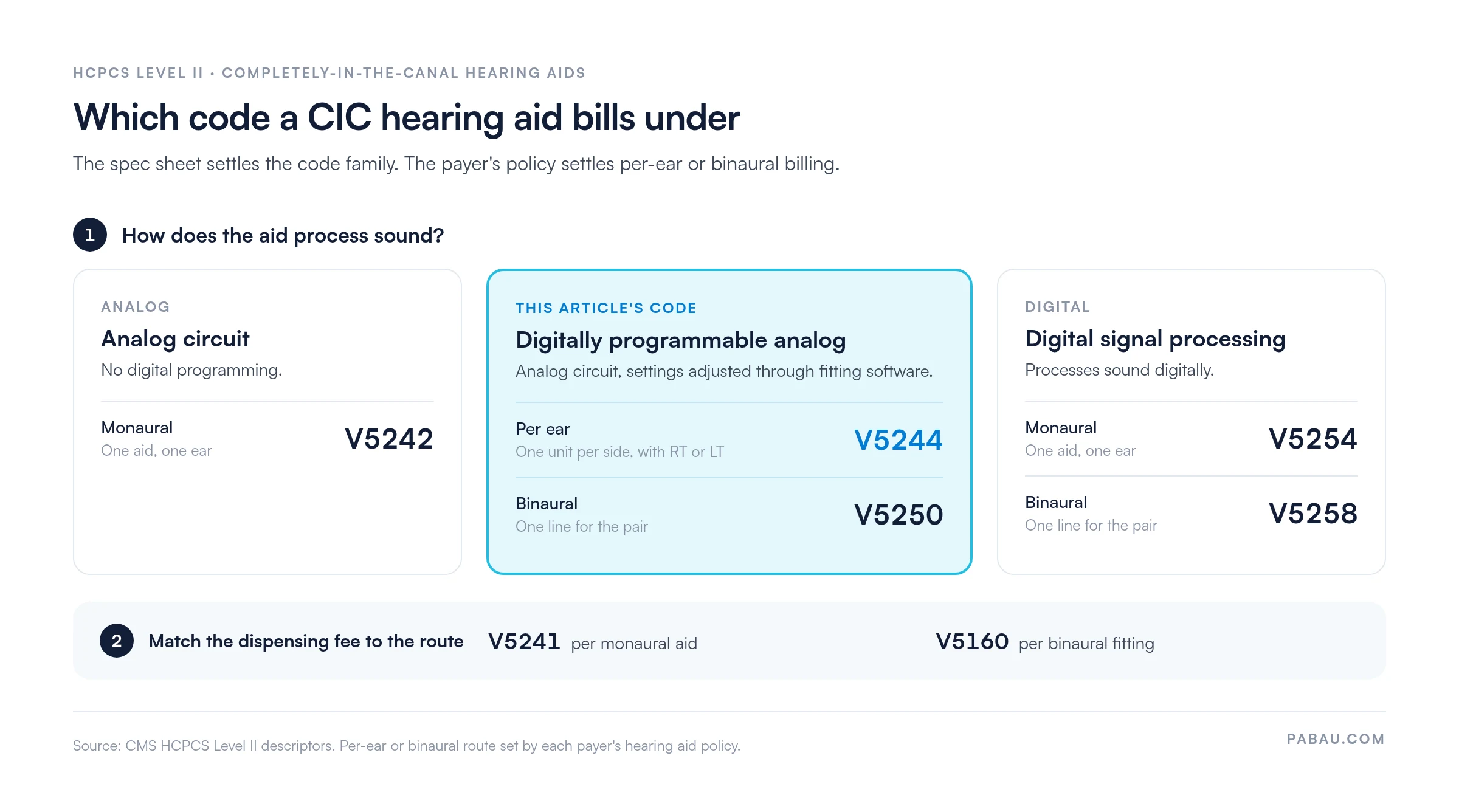
Decision diagram for CIC hearing aid HCPCS codes: analog monaural V5242; digitally programmable analog per ear V5244 with RT or LT, binaural V5250; digital monaural V5254, binaural V5258; dispensing fee V5241 per monaural aid or V5160 per binaural fitting
The spec sheet picks the code family, and the payer’s policy picks per-ear or binaural billing. Descriptors follow the CMS HCPCS Level II code set.

One unit per ear: billing V5244 with RT and LT

Because V5244 is monaural, one unit equals one hearing aid for one ear. One unit billed for a pair under-reports the fitting. Two units on a single line without side modifiers invite a duplicate denial.

For a bilateral fitting with two matching CIC aids, payers take one of two routes:

  1. Per-ear billing: two V5244 lines, one with RT and one with LT, each for one unit.
  2. Binaural billing: one line of V5250, the digitally programmable analog binaural CIC code.

Check the plan’s hearing aid policy before you submit, because a claim built on the other route can be denied. Match the dispensing fee to the same route: V5241 per monaural aid, or V5160 for a binaural fitting, as the payer directs.

Medicare and Medicaid coverage for V5244

Coverage for V5244 depends on the payer. Under government programs, medical billing for hearing aids splits across a federal exclusion, state Medicaid rules and Medicare Advantage plan designs.

Original Medicare

Original Medicare does not pay for hearing aids. Social Security Act §1862(a)(7) bars payment for them, and 42 CFR 411.15(d) lists them as an excluded service. The same exclusion covers exams for prescribing, fitting or changing hearing aids. No Local Coverage Determination overrides it. When a claim goes to Medicare only to obtain a denial for a secondary payer, append the GY modifier.

Medicare Advantage (Part C)

Medicare Advantage plans can offer hearing aids as a supplemental benefit. Coverage terms, prior authorization and allowed amounts vary by plan. Verify the benefit and obtain any required authorization before you order the device.

Medicaid

Hearing aids are an optional Medicaid benefit for adults, so adult coverage varies by state. Children and young adults under 21 are covered through the EPSDT benefit when the aid is medically necessary. Device tiers, replacement intervals and authorization rules still differ by state. Check the state Medicaid agency’s hearing aid policy and fee schedule for current V5244 rates.

Prior authorization requirements for V5244

Many Medicaid programs and Medicare Advantage plans require prior authorization before a hearing aid is dispensed. Insurance eligibility verification at scheduling is the first checkpoint, but authorization is a separate step.

A typical prior authorization workflow for V5244:

  1. Verify the patient’s hearing aid benefit, including when an aid was last dispensed for each ear.
  2. Obtain the physician order or referral the payer requires, stating medical necessity for a hearing aid in the ear or ears to be fitted.
  3. Complete an audiogram within the payer’s recency window, which differs by policy.
  4. Submit the request with the audiogram, the order, the device specifications and the side or sides to be fitted.
  5. Record the authorization number, its validity dates and the approved code and units before ordering the device.
  6. Bill V5244 with the authorization number in the claim’s authorization field, inside the validity window.

Turnaround times vary by payer. Build the authorization window into scheduling, so the fitting appointment never lands before approval arrives.

Documentation requirements for V5244 claims

Incomplete records are a common trigger for hearing aid audits and recoupments. Maintaining medical billing compliance for V5244 means keeping each item below in the patient’s record before the claim is filed.

  • Audiogram: A current audiometric evaluation by a licensed audiologist or other qualified provider, dated within the payer’s required window. It should show thresholds that support amplification for the ear being fitted.
  • Physician order or referral: A written order from the treating physician or another prescriber the payer accepts. Some Medicaid programs accept an audiologist’s recommendation without a separate physician order, so confirm with the payer.
  • Medical necessity statement: Documentation that links the audiometric findings to the need for a hearing aid in that ear. A generic line such as “patient needs hearing aids” rarely satisfies a reviewer.
  • Side of fitting: The ear fitted, recorded for each device, so every line’s RT or LT modifier matches the chart.
  • Device specifications: Manufacturer, model and serial number for each aid, confirming the CIC style and digitally programmable analog processing.
  • Prior authorization number: The approval number, when one was required, kept on file and entered on the claim.
  • Fitting notes: Notes on the fitting and programming session, the adjustments made and the patient’s response.

Modifiers used with HCPCS code V5244

Modifiers on V5244 tell the payer which ear was fitted, whether the aid is a replacement and whether coverage criteria were met. Requirements are payer-specific, so check the plan’s billing guide before you append any modifier.

ModifierMeaningWhen to useIf omitted or wrong
RTRight sideEach V5244 line for an aid fitted to the right ear, where the payer bills per earThe second line of a pair can deny as a duplicate.
LTLeft sideEach V5244 line for an aid fitted to the left ear, where the payer bills per earSame as RT.
KXRequirements specified in the medical policy have been metSome payers may require KX to attest that coverage criteria are met. Verify with the plan.Denial or a records request, per the plan’s policy.
GYItem or service statutorily excluded, or does not meet the definition of any Medicare benefitA claim sent to original Medicare only to generate a denial for a secondary payerMedicare still denies the line, but the exclusion reason is less clear to the secondary payer.
RAReplacement of a DME, orthotic or prosthetic itemSome payers ask for RA on a V5244 that replaces a lost, stolen or damaged aid. Others apply their own replacement rules.Frequency denial if the payer reads the line as a second aid in the benefit period.
RBReplacement of a part of a DME, orthotic or prosthetic item furnished as part of a repairRarely appropriate on V5244, which reports a whole aid rather than a partThe payer may treat the line as a full device.

The PGM Billing HCPCS lookup shows code-level details from the CMS data file. Medicaid and Medicare Advantage plans can still add requirements of their own.

Pro Tip

Review denied V5244 lines each quarter, sorted by reason code and side modifier. If one reason keeps repeating, add a single pre-submission check for it, such as an RT or LT on every per-ear line.

Common claim denial reasons for V5244 and how to avoid them

V5244 denials cluster around a few root causes, and each one is preventable before the claim is submitted. The table pairs each cause with the reason code payers usually return, and the claim denial codes reference explains each code in full. Building these checks into your denial management workflow stops the same rejection from repeating.

Denial reasonCommon reason codePrevention step
Billed to original MedicareCO-96 (non-covered charge)Confirm the payer before filing. An ABN is not required for a statutorily excluded item, but a voluntary notice tells the patient they will pay.
Missing prior authorizationCO-15 or CO-197Obtain authorization before dispensing. Record the authorization number and enter it in the claim’s authorization field.
Wrong code for the aid’s processingCO-16 (billing error) or a post-payment audit findingConfirm analog or digital processing on the spec sheet. Use V5254 for a fully digital monaural CIC aid.
Missing or conflicting side modifierCO-4 (modifier missing or inconsistent) or CO-18 (duplicate)Append RT or LT to every per-ear line, and match it to the fitting notes.
Missing KX where the plan requires itCO-4Check the plan’s policy and add KX only where it asks for it, with the supporting records on file.
Stale or missing audiogramCO-50 (not medically necessary)Track audiogram dates in scheduling. Repeat the evaluation if it will fall outside the payer’s window by the dispensing date.
Benefit period frequency exceededCO-119 (benefit maximum reached)Check the last dispensing date for each ear. Document loss or damage, and follow the payer’s replacement rules.

V5244 reimbursement rates and accessory billing

Each payer sets its own rate for V5244. Original Medicare does not pay for the code, so there is no Medicare allowable to anchor to. Medicaid and Medicare Advantage rates come from state fee schedules and individual plan documents.

How to find current reimbursement rates

  • Medicaid: Each state Medicaid agency publishes a hearing aid or DME fee schedule. Search it for V5244, and note any per-ear limits.
  • Medicare Advantage: Request the plan’s hearing aid fee schedule from its provider relations team. Medicare Advantage allowables are not published in one central CMS database.
  • Commercial insurers: Check each payer’s fee schedule or submit a fee inquiry. Allowed amounts vary widely and can change at contract renewal.

Billing accessory codes alongside V5244

Several codes commonly appear on the same claim as V5244. Whether each is paid separately or bundled into the device rate depends on the payer, so confirm before you bill.

Accessory codeDescriptionBilling notes
V5241Dispensing fee, monaural hearing aid, any typeOne per monaural aid where the payer pays the fee separately. Some payers bundle it into the device rate.
V5160Dispensing fee, binauralFor a fitting billed as binaural. Ask whether the payer wants V5160 or two V5241 lines when both ears get V5244.
V5275Ear impression, eachA CIC aid is custom-made, so an impression is taken for each ear fitted. Bill one unit per ear where payable.
V5264Ear mold/insert, not disposable, any typeBill only when a separate mold or insert is dispensed, one per ear.
V5266Battery for use in hearing deviceMany plans cap the yearly battery quantity or bundle batteries into the device rate.
V5267Hearing aid or assistive listening device/supplies/accessories, not otherwise specifiedFor a supply with no specific code. Expect the payer to ask for an invoice or a description.

Submitting a clean claim for V5244 with accessories means confirming each code’s payable status first. Record the payer’s answer in the account’s billing notes, so the same rule applies to every claim.

How claims management software reduces errors for HCPCS code V5244

Most V5244 denials start before the claim is built. A side modifier is missed, an audiogram ages out, or the aid is ordered before the authorization lands.

Pabau keeps the audiogram, the authorization number and the fitting notes on one patient record. Its claims management software sends insurance claims from that same record, so your team is not re-keying details between systems.

The outcome is fewer claims sent back for missing details, and less staff time spent on rework.

Manage hearing aid claims without the billing rework

Pabau tracks prior authorizations, stores audiometric documentation and sends claims from the patient record, so V5244 claims go out complete the first time.

Pabau claims management dashboard

Conclusion

V5244 is a narrow code: one digitally programmable analog CIC aid, for one ear. Most errors on it come from reading it as something broader — a pair, a digital aid or a Medicare benefit.

Code from the spec sheet, settle the per-ear or binaural route with the payer before the fitting, and keep the audiogram and authorization current. Those three checks belong before the claim is built, not after a denial. Book a demo to see how Pabau keeps hearing aid claims complete from authorization to payment.

Continue your research

Continue your research

Need to understand how clearinghouse submission works for HCPCS claims? Medical claims clearinghouse guide explains how payer routing, eligibility checks, and claim edits work before a code like V5244 reaches the payer.

Getting denials and not sure where to start the appeal? Denial codes in medical billing maps common CARC and RARC codes to the specific documentation or workflow fix each one requires.

Want to reduce claim rework across your whole audiology practice? Revenue cycle management overview covers the end-to-end workflow from eligibility through payment posting.

Frequently asked questions

What is HCPCS code V5244?

HCPCS code V5244 is the Level II code for one hearing aid that is digitally programmable analog, monaural and completely in the canal (CIC). One unit covers one ear. The fully digital counterpart is V5254.

Is V5244 covered by Medicare?

No. Original Medicare excludes hearing aids under Social Security Act §1862(a)(7) and 42 CFR 411.15(d). Medicare Advantage plans may cover V5244 as a supplemental benefit, with terms and prior authorization rules that vary by plan.

What is the difference between V5244 and V5254?

Both codes describe one CIC hearing aid for one ear. V5244 is for an analog circuit with digital programming, and V5254 is for an aid that processes sound digitally. Use the manufacturer’s spec sheet to decide.

How do you bill V5244 for both ears?

Bill two V5244 lines, one with RT and one with LT, each for one unit. Some payers want the binaural CIC code V5250 instead, so check the plan’s policy before you submit.

What modifiers are used with V5244?

RT and LT identify the ear fitted. Some payers may require KX to attest that coverage criteria are met, so verify with the plan. A replacement aid follows the payer’s replacement rules, which may call for RA.

Why do V5244 claims get denied?

Common causes are billing original Medicare, missing prior authorization and a missing or conflicting side modifier. Coding a fully digital aid as V5244, or an audiogram outside the payer’s recency window, also leads to denials.

Does Medicaid cover V5244?

Adult hearing aid coverage is optional under Medicaid, so it varies by state. Children under 21 are covered through EPSDT when the aid is medically necessary. Check the state agency’s policy for authorization and audiogram rules.

Which code covers batteries billed with V5244?

Batteries bill under V5266, battery for use in hearing device. Many plans cap the yearly quantity or bundle batteries into the device rate.
Tanja Lepcheska
Content Writer

Tanja Lepcheska is a Senior Content Writer at Pabau, where she turns complex med spa and aesthetics topics into clear, practical guides. Since 2023, she has written 500+ articles on launching, running, and growing a practice, from regulation across the UK, US, Canada, and UAE to day-to-day operations. Her goal is simple: help practice owners feel confident about their next business decision. Her featured work covers practice launches, compliance, business models, and med spa operations. Browse it below. Away from the keyboard, you'll find her watching movies, working on a new crochet project, or rearranging her home decor "just one more time."
×