

CCSD code XR940: Foreign body retrieval billing guide
CCSD code XR940 is the UK private healthcare code for retrieval of a foreign bod...

Last Updated: Nov 26, 2026
W0512 is the CCSD code for interpositional silastic arthroplasty of one metacarpophalangeal (MCP) or proximal interphalangeal (PIP) joint on a single digit. CCSD is the UK procedure schedule that private medical insurers such as Bupa, Aviva and AXA Health use to code specialist claims.
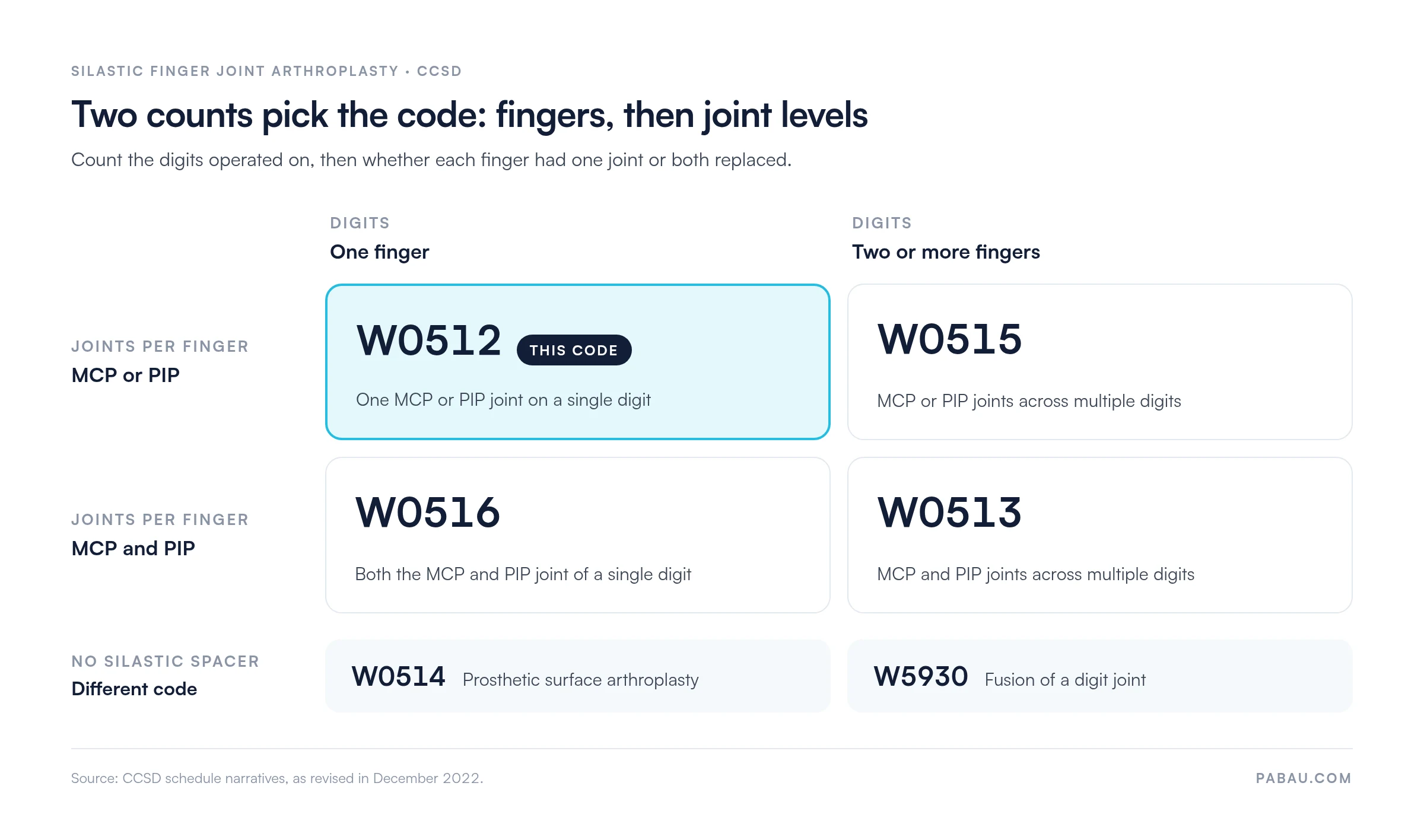
W0512 sits in section 16.6.2 Repair / Reconstruction, under 16.6.0 Hand, with CCSD reference Fp.138. Joints on two or more fingers, or both the MCP and PIP joints of one finger, take W0515, W0513 or W0516 instead.
Let Pabau's smart automation suggest the right codes, reduce claim denials, and keep your practice compliant—effortlessly.
Automate repetitive tasks and focus on what matters most—your patients.
Reduce coding errors and ensure compliance with the latest regulations.
Clean claims, fewer denials, and faster reimbursements.
Powerful insights and reporting to help your practice thrive.
HIPAA compliant SOC 2 certified GDPR-compliant Trusted by 4,000+ clinics worldwide

CCSD code W0512 covers interpositional silastic arthroplasty of one MCP or PIP joint on a single finger, CCSD reference Fp.138.
Since December 2022, the finger count and the joint levels decide the code. Several fingers take W0515 or W0513, and MCP plus PIP on one finger takes W0516.
Never repeat W0512 lines for several fingers in one operation. The CCSD record links W0512 to W0513, W0515 and W0516 through its coding principles.
National Friendly’s October 2025 schedule bands W0512 as Major at £753, but each UK insurer sets its own fee.
UK insurers such as Bupa and AXA Health generally want planned hand surgery pre-authorized, and claims go through Healthcode or direct to the insurer.
UK private insurers use CCSD code W0512 when a surgeon replaces one MCP or PIP joint of a single finger with a silastic spacer. National Friendly’s schedule of fees lists it in the Major band, at £753.
In an interpositional arthroplasty, the surgeon removes the damaged joint surfaces and seats a flexible silicone implant between the bone ends. The implant’s stems sit in the medullary canals, and its hinge lets the joint bend again.
Rheumatoid arthritis at the knuckle (MCP) joints is the classic indication. Osteoarthritis and post-traumatic arthritis of the PIP joint are the other common reasons for the operation.
The CCSD Group maintains the schedule, and UK insurers such as Bupa, Aviva and AXA Health build their procedure lists on it. Our index of CCSD codes lists the other procedure codes we cover.
Before December 2022, silastic finger arthroplasty had one code for a single joint and one for multiple joints. CCSD then added W0515 and W0516 and reworded W0512 and W0513. Two questions now settle the code.
W0510, Prosthetic arthroplasty of digital joint(s), was the older catch-all code. CCSD split it into separate codes to describe the number of joints and the complexity, so it no longer belongs on a claim.
Check the insurer’s own list before you submit. National Friendly’s October 2025 schedule prints W0512 and W0513 but not W0515 or W0516. Where a newer code is missing, ask the insurer how it wants the case coded and keep the answer on file.
Neighboring hand operations carry their own codes. A single tendon transfer is billed as CCSD code T6402. Arthritis at the base of the thumb is often treated by removing the trapezium, which is billed as CCSD code W0282. When the surgeon also reconstructs a ligament after removing the bone, the claim carries CCSD code W0284. A finger fracture fixed through an incision is billed as CCSD W1940. Cutting a small bone of the hand to realign it, with or without fixation or a bone graft, is billed as code W1641.
CCSD follows a single code principle, set out in the CCSD technical guide. One code describes the operation from start to finish, including pre-operative assessment, intra-operative care and post-operative care.
So the exposure, the joint resection, canal preparation, implant sizing and seating, capsular repair and closure all sit inside W0512. None of these steps is billed as a separate line.
Some combinations are ruled out. The CCSD record for W0512 lists W0513, W0514, W0515 and W0516 under its coding principles. That is CCSD’s term for code pairs that should not be used together, and joint injection codes W9030 and W9040 sit on the same list.
A separate synovectomy needs a check first. W6912, Total synovectomy of small joint, has its own code, but the technical guide says each insurer has its own rules on multiple codes. Ask the insurer before a second line goes on the claim.
Insurers want the condition behind the operation in the pre-authorization request. UK claims use WHO ICD-10, and the WHO ICD-10 browser holds the codes below.
Code the condition the surgeon documented, in the same terms as the referral. Confirm the choice with the surgeon before the request goes in.
A W0512 claim is only as strong as the operation note behind it. The coder reads the code straight from the note, so it needs five details.
Put the joints and the fingers in the procedure title, such as “Silastic MCP arthroplasty, right index finger”. The coder can then tell W0512 from W0515 or W0516 at a glance.
The work starts before the operation. UK insurers such as Bupa, AXA Health, Aviva and Vitality generally ask for planned surgery to be approved in advance. Our guide to Bupa CCSD codes covers how Bupa handles CCSD claims.
The anesthetist usually bills separately for the same operation. If both hands are operated on, ask the insurer how it wants the second side billed.
These are the slips that get W0512 claims queried, and how to fix each one.
If a claim is still refused, check the insurer’s current provider manual for its appeal process. Only commit to a deadline you have confirmed there.
In many hand surgery practices, the authorization sits in an email and the operation note in another system. Someone then keys the claim in by hand, and each handoff risks a lost reference or the wrong code.
Pabau keeps those steps on the patient record. Its claims management software sends claims electronically through Healthcode and to Bupa. The authorization code, dates and sessions sit on the patient’s case, with a warning when one is missing.
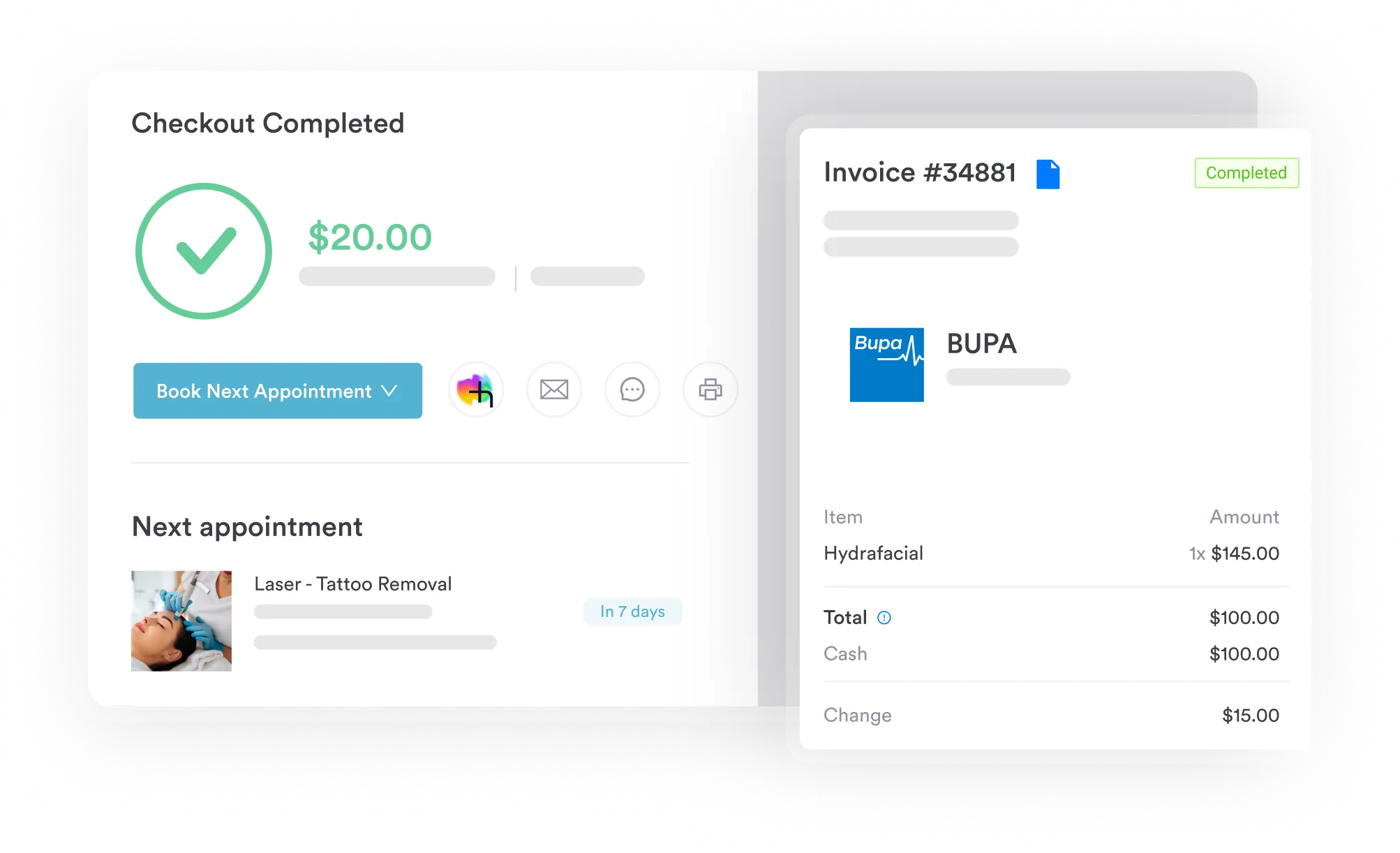
Your coder sees the operation note, the authorization and the claim in one place. Checking the finger count against the code becomes a quick look at one record, and your team spends less time answering insurer queries.

Pabau tracks authorization codes on the patient’s case and sends claims electronically through Healthcode and to Bupa. Your team codes from the note and submits from the same record.

W0512 is a narrow code. It fits one silastic joint on one finger, and the December 2022 split moved every larger case to W0515, W0516 or W0513.
Count the fingers and the joint levels in the note before you pick a code, and check that the insurer’s list carries the newer codes. Those two checks head off the queries that slow finger arthroplasty payments. Book a demo to see how Pabau tracks authorizations and sends your Healthcode claims from one patient record.

Billing a tendon transfer in the hand? CCSD code T6402 explains the single-transfer code and when T6410 applies instead.
Need a full Bupa CCSD billing reference? Bupa CCSD codes covers Bupa’s procedure list and how its claims work.
Checking Bupa fees before you invoice? Bupa procedure codes and fee schedule walks through Bupa’s recognized codes and fee tiers.
CCSD code W0512 covers interpositional silastic arthroplasty of one MCP or PIP joint on a single finger. CCSD is the UK procedure schedule used by private medical insurers such as Bupa, Aviva and AXA Health. The code’s CCSD reference is Fp.138.
Use W0515 when the MCP or the PIP joints are replaced on two or more fingers. Use W0513 when both MCP and PIP joints are replaced across two or more fingers. Don’t repeat W0512 lines for each finger.
That case takes W0516, the single-digit code for silastic arthroplasty of both the MCP and PIP joints. CCSD added it in December 2022, so check that the insurer’s schedule lists it before you submit.
No. W0512 is for a silastic interpositional spacer. A prosthetic surface arthroplasty of an MCP or interphalangeal joint is W0514, cemented or uncemented. A fused finger joint is W5930.
The narrative changed from “Interpositional silastic arthroplasty of MCP/PIP joint – single” to the current wording, which ends “single digit”. CCSD added W0515 and W0516 at the same time. The finger count and the joint levels now decide the code.
UK claims use WHO ICD-10 codes when an insurer asks for a diagnosis. Rheumatoid arthritis is coded in M05 or M06.0, and finger joint osteoarthritis often falls under M19.0 or M15.2. Use the diagnosis the surgeon documented.



