HCPCS Code S0128: Follitropin beta injection billing guide
What is HCPCS code S0128? HCPCS code S0128 reports one 75 IU unit of injected fo...

Last Updated: Nov 19, 2026
V5255 is the HCPCS Level II code for a digital hearing aid fitted to one ear in the in-the-canal (ITC) style. The custom shell sits in the outer part of the ear canal.
It is often confused with V5257, the behind-the-ear (BTE) equivalent, and with V5259, the binaural ITC code. Claims fail most often because of missing prior authorization, a missing LT or RT modifier, or a payer that excludes hearing aids.
Let Pabau's smart automation suggest the right codes, reduce claim denials, and keep your practice compliant—effortlessly.
Automate repetitive tasks and focus on what matters most—your patients.
Reduce coding errors and ensure compliance with the latest regulations.
Clean claims, fewer denials, and faster reimbursements.
Powerful insights and reporting to help your practice thrive.
HIPAA compliant SOC 2 certified GDPR-compliant Trusted by 4,000+ clinics worldwide

HCPCS Code V5255 describes a single-ear digital in-the-canal (ITC) hearing aid. V5257 covers the BTE style, and V5259 covers binaural ITC fittings.
Traditional Medicare excludes hearing aids under Social Security Act Section 1862(a)(7). Coverage depends on Medicare Advantage, Medicaid or a commercial plan.
Most payers require or expect an LT or RT modifier on each V5255 line to show the fitted ear. Confirm payer policy, because wrong laterality is a top denial trigger.
Pabau’s claims management tools help audiology practices track prior auth status, attach audiogram documentation and reduce V5255 claim denials.
HCPCS Code V5255 is a Level II V code, the range for vision, hearing and speech-language pathology services. Its official descriptor in the CMS HCPCS Level II code set reads: Hearing aid, digital, monaural, ITC. Three terms define what the code covers and what it excludes.
Digital: The device uses digital signal processing rather than analog circuitry. Analog aids fall under older HCPCS codes and cannot be reported with V5255.
Monaural: The dispensing covers one ear only. Fitting both ears on the same date takes two V5255 lines, one with LT and one with RT. The alternative is the binaural code V5259 (digital binaural ITC), depending on payer policy. A contralateral routing (CROS) system is coded separately, with V5240 as its binaural dispensing fee.
ITC (in-the-canal): The custom-molded shell sits in the outer part of the ear canal. It is smaller than an in-the-ear (ITE) aid and larger than a completely-in-canal (CIC) aid. Other digital monaural styles have their own codes: V5254 for CIC, V5256 for ITE and V5257 for behind-the-ear (BTE).
V5255 covers the digital ITC hearing aid itself, including its custom-molded shell. Payers that cover the code generally treat the device as one billable unit per ear.
Several items are explicitly outside the allowable and must be billed separately or not at all:
Payers that cover V5255 set their own allowable, and many benchmark against CMS rates. CMS updates its files every year, so check the current-year release on the CMS DMEPOS fee schedule page before quoting a figure. That schedule publishes state-specific rural and non-rural rates.
Traditional Medicare does not pay V5255 for most beneficiaries. Social Security Act Section 1862(a)(7) explicitly excludes hearing aids from Medicare Part B coverage. Any published allowable matters mainly to Medicaid, Medicare Advantage and commercial payers that use CMS rates as a benchmark. Submitting V5255 to traditional fee-for-service Medicare for a standard beneficiary will result in a statutory non-covered denial.
Always verify the fee schedule allowable for V5255 directly from the current-year CMS DMEPOS fee schedule file at cms.gov before quoting a reimbursement rate. Rates update each January 1 and vary by state and by rural or non-rural status. A prior-year figure pulled from a third-party tool is not a reliable basis for patient estimates or contract negotiations.
Coverage for V5255 varies sharply across payer types. Knowing which payer is on the claim before dispensing prevents the most common and most avoidable denial.
Medicare Advantage plans are where most confusion arises. Plans are required to cover at least the same benefits as traditional Medicare, but many voluntarily add hearing aid benefits. Each plan sets its own V5255 allowable, prior authorization threshold, and network-supplier rules. Confirm coverage and obtain a referral or authorization before dispensing.
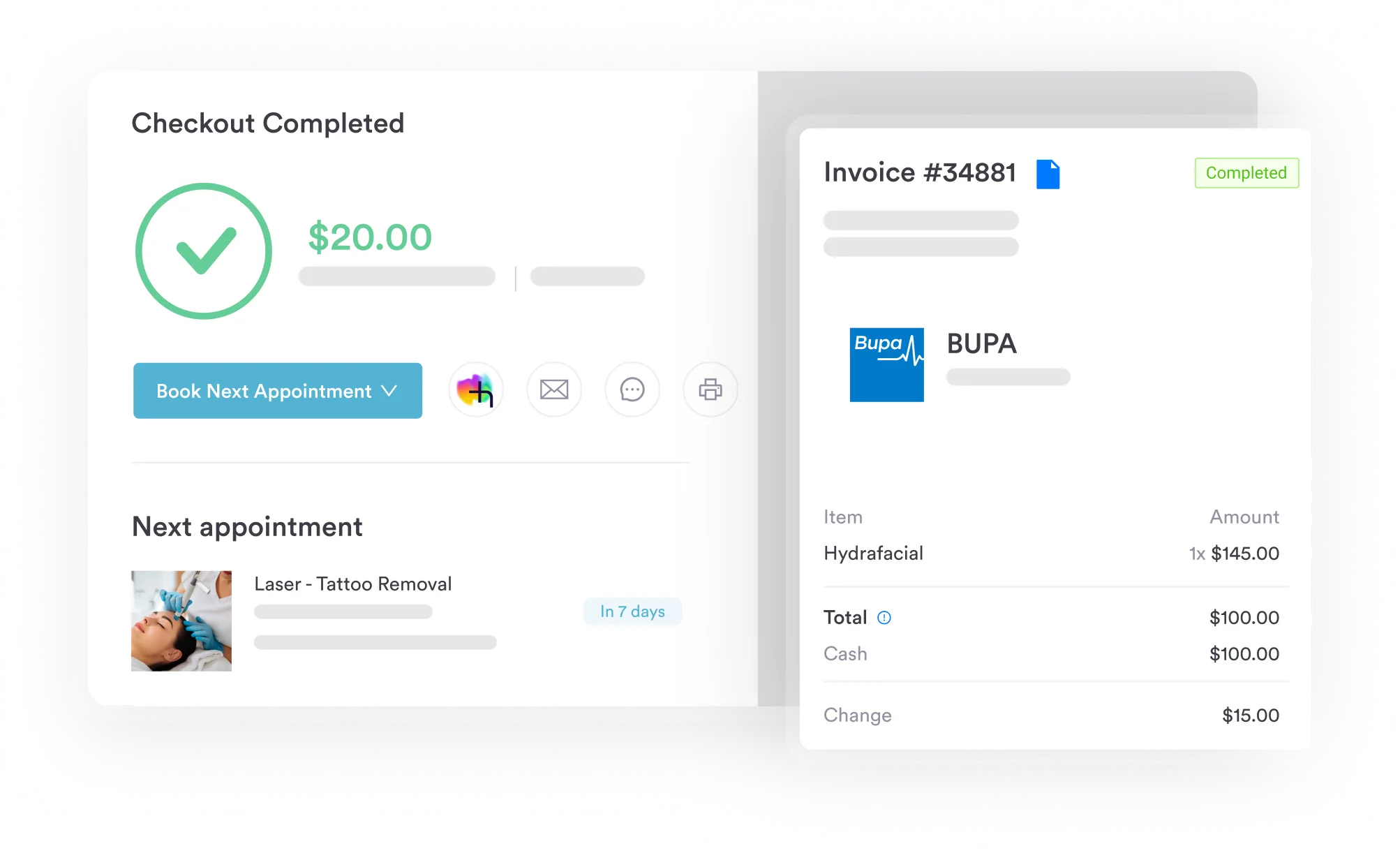
Accurate V5255 billing takes seven steps, from DMEPOS supplier enrollment to timely filing. Most of them happen before the claim is built, so the checkout record has to carry the authorization and the payer details from the start.
Documentation drives medical necessity determinations. Payers that do cover V5255 require a minimum set of records before they will pay. Missing any item is a leading cause of denial, so assemble the file before the claim drops rather than after a denial arrives.
Prior authorization is not universal for V5255, but it is the norm for Medicaid and common for Medicare Advantage and commercial plans. Submitting a claim without required authorization produces a CO-15 or CO-197 denial.
The following situations typically trigger a PA requirement:
V5255 requires a supporting ICD-10 diagnosis code on the claim. The diagnosis must reflect hearing loss in the fitted ear. Its laterality must also match the LT or RT modifier on the V5255 line.
Laterality alignment is a compliance requirement. A V5255 line billed with LT next to H90.41 (right-ear sensorineural loss) will likely deny for inconsistent laterality. The audiogram, diagnosis code, and LT/RT modifier must all point to the same ear.
The digital hearing aid series runs from V5254 to V5261 and splits by form factor (CIC, ITC, ITE, BTE) and by ear coverage. Choosing the wrong one is an accuracy problem that can trigger audits, not simply a denial that corrects itself on resubmission.
Consult the AAPC HCPCS code lookup to verify current descriptors for each code before billing. The grid below places all eight digital codes by device style and ear count.
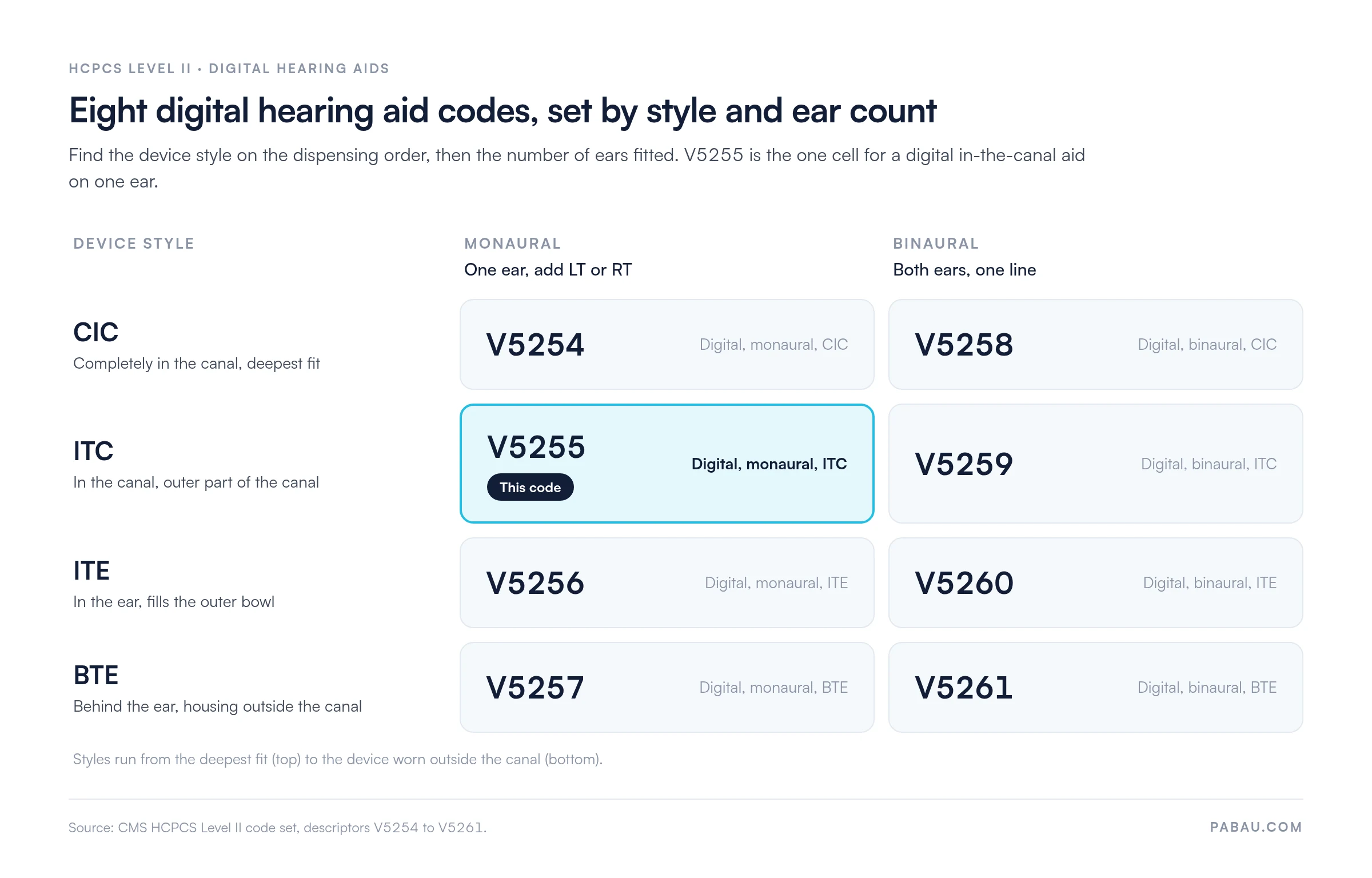
The V5255 vs V5257 distinction is the one most likely to cause a compliance issue. Both are digital monaural aids, and the difference is form factor, not technology tier. V5255 is an ITC aid worn in the ear canal, while V5257 is a BTE aid whose housing sits behind the ear.
Code from the device style on the dispensing order, and confirm current descriptors in the PGM Billing HCPCS lookup. Every neighboring code also has its own billing guide in our HCPCS code library.
Most payers require or expect a laterality modifier on every V5255 claim line, so confirm payer policy. Submitting V5255 without LT or RT is a data-entry error that produces a CO-4 (missing modifier) or CO-16 (claim lacks required information) denial. The two modifiers work as follows:
Two LT lines on one claim point to a data error. LT and RT lines without payer approval for bilateral dispensing may signal a binaural fitting that belongs under V5259. When fitting both ears, check whether the payer prefers two V5255 lines (each with its own LT or RT) or one V5259 line before submitting.
Most V5255 denials fall into one of seven categories, and each has a corrective action. Prevention is cheaper than any of them: a pre-service checklist catches each trigger before the claim drops.
Run a benefits and authorization check at the time of the consultation, not on the day of dispensing. For V5255, the payer’s frequency window, benefit dollar cap, and PA requirement are all knowable in advance. Settling coverage before the fitting date prevents the most expensive denial of all. That is a dispensed device the patient cannot pay for and the payer will not cover.
Most V5255 denials trace back to steps that happen before the claim is built: the benefit check, the prior authorization and the audiogram on file. When those live in separate systems, a missing piece only shows up after the payer rejects the claim.
Pabau, a practice management and billing platform, keeps all three in one patient record. Its cleaner claims management tracks prior authorization status, stores the audiogram against the patient and carries the modifier and diagnosis linkage onto the claim. Your team sees which hearing aid claims are still waiting on authorization before the fitting date, not after a denial arrives.

Pabau’s claims management tools help audiology practices and DMEPOS suppliers track prior authorization status and attach audiogram documentation. Submit clean V5255 claims across Medicaid, Medicare Advantage and commercial payers.

V5255 looks simple on paper, but it sits in a series of eight digital codes that differ only by form factor and ear coverage. Confirm the device is an in-the-canal aid fitted to one ear, then match laterality across the audiogram, diagnosis and modifier. Verify coverage and authorization before the fitting, and most avoidable V5255 denials never happen.
Book a demo to see how Pabau handles HCPCS billing workflows for hearing aid practices.

Need to understand how claims move through the billing cycle? Revenue cycle management explained covers the end-to-end process from eligibility check to payment posting.
Looking for tools to reduce payer denials across all claim types? Best medical billing software for US practices reviews the platforms that support DMEPOS and audiology claim workflows.
Want a framework for appealing denied claims? Denial codes in medical billing breaks down the most common remittance remark codes and the corrective actions that resolve each one.
Fitting digital CIC aids in both ears? HCPCS Code V5258 covers the binaural completely-in-canal code and how it compares with two monaural lines.
Dispensing behind-the-ear aids for both ears? HCPCS Code V5261 explains the binaural BTE code, its documentation and its common denials.
HCPCS Code V5255 covers a digital monaural in-the-canal (ITC) hearing aid, including its custom-molded shell. It does not cover batteries (V5266), professional fitting services, cochlear implants, or replacement parts, which are billed under separate codes.
No. Traditional Medicare Part B does not cover hearing aids under HCPCS Code V5255 due to the statutory exclusion in Social Security Act Section 1862(a)(7). Medicare Advantage (Part C) plans may cover V5255 as a voluntary supplemental benefit. Check each plan’s Evidence of Coverage before dispensing.
Both are digital monaural hearing aids, and the difference is form factor, not technology tier. V5255 is an in-the-canal (ITC) aid worn in the ear canal, while V5257 is a behind-the-ear (BTE) aid whose housing sits behind the pinna. Code from the device style on the dispensing order.
The primary ICD-10 codes used with V5255 are H90.11 and H90.12 for conductive loss and H90.41 and H90.42 for sensorineural loss. H90.71 and H90.72 cover mixed hearing loss, and each code names the right or left ear. The diagnosis code’s laterality must match the LT or RT modifier on the V5255 claim line.
The most common reasons are a non-covered payer (the Medicare Part B exclusion), missing prior authorization, or a wrong or missing LT or RT modifier. An incomplete audiogram, a replacement inside the frequency limit, or a missed timely filing window also cause denials. Laterality mismatches and missing audiograms account for the highest proportion of correctable denials.
Monaural billing (V5255 with LT or RT) covers one ear. Binaural billing covers both ears, either as two monaural claims on the same date or under the binaural ITC code V5259. Some payers prefer one binaural code when both ears are fitted at the same visit, while others require two monaural claims. Confirm the payer’s preference before dispensing bilaterally.