CPT Code 19361: Latissimus dorsi flap breast reconstruction
CPT code 19361: Official descriptor and payment basics CPT code 19361 is the Cat...

Last Updated: Nov 18, 2026
V2199 is the HCPCS Level II code for a single vision lens that is not otherwise classified, billed per lens.
Its official descriptor reads "Not otherwise classified, single vision lens." V2199 is the NOC code for single vision lenses only, not for lenses in general. Use it only after you rule out every named single vision code (V2100-V2121) for the lens dispensed. Bifocal, trifocal, and variable asphericity lenses have NOC codes of their own.
Let Pabau's smart automation suggest the right codes, reduce claim denials, and keep your practice compliant—effortlessly.
Automate repetitive tasks and focus on what matters most—your patients.
Reduce coding errors and ensure compliance with the latest regulations.
Clean claims, fewer denials, and faster reimbursements.
Powerful insights and reporting to help your practice thrive.
HIPAA compliant SOC 2 certified GDPR-compliant Trusted by 4,000+ clinics worldwide

HCPCS Code V2199 covers a single vision lens that is not otherwise classified, billed per lens when no named code from V2100 to V2121 fits.
V2199 is a NOC (not otherwise classified) code, so use it only after you rule out every named single vision code.
Medicare Part B excludes routine eyeglasses but covers one pair after each cataract surgery with IOL insertion, under Social Security Act §1861(s)(8). V2199 applies to that pair only when it needs an atypical single vision lens.
Bill V2199 per lens, not per pair, with LT and RT modifiers, because unit errors are a common denial trigger for spectacle lens codes.
Pabau’s claims management software tracks HCPCS code submissions, modifier requirements, and payer-specific rules in one place.
HCPCS Code V2199 is the Level II code for a single vision lens that is not otherwise classified, billed per lens. The Centers for Medicare & Medicaid Services (CMS) maintains the HCPCS Level II code set, which covers products, supplies, and services not included in CPT codes. Vision items such as frames, lenses, and contact lenses sit in its V series.
V2199 closes the single vision lens range, V2100-V2199. In HCPCS convention, a NOC code sits at the end of its range and takes the lenses its named codes do not describe. Bifocal, trifocal, and variable asphericity lenses have separate NOC codes: V2299, V2399, and V2499. The table below shows where V2199 sits in the HCPCS structure.
The official descriptor is published verbatim in the CMS HCPCS Alpha-Numeric file, updated each October for the following calendar year. Always verify against the current-year release before submitting claims, as descriptors occasionally receive technical revisions.
The NOC qualifier in V2199’s descriptor means the code fits only after you rule out every named single vision code from V2100 to V2121. Using V2199 when a named code exists is miscoding, and medical billing compliance audits treat it as a billing error.
Lenses that land on V2199 are atypical single vision designs whose material, power, or optical construction falls outside every named single vision descriptor. A typical example is a custom single vision lens built for prescription parameters that no named power bracket or design code describes.
What V2199 does not cover is equally important. The following lens types have dedicated codes and must never be defaulted to V2199:
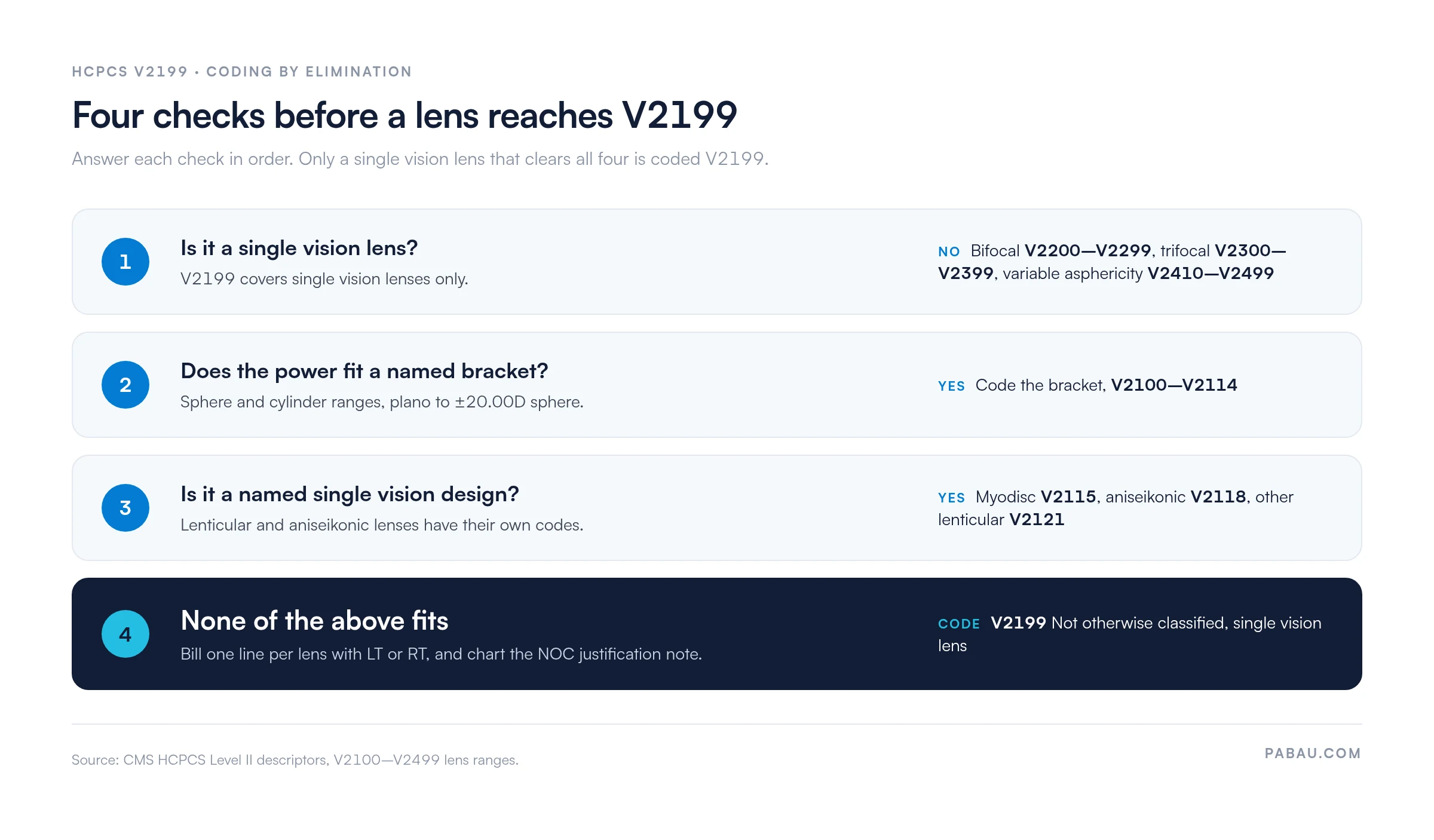
The most consequential coding decision for V2199 is ruling out its neighbors. The V2100-V2121 range covers single vision lenses only. V2100-V2114 are power brackets by sphere and cylinder, while V2115, V2118, and V2121 name lenticular and aniseikonic designs. If the lens matches any of them, V2199 is wrong.
The AAPC single vision lens range and the CMS Alpha-Numeric file both list the full descriptor for each V21xx code. They also cover V2105-V2114, which continue the spherocylinder brackets at higher powers. Cross-reference both before selecting V2199, working through the four checks below in order.
V2199 is billed per lens, so a complete pair of eyeglasses generates two claim lines for this code. Coders often misread this convention on spectacle lens codes, and incorrect units are a frequent audit finding across the V21xx range.
Submit one claim line per lens, with a quantity of 1 per line. Do not set quantity to 2 for a pair on a single line. Many practice management systems default to “1 pair” for eyewear, which silently creates a units error on HCPCS claims unless corrected.
LT (left side) and RT (right side) modifiers identify which lens each claim line covers. Most vision plan payers and Medicare Administrative Contractors require LT/RT on spectacle lens codes. A missing modifier is a leading denial trigger. The NU modifier (new equipment) is typically appended for newly dispensed lenses. Loaner and reissue scenarios take RR (rental) or UE (used) instead.
V2199 is typically billed with place of service 11 (office) for dispensing opticians and OD/MD practices. Optometrists (OD), ophthalmologists (MD), and licensed dispensing opticians may all submit V2199 claims, subject to state scope-of-practice rules and payer credentialing requirements. Verify that the billing provider’s NPI and taxonomy code align with the payer’s recognized vision care provider types.
Medicare Part B excludes routine vision care, including standard eyeglasses and contact lenses. V2199 claims submitted to Medicare Part B for routine spectacle needs will be denied on this basis regardless of the specific lens code used.
The narrow Medicare exception comes from Social Security Act §1861(s)(8). It covers one pair of conventional eyeglasses or contact lenses after each cataract surgery with insertion of an intraocular lens (IOL). The Medicare Benefit Policy Manual, chapter 15 sets out the same limit in section 120. V2199 applies to that pair only when the post-surgical prescription needs an atypical single vision lens that no named V21xx code describes. Before submitting, document the surgery date, the IOL insertion, and the clinical reason for the atypical design.
Vision-only plans from VSP, EyeMed, UnitedHealthcare Vision, Humana Vision, and Davis Vision generally accept V2199 for covered specialty lens benefits. Each plan’s Evidence of Coverage defines which lens categories are eligible and at what benefit level. Because V2199 is a catch-all code, some payers require additional supporting documentation (see the documentation section below) or prior authorization before they will adjudicate it. Always verify against the specific member’s plan year documents; benefits vary significantly by employer contract and plan tier.
Check payer coverage before dispensing atypical lenses. For commercial vision plans, call the eligibility and benefits line. Ask whether specialty lenses coded under HCPCS V2199 are covered under the member’s current benefit tier. Verbal authorization should be followed up with a written reference number documented in the chart.
V2199 claims require more supporting documentation than standard power-based lens codes because the NOC designation signals to auditors that no specific code applied. Building a strong chart record before submission is the fastest way to avoid post-payment audit exposure.
The following documentation should be in the patient record before submitting a V2199 claim:
Reviewers at Medicare Administrative Contractors and commercial vision plans look for the NOC justification note when they audit V2199 claims. Without it, the claim suggests the code was chosen without reviewing the named alternatives. A one-sentence note such as “V2100-V2121 reviewed; lens design and power match no named descriptor; V2199 applies” takes seconds to add. A structured claims management workflow that prompts for this note at the billing step keeps it from being skipped under time pressure.
V2199 denials follow predictable patterns, and most trace back to one of six root causes. Understanding the denial management process for each lets billing staff resolve them quickly rather than writing them off.
The denial codes in medical billing on the Explanation of Benefits (EOB) for these scenarios are typically CO-4, CO-5, and CO-15. They flag an incorrect code, a non-covered service, and a missing or invalid authorization number. Map each denial code to the resolution step above and document your appeal rationale in the patient account before resubmitting.
Run a monthly V2199 denial report filtered by CARC code. If CO-4 (incorrect code) accounts for more than 15% of denials, your intake workflow likely skips a systematic V21xx review before the claim is built. Add a mandatory code-justification field to the dispensing order so the coder has the NOC rationale before the claim is submitted, not after.
V2199’s NOC status means payers often apply additional scrutiny to these claims. Running a brief pre-submission policy check prevents the most avoidable denials. Work through the following before billing any V2199 claim:
Accurate payer policy verification reduces the lag between dispensing and payment. Practices using clean claim submission workflows catch these issues at the front end, before the claim reaches the payer. The PGM Billing HCPCS lookup tool and the CMS Physician Fee Schedule are free resources for checking coverage indicators. They also show Medicare payment status by HCPCS code and MAC jurisdiction.
Without a shared workflow, a V2199 claim depends on one biller’s memory. That biller has to recall the LT and RT lines, the NOC note, and each payer’s prior authorization rule. Miss one, and the claim comes back as a CO-4, a units error, or a records request.
Pabau, the practice management platform we build, keeps those checks inside its medical billing workflow. Optometry and ophthalmology practices track HCPCS modifier requirements, payer coverage rules, and claim status without switching between systems. The justification note sits with the claim, so an auditor’s records request is answered from one place.

Pabau’s claims management software tracks modifier requirements, payer rules, and submission status for every V-code encounter in your schedule.

HCPCS Code V2199 exists for atypical single vision lenses that fall outside every named single vision descriptor. Chosen by elimination, it gets those lenses paid. Chosen by default, it leaves a trail of coding errors for auditors to find.
The habit that protects the claim is simple. Rule out V2100 through V2121 in order, code V2199 only when none fits, and write that review into the chart before the claim goes out. Book a demo to see how Pabau keeps V2199 claims, modifiers, and justification notes in one billing workflow.

Need a denial resolution framework? Denial management in healthcare covers the full workflow for identifying, categorizing, and appealing denied claims across payer types.
Unsure which coding errors trigger the most audits? Denial codes in medical billing maps common CARC codes to their root causes and resolution steps.
Looking to tighten your front-end billing process? Medical billing compliance outlines the documentation and coding standards that keep claims clean before they reach the payer.
HCPCS Code V2199 is the code for a single vision lens that is not otherwise classified, billed per lens. It is the NOC code for the single vision range, used when no named code from V2100 to V2121 matches the lens dispensed. Bifocal, trifocal, and variable asphericity lenses have their own NOC codes.
V2100 through V2121 each name a single vision lens by power bracket or design, covering sphere and cylinder ranges plus lenticular and aniseikonic lenses. V2199 applies only after none of those named codes fits the lens dispensed. Using V2199 when a specific code exists is a miscoding error.
Medicare Part B does not cover routine vision care or standard eyeglasses. The exception is Social Security Act §1861(s)(8), which covers one pair of conventional eyeglasses or contact lenses after each cataract surgery with IOL insertion. V2199 applies to that pair only when it needs an atypical single vision lens that no named V21xx code describes. Document the IOL surgery date and clinical justification before submitting.
V2199 is billed per lens, not per pair. Submit two separate claim lines for a complete pair, each at quantity 1. One line carries the LT modifier (left lens) and the other the RT modifier (right lens). Submitting a single line at quantity 2 is a units error and a common denial trigger.
The most common reason is a more specific V21xx code that was not used (CO-4). Other causes are a missing LT or RT modifier, routine vision under Medicare Part B, a missing prior authorization, and units billed as a pair. The NOC designation flags these claims for closer review by payer auditors, so documentation quality is especially important.
Use V2199 only after systematically reviewing V2100 through V2121 and confirming that none accurately describes the lens dispensed. Document this review in the chart with a brief NOC justification note. If the lens power, design, or material matches any named code in the range, that specific code is required.