CCSD code L6530: Revision femoral bypass graft
CCSD code L6530: Definition and clinical scope CCSD code L6530 carries the offic...

Last Updated: Nov 13, 2026
V2787 is the HCPCS Level II code for astigmatism correcting function of intraocular lens.
It reports the non-covered charges for the astigmatism-correcting function of a toric IOL implanted in place of a conventional lens during cataract surgery. Medicare pays for the conventional lens portion. Under CMS Ruling 1536-R, the patient pays for the astigmatism-correcting function. Presbyopia correction is reported separately with V2788.
Let Pabau's smart automation suggest the right codes, reduce claim denials, and keep your practice compliant—effortlessly.
Automate repetitive tasks and focus on what matters most—your patients.
Reduce coding errors and ensure compliance with the latest regulations.
Clean claims, fewer denials, and faster reimbursements.
Powerful insights and reporting to help your practice thrive.
HIPAA compliant SOC 2 certified GDPR-compliant Trusted by 4,000+ clinics worldwide

HCPCS code V2787 reports the non-covered astigmatism-correcting function of a toric IOL, not the lens itself.
Medicare pays for the cataract surgery and the conventional lens share. Under CMS-1536-R, the patient pays the charges that exceed a conventional IOL case.
V2788 is the presbyopia-correcting code. It has been invalid for toric lenses since January 1, 2008, when V2787 took over that job.
In a physician office, bill V2632 for the conventional lens beside V2787. In an ASC or hospital, the lens is packaged into the facility payment.
Pabau, practice software with built-in claims management, keeps the signed patient estimate, the operative note and the claim on one patient record.
HCPCS code V2787 is the HCPCS Level II code for the astigmatism-correcting function of an intraocular lens. Its official descriptor reads “Astigmatism correcting function of intraocular lens.” CMS introduced it in Transmittal 1430 (Change Request 5853) for dates of service on or after January 1, 2008. It reports the non-covered charges tied to a toric IOL, not the lens as a whole.
CMS calls these lenses astigmatism-correcting IOLs, or A-C IOLs. In clinical use they are toric IOLs, which replace the clouded lens and correct pre-existing astigmatism at the same time. CMS Ruling 1536-R treats one toric lens as two items: a covered conventional IOL and a non-covered refractive correction. V2787 carries the second of those.
V2787 covers one function of the lens: The correction of pre-existing astigmatism. The conventional lens, the surgery and the routine postoperative care each sit elsewhere on the claim. Medicare pays for those as usual.
Medicare covers cataract surgery and a conventional IOL. Under CMS-1536-R, the astigmatism-correcting function falls outside every Medicare benefit category, because an IOL is neither eyeglasses nor contact lenses. The beneficiary pays the part of the physician and facility charges that exceeds the charges for a conventional lens. Medicare still pays the conventional share.
V2787 reports the astigmatism-correcting function of a toric IOL. V2788 reports the presbyopia-correcting function of a multifocal, extended depth of focus (EDOF) or accommodating IOL. The two codes rest on separate CMS rulings and should never be swapped.
The mix-up has a history. From January 22, 2007, CMS told providers to report toric lens charges with V2788, the presbyopia code. Transmittal 1430 moved those charges to V2787 from January 1, 2008, and V2788 stopped being valid for toric lenses. A billing template or chargemaster built in 2007 can still send toric lenses to V2788. The timeline below shows which code each lens type has carried since 2005.
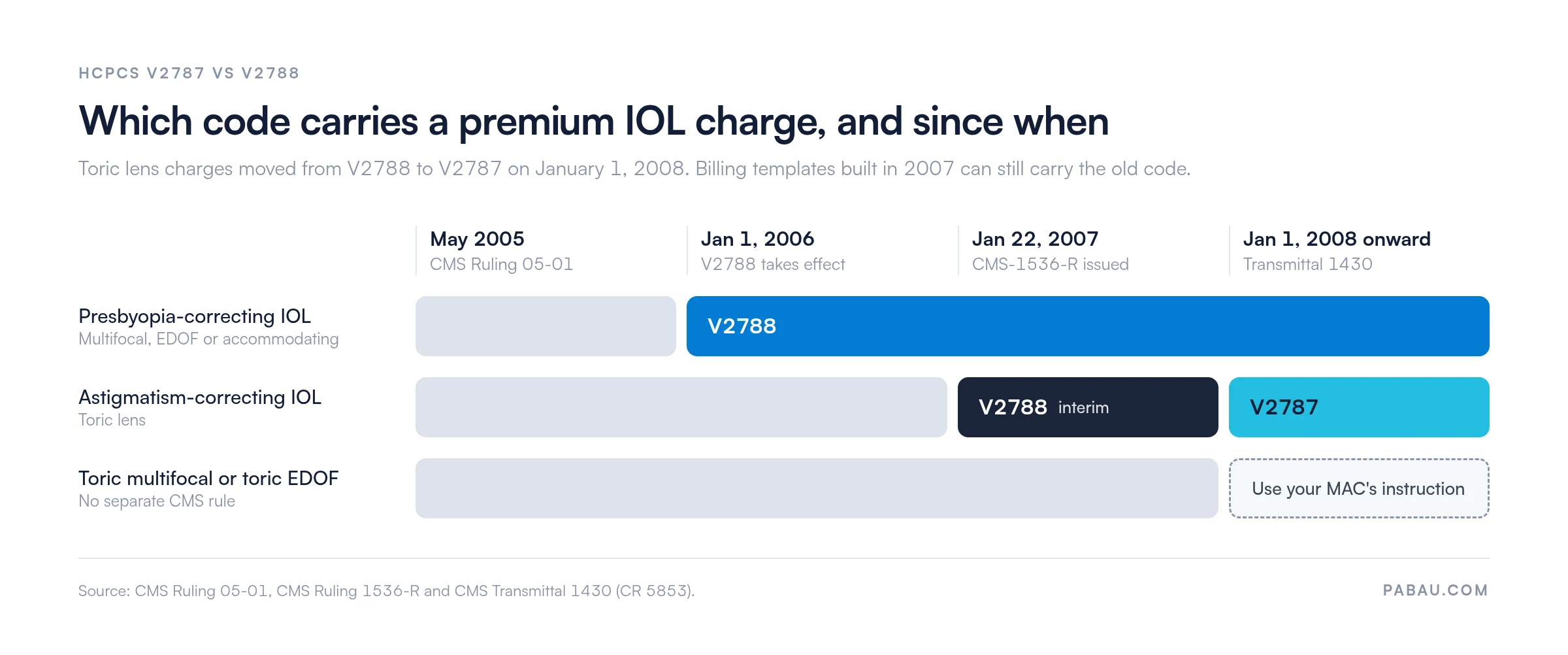
A toric multifocal or toric EDOF lens corrects astigmatism and presbyopia in one implant, so both CMS rulings touch it. Transmittal 1430 does not set a separate rule for a combination lens. The Johnson & Johnson Vision 2026 cataract billing guide bills combination lenses as astigmatism-correcting IOLs. It lists its toric multifocal and toric EDOF models under V2787.
That is manufacturer guidance rather than a CMS rule, and some coders report both codes. Confirm your Medicare Administrative Contractor’s (MAC’s) instruction before the first combination-lens case, then apply it the same way every time. Whichever route the MAC sets, the operative report names the lens model, and the patient is charged once for one lens.
HCPCS code V2787 sits beside the conventional lens payment and never replaces it. Where the surgery happens decides which lines appear on the claim.
In an ASC or hospital outpatient department, the conventional lens is packaged into the facility payment for the cataract procedure. The facility reports the same cataract CPT code it would use for a conventional IOL and adds V2787 for the extra charges. A surgeon operating in a facility does not bill the lens at all. CMS warns that billing a lens on an ASC case can bring a civil money penalty.
The patient’s share is the part of the physician and facility charges that exceeds the charges for a conventional IOL case. That share can include the extra work and resources for insertion, fitting and visual acuity testing of the toric lens. It never includes the conventional share, which Medicare pays.
Build the patient-pay figure for a toric lens from line items. List the lens charge above a conventional lens, the extra insertion and fitting work, and the visual acuity testing. Each line then traces back to a function Medicare excludes, which makes the total easy to explain if the patient queries it.
Medicare’s position on HCPCS code V2787 comes from CMS Ruling 1536-R, issued in January 2007. The toric function is not covered, so Medicare pays the conventional share and the beneficiary pays the rest. Contractors deny the V2787 line with Medicare Summary Notice message 16.10 and claim adjustment reason code 96. Pabau’s ophthalmology claims management tools keep the covered and non-covered lines on one patient account.
Because the premium function of the lens is excluded by statute, the American Academy of Ophthalmology says no Advance Beneficiary Notice (ABN) is required. It adds that V2787 does not need modifier GY. Some practices still use a voluntary ABN or a signed financial agreement as the written notice. Keeping that notice patient-specific and dated before surgery supports medical billing compliance if a charge is ever disputed.
A V2787 line denies by design, so its documentation supports the covered lines and the patient charge. The record also has to survive a post-payment review of the covered cataract claim. Good superbill documentation that pulls the lens make, model and lot number from the OR log saves a retrieval step on every case.
The cataract diagnosis carries medical necessity for the covered lines, so code it as specifically as the chart allows. Categories H25 and H26 in the ICD-10-CM diagnostic codes separate cataract type and the eye treated.
Medicare is meant to deny the V2787 line, so that denial needs no correction. The remittance shows the line as non-covered, and the patient pays the amount they agreed to. The errors that cost money sit around that line. Denial management workflows that tag V-code lines separately from CPT lines make those patterns visible sooner.
Original Medicare has no prior authorization step for V2787, because the toric function is not covered and there is nothing to approve. Other payers set their own rules, so confirm coverage at the plan level. Run insurance eligibility verification early enough to settle any authorization request before the surgery date.
Catching a payer rule before surgery protects the practice and the patient. A clean claim starts with the authorization reference, the approval date and the lens model in the patient record before the operative note is written.
Before each toric lens case, run a short checklist. Cover the payer type, the authorization status, the signed patient estimate and its date, and the lens make and model. For a toric multifocal, add the MAC’s code instruction. Running it the week before surgery catches these problems while they can still be fixed.
In many ophthalmology practices, a toric lens case lives in three places. The surgeon’s note names the lens, the front desk holds the signed estimate, and the billing team builds the claim from both. When those records disagree, the V2787 line, the patient invoice and the remittance stop matching.
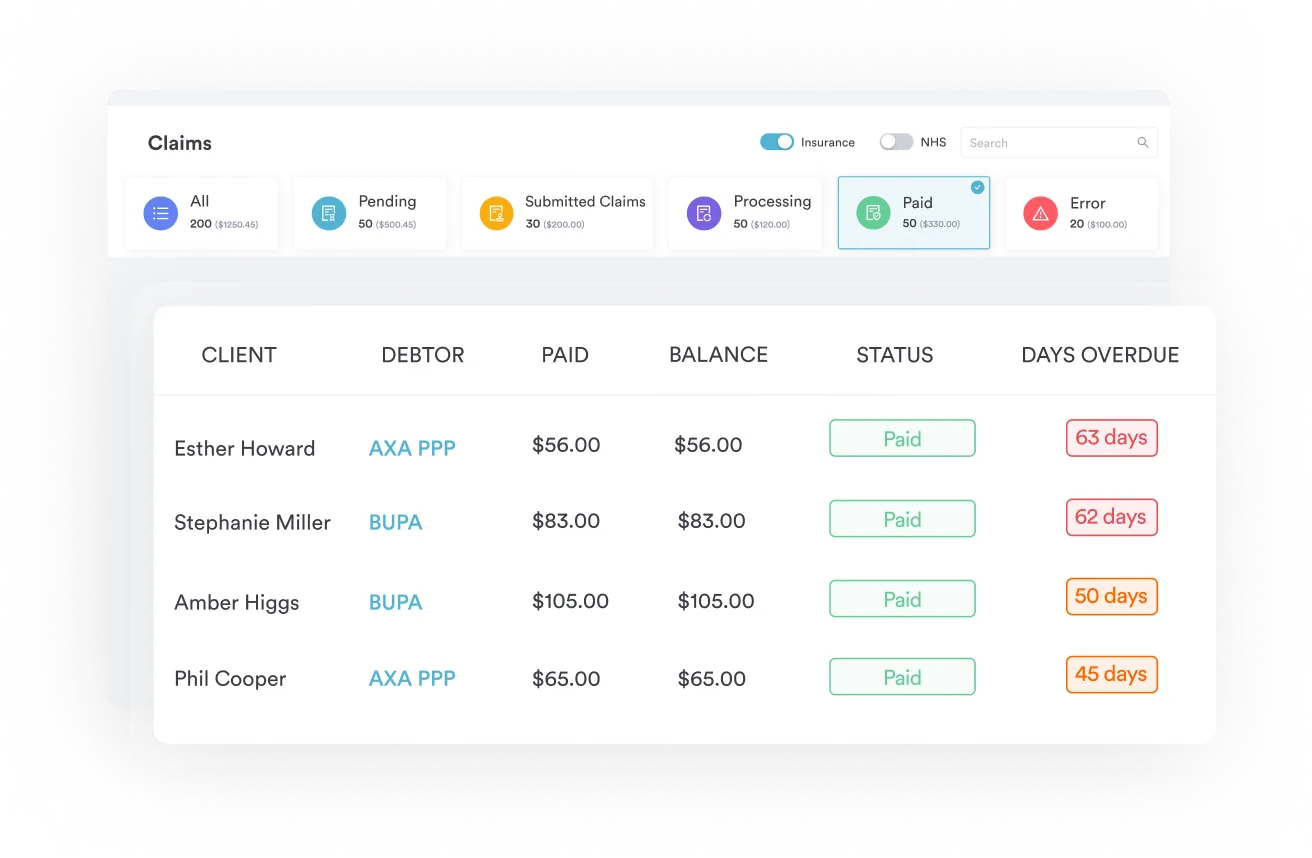
Pabau holds the clinical record, the patient’s signed digital forms and the claim against one patient account. Its medical billing software ties the covered cataract lines and the non-covered V2787 line to the same encounter. The patient invoice then follows the amount the patient signed for.
The result is a toric case you can explain line by line. The patient sees the charge they agreed to, and Medicare sees the conventional case it pays for. Every Pabau plan includes the core features, so forms, records and billing work from the same patient file.

Pabau keeps the operative note, the signed patient estimate and the claim on one patient record. See how practices bill a toric IOL case without re-keying data.

HCPCS code V2787 reports one thing: The non-covered astigmatism-correcting function of a toric IOL. Medicare pays for the cataract surgery and the conventional lens share. Under CMS-1536-R, the patient pays the excess. The errors that cost practices money come from swapping V2787 with V2788, or from putting covered charges on the wrong line.
Treat the denied V2787 line as the expected outcome, and put the effort into the written estimate and the lens documentation before surgery. Pabau’s claims management software keeps those records and the claim together. To see it handle a cataract case from estimate to remittance, book a demo.

Need to understand how the claims pipeline works? Revenue cycle management in healthcare explains every stage from eligibility check through final payment posting.
Seeing high denial rates across your ophthalmology claims? Denial codes in medical billing covers the most common CARC and RARC codes and how to respond to each.
Trying to standardize your billing across multiple surgeons or locations? Medical claims clearinghouse guide walks through how clearinghouses validate and route HCPCS claims before they reach the payer.
Billing a multifocal or EDOF lens instead? HCPCS code V2788 covers the presbyopia-correcting function and how it sits beside the conventional lens on the claim.
HCPCS code V2787 covers the astigmatism-correcting function of an intraocular lens, the toric correction of pre-existing astigmatism. It reports the non-covered charges for that function on a cataract surgery claim. The cataract CPT code and the conventional lens share are billed separately, and Medicare pays them as usual.
Under CMS Ruling 1536-R, V2787 reports the astigmatism-correcting function of a toric IOL. Under CMS Ruling 05-01, V2788 reports the presbyopia-correcting function of a multifocal, EDOF or accommodating IOL. Since January 1, 2008, V2788 has not been valid for astigmatism-correcting lenses.
Medicare pays for the cataract surgery and the conventional lens portion. Under CMS-1536-R, the astigmatism-correcting function is not covered. The patient pays the part of the physician and facility charges that exceeds a conventional IOL case, and should get a written estimate before surgery.
A toric multifocal corrects astigmatism and presbyopia in one lens, and the CMS transmittal for V2787 sets no separate rule for it. The Johnson & Johnson Vision 2026 billing guide bills combination lenses as astigmatism-correcting IOLs under V2787. Confirm your MAC’s instruction before the first case, and charge the patient once for one lens.
The American Academy of Ophthalmology says no ABN is required, because the premium function of the lens is excluded by statute. Practices still give the patient a signed, dated estimate before surgery, often a voluntary ABN or a financial agreement. Check your MAC’s guidance on any modifier for the V2787 line.
Medicare denies the V2787 line by design, because the astigmatism-correcting function is non-covered. Contractors use Medicare Summary Notice message 16.10 and claim adjustment reason code 96 for these lines. The denial records the patient’s responsibility, so it does not need an appeal.
Yes. V2787 is billed on the same claim as the cataract CPT code, usually 66984 or 66982. In a physician office, V2632 is added for the conventional lens share. In an ASC or hospital, the lens is packaged into the facility payment, so only the CPT code and V2787 appear.
Original Medicare has no prior authorization step for V2787, because the function is not covered. Medicare Advantage, commercial and Medicaid plans set their own rules. Check the plan’s policy and any authorization step well before the surgery date.