

CCSD code G5100: Bypass of duodenum billing guide
CCSD code G5100 bills a bypass that leaves the duodenum in place CCSD code G5100...

Last Updated: Oct 16, 2026
19499 is the CPT code for unlisted procedure, breast. It reports a breast procedure that no specific code in the 19000-19499 Breast subsection describes, such as a novel or hybrid technique.
Medicare assigns 19499 no fixed RVU, so the payer prices each claim from the documentation. Every claim needs an operative report and a cover letter that names the closest comparable code.
Let Pabau's smart automation suggest the right codes, reduce claim denials, and keep your practice compliant—effortlessly.
Automate repetitive tasks and focus on what matters most—your patients.
Reduce coding errors and ensure compliance with the latest regulations.
Clean claims, fewer denials, and faster reimbursements.
Powerful insights and reporting to help your practice thrive.
HIPAA compliant SOC 2 certified GDPR-compliant Trusted by 4,000+ clinics worldwide

CPT code 19499 reports a breast procedure that no specific CPT code describes, so it is a last resort.
Every 19499 claim needs a cover letter citing the closest comparable code and a detailed operative report explaining why no specific code applies.
Medicare publishes no national fee schedule RVU for 19499. Each Medicare Administrative Contractor prices the claim individually using carrier judgment.
Claims software such as Pabau pre-fills each 19499 claim and checks required details before it is sent. Your team still prepares the cover letter and operative report.
CPT code 19499 is the unlisted procedure code for the breast, with the official descriptor “Unlisted procedure, breast.” The AMA CPT Editorial Panel maintains it. It closes the 19000-19499 Breast subsection, and coders use it only when no specific breast code describes the operation.
Payers scrutinize unlisted codes closely. Medicare assigns 19499 no fixed RVU, so each claim is priced individually from the documentation the practice submits. A claim sent with only a diagnosis code attached is usually denied on receipt.
The code fits three situations:
Check Category III codes before you settle on 19499. CPT guidelines direct coders to report a Category III code, where one exists, instead of an unlisted code. Outside those situations, a specific code almost certainly exists and must be used.
19499 fits a breast procedure whose technique, approach, or clinical scenario falls outside every named code in the breast range. Qualifying examples include a new oncoplastic reconstructive technique with no dedicated code yet. A complex revision that combines reconstructive and excisional work no single code describes can qualify too.
The exclusions matter more than the inclusions. These procedures all have specific CPT codes and must never be submitted as 19499:
Using 19499 when a specific code exists is incorrect coding. Payers may treat it as upcoding or downcoding, depending on the relative value of the procedure performed. Either outcome creates compliance risk and a denial. The three checks below show the order to work through before 19499 goes on a claim.
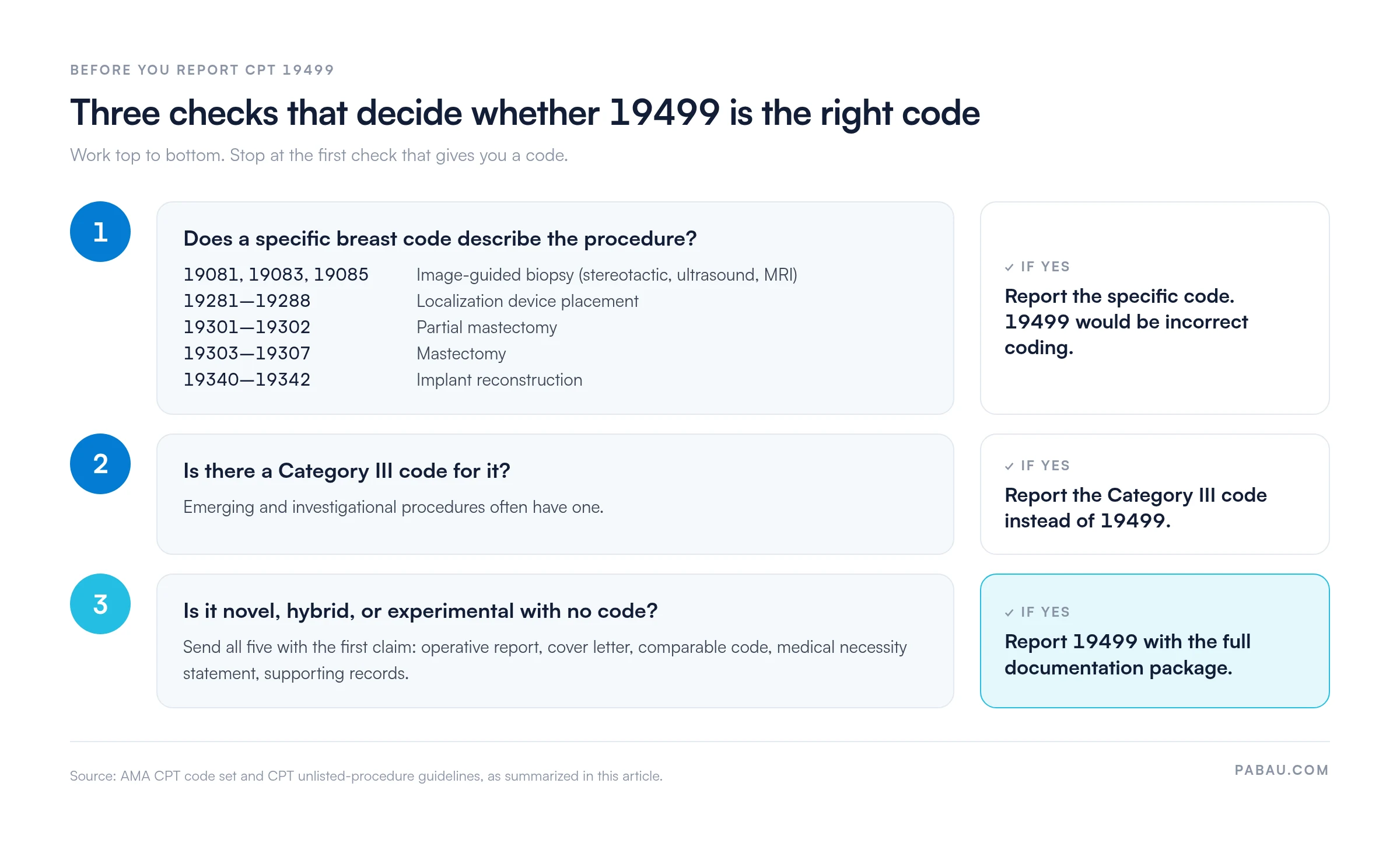
The most common miscoding picks 19499 for an image-guided biopsy. An ultrasound-guided breast biopsy, for example, belongs under 19083. This table shows the codes most often confused with 19499 and what separates each one.
The operative report settles the choice. If the technique matches any existing descriptor, the specific code is mandatory. 19499 becomes appropriate only when the operative report describes a procedure with no matching code.
AMA CPT guidelines require a special report, also called a cover letter, whenever an unlisted code is submitted. Without it, the payer has nothing to price the claim against. A clean claim is the minimum bar for any submission, and a 19499 claim needs considerably more.
Every 19499 claim package must include:
A missing element is the most common cause of a 19499 denial. Sending all five with the first submission spares you the round trip of a request for more information.
Attach the operative report and cover letter as a single PDF with the claim, not as a fax sent separately. Separate submissions often reach the reviewer after the claim is adjudicated, so it gets assessed with incomplete information.
A cover letter that works includes six elements. Payers use them to price the claim against the comparable code, so leaving one out usually triggers a records request or a denial.
Payers compare the submitted procedure against the comparable code’s RVUs, looking for proportionality. If you cite partial mastectomy code 19301, the letter has to show how your procedure went beyond it. A procedure described as substantially more complex than the comparator supports a higher payment. One that sounds identical to the comparator raises upcoding questions.
Most commercial payers require prior authorization (PA) for unlisted procedure codes. Many deny a 19499 claim outright if PA was not obtained before the procedure. Requirements vary by payer and plan year, so check with each carrier before scheduling the case.
The typical PA workflow for an unlisted breast procedure follows these steps:
If PA is denied, the appeal mirrors a claim appeal. Submit peer-reviewed literature supporting the procedure’s clinical necessity and a letter from the treating physician. Add any applicable clinical guidelines from the American Society of Breast Surgeons (ASBrS).
Medicare does not publish a national fee schedule RVU for CPT code 19499. The CMS Physician Fee Schedule assigns no work, practice expense, or malpractice RVU to unlisted codes. Each Medicare Administrative Contractor (MAC) sets payment through carrier judgment, using the documentation and the comparable code as pricing anchors.
So two surgeons performing the same novel procedure can be paid different amounts by different MACs. The strength of the comparable-code argument in the cover letter is the main variable the MAC reviewer uses to set payment. Look up the comparable code’s RVUs in the CMS Physician Fee Schedule lookup, since that value anchors the MAC’s pricing decision.
Commercial payers price 19499 in different ways. Some pay the comparable code’s contracted rate. Others pay a percentage of billed charges, and a few cap payment at a fixed dollar amount regardless of complexity. Confirm the payment method before you submit, so the electronic remittance advice holds no surprises.
Several CPT modifiers can be appended to CPT code 19499 when the clinical circumstances warrant them. Each modifier needs its own documentation trigger in the operative report. The AAPC CPT coding reference sets out modifier criteria and when each one applies.
Modifier 22 draws extra scrutiny on unlisted code claims. The comparable code already sets the base value of 19499, so modifier 22 signals that the procedure exceeded even that reference. The documentation burden rises with it. Many payers want a written explanation of how the complexity differed from the comparable code, on top of the standard cover letter.
CPT code 19499 claims are denied more often than named-code claims. AMA CPT guidelines call for a special report with every unlisted code, and payers review each such claim individually before pricing it. The most frequent denial causes fall into six categories:
A denied 19499 claim can still be paid. Most payers have a formal appeal process, and unlisted-code denials are often overturned when the appeal carries stronger documentation than the first submission. Start from the reason code on the remittance, and match it against the top CARC codes and their fixes.
Manual 19499 workflows break in predictable places. A cover letter gets left off or a PA number is never keyed in. Sometimes the operative report stays in the chart instead of the claim package.
Pabau, the practice management and billing platform we build, covers the claim side of that work. Its medical claims management tools pull patient, treatment, and insurer details from the patient record into a pre-filled claim. Before the claim can go out, Pabau checks that required details such as membership and authorization numbers are present. A missing authorization number gets caught at your desk, not on a remittance weeks later.
The cover letter and operative report stay with your team. Pabau does not write or assemble them, so build them into your 19499 routine before the claim is created.
For US practices, Pabau sends electronic CMS-1500 claims through the Claim.MD clearinghouse. Claim status updates and electronic remittance advice flow back into Pabau. Your billing team sees which 19499 claims were paid and which need an appeal, without logging into a separate portal.
Build a 19499 pre-submission checklist as a standing task in your practice management system. Confirm the operative report, cover letter, comparable code, PA number, and NCCI check on every unlisted breast procedure claim before it is sent.

Pabau pre-fills each claim from the patient record and holds it until details like authorization numbers are in. US claims then go out and are tracked through Claim.MD.

Treat 19499 as a coding decision you have to defend on paper. Rule out the specific breast codes and any Category III code first. Then build the claim around one comparable code, and price your argument against its RVUs.
The trade-off is time. A 19499 claim takes longer to prepare and longer to pay than a named code. Reserve it for procedures where the operative report leaves no closer match.
Your team writes the cover letter and assembles the operative report, and software can keep the claim itself complete. Book a demo to see how Pabau pre-fills claims and catches a missing authorization number before a 19499 claim is sent.

Need a framework for managing claim denials systematically? Denial management in healthcare walks through the denial prevention and appeals process for surgical billing teams.
Want to understand how clearinghouse claims processing works? Medical claims clearinghouse guide explains how 837P submissions are validated and routed to payers.
Looking for guidance on superbill construction for complex surgical claims? Superbill documentation guide covers what belongs on a superbill for unlisted and complex procedure codes.
CPT code 19499 is the unlisted breast procedure code, with the official AMA descriptor “Unlisted procedure, breast.” Coders use it when no specific code in the 19000-19499 Breast subsection describes the service. Every claim needs a cover letter citing a comparable CPT code and a detailed operative report.
Use 19499 only when the procedure is novel, experimental, or a hybrid that no specific breast code describes. Check for a Category III code first. If a named code applies, even partially, use that code. Submitting 19499 when a specific code exists is incorrect coding.
Yes, Medicare can reimburse CPT 19499, but there is no national fee schedule RVU for the code. Each Medicare Administrative Contractor (MAC) prices claims individually, using carrier judgment based on the documentation and the comparable code cited. Reimbursement amounts therefore vary by MAC jurisdiction.
Choose the specific CPT code whose descriptor most closely resembles the procedure you performed, even if it does not match exactly. For an oncoplastic procedure close to a lumpectomy, for example, cite 19301 or 19302. The cover letter must then explain how your procedure differed from that comparator and why the specific code does not fully apply.
CPT 19083 is the specific code for percutaneous breast biopsy with ultrasound guidance, first lesion. CPT 19499 is the unlisted code for breast procedures with no specific code. If an ultrasound-guided biopsy was performed, 19083 is the correct code. Using 19499 in place of 19083 is a coding error regardless of the circumstances.
Modifier 22 (increased procedural services) may be appended when the procedure was substantially more complex than the comparable code suggests, supported by the operative note. Modifier 50 applies for bilateral procedures, modifier 51 for multiple procedures on the same date, and modifiers 80 or 82 for assistant surgeons. Confirm each modifier with the specific payer before submission.



