

CCSD code G5100: Bypass of duodenum billing guide
CCSD code G5100 bills a bypass that leaves the duodenum in place CCSD code G5100...

Last Updated: Oct 16, 2026
92502 is the CPT code for otolaryngologic examination under general anesthesia. It covers an ear, nose and throat exam for a patient who cannot tolerate one awake, most often a young child.
The anesthesia provider bills the anesthesia separately under CPT 00124. Binocular microscopy (92504) and cerumen or foreign body removal are also reported separately when performed and documented. Most denials trace back to a missing note on why general anesthesia was needed, or an incorrect place-of-service code.
Let Pabau's smart automation suggest the right codes, reduce claim denials, and keep your practice compliant—effortlessly.
Automate repetitive tasks and focus on what matters most—your patients.
Reduce coding errors and ensure compliance with the latest regulations.
Clean claims, fewer denials, and faster reimbursements.
Powerful insights and reporting to help your practice thrive.
HIPAA compliant SOC 2 certified GDPR-compliant Trusted by 4,000+ clinics worldwide

CPT 92502 is an ear, nose and throat examination under general anesthesia, reported when the patient cannot tolerate an awake exam.
The anesthesia provider bills separately under CPT 00124, anesthesia for procedures on the external, middle, or inner ear, including otoscopy.
Laterality reporting is payer-dependent. Some payers want LT or RT for a one-sided exam, so confirm the rule with your MAC.
CMS values 92502 at 2.59 total RVUs for 2026, about $86.51 nationally at the non-QP conversion factor.
Pabau’s claims management software submits claims through Claim.MD and tracks their status after submission.
CPT Code 92502 describes an otolaryngologic examination under general anesthesia. It is used when a patient cannot cooperate with an awake ear, nose and throat exam. The American Medical Association (AMA), which maintains the CPT code set, places 92502 in Special Otorhinolaryngologic Services (CPT range 92502-92700).
The exam takes place under general anesthesia, usually in an operating room or procedure suite. Payers scrutinize it closely because general anesthesia adds cost and risk, and the medical record must justify both.
The one-line CPT descriptor does not list the anatomy examined. In practice, the examination typically includes:
Knowing what 92502 does and does not cover is the fastest way to prevent bundling denials. The code covers the examination itself. Other ear procedures performed under the same anesthesia are reported with their own codes.
CPT 92504 (binocular microscopy) is the code most often confused with 92502. The two describe distinct services and can appear on the same date when both are performed and documented separately.
Check the current NCCI PTP table for the 92502 and 92504 pair before submitting. Append modifier 59 (or XS or XU) only where an edit exists and the microscopy was a distinct service. The operative note must show the binocular microscopy as separate from the comprehensive examination.
Medical necessity for 92502 rests on showing that the examination could not reasonably be done without general anesthesia. Payers applying Local Coverage Determination (LCD) criteria look for documented, patient-specific barriers to an awake exam.
Common qualifying scenarios include:
Each scenario must be linked to the preoperative diagnosis in the operative note. Writing only “patient uncooperative” without a clinical rationale is a common reason payers deny 92502 on audit.
Document the reason for general anesthesia in its own paragraph of the preoperative note, rather than burying it in the history of present illness. Auditors look for one explicit sentence explaining why a standard office exam was not feasible for this patient on this date.
The CPT descriptor for 92502 does not specify laterality, and CMS assigns the code bilateral surgery indicator 0. Modifier 50 therefore earns no bilateral payment adjustment on this code.
Laterality modifiers are payer-dependent. Some payers want LT or RT on the claim line when only one ear is examined, while others accept the code without one. Confirm your MAC’s or commercial payer’s policy before submitting.
The table below covers the modifiers most often applied to 92502 claims, with guidance on when each one fits.
Solid medical billing compliance for 92502 depends on a complete operative record. Payer auditors look for these elements specifically:
Anesthesia-assisted codes carry a heavier documentation burden than standard office procedures. A generic operative template that skips the anesthesia rationale is a leading audit failure point for 92502 claims.
Medicare covers 92502 when medical necessity is established and the exam takes place in a facility setting. The anesthesia provider bills the anesthesia service separately under CPT 00124. That code covers anesthesia for procedures on the external, middle, or inner ear, including otoscopy, and it is not part of the 92502 payment.
The national figures below come from the CMS 2026 relative value files (October update). Multiply the 2.59 total RVUs by the 2026 conversion factor that applies to you to reach the national rate.
CMS marks the non-facility practice expense for 92502 as NA, meaning the service is rarely or never performed in an office. The exam is performed in a facility setting, such as a hospital outpatient department or an ambulatory surgery center. The code carries a 000 global period.
Rates vary by MAC locality, so use the CMS Physician Fee Schedule lookup tool for your adjusted rate. Medicaid and commercial payer rates differ, so check each payer’s own fee schedule.
ENT encounters under general anesthesia often include more than the examination. The codes below can appear on the same claim as 92502 when each service is separately documented. The surgeon and the anesthesia provider each submit their own lines, as the map below shows.
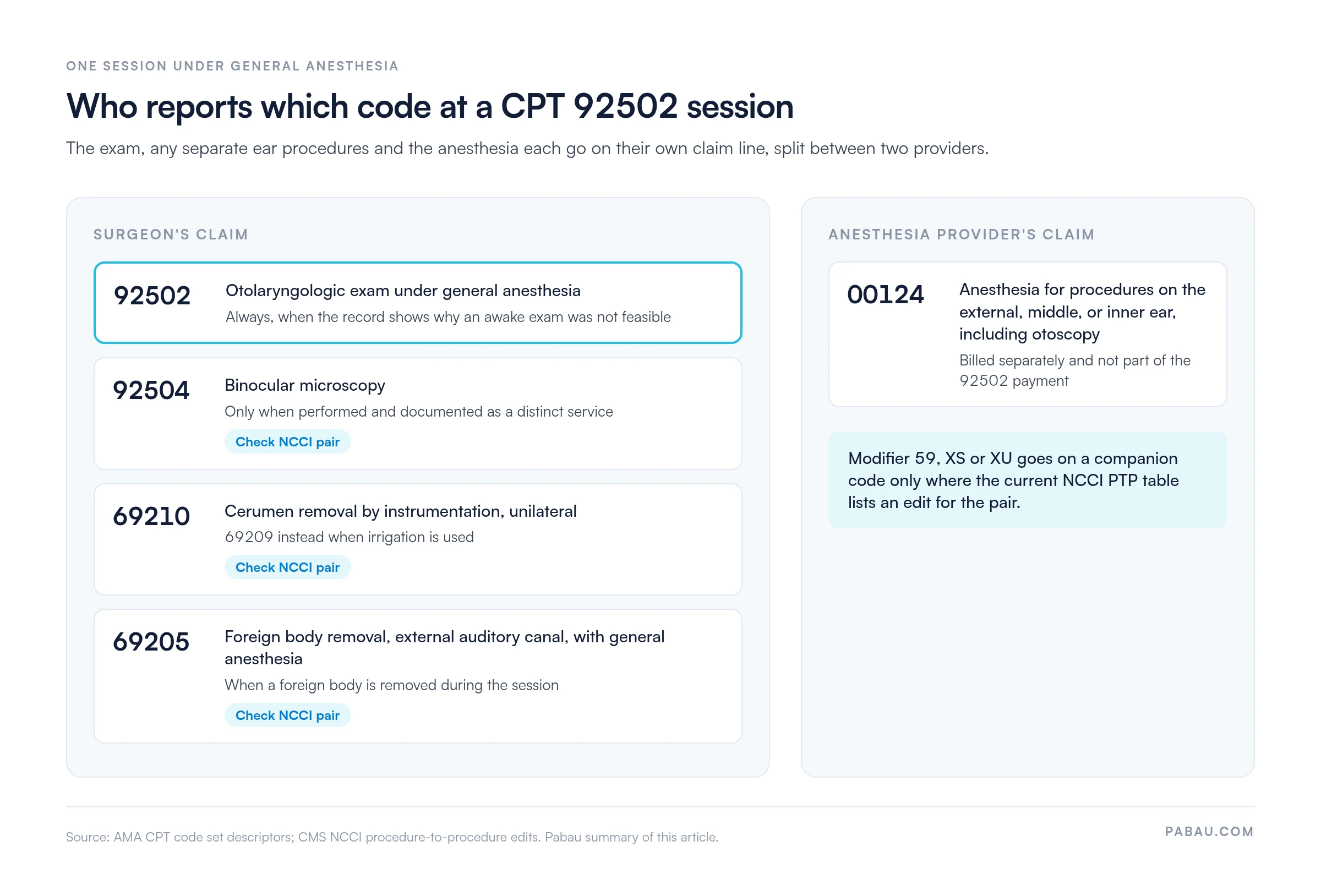
Check the CMS NCCI PTP edits before submitting a multi-code claim, because each pair’s modifier indicator decides whether a modifier can override it. CMS updates the tables every quarter, so a pairing that allowed an override last quarter can change.
Cerumen removal carries its own unit and documentation rules, which the CPT 69210 guide covers in detail.
Effective denial management workflows for ENT practices start with knowing which failure patterns recur on 92502 claims. Understanding medical billing denial codes helps billing staff respond faster and fix root causes upstream.
Payers use diagnosis-procedure pairing in pre-payment edits. The ICD-10-CM codes below are common diagnoses supporting medical necessity for an otolaryngologic examination under anesthesia. Each must be fully documented in the preoperative assessment.
A clean claim submission depends on the diagnosis matching the documented reason for anesthesia. A superbill that pre-maps approved diagnosis codes to 92502 reduces selection errors at charge entry.
Where the record names the ear, code the side instead, such as T16.1XXA for the right ear or T16.2XXA for the left. Verify each diagnosis code against your MAC’s current LCD before use, because some contractors restrict which codes support anesthesia-assisted ENT exams.
Build a pre-approved ICD-10-to-92502 crosswalk into your superbill and charge-entry workflow. When the ENT physician selects 92502, the system should prompt for an approved diagnosis code instead of allowing free text. That one change cuts ICD-10 mismatch denials at the source.
Many ENT practices keep the operative note in one system and build the claim in another. The anesthesia rationale then gets retyped or chased by hand before the claim goes out.
Pabau, the practice management platform we build, keeps clinical notes and billing in the same patient record. Its claims management software submits claims through Claim.MD and tracks their status after submission.
Your billing team checks the note, the diagnosis and the claim status in one place. When a payer rejects a 92502 claim, the documentation needed for the appeal is already on file.

Pabau keeps operative notes and billing in one patient record, then submits claims through Claim.MD and tracks their status. Your team can follow up on a 92502 denial without switching systems.

Treat 92502 as a documentation code first. A preoperative note with a dedicated medical necessity paragraph protects the exam claim and the anesthesia provider’s 00124 claim at the same time.
Then make the NCCI check a habit for every companion code, because edit status changes quarterly. Report the place of service where anesthesia was given, and check each payer’s laterality policy before adding LT or RT.
Book a demo to see how Pabau keeps your ENT operative notes and 92502 claims in one place, from submission to status tracking.

Need help managing claim denials across your ENT practice? Denial management in healthcare covers the workflows, appeal strategies, and reporting systems that reduce denial rates at the practice level.
Billing binocular microscopy on the same date? CPT code 92504 explains when ear microscopy is reported on its own and how to document it.
Want to understand how clearinghouse submission works for ENT codes? Medical claims clearinghouse explained breaks down how 837P files and ERA remittances connect your practice to payers.
Building a charge-entry form for ENT procedures? How to create a superbill walks through the fields a superbill needs so diagnosis and procedure codes stay paired.
Looking to streamline ENT billing compliance documentation? Medical billing compliance outlines the documentation standards and internal audit steps that protect practices during payer audits.
CPT Code 92502 is an otolaryngologic examination under general anesthesia. It typically includes the ear canals, tympanic membranes, nasal passages, nasopharynx and larynx when the patient cannot cooperate with an awake exam. It is most often used for uncooperative children, suspected foreign bodies, cholesteatoma evaluation, or complex chronic ear disease.
The CPT descriptor for 92502 does not specify laterality, and CMS allows no bilateral payment adjustment, so modifier 50 does not apply. Laterality reporting is payer-dependent. Some payers want LT or RT for a one-sided exam, so confirm the rule with your MAC.
Generally, yes. CPT 69210 (cerumen removal by instrumentation) and CPT 69209 (removal by irrigation) can be billed on the same date as 92502 when performed and documented. Verify the current NCCI edit status for each pair first, as CMS updates the tables quarterly.
The top denial reason is a missing explanation of why general anesthesia was required. Another is the wrong place-of-service code, such as POS 11 instead of the facility code. Others include companion codes billed against an active NCCI edit without a supported modifier, and ICD-10 codes that miss the payer’s LCD criteria.



