

CCSD code G5100: Bypass of duodenum billing guide
CCSD code G5100 bills a bypass that leaves the duodenum in place CCSD code G5100...

Last Updated: Oct 16, 2026
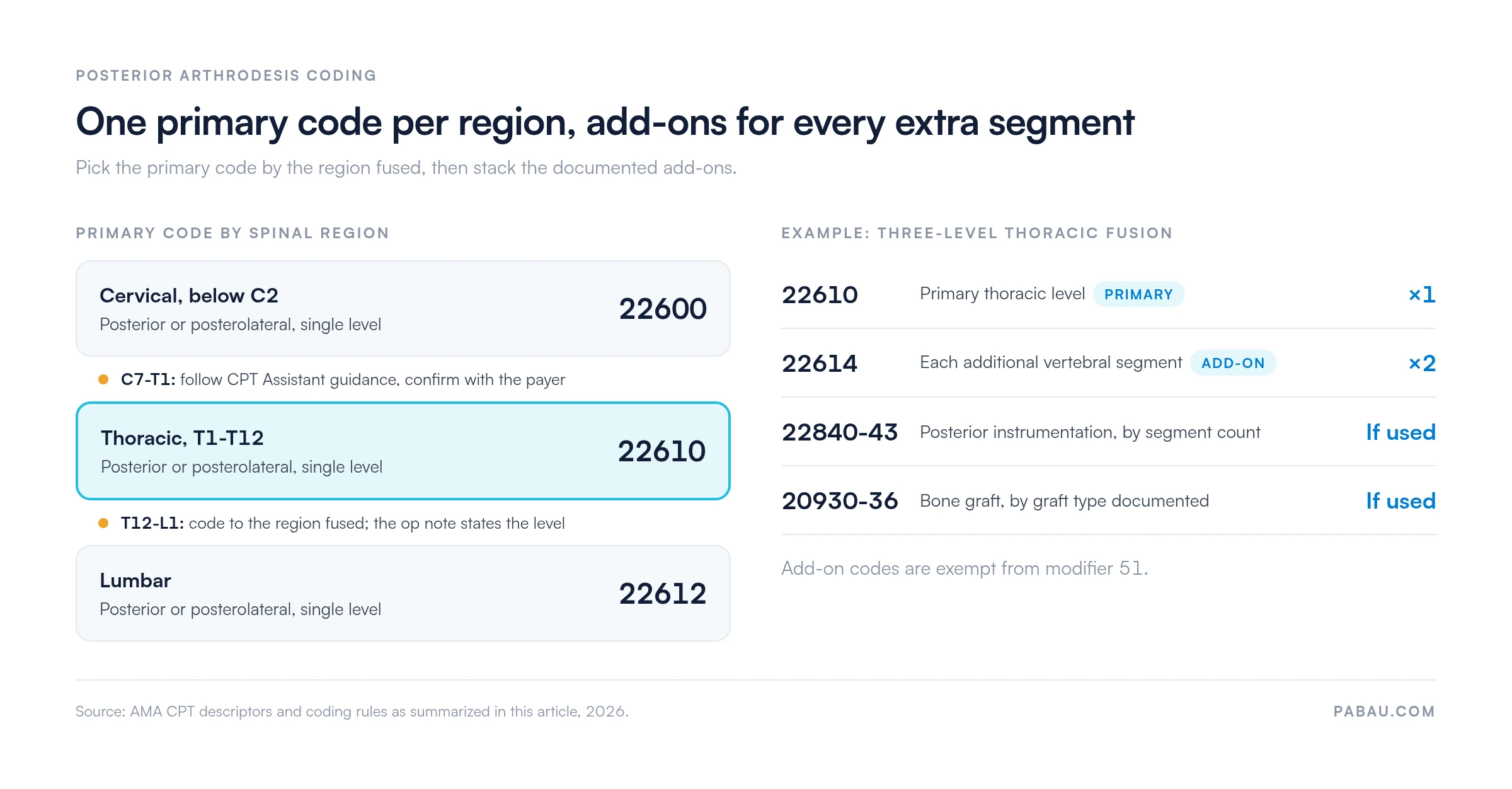
22610 is the CPT code for arthrodesis, posterior or posterolateral technique, single level; thoracic. It reports a posterior fusion at one thoracic level, T1 through T12, and each additional vertebral segment is added with 22614.
The thoracic code sits between its neighbors, numerically and anatomically. Cervical fusion below C2 is 22600, before it, and lumbar fusion is 22612, after it. At the T12-L1 junction, the operative note must state the level fused so the claim carries the right code.
Let Pabau's smart automation suggest the right codes, reduce claim denials, and keep your practice compliant—effortlessly.
Automate repetitive tasks and focus on what matters most—your patients.
Reduce coding errors and ensure compliance with the latest regulations.
Clean claims, fewer denials, and faster reimbursements.
Powerful insights and reporting to help your practice thrive.
HIPAA compliant SOC 2 certified GDPR-compliant Trusted by 4,000+ clinics worldwide

CPT Code 22610 reports posterior or posterolateral arthrodesis of one thoracic level, while cervical levels below C2 take 22600 and lumbar levels take 22612.
Add-on codes 22614, 22840, 22842 and the spine bone graft codes are reported alongside 22610 when the operative note documents them.
The operative report must name the vertebral level fused, the approach, the bone graft type and any instrumentation to support medical necessity.
Pabau, our practice management software, submits 22610 claims through Claim.MD and brings ERA/835 remittances back against each claim.
CPT Code 22610 describes arthrodesis, posterior or posterolateral technique, single level, thoracic. The AMA CPT code set places it in the Musculoskeletal System section under Spine (Vertebral Column), Arthrodesis. It is a primary procedure code, not an add-on. Moreover, it counts one level, however many vertebrae are technically involved in fusing that level.
The official descriptor covers a posterior or posterolateral technique at a single thoracic level, with lateral transverse technique when performed. However, no interbody component is part of the base descriptor. Instead, add-on 22853 covers an interbody device placed in conjunction with interbody arthrodesis. It is therefore reported with an interbody arthrodesis code such as 22633, never with posterior-only 22610.
The thoracic spine runs from T1 through T12. Therefore, CPT Code 22610 is appropriate when the arthrodesis level falls entirely within that range. Common indications include deformity correction (scoliosis, kyphosis), fracture stabilization, neoplasm resection, and degenerative disease at mid-thoracic levels.
Cervical fusion below C2 is reported with 22600, not 22610. For example, a C7-T1 fusion crosses the cervicothoracic junction, so report it per CPT and CPT Assistant guidance and verify with the payer before submission.
22610 covers only the single-level posterior arthrodesis itself. In addition, instrumentation, additional levels, bone graft procurement, and interbody devices are all separately billable add-ons when documented in the operative note. Also, do not apply modifier -51 to any of these, because CPT exempts add-on codes from it.
22614 is a frequently missed add-on. When the surgeon fuses three thoracic levels, report 22610 once for the primary level and 22614 twice for the two additional levels. As a result, a claim that carries 22610 alone understates the work performed and leaves the additional levels unpaid.
The posterior arthrodesis codes form a series by spinal region. Cervical fusion below C2 takes 22600, and lumbar fusion takes 22612, with 22610 between them. Consequently, picking the wrong region is a frequent cause of thoracic fusion denials, usually because the operative note never states the exact level.
The thoracolumbar junction, T12-L1, is where region selection needs the most care. A single-level thoracolumbar fusion is coded per CPT guidance to the region where the fusion is performed. Only one primary code applies to that level. Therefore, the surgeon must state the level fused in the operative note. Otherwise, the coder is choosing between 22610 and 22612 blind, and an auditor can question either choice. The diagram below shows how the region and the segment count build the claim.
Every 22610 claim requires a covered ICD-10-CM diagnosis. Coverage criteria vary by Medicare Administrative Contractor (MAC) jurisdiction and by commercial payer LCD. The diagnoses below are widely accepted, but you should still always verify against the current MAC LCD for your region.
Non-specific pain codes (M54.6 for thoracic pain) without a structural correlate consistently trigger denials. Instead, payers require imaging evidence of the underlying condition and documentation of failed conservative therapy before approving elective thoracic fusion.
Modifier selection errors on CPT Code 22610 are a recurring audit trigger, particularly for co-surgery cases involving two attending spine surgeons.
For -62 co-surgery, check the co-surgery indicator for 22610 in the current MPFS file before submitting. Co-surgery is payable only where the indicator is 1 or 2, with documentation supporting both surgeons’ roles. Also, the indicator can change with the annual MPFS update.
Flag every 22610 claim where two surgeons are listed in the operative report before submission. A missing -62 on one surgeon’s claim triggers a duplicate-billing audit flag even if the other surgeon’s claim is correct. Run a pre-submission check against the co-surgery indicator in the current CMS fee schedule file.
CPT Code 22610 is predominantly billed in a facility setting (hospital inpatient or outpatient surgery center). As a result, Medicare pays the surgeon the facility rate in those settings. Moreover, the CMS Physician Fee Schedule lookup tool publishes current-year rates by locality. Pull the rate for the MAC jurisdiction where the procedure was performed.
CPT Code 22610 carries about 16.85 work RVUs (wRVU) in the 2026 MPFS, so verify the figure in the current file. In addition, the value reflects the physician work of a major spinal fusion and changes with each annual MPFS final rule. For that reason, use the current-year value, not a prior-year figure, when you model contract rates.
CPT Code 22610 carries a 90-day global surgery period, consistent with other major spinal procedures. Therefore, during those 90 days, routine post-operative evaluation and management visits are bundled into the procedure payment and cannot be billed separately.
Most commercial payers and Medicare Advantage plans require prior authorization for elective thoracic spinal fusion. However, traditional Medicare fee-for-service does not require prior auth for 22610. Still, MAC LCDs impose coverage criteria that act as a de facto authorization check on audit.
Typical commercial payer prior auth documentation requirements include:
However, an approved authorization does not guarantee coverage. For example, if the procedure as performed differs materially from what was authorized (different approach, additional levels), reauthorization or a post-service review appeal may be necessary. Therefore, accurate coding that matches the authorized procedure is the first line of defense.
The National Correct Coding Initiative (NCCI) defines which codes are bundled with 22610 and which require a modifier to be separately reportable. NCCI edit pairs update quarterly, so you should check the current CMS NCCI edits before submitting complex spine cases. Refer to medical billing compliance best practices for building a quarterly edit review process.
The 22610 + 63046 pair draws close review. First, when the surgeon decompresses at the same level as the fusion, the edit bundles 63046 into 22610. In contrast, when decompression occurs at a distinct level, such as a T8-T9 fusion with a T9-T10 laminectomy, modifier -59 on 63046 signals a distinct procedural service. However, use it only when the NCCI modifier indicator for the pair allows a modifier and the operative note documents both levels.
Thoracic fusion claims denied for “lack of medical necessity” or “insufficient documentation” often trace to operative notes that describe the procedure in generic terms. For that reason, building a surgical superbill documentation checklist for spine cases reduces these denials before submission.
Every CPT Code 22610 operative report must include:
A clean claim for a thoracic fusion starts with the operative note, not the billing form. Moreover, every add-on code you intend to bill needs a corresponding sentence in the report. For instance, billing 22842 without a note describing pedicle screw count and rod placement is a frequent cause of instrumentation add-on reversals on post-payment audit.
CPT Code 22610 claims fail for predictable reasons. Effective denial management workflows address these before they reach the payer.
Payers return each of these denials with CARC and RARC codes. Therefore, decoding each denial code tells you whether the fix is a corrected claim or a documented appeal.
Audit your 22610 claims quarterly against the NCCI edit table for that quarter. A pair that was separately reportable in Q1 may be bundled by Q3 without a modifier. Build a quarterly NCCI review into your spine billing calendar.
A multi-level thoracic fusion produces a claim with several lines, from 22610 and 22614 to instrumentation and graft add-ons. Moreover, keying those lines into a separate clearinghouse portal invites transcription errors and slows payment on a high-value case.
Pabau brings claims management without re-keying into the practice. Each claim is generated from the invoice you already raised. Then it goes out as an electronic CMS-1500 through Claim.MD, Pabau’s US clearinghouse partner, to thousands of US payers.
Claim statuses update from the payer, and ERA/835 remittances come back into Pabau matched to the claims they settle. In addition, denied claims are flagged for rework, so your coder sees which 22610 line was cut and can send the operative note with the appeal.
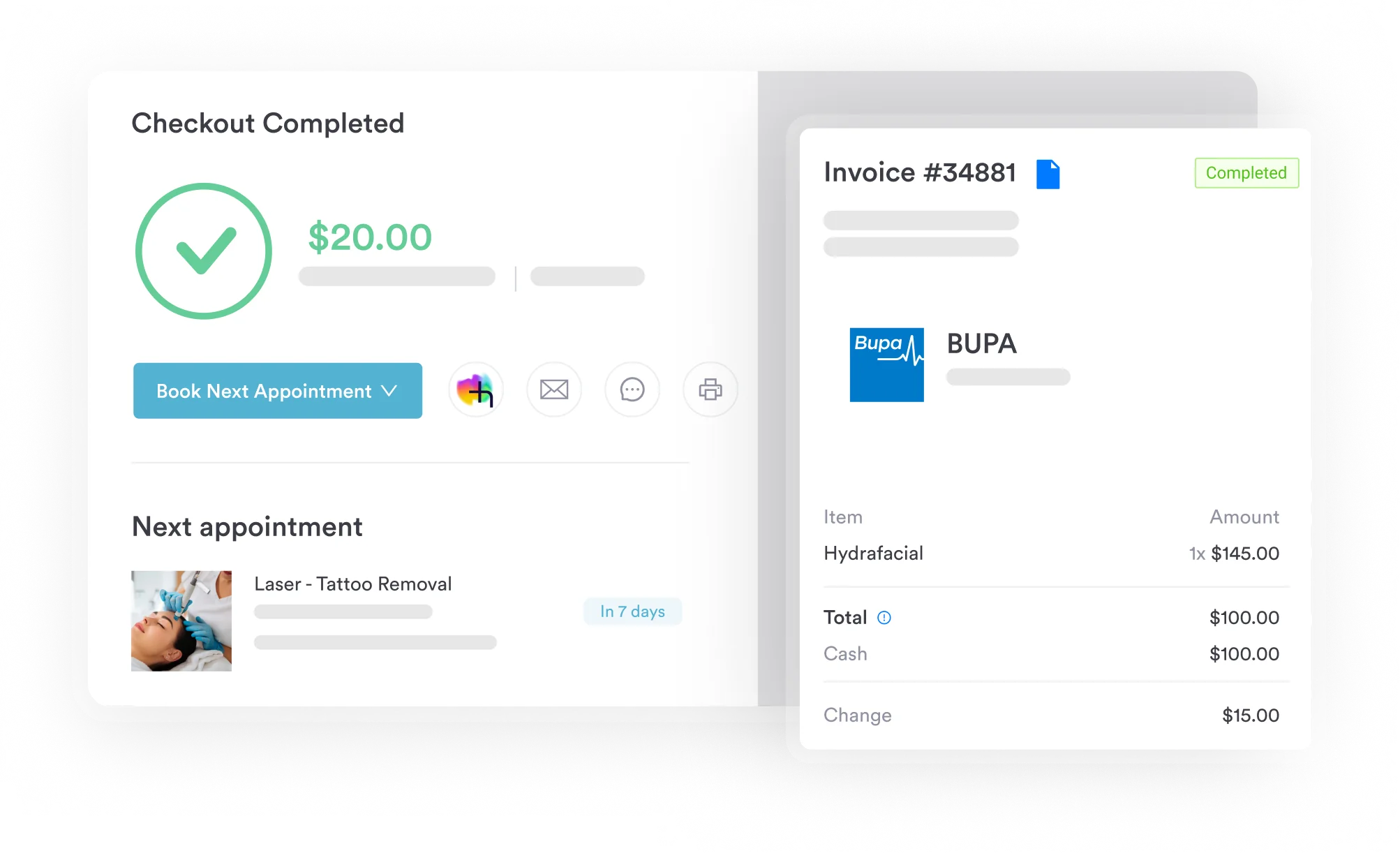

Pabau submits CPT Code 22610 claims through Claim.MD and brings ERA remittances back against each claim. Your team sees every paid, pending and denied fusion line in one dashboard.

Code 22610 from the operative note outward. First, ask the surgeon to name the thoracic level, the technique, the graft and the hardware in plain terms. When the note states the level and the instrumented segment count, the primary code and each add-on line follow from it. As a result, that claim holds up on audit.
The trade-off is a few more minutes of dictation before billing starts. Overall, those sentences cost far less than an appeal on a high-value fusion claim, or a refund after a post-payment review.
Book a demo to see how Pabau submits spine surgery claims through Claim.MD and tracks each remittance back to its claim.

Need to understand how claim submission works end to end? Medical claims clearinghouse guide walks through how claims travel from practice to payer and where errors enter the chain.
Submitting 837P electronic claims for surgical procedures? 837 transaction file reference covers the HIPAA-standard claim file format used for CMS-1500 submissions.
Working through a remittance posting backlog after a denial wave? Electronic remittance advice (ERA) guide explains ERA 835 file structure, CARC denial reason codes, and how to action remittances efficiently.
Billing a pedicle screw construct with the fusion? CPT code 22842 covers posterior segmental instrumentation across 3 to 6 vertebral segments.
Did the surgeon place an interbody cage at a lumbar level? CPT code 22633 explains combined posterior and interbody lumbar arthrodesis.
CPT Code 22610 reports posterior or posterolateral arthrodesis of a single thoracic level, with lateral transverse technique when performed. It covers fusion at T1-T12 for deformity correction, fracture stabilization, neoplasm resection and degenerative disease. Cervical fusion below C2 is reported with 22600, and lumbar fusion with 22612.
The Medicare facility payment rate for CPT Code 22610 changes each year with the Medicare Physician Fee Schedule final rule. Pull the current rate from the CMS fee schedule lookup tool using your MAC locality, because rates vary by geographic practice cost index. The 2026 MPFS assigns 22610 about 16.85 work RVUs, so verify the value in the current file.
CPT Code 22610 carries a 90-day global surgery period. Routine post-operative visits within those 90 days are bundled into the procedure payment and cannot be billed separately. E/M services for an unrelated problem during the global period require modifier -24; return to the OR for a complication requires modifier -78.
Commonly accepted diagnosis codes include thoracic kyphosis (M40.204), thoracic spondylosis (M47.814) and thoracic spinal stenosis (M48.04). Thoracic vertebral fracture (S22.0-, 7th character required) and thoracic idiopathic scoliosis (M41.24) also qualify. Payer LCDs vary by MAC jurisdiction. Non-specific thoracic pain codes without a structural correlate consistently trigger medical necessity denials.



