HCPCS Code V5095: Semi-implantable middle ear hearing prosthesis
HCPCS Code V5095: Definition and clinical descriptor HCPCS Code V5095 is the Lev...

Last Updated: Nov 25, 2026
86832 is the CPT code for a high definition qualitative panel that identifies antibodies to HLA Class I antigens. Labs usually run it as a single antigen bead assay. Each bead carries one antigen, so the lab can name every Class I specificity in the serum.
Transplant programs use it to assess sensitization and donor-specific antibodies, and hematology teams use it for platelet refractoriness. CPT 86833 reports the same assay for HLA Class II. Medicare pays 86832 under the Clinical Laboratory Fee Schedule, with a 2026 national limit of $323.75.
Let Pabau's smart automation suggest the right codes, reduce claim denials, and keep your practice compliant—effortlessly.
Automate repetitive tasks and focus on what matters most—your patients.
Reduce coding errors and ensure compliance with the latest regulations.
Clean claims, fewer denials, and faster reimbursements.
Powerful insights and reporting to help your practice thrive.
HIPAA compliant SOC 2 certified GDPR-compliant Trusted by 4,000+ clinics worldwide

CPT code 86832 reports a high definition qualitative panel, such as single antigen beads, that identifies antibodies to HLA Class I antigens.
CPT 86833 is the same assay for HLA Class II, not an add-on for a second panel.
Medicare pays 86832 under the Clinical Laboratory Fee Schedule, with a 2026 national limit of $323.75.
HLA testing for transplant histocompatibility counts as an organ acquisition cost, so it is usually not billed as a separate Part B claim.
Red cell antibody identification is CPT 86870, and typing the patient’s own HLA antigens uses 86812-86817.
CPT code 86832 reports a high definition qualitative panel that identifies antibodies to HLA Class I antigens with a solid phase assay. The descriptor below matches the CMS 2026 Clinical Laboratory Fee Schedule file, which also sets the Medicare payment for the code.
Antibody to human leukocyte antigens (HLA), solid phase assays (eg, microspheres or beads, ELISA, flow cytometry); high definition qualitative panel for identification of antibody specificities (eg, individual antigen per bead methodology), HLA Class I
CPT 86832 descriptor, as listed in the CMS 2026 Clinical Laboratory Fee Schedule file.
In practice, the lab mixes patient serum with beads that each carry one HLA Class I antigen. A flow-based analyzer reads which beads the antibodies bind to. The report lists every HLA-A, HLA-B and HLA-C specificity the serum reacts to.
That one-antigen-per-bead design is what “high definition” means in the descriptor. A phenotype panel (86830) uses targets that carry a full set of antigens, so it narrows the possibilities without isolating each specificity.
The eight codes in this family split on two questions. Which HLA class did the lab test, and how precisely did it identify the antibodies? Answer both and only one code fits.
A common lab sequence starts with a screen (86828 or 86829) and moves to identification only when the screen is positive. When the lab runs single antigen beads for both classes, the claim carries 86832 and 86833. A titer or dilution series moves the claim to 86834 or 86835 instead. The grid below lays out all eight codes by class and method.
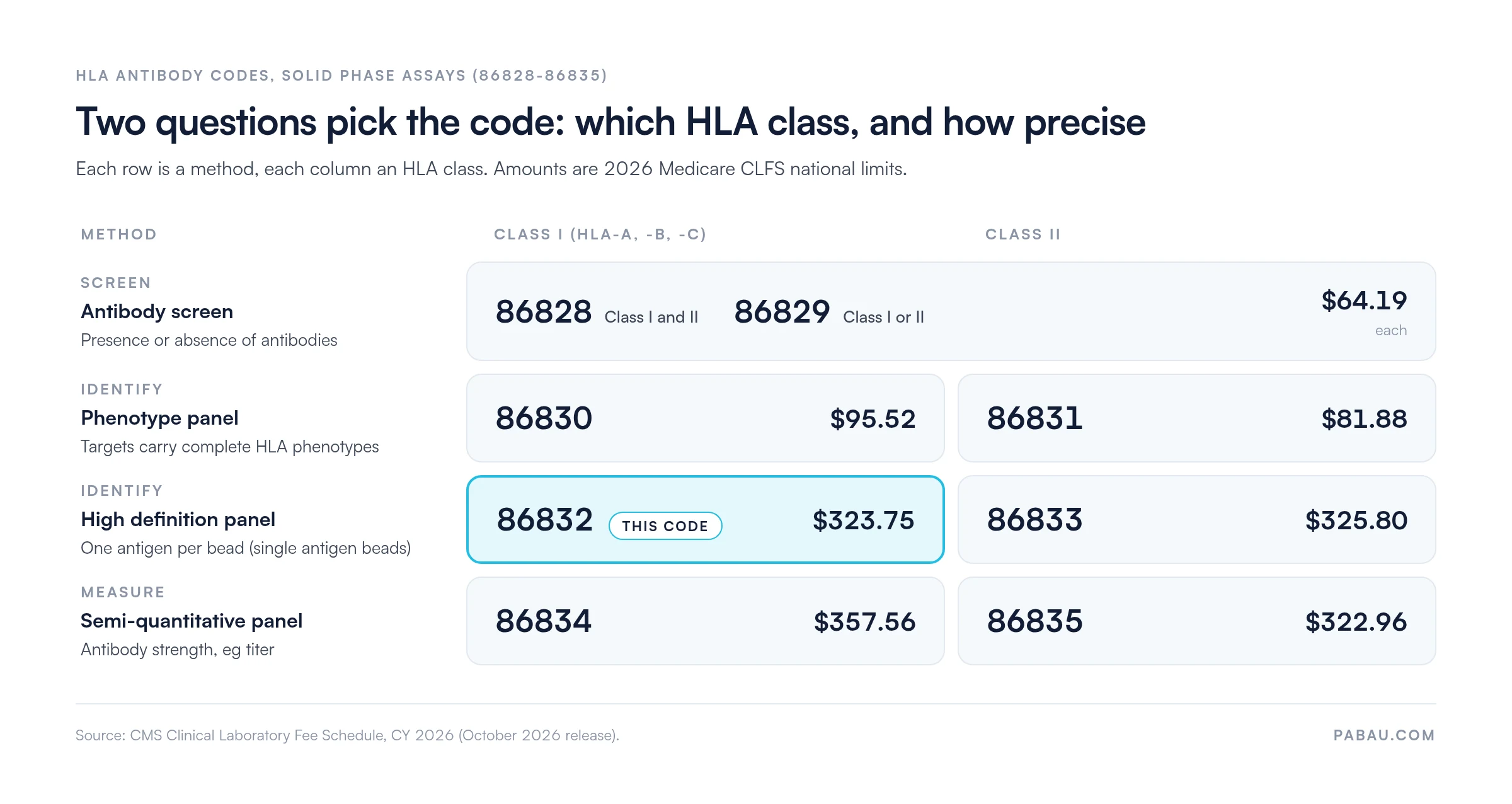
Each indication below turns on HLA Class I antibodies specifically. That is why the class matters on the order as much as on the claim.
The last indication has a coding consequence. Platelets carry HLA Class I antigens but not Class II, so a refractoriness workup usually needs 86832 alone. Adding 86833 to that claim invites a medical necessity question. Once the specificities are known, the blood bank can supply HLA-matched apheresis platelets, billed as P9052.
Most coding errors on 86832 come from neighboring codes with similar wording. The table shows what separates each one. For codes outside the HLA family, start from the CPT code billing guides.
Some charge masters still map 86832 to red cell antibody identification. That mapping is wrong. A red cell antibody panel belongs on 86870, reported for each panel and each serum technique.
Medicare pays 86832 under the Clinical Laboratory Fee Schedule (CLFS), not the Physician Fee Schedule. The 2026 national limit is $323.75, effective January 1, 2026. No RVUs or geographic adjustments apply to the code.
When 86832 supports a transplant, Medicare usually pays for it through a different channel. Under 42 CFR 413.402, tissue typing and recipient evaluation count as organ acquisition costs. Transplant hospitals report those costs on the Medicare cost report.
Noridian’s billing article A57970 applies that rule in the JE and JF jurisdictions. It denies claims for HLA testing used for transplant histocompatibility. The article excludes HLA testing for non-transplant services, which is where a platelet refractoriness workup sits.
Outside those jurisdictions, confirm the routing with your MAC and the transplant program before anyone files a claim. Post-transplant monitoring falls outside the acquisition period, so ask how your MAC handles it.
The diagnosis on an 86832 claim should explain why HLA Class I antibodies matter for this patient. The pairings below are illustrative, not a coverage list. Confirm each code in the CDC ICD-10-CM browser and against the payer’s policy.
Use D69.6 for a refractoriness workup only when the record documents the transfusion history behind it. For a kidney recipient, T86.11 belongs on the claim once rejection is documented, while scheduled monitoring stays on Z94.0.
The record has to show which assay ran, which HLA class it tested, and why. These elements cover all three.
Most denials and audit findings on 86832 trace back to code identity rather than paperwork. The table lists the errors worth checking first.
The histocompatibility lab bills 86832, but the ordering practice owns the context around it. That covers the indication, the sensitizing history, the result and the follow-up visit.
Pabau, a practice management and billing platform, keeps those pieces on the patient record. US practices that order through Quest send the order from that record, and results import automatically. Digital forms capture transfusion, pregnancy and transplant history before the visit.
For the practice’s own services, Pabau’s denial-tracking claims management sends CMS-1500 claims through Claim.MD. It runs eligibility checks before the visit and posts ERA remittances back, so each denial lands on the visit that caused it.
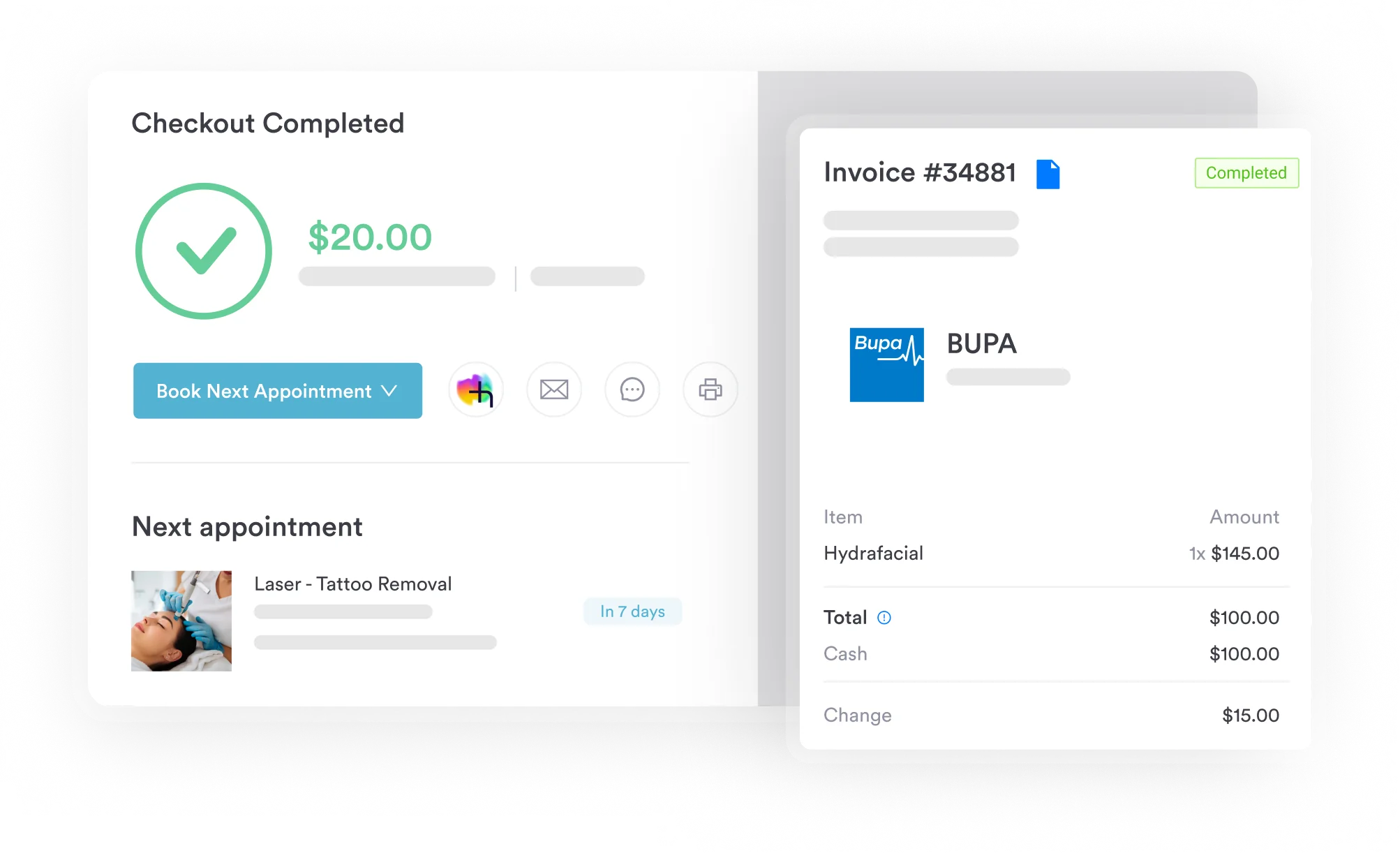

Pabau ties lab orders, history forms and Claim.MD claims to the patient record. Your team sees the indication, the result and the remittance in one place.

Let the assay the lab ran choose the code. Single antigen beads for Class I mean 86832, and Class II beads mean 86833. A red cell antibody panel was never either one.
Then check where the payment comes from. A transplant workup usually rides on organ acquisition costs. A platelet refractoriness workup is an ordinary CLFS claim, paid at up to $323.75 in 2026.
Book a demo to see how Pabau keeps lab orders, results and claims on the record that explains them.

Need a full reference on what goes wrong at the clearinghouse? Medical claims clearinghouse guide explains how 837P claims are validated and what happens when an edit fires before adjudication.
Trying to understand what your ERA is telling you? Electronic remittance advice (ERA) explained breaks down 835 remittance files, CARC codes, and how to read a denial reason at scale.
Building a denial prevention program for lab billing? Best medical billing software for US practices covers what to look for in a lab billing platform, including clearinghouse integration and built-in code validation.
CPT code 86832 describes a high definition qualitative panel that identifies antibodies to HLA Class I antigens with a solid phase assay. Single antigen bead testing is the typical method. The report names each HLA-A, HLA-B and HLA-C specificity the serum reacts to.
86832 covers HLA Class I and 86833 covers HLA Class II, using the same high definition method. 86833 is not an add-on for extra panels. When the lab tests both classes, the claim carries both codes.
Yes. When the test is reasonable and necessary, Medicare pays it under the Clinical Laboratory Fee Schedule. HLA testing for transplant histocompatibility is handled differently. It counts as an organ acquisition cost, and Noridian denies it as a separate claim in JE and JF.
The diagnosis should explain why HLA Class I antibodies matter. Common pairings include Z76.82 for a transplant candidate, Z94.0 or T86.11 after kidney transplant, and D69.6 for a platelet refractoriness workup. Confirm each code against the payer policy.
The 2026 CLFS national limit for 86832 is $323.75. Medicare pays the lower of the billed charge and that limit. Covered Part B clinical lab tests carry no deductible or coinsurance.
No. 86832 is an HLA antibody code. Red cell antibody identification is CPT 86870, reported for each panel for each serum technique. The red cell antibody screen that usually comes first is 86850.