CPT Code 32655: Thoracoscopic bulla resection billing guide
CPT code 32655 at a glance CPT code 32655 describes thoracoscopic resection or p...

Last Updated: Nov 25, 2026
V5095 is the HCPCS Level II code for a semi-implantable middle ear hearing prosthesis. The device pairs a magnet fixed to the middle ear bones with an external sound processor. ASHA notes the code is used for the Vibrant Soundbridge.
CMS lists V5095 as non-covered by Medicare statute, and many commercial payers class these implants as investigational. Payment therefore turns on the plan's own policy, prior authorization and the medical necessity record.
Let Pabau's smart automation suggest the right codes, reduce claim denials, and keep your practice compliant—effortlessly.
Automate repetitive tasks and focus on what matters most—your patients.
Reduce coding errors and ensure compliance with the latest regulations.
Clean claims, fewer denials, and faster reimbursements.
Powerful insights and reporting to help your practice thrive.
HIPAA compliant SOC 2 certified GDPR-compliant Trusted by 4,000+ clinics worldwide

HCPCS Code V5095 reports a semi-implantable middle ear hearing prosthesis, such as the Vibrant Soundbridge, not a conventional in-the-ear hearing aid.
CMS lists V5095 as non-covered by Medicare statute under Section 1862(a)(7), so Original Medicare does not pay for the device.
Many commercial policies treat semi-implantable middle ear hearing aids as investigational, so prior authorization and the medical necessity file decide payment.
The surgery is a separate service: payer policies list HCPCS S2230 for implanting the magnetic component, while V5095 reports the device.
Pabau’s claims management software keeps audiograms, authorization letters and implant records on one patient file, so a V5095 claim or appeal goes out complete.
HCPCS Code V5095 is the Level II code for a semi-implantable middle ear hearing prosthesis. In the Centers for Medicare & Medicaid Services (CMS) HCPCS Level II code set, the descriptor names a device, not a procedure. It reports the hearing system itself, while the surgery that places it is reported separately.
The American Speech-Language-Hearing Association’s HCPCS list for audiology notes that the code is used for the Vibrant Soundbridge. A biller who treats V5095 as an ordinary hearing aid code applies the wrong device family and the wrong coverage rules.
The table draws on the CMS October 2026 alpha-numeric HCPCS file. Coverage code S matters most: Medicare will not pay the device under any diagnosis, so the claim’s value sits with other payers.
V5095 reports the semi-implantable prosthesis as a device. Several related items sit outside it and need their own codes:
Getting this split right matters because each line meets a different policy. A plan can deny the device as investigational and still pay the hearing evaluation.
A semi-implantable device bypasses the ear canal and drives the middle ear bones directly. Premera’s medical policy 7.01.84 follows the Blue Cross Blue Shield Association reference policy. It describes three parts: a magnetic implant on the ossicles, a receiver and a sound processor.
The processor turns sound into electrical signals, and the receiver converts those into an electromagnetic field. That field vibrates the magnet, which moves the middle ear bones much as sound normally does.
According to the same policy, two semi-implantable systems hold FDA premarket approval:
FDA labeling for both limits use to adults 18 or older with moderate to severe sensorineural hearing loss. The patient must also want an alternative to an acoustic hearing aid. That wording shapes every coverage review that follows.
V5095 sits beside several codes that describe similar hardware or the same surgery. A conventional in-the-ear aid for one ear is V5050, and an aid with no specific code falls to V5298. The table maps these and the other close neighbors.
V5095 is the prosthesis, and S2230 is the procedure that fixes its magnetic component to the ossicles. Premera’s policy lists both codes together, so expect the payer to review them as one case.
S-codes are temporary national codes for private payers. CMS marks S2230 with coverage code I: not valid for Medicare purposes. Some plans, such as Blue Cross Blue Shield of Michigan, also list unlisted middle ear CPT code 69799. Confirm the surgical code with each plan before the procedure.
The descriptor carries no left or right, so add RT or LT to show which ear received the implant. Report one unit per prosthesis unless the payer’s policy directs otherwise. A bilateral case needs a separate line for each ear.
Before you build a V5095 claim, pull the plan’s middle ear implant policy and check its coding table. If V5095 sits on an investigational list, request prior authorization and draft the medical necessity letter before surgery is scheduled.
Because payers review V5095 case by case, the chart has to prove two points. The patient fits the device’s labeled indications, and conventional hearing aids are not a workable option.
Store each record against the patient file with its date. An appeal letter can then cite every item without a records hunt.
The FDA labeling points to sensorineural loss, so the primary diagnosis usually comes from ICD-10-CM category H90. Bilateral loss, the labeled indication, is coded H90.3. Code laterality and the hearing in the other ear exactly as the audiogram shows.
Add a secondary code for the reason external aids failed, such as an otitis externa code from category H60. That code backs the medical necessity case on its own.
Commercial plans set their own modifier rules for V5095 and S2230. Check the plan’s billing guide before the first claim.
No. CMS assigns V5095 coverage code S, non-covered by Medicare statute, citing Section 1862(a)(7) of the Social Security Act. That section bars Part A and Part B payment for hearing aids.
The Medicare Benefit Policy Manual, Chapter 16, Section 100 explains why the implant counts as a hearing aid. Its definition includes devices that deliver mechanical energy by direct contact with the middle ear ossicles. A semi-implantable prosthesis works that way.
The same section treats cochlear, auditory brainstem and osseointegrated implants as prosthetic devices that Medicare can pay. Semi-implantable middle ear devices are not on that list, and no national coverage determination addresses them. Other payers each apply their own policy, and the map after this list sets the four paths side by side.
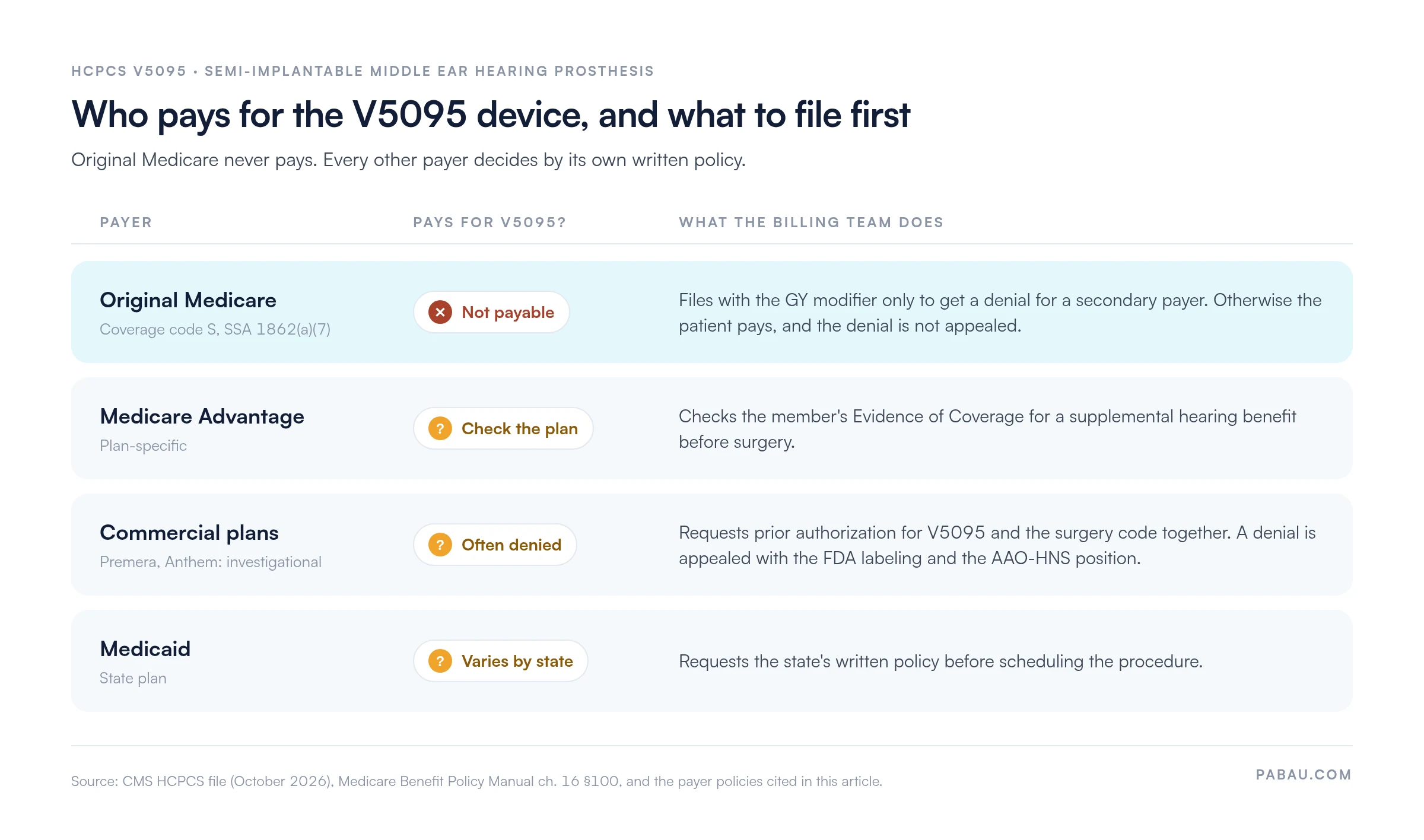
Appeals have one strong counterweight. The American Academy of Otolaryngology-Head and Neck Surgery calls active middle ear implants appropriate treatment for adults with moderate to severe hearing loss. It applies that to patients who benefit from amplification but cannot benefit from conventional hearing aids.
Request prior authorization on every commercial V5095 case, even where the plan lists the device as investigational. A written decision before surgery gives the patient a clear financial picture and starts any appeal early.
V5095 denials trace back to a short list of causes. Matching the claim adjustment reason code (CARC) to its cause tells you whether to appeal, correct the claim or bill the patient.
A V5095 case pulls records from audiology, surgery and billing. When those records live in separate systems, staff rebuild the case by hand each time a plan asks for proof.
Pabau, a practice management platform with built-in billing, keeps audiograms, authorization letters and operative notes on the same patient file. Its claims management software lets you map HCPCS codes and modifiers to each service. The device line and the surgery line then go out consistent.
The result is a claim the payer can review without chasing records. When a denial arrives, the patient records behind the appeal already sit on one timeline.
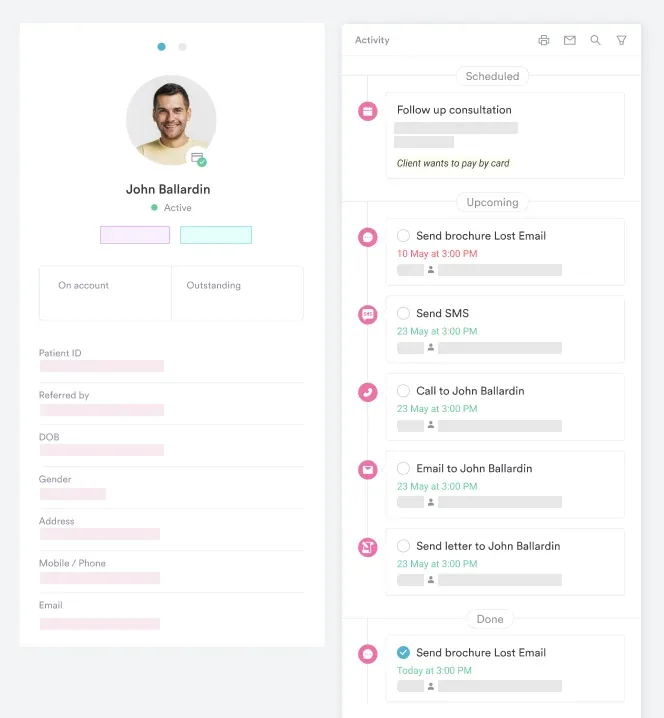

Pabau keeps audiograms, prior authorization letters and implant records on one patient file, so middle ear implant claims and appeals go out complete.

Treat V5095 as a payer-policy problem first and a coding problem second. The code itself is simple, but Medicare will not pay it and many commercial plans start from an investigational position.
Your leverage is the file you build before surgery. A complete audiogram, a documented hearing aid history and a prior authorization decision turn a likely denial into a case you can argue. Without them, the practice or the patient carries the device cost.
Book a demo to see how Pabau keeps implant documentation and claims together for audiology and ENT practices.

Seeing high denial rates across your claims? Denial management in healthcare outlines a systematic approach to categorizing, appealing and preventing recurring claim rejections.
Want fewer claims bounced on the first pass? Clean claims explains what a payer checks before it accepts a claim for processing.
Want to understand the full revenue cycle behind an implant claim? What is revenue cycle management explains how each billing step connects, from eligibility check to payment posting.
HCPCS Code V5095 is the Level II code for a semi-implantable middle ear hearing prosthesis. ASHA notes it is used for the Vibrant Soundbridge. It reports the device, not the surgery that places it.
No. CMS lists V5095 as non-covered by Medicare statute under Section 1862(a)(7), the hearing aid exclusion. Medicare Advantage plans set their own rules, so check the member’s policy and Evidence of Coverage.
It sits in the hearing services range of HCPCS, but it describes a partly implanted device. Conventional external hearing aids use other V-codes, chosen by style and by ear.
Payer policies list HCPCS S2230 for implanting the magnetic component on the middle ear ossicles. Medicare does not recognize S-codes, and some plans list unlisted CPT code 69799. Confirm the plan’s coding table before surgery.
Sensorineural hearing loss codes from ICD-10-CM category H90 match the FDA labeling, such as H90.3 for bilateral loss. Add a code for the reason external aids failed, such as otitis externa.
Common reasons are the Medicare statutory exclusion, investigational policies, missing prior authorization and thin medical necessity records. Each one needs a different response, from billing the patient to a full appeal.