HCPCS Code V5095: Semi-implantable middle ear hearing prosthesis
HCPCS Code V5095: Definition and clinical descriptor HCPCS Code V5095 is the Lev...

Last Updated: Nov 25, 2026
32655 is the CPT code for thoracoscopy, surgical; with resection-plication of bullae, includes any pleural procedure when performed. Surgeons report it when a VATS approach is used to staple and excise or plicate discrete bullae, and same-side pleurodesis in that session is included.
The code carries a 90-day global period and about 27.4 total RVUs under the CY2026 Medicare fee schedule. Its neighbors in the 32650-32674 range describe pleurodesis, lung volume reduction and lobe or lung removal, so the op note decides which one applies.
Let Pabau's smart automation suggest the right codes, reduce claim denials, and keep your practice compliant—effortlessly.
Automate repetitive tasks and focus on what matters most—your patients.
Reduce coding errors and ensure compliance with the latest regulations.
Clean claims, fewer denials, and faster reimbursements.
Powerful insights and reporting to help your practice thrive.
HIPAA compliant SOC 2 certified GDPR-compliant Trusted by 4,000+ clinics worldwide

CPT 32655 covers thoracoscopic resection-plication of pulmonary bullae, and any pleural procedure performed in the same session is included.
Same-side pleurodesis (CPT 32650) is bundled into 32655, so billing it separately triggers an NCCI edit and a denial.
Many payers expect an LT or RT modifier on this code, so follow payer policy and take the side from the operative report.
The code carries a 90-day global period and about 27.4 total RVUs under the CY2026 Medicare fee schedule.
Pabau, a practice management platform, tracks prior authorizations on the patient’s case and warns when an authorization code is missing.
CPT code 32655 describes thoracoscopic resection or plication of pulmonary bullae, and it includes any pleural procedure performed in the same session. It is a major surgical code with a 90-day global period and about 27.4 total RVUs in the 2026 Medicare fee schedule data.
The table below summarizes the core billing facts. Reimbursement figures are national and unadjusted, so confirm your locality’s rate in the CMS Physician Fee Schedule lookup tool before submitting.
CPT 32655 covers thoracoscopic resection or plication of one or more pulmonary bullae in a single operative session. It also bundles any pleural procedure performed at the same time. If the surgeon adds pleurodesis (CPT 32650) on the same side in that session, the pleurodesis is part of 32655. Billing both triggers a National Correct Coding Initiative (NCCI) edit and a denial.
The AMA CPT code set governs the official descriptor and its parenthetical notes, so check the current-year codebook for updates. Coders new to surgical claims can start with these medical billing fundamentals.
What 32655 does not include:
Coders who know the operative sequence can match the op note to CPT 32655 and spot missing documentation before the payer does. The procedure runs in four phases.
Documentation tip: the op note should confirm the thoracoscopic approach, the operative side, the staple-line plication, and the absence of open conversion. A note missing any of these invites a medical necessity denial.
Every CPT 32655 claim needs an ICD-10-CM diagnosis that supports the procedure under the payer’s medical necessity criteria. The table below lists common pairings. Check your MAC’s coverage articles and each payer’s medical policy before submitting, because diagnosis requirements vary.
Always use the most specific ICD-10 code the documentation supports. Payers that publish coverage policies for VATS procedures often limit coverage to a named list of diagnosis codes. Using J43.9 when the record supports J43.1 is not incorrect, but the specific code meets those criteria more cleanly.
The thoracoscopic surgery range holds several codes that share a VATS approach but describe different procedures. Picking the wrong one invites an upcoding audit or leaves money unbilled. The AAPC CPT code range lookup lets you compare the full descriptors side by side.
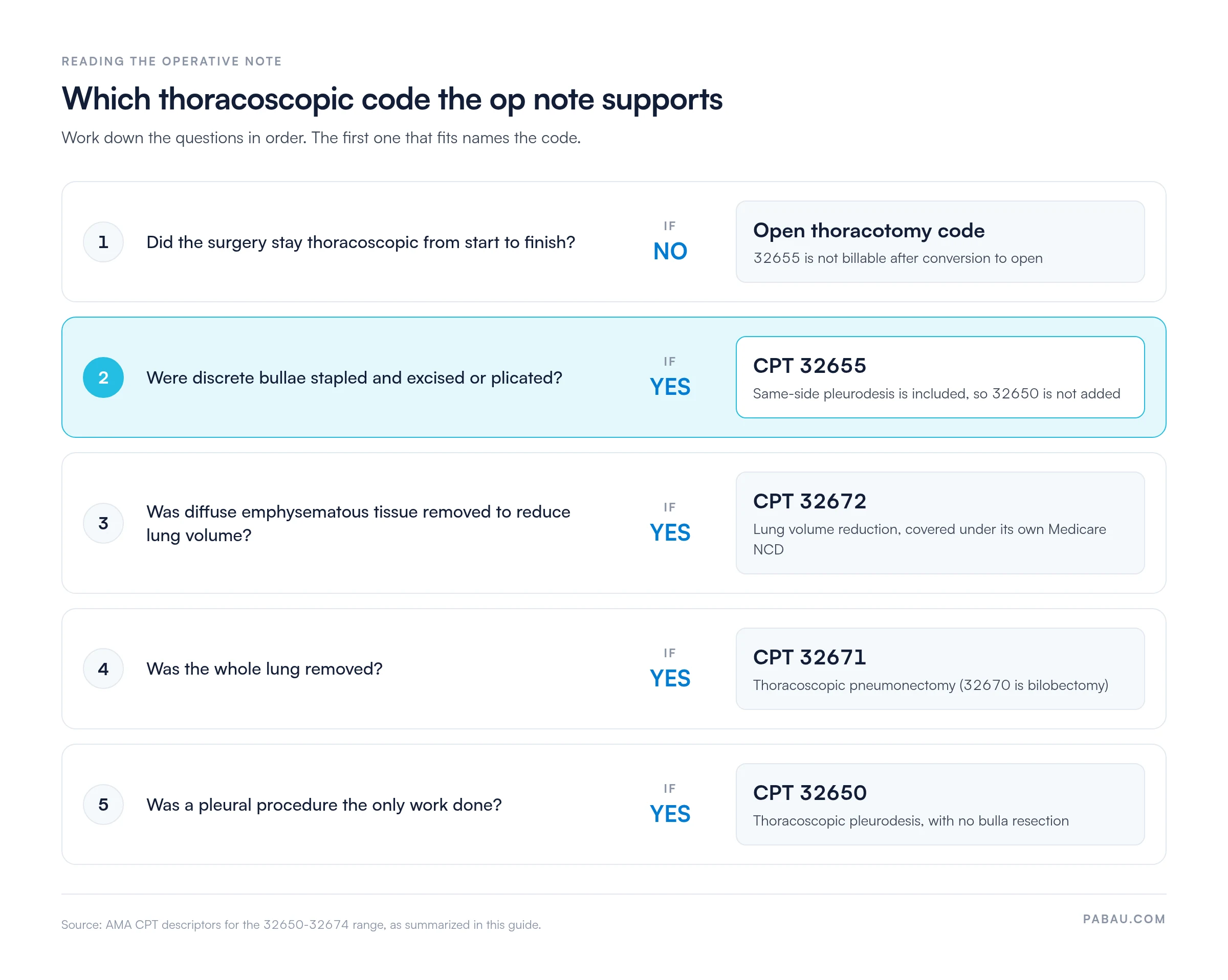
Key selection rule: if the op note describes discrete bullae that are stapled and excised, 32655 is correct. If it describes diffuse parenchymal resection for COPD without discrete bullae, 32672 applies. Billing 32650 alongside 32655 for the same side generates an NCCI edit that the payer will deny.
Read in order, five questions about the op note settle which of these codes the claim supports.
Many payers expect an LT or RT modifier on CPT 32655, because the lungs are paired organs. Follow each payer’s policy, and take the side from the operative report rather than the scheduling record.
Payer audits on VATS procedures focus on the operative report. A well-structured op note is the most reliable route to clean claim submission and a sound medical necessity defense. Review these elements before submitting.
Prior authorization rules vary by payer type. Insurance eligibility verification before scheduling is the starting point, but PA is a separate step with its own documentation.
Commercial PA requirements change regularly, so verify with the plan before the procedure. Record the PA number in the patient account and on the claim. A missing PA number triggers a denial even when approval was obtained.
CPT 32655 carries about 27.4 total RVUs in the CY2026 Medicare Physician Fee Schedule. The table below breaks that total into its three components. RVUs and conversion factors change every year, so pull current figures from the CMS Physician Fee Schedule lookup before relying on them.
Final payment is also adjusted by the Geographic Practice Cost Index (GPCI) for your locality. A practice in Manhattan receives a different amount than one in rural Tennessee.
At the $33.4009 conversion factor, the national unadjusted payment works out to roughly $916 before GPCI. The FastRVU lookup tool calculates a location-adjusted figure from your practice’s zip code.
VATS claims attract more scrutiny than routine office codes. Denial management workflows for thoracic surgery start with the rejection patterns below. They also help when you read denial codes in medical billing on remittance advice.
CPT 32655 carries a 90-day global period (CMS indicator 090). Post-operative evaluation and management services related to the surgery are bundled into the global fee for 90 days after the procedure. A standard E/M visit billed in that window without a modifier is denied.
Three modifiers allow separate E/M billing around the global period:
Unbundling risk in the same session is highest when 32655 is billed with other thoracoscopic codes. If a distinct VATS procedure was performed on the opposite side, bill it with modifier 59, or XS where the payer prefers it. Document the separate indication clearly, because an NCCI-edited secondary code without the modifier is denied.
Review every 32655 claim from the previous 90 days once a quarter. Filter by denial reason code and sort by modifier to see whether laterality or diagnosis mismatches recur. A 30-minute review shows which front-end check to tighten next.
Many CPT 32655 denials start before the claim is built. A prior authorization number never reaches the account at scheduling, or nobody checked eligibility for the surgery date. The billing team then hears about it weeks later, from the remittance.
Pabau’s claims management software submits US claims through its Claim.MD clearinghouse integration to thousands of US payers. Claims are generated from the invoices already in Pabau, and eligibility checks run before the procedure. ERA remittances (835 files) post back to the billing queue.
Prior authorizations sit on the patient’s case with the auth code, dates, and sessions, and Pabau warns when a code is missing. Code and modifier selection stays with your coders and the operative report. The PA and eligibility steps of revenue cycle management then happen every time, not only when someone remembers.
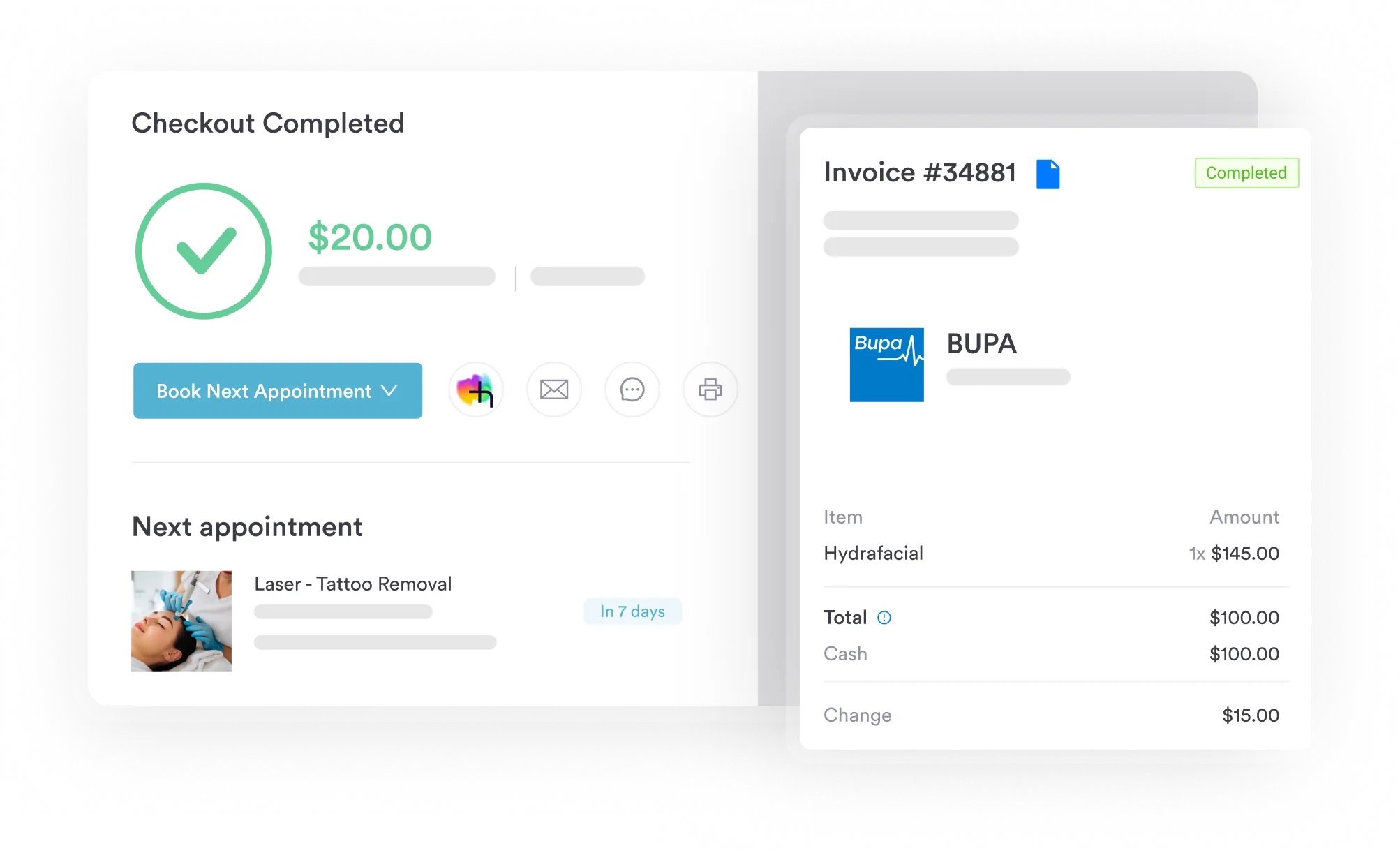

Pabau tracks prior authorizations on the case, checks eligibility, and submits claims through Claim.MD. ERA remittances post back to the billing queue, so your team sees each payment without chasing it.

CPT 32655 rewards a careful read of the op note. When the note names discrete bullae, a stapled plication, and a thoracoscopic approach throughout, the code and its bundled pleural work are straightforward.
Denials come from what surrounds the code: an uncaptured prior authorization, a laterality modifier the payer expected, or a diagnosis its policy does not list. Settle those before the claim leaves, and the 90-day global period becomes the main rule left to watch.
Pabau keeps prior authorizations, eligibility checks, and ERA remittances in one system. Book a demo to see how a surgical practice keeps VATS claims moving without adding billing staff.

Need a walkthrough of the claims clearinghouse process? Medical claims clearinghouse guide covers how electronic claim submission works from practice to payer.
Want to understand the 837 file your clearinghouse transmits? 837 EDI file explained breaks down the electronic claim format payers require for VATS and other surgical codes.
Looking for a framework to track ERA remittances? Electronic remittance advice (ERA) guide explains how 835 files feed back into the billing workflow after claim adjudication.
CPT 32655 covers thoracoscopic resection-plication of pulmonary bullae, including any pleural procedure performed at the same time. It applies when a surgeon uses a video-assisted thoracoscopic (VATS) approach to staple and excise discrete bullae. Same-session pleurodesis or pleural abrasion on the same side is bundled into the code.
CPT 32650 is thoracoscopic pleurodesis only, with no bulla resection. CPT 32655 is thoracoscopic bulla resection-plication, which includes any pleural procedure performed at the same time. When both apply in the same session on the same side, only 32655 is billable.
Common pairings are J93.11 (primary spontaneous pneumothorax), J93.12 (secondary spontaneous pneumothorax), and J43.9 (emphysema, unspecified). More specific emphysema codes such as J43.0, J43.1 and J43.2 apply when the record supports them. Check each payer’s coverage policy before submitting, because accepted diagnoses vary.
CPT 32655 carries a 90-day global period (CMS major surgery indicator 090). Post-operative E/M visits related to the surgery are bundled into the global fee. Modifier 24 covers an unrelated post-op E/M, and modifier 25 a separate problem on the procedure day. Modifier 57 marks the visit where the decision to operate was made.
Medicare pays CPT 32655 under the annual Physician Fee Schedule, adjusted by your locality’s Geographic Practice Cost Index (GPCI). For CY2026 the code carries about 27.4 total facility RVUs, including a malpractice RVU of about 3.95. At the $33.4009 conversion factor, that is roughly $916 nationally before GPCI.
Not for the same lung in the same session. CPT 32671 (thoracoscopic pneumonectomy) and 32672 (thoracoscopic lung volume reduction) are distinct procedures with different scope and coverage criteria. CPT 32670 is thoracoscopic bilobectomy. If separate procedures were performed on opposite sides, bill them with laterality modifiers and modifier 59, and document each one in the operative report.
Frequent triggers are a missing prior authorization on commercial plans, and a diagnosis outside the payer’s coverage policy. A missing LT or RT modifier on payers that expect one, and 32650 billed separately on the same side, cause denials too. An op note that does not confirm the thoracoscopic approach or the stapled plication fails medical necessity review.