

CCSD code G5100: Bypass of duodenum billing guide
CCSD code G5100 bills a bypass that leaves the duodenum in place CCSD code G5100...

Last Updated: Oct 16, 2026
HCPCS code V2205 covers one bifocal spherocylinder lens, with a sphere from plano to plus or minus 4.00D and a cylinder from 4.25D to 6.00D. It's billed per lens, so a pair of glasses goes on two claim lines.
The cylinder is the number that decides this code. A cylinder of 2.12D to 4.00D drops to V2204, and anything over 6.00D moves to V2206. Medicare pays only after cataract surgery or for aphakia, so the diagnosis link matters as much as the power. Get the band, the RT and LT modifiers, and the diagnosis right, and the claim is far less likely to come back.
Let Pabau's smart automation suggest the right codes, reduce claim denials, and keep your practice compliant—effortlessly.
Automate repetitive tasks and focus on what matters most—your patients.
Reduce coding errors and ensure compliance with the latest regulations.
Clean claims, fewer denials, and faster reimbursements.
Powerful insights and reporting to help your practice thrive.
HIPAA compliant SOC 2 certified GDPR-compliant Trusted by 4,000+ clinics worldwide

HCPCS code V2205 bills one spherocylinder bifocal lens with a plano to plus or minus 4.00D sphere and a 4.25D to 6.00D cylinder.
Cylinder power picks the code inside V2203 to V2206, and the bifocal add power is not part of any V2200-series descriptor.
Medicare covers V2205 only for pseudophakia, aphakia, or congenital aphakia, with one pair of glasses after each cataract surgery that implants a lens.
Bill each lens on its own line with RT or LT and one unit, and put frames, tints, coatings, and progressive upgrades on separate lines.
Progressive upgrades (V2781) and deluxe frames (V2025) go on separate lines, and Medicare leaves those lines for the patient to pay.
HCPCS code V2205 is a HCPCS Level II code for one spherocylinder bifocal lens. The sphere runs from plano to plus or minus 4.00 diopters, and the cylinder runs from 4.25 to 6.00 diopters. CMS maintains Level II for supplies, equipment, and services that CPT codes do not capture.
V2205 sits in the V2200 to V2299 bifocal lens range, inside the vision services section of the V codes. Each code in that range maps to a sphere band and, for spherocylinder lenses, a cylinder band. The cylinder value on the prescription is what separates V2205 from its neighbors.
The official CMS descriptor for V2205 reads: Sphercylinder, bifocal, plano to plus or minus 4.00d sphere, 4.25 to 6.00d cylinder, per lens. “Sphercylinder” is the CMS spelling of spherocylinder. Two conditions decide the code, and both must be true for the same lens.
Code from the dispensed prescription, not from memory of the patient’s last pair. A cylinder written as 4.00D belongs in V2204, and rounding it up to reach V2205 is a coding error that auditors flag.
V2205 covers the base bifocal lens within the powers above, in glass or plastic. The segment style, such as a flat-top 28 or a round segment, does not change the code.
Several items sit outside the code and go on their own lines:
HCPCS optical billing is unbundled by design. Each optical element gets its own code, and some payers ask for a separate prior authorization reference for each one.
Bifocal spherocylinder codes work like a grid. The sphere picks the row, and the cylinder picks the column inside it. V2205 sits in the low-sphere row, third cylinder band along. When the sphere falls in the plus or minus 4.25D to 7.00D row instead, the lowest cylinder band is V2207.
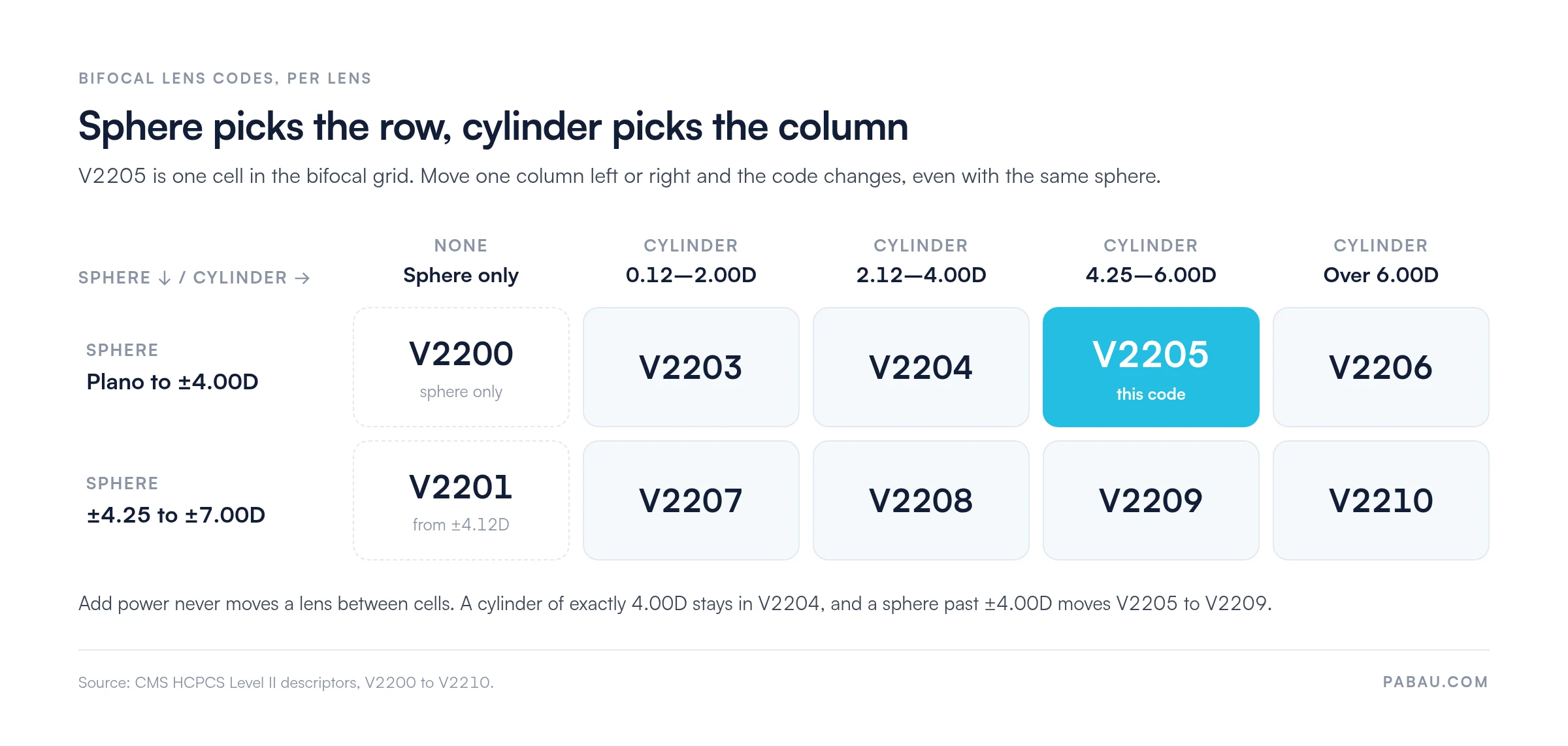
Most common mix-up: V2204 versus V2205. Both codes share the plano to plus or minus 4.00D sphere range, so only the cylinder separates them. A cylinder of 2.12D to 4.00D is V2204, and 4.25D to 6.00D is V2205.
The second mix-up runs the other way. V2205 and V2209 share the 4.25D to 6.00D cylinder band, so the sphere decides between them. Add power plays no part in either choice.
Decision rule for a bifocal with cylinder on the prescription:
One trap sits near the 4.00D sphere boundary. Transposing a prescription between plus-cylinder and minus-cylinder form keeps the cylinder size but changes the sphere.
For example, +0.50 -5.00 x 180 transposes to -4.50 +5.00 x 090, which reads as V2209 instead of V2205. The descriptor does not say which form to use. So code from the form on the lab order, and keep the prescription on file in that same form.
Keep the power ladder above at the billing workstation. Checking the cylinder column at point of entry stops the V2204/V2205 mix-up before the claim reaches the clearinghouse.
Here’s how the grid plays out on a single order. A patient returns after cataract surgery with an intraocular lens in each eye. The new spectacle prescription reads:
Both spheres sit inside plano to plus or minus 4.00D, so both lenses belong in V2203 to V2206. The right cylinder of 4.75D lands in V2205. The left cylinder of 3.25D falls one band lower, in V2204.
So the order becomes two lens lines, not one. Bill V2205-RT and V2204-LT, one unit each, with Z96.1 linked to both. The standard frame goes on its own line as V2020, and the +2.50 add plays no part in either code.
Payers expect four core documents behind a V2205 claim. A missing or mismatched one is the usual cause of a denial or a failed post-payment review.
For medical billing compliance, Medicare requires DMEPOS suppliers to keep proof of delivery for seven years from the date of service. Keep the prescription and order for the same period, or longer where state law requires it.
V2205 is billed per lens, not per pair. Medicare sends these claims to the durable medical equipment Medicare administrative contractors (DME MACs).
Their refractive lenses policy has required RT and LT on separate lines since March 1, 2019, with one unit each. Lines billed without RT or LT, or with RTLT on a single line, are rejected as incorrect coding.
Commercial and Medicaid payers set their own modifier rules. Most follow the RT and LT convention, but check each payer’s vision billing manual before you change a workflow.
Medicare does not cover eyeglasses for routine vision correction. Refractive lenses are covered only for patients without a natural lens: pseudophakia, aphakia, or congenital aphakia. After each cataract surgery that implants an intraocular lens, Part B covers one pair of eyeglasses with standard frames or one set of contact lenses.
These claims go to the DME MAC, and the patient pays 20% of the approved amount after the Part B deductible. Without a covered ICD-10-CM diagnosis code on the claim and in the record, the lens is denied as non-covered.
Outside of Medicare, coverage varies widely:
V2205 is priced on the Medicare DMEPOS fee schedule, not the Physician Fee Schedule. Amounts vary by state and are updated each year, so never apply prior-year figures to current claims.
Upgrades are billed as a second line, not by swapping the base code. For a progressive lens, bill V2205 for the standard bifocal and V2781 for the price difference. Medicare treats V2781 as non-covered, so the patient pays that line.
Frames follow the same pattern. Medicare covers standard frames only, billed as V2020. For a deluxe frame, bill V2020 for the standard frame cost and V2025 for the difference.
V2205 denials cluster around four causes: the wrong cylinder band, missing laterality, a non-covered diagnosis, and late filing. Each has its own fix. A clear denial management process keeps a resubmission from running into the timely-filing limit.
Appeal pathway: note the denial code and remark code from the Explanation of Benefits or 835 remittance advice. Attach the prescription, dispensing order, and proof of delivery to the reconsideration request. For a CO-96 Medicare denial on a pseudophakic patient, include the operative report showing the cataract extraction and intraocular lens insertion.
Set a reminder for 30 days after dispensing any V2205 lens. If the claim has not paid or denied by then, trace it at the clearinghouse before the timely-filing window closes.
A V2205 claim starts at the prescription and ends at the remittance. Work through these steps in order, and you send clean claims on the first submission.
Many optical practices still key each lens line by hand, copying codes and diagnoses from the chart into a separate billing tool. Every copy is a chance to drop a modifier or link the wrong diagnosis.
Pabau, the practice management platform we build, offers simpler claims management by pre-filling each claim from the patient record. HCPCS and ICD-10-CM lookup libraries sit inside the claim form, and the form checks required fields before it can be sent.
In the US, claims go out through Claim.MD from the same screen. Your team then tracks each claim’s status in one place, so a stalled lens claim gets traced before the filing window closes.
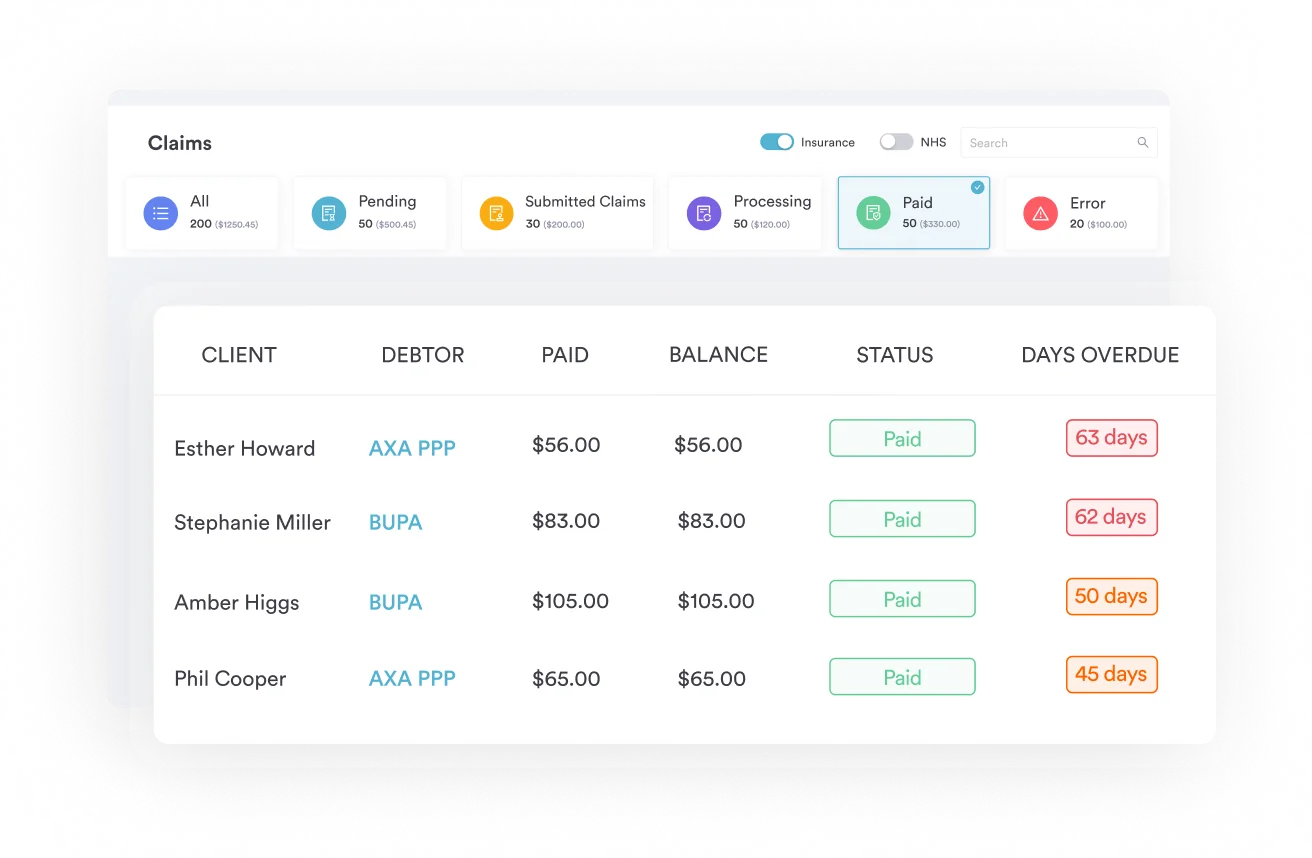

Pabau pre-fills claims from the patient record, checks required fields before sending, and tracks each claim after submission. Your optical team spends less time rekeying lens lines.

Code V2205 from the cylinder first and the sphere second. That order catches the V2204 and V2209 mix-ups before they turn into recodes. When a cylinder reads exactly 4.00D, leave it in V2204, however close it looks.
The trade-off is a little more work at the front of each order. Splitting lines by eye, linking a covered diagnosis, and filing proof of delivery all take time. Still, that time costs far less than an appeal months later.
If your team bills optical claims every week, build those checks into the system that creates the claim. Book a demo to see how Pabau carries the prescription and diagnosis onto every lens line.

Billing the next cylinder band up? HCPCS code V2206 covers the same low-sphere bifocal once the cylinder passes 6.00D.
Working with a low cylinder instead? HCPCS code V2203 covers bifocals with a cylinder of 0.12D to 2.00D.
Need a starting point for HCPCS billing compliance? Medical billing compliance covers the documentation retention, audit defense, and payer rules that apply across all HCPCS claim types.
Want to understand how claim edits work end to end? What is medical billing explains the full revenue cycle from eligibility check through remittance posting.
Dealing with repeated CO-4 or CO-96 denials? Denial management in healthcare covers appeal workflows, root-cause analysis, and systemic fixes for recurring denial patterns.
It can be. Toric is the optical term for a lens with cylinder, so a toric bifocal is a spherocylinder bifocal. It bills as V2205 when the sphere is plano to plus or minus 4.00D and the cylinder is 4.25D to 6.00D.
No. V2205 covers spectacle lenses only. Contact lenses have their own HCPCS codes in the V2500 to V2599 range, billed per lens.
Prism goes on its own line as V2715, per lens, with RT or LT. The V2205 line stays the same, because prism is not part of the base lens descriptor.
Both cover a bifocal with a plano to plus or minus 4.00D sphere, so the cylinder decides. V2204 covers 2.12D to 4.00D, and V2205 covers 4.25D to 6.00D.
Only when the natural lens is gone, as with pseudophakia, aphakia, or congenital aphakia. After each cataract surgery with an intraocular lens, Part B covers one pair of glasses with standard frames. Routine vision correction is not covered.
The usual causes are a power outside the V2205 bands, missing RT or LT modifiers, and a diagnosis Medicare does not cover. Check the prescription, modifiers, and diagnosis link before you resubmit.



