HCPCS code C1731: Catheter billing, OPPS reimbursement, and denial guide
HCPCS code C1731: Official descriptor and code series context HCPCS code C1731 i...

Last Updated: Oct 8, 2026
V2207 is the HCPCS code for a spherocylinder bifocal lens, per lens, with plus or minus 4.25 to 7.00d sphere and .12 to 2.00d cylinder. It corrects moderate to high nearsightedness or farsightedness alongside mild astigmatism.
V2207 covers ±4.25 to ±7.00D sphere with .12 to 2.00D cylinder, and neighboring V2208 covers the same sphere with 2.12 to 4.00D cylinder. Cylinder power decides between them, so read both values before you code. Medicare pays for V2207 only as a prosthetic lens after cataract surgery, and each lens goes on its own claim line.
Let Pabau's smart automation suggest the right codes, reduce claim denials, and keep your practice compliant—effortlessly.
Automate repetitive tasks and focus on what matters most—your patients.
Reduce coding errors and ensure compliance with the latest regulations.
Clean claims, fewer denials, and faster reimbursements.
Powerful insights and reporting to help your practice thrive.
HIPAA compliant SOC 2 certified GDPR-compliant Trusted by 4,000+ clinics worldwide

HCPCS code V2207 covers one spherocylinder bifocal lens with ±4.25 to ±7.00D sphere and .12 to 2.00D cylinder.
Cylinder power separates V2207 from V2208, V2209 and V2210, which all share the same sphere band.
V2207 is billed per lens, so a pair needs two claim lines with RT and LT modifiers.
Medicare Part B pays for V2207 only as a prosthetic lens after cataract surgery, not for routine vision care.
Most V2207 denials come from administrative misses, such as the wrong cylinder tier, a missing modifier or no operative note on file.
HCPCS code V2207 is the billing code for a single spherocylinder bifocal lens. The prescription must read ±4.25 to ±7.00 diopters (D) of sphere and .12 to 2.00D of cylinder. CMS maintains it in HCPCS Level II, the national code set for supplies and services outside CPT.
Here are the administrative facts to confirm before a claim goes out. You’ll find the neighboring lens codes among our HCPCS code guides.
The per-lens unit matters more than it looks. A patient who needs V2207 in both eyes gets two claim lines, one marked RT and one marked LT. Billing the pair on a single line either underpays the order or starts a reimbursement dispute.
A spherocylinder bifocal lens corrects two refractive errors at once. The sphere handles nearsightedness or farsightedness, while the cylinder corrects astigmatism. A bifocal segment then adds near-vision correction in the same lens.
V2207 fits a prescription with moderate to high sphere power and mild astigmatism. Both values have to land inside the code’s ranges.
The sphere range uses the absolute value of the power. So a -5.50 sphere (myopia) and a +5.50 sphere (hyperopia) both fall within V2207. The sign shows the direction of correction, not a separate coding tier.
Take a typical post-cataract order. The right eye reads -6.25 sphere with -1.50 cylinder, so it lands in V2207. The left eye reads -6.00 sphere with -2.50 cylinder. That extra cylinder moves the left lens to V2208, so one claim carries two codes.
Cylinder power is what separates V2207 from V2206 and V2208. The ±4.25 to ±7.00D sphere band applies to both V2207 and V2208. V2207 takes .12 to 2.00D of cylinder, while V2208 takes 2.12 to 4.00D.
The wider family follows one grid. V2203 to V2206 cover plano to ±4.00D sphere. They step through four cylinder tiers: .12 to 2.00D, 2.12 to 4.00D, 4.25 to 6.00D and over 6.00D.
V2207 to V2210 repeat those tiers at ±4.25 to ±7.00D sphere. So V2209 takes 4.25 to 6.00D of cylinder, and V2210 takes cylinder over 6.00D. The grid below shows where V2207 sits.
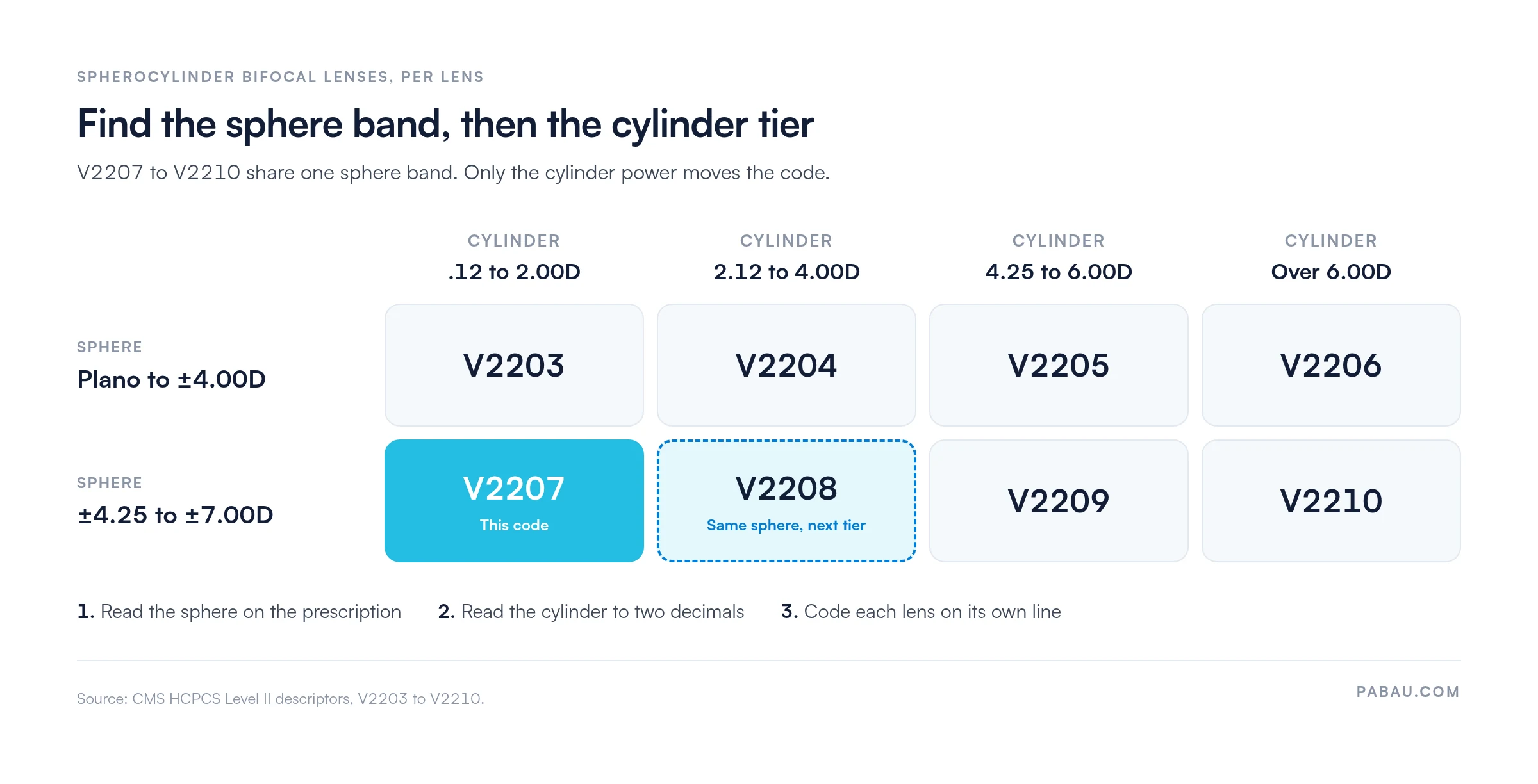
Read the cylinder to two decimal places before you choose. A cylinder of 2.00D stays in V2207, but 2.12D moves the lens to V2208. Spheres beyond ±7.00D leave this band entirely, so check both numbers every time.
Check the cylinder before the sphere when you code a spherocylinder bifocal. V2207 to V2210 share one sphere band, so the cylinder is what changes the code. If the cylinder is handwritten or unclear, confirm the exact value with the prescriber before you bill.
Medicare Part B covers HCPCS code V2207 as a prosthetic lens benefit following cataract surgery. It doesn’t cover routine eyeglasses, so a V2207 claim for everyday vision correction gets denied.
For Medicare to pay, the claim needs all of these:
Standard frames for the same order are billed on their own line under V2020.
Medicaid coverage of V2207 varies by state. Some programs cover post-cataract lenses under their vision benefit. Others require prior authorization, set quantity limits, or exclude adults. Check the state’s Medicaid provider manual before you submit.
Medicare pays V2207 under the DMEPOS fee schedule, not the Physician Fee Schedule. CMS updates the amounts each year, usually effective January 1. Look up the current rate on the CMS DMEPOS fee schedule page before you quote patients.
Once you have the rate, the payment split works like this:
We haven’t published a national dollar figure here, because the amount depends on the current CMS file. Pull the allowable from CMS or your billing system before you set patient expectations.
Medicare audits of DMEPOS vision claims often cite missing documentation. Your records need to support the claim on day one. They also have to survive a post-payment review or a Comprehensive Error Rate Testing (CERT) audit months later.
Keep these on file for every V2207 claim:
Store these in the patient’s electronic record. When an auditor asks, you can pull them in minutes instead of digging through paper files.
A V2207 claim follows the same path every time. Work through it in this order:
The AAPC HCPCS code reference is a handy second source for modifier guidance. Still, the CMS HCPCS file stays the authority on the official descriptor and billing rules.
Run through these seven checks on every lens order. Each one maps to a denial reason in the next section.
V2207 denials keep coming back to the same six problems. You can head off nearly all of them while choosing the code and gathering documents.
Medical necessity is rarely the fight on V2207. The usual culprits are the wrong cylinder tier, the wrong unit, a missing modifier or missing paperwork. The checklist above catches all six.
Once a month, pull your V-code claim lines and look for bilateral orders billed on one line or without RT and LT. The pattern is easy to spot and quick to fix before claims go out.
Plenty of practices keep the prescription, the operative note and the claim in three different places. When an auditor asks for proof, someone rebuilds the file by hand.
Pabau, the practice management platform we build, keeps those records on the patient file next to the invoice. Its claims tools for practices help you submit and track claims, so you can see where each lens claim stands.
The payoff is fewer resubmissions and an audit file you can open in minutes. Your team spends less time chasing paperwork and more time fitting patients with their new lenses.

Pabau’s claims management software helps practices submit and track claims, with prescriptions and surgical notes stored on the patient record. See how it fits your billing workflow.

V2207 rewards a careful read of the prescription. Check the cylinder first, because it decides between V2207 and its same-sphere neighbors. Then put each lens on its own line and keep the cataract surgery record within reach.
Build those three habits and most V2207 denials never happen. Skip them, and the time you saved goes straight into resubmissions. Book a demo to see how Pabau keeps lens prescriptions, surgical notes and claims together for your billing team.

Coding a lens with more astigmatism? HCPCS code V2208 covers the same sphere band with 2.12 to 4.00D of cylinder.
Working with a lower sphere power? HCPCS code V2203 covers plano to ±4.00D sphere at the same cylinder tier as V2207.
Billing a high-cylinder bifocal? HCPCS code V2209 explains the 4.25 to 6.00D cylinder tier.
Need the plano-sphere code with the most cylinder? HCPCS code V2206 walks through lenses with over 6.00D of cylinder.
Chasing a denied lens claim? Denial codes in medical billing decodes the reason codes payers send back.
V2207 covers one spherocylinder bifocal lens with a sphere power of ±4.25 to ±7.00 diopters and a cylinder power of .12 to 2.00 diopters. It’s billed per lens, so a pair takes two claim lines.
Cylinder power is the main difference. V2207 covers ±4.25 to ±7.00D sphere with .12 to 2.00D cylinder. V2208 covers the same sphere with 2.12 to 4.00D cylinder. V2206 covers plano to ±4.00D sphere with cylinder over 6.00D.
After each cataract surgery with an intraocular lens, Medicare Part B covers one pair of eyeglasses with standard frames, or one set of contact lenses. The patient pays 20% after the Part B deductible.
No. V2207 covers the base lens only. Add-ons have their own per-lens codes, such as V2745 for a tint and V2750 for an anti-reflective coating. Medicare often treats them as upgrades, so get a signed ABN first.
Yes. Each lens is coded from its own prescription values. If the right eye has 1.50D of cylinder and the left has 2.50D, bill V2207 RT and V2208 LT on separate lines.