CCSD Code H3334: Low anterior resection billing guide
CCSD Code H3334: Definition and clinical scope CCSD Code H3334 covers an open an...

Last Updated: Oct 16, 2026
V2201 is the HCPCS Level II code for a bifocal sphere lens from plus or minus 4.12 to plus or minus 7.00 diopters. It is billed per lens and covers a spherical bifocal lens with no cylinder correction.
A bifocal sphere power of 4.00 D or less belongs to V2200, and 7.12 D or more belongs to V2202. Any cylinder on the prescription moves the lens to the spherocylinder codes from V2203 upward.
Let Pabau's smart automation suggest the right codes, reduce claim denials, and keep your practice compliant—effortlessly.
Automate repetitive tasks and focus on what matters most—your patients.
Reduce coding errors and ensure compliance with the latest regulations.
Clean claims, fewer denials, and faster reimbursements.
Powerful insights and reporting to help your practice thrive.
HIPAA compliant SOC 2 certified GDPR-compliant Trusted by 4,000+ clinics worldwide

V2201 covers one bifocal sphere lens from plus or minus 4.12 to plus or minus 7.00 diopters, billed per lens.
V2200 covers bifocal sphere powers up to 4.00 D, and V2202 covers 7.12 to 20.00 D. Any cylinder moves the lens to V2203 or higher.
Medicare pays only for aphakia, congenital aphakia, or pseudophakia, under the prosthetic device benefit and the DME MAC refractive lenses policy.
Bill each lens on its own claim line with RT or LT and one unit, never RTLT with two units.
Pabau keeps the prescription, operative note, and ABN on the patient record, so each lens claim has its support in one place.
HCPCS Code V2201 is the Level II code for a bifocal sphere lens from plus or minus 4.12 to plus or minus 7.00 diopters. The official descriptor reads “Sphere, bifocal, plus or minus 4.12 to plus or minus 7.00d, per lens.” One unit equals one lens, so a pair is two units on two claim lines.
The code sits in the bifocal lens range of the CMS HCPCS Level II code set, between V2200 and V2202. It describes a lens with a spherical distance power and a bifocal segment, but no cylinder for astigmatism. Frames, coatings, tints, and progressive upgrades are separate codes.
Three codes cover bifocal sphere lenses, and the sphere power on the prescription decides which one applies. V2201 is the middle tier.
Prescriptions are usually written in 0.25 D steps, so 4.25 D is the first common value that lands in V2201. A lens at exactly 4.00 D stays in V2200, and a lens at 7.25 D moves to V2202.
Two neighbors cause most miscoding. Codes V2203 through V2214 are bifocal spherocylinder lenses, so any cylinder on the prescription takes the lens out of V2201. Single vision sphere lenses use V2100 through V2102, not the V22xx range. The diagram below runs the choice in two steps, cylinder first and sphere power second.
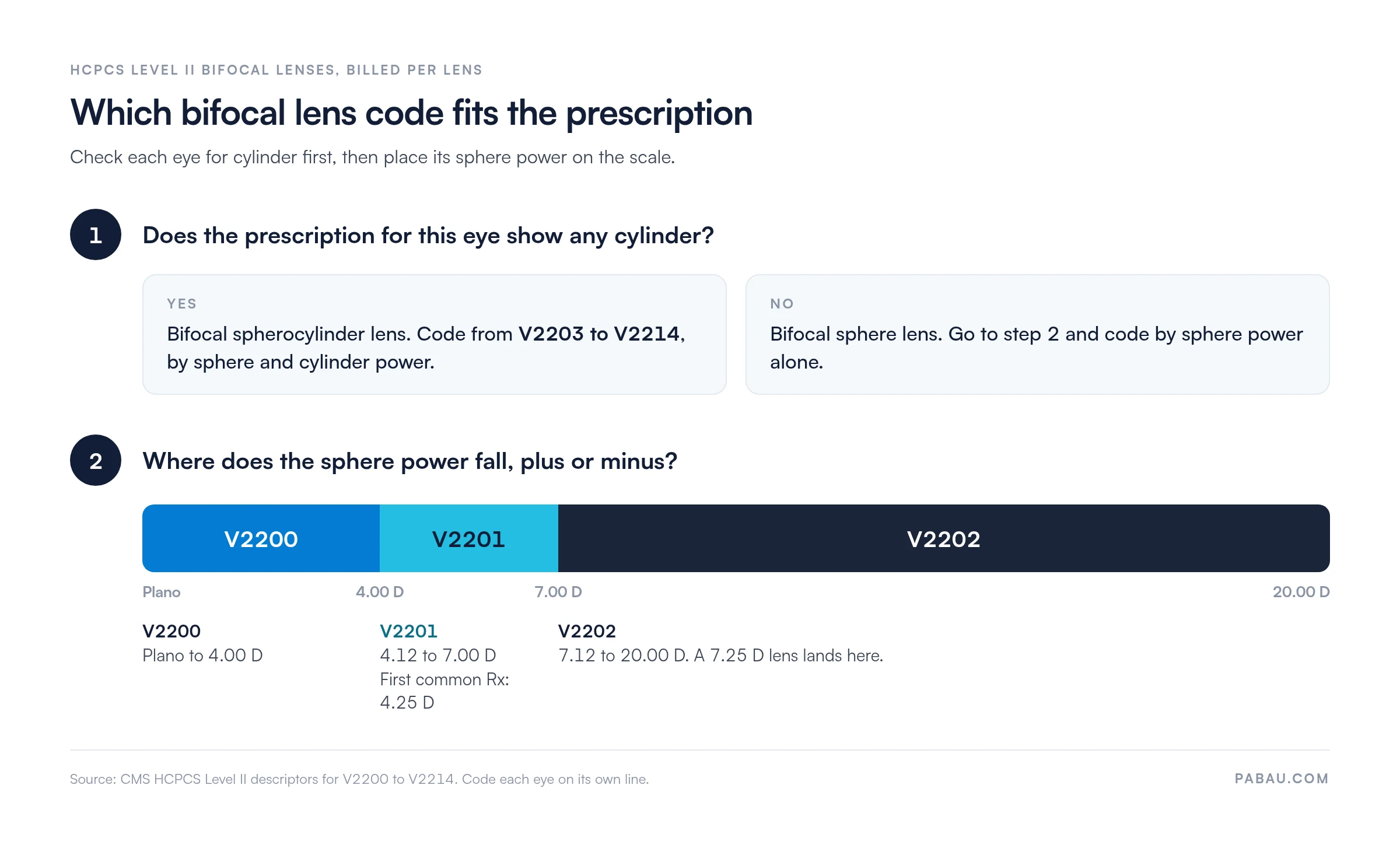
Each lens is coded on its own. A patient with a 3.75 D right eye and a 5.00 D left eye gets V2200-RT and V2201-LT on separate lines.
V2201 is billed by the supplier that dispenses the lens, not by the prescriber for writing the order. On a Medicare claim, that supplier must be enrolled as a DMEPOS supplier and bills the DME MAC for its region.
Medicare covers V2201 only for patients with aphakia, congenital aphakia, or pseudophakia. Refractive lenses fall under the prosthetic device benefit in Social Security Act section 1861(s)(8). The DME MAC Refractive Lenses LCD (L33793) and its Refractive Lenses policy article (A52499) set the rules.
For pseudophakia, coverage is one pair of eyeglasses or contact lenses after each cataract surgery with an intraocular lens. Replacement lenses for pseudophakic patients are not covered. For aphakia, replacement lenses are covered when they are medically necessary.
Before billing V2201 to Medicare, check which eye had surgery and when. A second pair after the same surgery is not covered for pseudophakia, so get a signed ABN before you dispense it.
Medicare Advantage plans must cover post-cataract lenses at least as well as traditional Medicare. Many also add routine eyewear benefits, with their own networks and allowances.
Medicaid coverage of bifocal lenses varies by state. Some states cover adult eyewear on a set schedule, and others limit it to children. Commercial vision plans often accept V-codes for routine eyewear, but each plan sets its own frequency and allowance. Run insurance eligibility verification before the patient orders the glasses.
Every V2201 claim needs a diagnosis code that supports the lens. On a Medicare claim, only the aphakia and pseudophakia codes below support coverage.
A refractive error code alone on a Medicare V2201 claim leads to a noncovered denial. Match the diagnosis to the operative record for the eye that had surgery.
Laterality is mandatory on every V2201 line. The Medicare policy article also sets rules for patient-requested items that fall outside coverage.
When both lenses use V2201, bill two claim lines with one unit each, one with RT and one with LT. Do not bill RTLT on one line with two units. The policy article has required this since March 1, 2019.
KX does not apply to V2201 itself. It belongs on add-ons such as anti-reflective coating or tints, and only when medical necessity is documented.
Medicare treats progressive lenses as a deluxe upgrade. When a covered patient chooses progressives in the V2201 power range, bill V2201 for the standard bifocal on each eye.
Then add a separate V2781 line for the difference in charge between the progressive and the standard lens. V2781 is not covered, so it carries GA when the patient signed an ABN, or GZ when there is none.
A clean V2201 claim links the lens to a covered diagnosis and a valid order. Knowing what makes a clean claim helps you catch problems before you dispense. Keep these records on file:
Thorough records also support medical billing compliance if a payer audits the claim later.
Medicare pays V2201 from the CMS DMEPOS fee schedule, not the physician fee schedule. Allowed amounts are set per lens and vary by state, and CMS updates them each year.
Load the current figure for your state into your fee table each January. Add-on items are billed on their own lines, such as V2020 for frames or V2750 for anti-reflective coating. Review your electronic remittance advice to spot lines that paid at zero or below the fee schedule.
Check your V2201 fee against the current DMEPOS fee schedule each January. Billing below the allowed amount leaves money unpaid on every lens.
Most V2201 denials trace back to the power range, laterality, or diagnosis. Denial management that sorts rejections by code shows which cause repeats.
A Medicare redetermination request must reach the DME MAC within 120 days of the initial determination. Our denial codes guide explains the reason codes on your remittance. Coding errors are usually faster to fix with a corrected claim than with an appeal.
Many optical teams keep the prescription in one system, the surgery date in another, and the ABN in a paper file. When a V2201 claim is questioned, someone has to find all three.
Pabau, the practice management platform we build, keeps those records on one patient file. Staff can confirm the eye, the power, and the surgery date before they dispense. With claims management built in, the team submits the claim and tracks its status in the same place.
The result is fewer claims sent without support, and faster corrections when a line comes back rejected.


Pabau keeps prescriptions, operative notes, and ABNs on the patient record and tracks each claim after submission. Your team spends less time chasing V-code denials.

V2201 is a narrow code. It fits only a bifocal lens with no cylinder and a sphere power from 4.12 to 7.00 diopters. Code each eye on its own, because one patient can need V2200 on one side and V2201 on the other.
For Medicare, the diagnosis decides payment more often than the lens does. Confirm aphakia or pseudophakia, check whether this pair is the first since surgery, and get an ABN for any upgrade. Book a demo to see how Pabau keeps your lens claims and their records together.

Need to understand how denials get coded on your remittance? Denial codes in medical billing explains the CARC and RARC codes that appear on optical supply claim remittances.
Want a cleaner claims workflow from first submission? What is medical billing covers the end-to-end billing cycle that V-series optical claims move through.
Looking to reduce revenue cycle friction? What is revenue cycle management outlines how optical practices can structure billing workflows to improve first-pass claim acceptance rates.
Does the prescription carry cylinder? HCPCS Code V2203 covers the first bifocal spherocylinder tier, where many V2201 prescriptions end up once astigmatism is added.
Is the patient upgrading to progressives? HCPCS Code V2781 explains how to bill the progressive upcharge alongside the standard bifocal lens.
HCPCS Code V2201 covers one bifocal sphere lens with a power from plus or minus 4.12 to plus or minus 7.00 diopters, billed per lens. Frames, coatings, and cylinder correction use separate V-codes.
Both are bifocal sphere lens codes, split by power. V2200 covers plano to plus or minus 4.00 D, and V2201 covers plus or minus 4.12 to 7.00 diopters. A 4.00 D lens is V2200, and a 4.25 D lens is V2201.
Yes, but only for aphakia, congenital aphakia, or pseudophakia, under the prosthetic device benefit. For pseudophakia, Medicare covers one pair of eyeglasses or contact lenses after each cataract surgery with an intraocular lens. Routine vision correction is not covered.
V2201 applies to bifocal sphere powers from plus or minus 4.12 to plus or minus 7.00 diopters. A 7.00 D lens stays in V2201, and a 7.25 D lens moves to V2202.
Common causes are a missing RT or LT modifier, two units on one line, or a refractive error diagnosis on a Medicare claim. A power outside 4.12 to 7.00 D, or any cylinder on the prescription, also leads to a denial.
Use a bifocal spherocylinder code from the V2203 to V2214 range, chosen by the sphere and cylinder values. V2201 is only for bifocal lenses with no cylinder.