CPT Code 51705: Change of cystostomy tube, simple
CPT Code 51705 at a glance CPT Code 51705 reports a simple change of a cystostom...

Last Updated: Oct 16, 2026
A4562 is the HCPCS Level II code for a pessary, reusable, non rubber, any type. It covers the device itself, while the fitting bills separately under CPT 57160.
A4562 sits next to A4561, the code for a reusable rubber pessary, and the material in the chart decides between them. A single-use pessary bills as A4564 instead. Medicare Part B claims go to the A/B MAC, not a DME MAC.
Let Pabau's smart automation suggest the right codes, reduce claim denials, and keep your practice compliant—effortlessly.
Automate repetitive tasks and focus on what matters most—your patients.
Reduce coding errors and ensure compliance with the latest regulations.
Clean claims, fewer denials, and faster reimbursements.
Powerful insights and reporting to help your practice thrive.
HIPAA compliant SOC 2 certified GDPR-compliant Trusted by 4,000+ clinics worldwide

A4562 covers a reusable, non-rubber pessary of any type, usually silicone. A4561 covers a reusable rubber pessary, so the material recorded in the chart decides the code.
Medicare Part B claims for A4562 go to the A/B MAC with fitting code CPT 57160, not to a DME MAC. A4562 is carrier-priced, with no DMEPOS fee schedule amount.
No KX modifier or pessary LCD applies to A4562. Use GA, GX, GY or GZ only when Medicare coverage is in doubt.
Pair the claim with a documented diagnosis, such as N81.x pelvic organ prolapse, N39.3 stress incontinence or N39.46 mixed incontinence.
Pabau, the practice management platform we build, keeps the fitting note and ABN on the patient record. Its claims management submits and tracks claims built from that record.
HCPCS Code A4562 is one of the HCPCS Level II codes, an alphanumeric supply code in the A-range. It is maintained by the Centers for Medicare and Medicaid Services (CMS) HCPCS Workgroup. The official descriptor is Pessary, reusable, non rubber, any type. It covers the device only. The fitting bills separately as CPT 57160, and Medicare Part B claims for both go to the A/B MAC.
The A-range covers medical and surgical supplies. A4562 sits alongside A4561 (rubber pessary) as a supply code, so it covers the device itself. The clinical service of fitting or managing it is a separate charge. Billers often conflate the two. They need separate claim lines, each supported by the chart note.
A4561 and A4562 share the same structure, and only the material separates them. Both describe a reusable device. A4561 is a rubber pessary and A4562 is any non-rubber pessary.
Before submitting, confirm the material type documented in the medical record. If the chart says “silicone ring pessary,” the correct code is A4562. Billing A4561 for a silicone device is a coding error, and it needs a corrected claim.
Check whether the device is reusable, too. A single-use pessary fits neither code, because CMS lists it separately as A4564, “Pessary, disposable, any type.” The diagram below maps all three codes and the claim path for A4562.
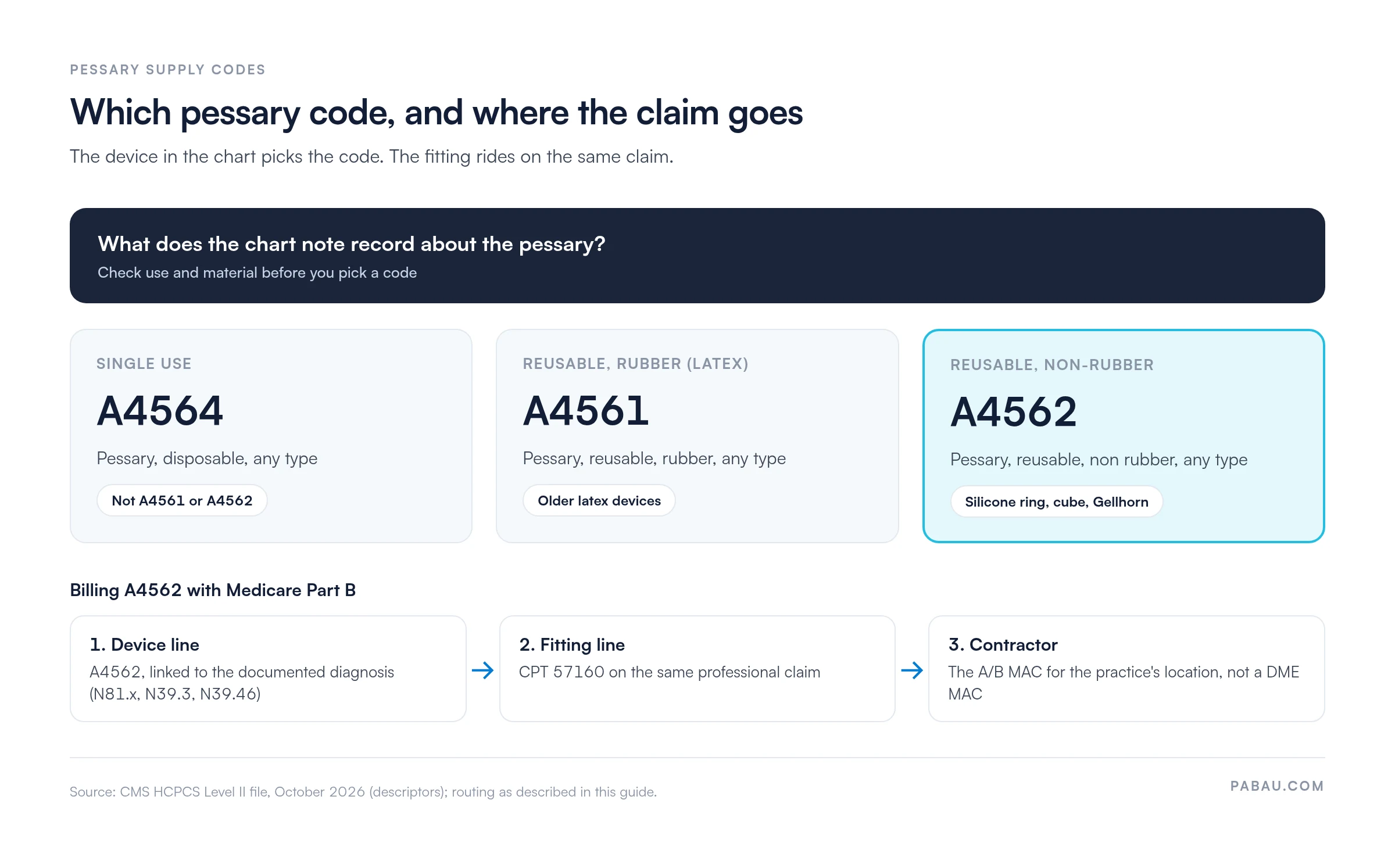
Medicare and most commercial payers require documented medical necessity before covering a pessary supply. The treating physician’s notes must establish one of the accepted clinical indications, and the matching ICD-10-CM code must appear on the claim.
We found no Local Coverage Determination (LCD) that lists covered diagnoses for pessaries. The chart note therefore carries the medical necessity case on its own. Check commercial payer policies too, since some publish their own diagnosis lists.
Billing A4562 correctly follows a set sequence before the claim reaches the A/B MAC. Skipping a step creates audit exposure. Understanding medical billing fundamentals for in-office supplies helps practices build a clean workflow from the start.
When coverage is in doubt, the modifier on an A4562 claim decides who carries the cost if Medicare denies. The table below covers the ABN modifiers, which apply only when Medicare coverage is in doubt. Confirm current guidance with your A/B MAC, because modifier policies change.
Most A4562 claims need no modifier at all, because no pessary LCD sets a KX requirement. GY tells Medicare the item is non-covered, so payment routes elsewhere. Applying GZ when you should have issued an ABN and used GA means the provider cannot recover payment from anyone.
Medicare Part B pays for A4562 through the A/B MAC when the practice supplies and fits the pessary. A4562 is carrier-priced, so each A/B MAC sets its own allowance. There is no DMEPOS fee schedule amount for it. Check the fitting fee for CPT 57160 in the CMS Physician Fee Schedule look-up tool before quoting an out-of-pocket estimate.
An ABN protects the provider’s right to collect from the patient if Medicare denies the claim. Issuing it correctly matters as much as issuing it at all.
Run an eligibility check before every pessary fitting. Confirming active Part B coverage and the patient’s secondary payer takes two minutes. It also shows whether you need an ABN before the visit.
A4562 covers the device only. The clinical service of fitting and inserting the pessary bills separately under CPT 57160. Leave either line off and the practice loses that payment.
Both lines go on the same professional claim to the A/B MAC. A4562 pays the device, and CPT 57160 pays the fitting. If the visit also covers a separately identifiable problem, bill the E/M code with modifier 25.
Most A4562 denials trace back to a handful of root causes. Solid denial management workflows catch these before they reach the payer. Use the table below to identify the pattern and apply the corrective action before resubmission. OB-GYN and urogynecology practices should keep the fitting note and diagnosis on the same record, so it is ready if a claim is questioned.
Work through this checklist before submitting every A4562 claim. Clean claim submission depends on fixing missing documentation before the claim reaches the payer, not after a denial letter arrives.
Audit your A4562 claims quarterly. Pull every denial from the last 90 days and sort them by root cause. Typical causes are a wrong code, an ABN modifier error, a diagnosis mismatch or the wrong contractor. One hour of audit work typically uncovers a billing pattern worth correcting before the next quarter.
Pessary claims depend on details recorded at the fitting: the material, the size, the diagnosis and any ABN. When those sit in different places, a coder has to chase them before the claim can go out.
Pabau keeps the fitting note, consent and ABN on the same patient record. Its claims management software submits claims built from that record and tracks their status. Billing staff can see what was sent and where each claim stands.
Practices running a pelvic health service can also use templated notes for pessary fittings and follow-up visits. Each review then records the same details, so the next claim starts from a complete note.

Pabau keeps the fitting note, the pessary details and any ABN on one patient record. Its claims management then submits and tracks the claim. See how it works for pelvic health practices.

A4562 is a practice-billed supply, and the routing decision follows from that. The pessary and its CPT 57160 fitting travel together on one claim to the A/B MAC. A DME MAC never sees it.
The judgment to keep is that the material decides the code, and the chart note decides the payment. Record the pessary type, size and diagnosis at the fitting, and the claim needs no special modifiers. Book a demo to see how Pabau keeps pessary fittings and claims on one record.

Need to understand how medical billing errors create revenue leakage? Medical billing fundamentals for healthcare practices walks through the end-to-end claims process and where most practices lose revenue.
Looking for a clearinghouse to submit physician claims? How a medical claims clearinghouse works explains payer connectivity, claim scrubbing, and electronic remittance for outpatient billers.
Want a systematic approach to working denied claims? Denial management in healthcare covers root-cause analysis, appeal workflows, and tracking denial trends by payer.
Billing a latex pessary instead? HCPCS Code A4561 covers the rubber pessary code, its diagnosis pairing and where the claim goes.
HCPCS Code A4562 is the Level II supply code for a reusable, non-rubber pessary of any type. It covers the device cost only. The fitting bills separately as CPT 57160, and Medicare Part B claims for both go to the A/B MAC.
Most A4562 claims need no modifier, because no pessary LCD sets a KX requirement. When Medicare coverage is in doubt, use GA with a signed ABN or GX for a voluntary ABN. Use GY for a known non-covered item, or GZ without an ABN. Other modifier use depends on the payer.
A4561 covers a reusable rubber (latex) pessary, and A4562 covers a reusable non-rubber pessary, most commonly silicone. The material documented in the medical record determines which code applies. Billing A4561 for a silicone pessary is a coding error that needs a corrected claim.
The main supporting codes come from the N81.x series for pelvic organ prolapse, including cystocele, uterovaginal prolapse and rectocele. For incontinence, use N39.3 for stress, N39.41 for urge, or N39.46 for mixed incontinence. Code each one to full specificity, such as N81.11 for a midline cystocele.
Common denial reasons are the wrong material code, a diagnosis that does not support medical necessity, and thin documentation. Claims sent to a DME MAC instead of the A/B MAC also fail. To appeal, gather the chart notes and confirm the ICD-10-CM code. Then file a redetermination request with the A/B MAC.