CCSD Code W0282: Trapezium excision surgery
W0282 covers removal of the whole trapezium CCSD code W0282 is the UK private-se...

Last Updated: Nov 24, 2026
T5999 is the HCPCS Level II code for a supply, not otherwise specified. State Medicaid programs use it when no specific HCPCS code describes the item.
T codes are not payable by Medicare, though some private insurers accept them. Because the code names no item, each claim is reviewed by hand. Send the item description, manufacturer, quantity and invoice price with it.
Let Pabau's smart automation suggest the right codes, reduce claim denials, and keep your practice compliant—effortlessly.
Automate repetitive tasks and focus on what matters most—your patients.
Reduce coding errors and ensure compliance with the latest regulations.
Clean claims, fewer denials, and faster reimbursements.
Powerful insights and reporting to help your practice thrive.
HIPAA compliant SOC 2 certified GDPR-compliant Trusted by 4,000+ clinics worldwide

HCPCS Code T5999 means “Supply, not otherwise specified” and applies only when no specific HCPCS Level II code describes the item.
T codes are designated mainly for state Medicaid agencies and may be used by private insurers, but Medicare does not pay them.
Payers review miscellaneous codes by hand, so every T5999 claim needs an item description, pricing, and a letter of medical necessity.
Pabau’s claims management software tracks prior authorizations on the case and sends US claims through the Claim.MD clearinghouse.
HCPCS Code T5999 is the Level II code with the official descriptor Supply, not otherwise specified. It belongs to the T-code range (T1000-T5999), a series maintained by the Centers for Medicare & Medicaid Services (CMS).
CMS’s HCPCS Level II coding procedures reserve T codes mainly for state Medicaid agencies. Private insurers may also use them, but they are not payable by Medicare. T5999 applies only when no specific HCPCS code describes the item.
T5999 is not the only catch-all in the range. The T series holds other not-otherwise-specified entries, such as T2032 for monthly residential care under a waiver. The table below shows the core code facts at a glance.
The “not otherwise specified” wording is the part of the descriptor that drives the workflow. It tells the payer the biller has checked the HCPCS Level II code set and found no specific code for the item.
CMS notes that claims with miscellaneous codes are reviewed manually. The item has to be clearly described, with pricing and documentation explaining why the patient needs it.
HCPCS Code T5999 applies when a Medicaid-covered patient needs a supply that matches no specific descriptor in the HCPCS Level II code set. It is a last-resort code, used only after a review of the available codes confirms there is no match.
If a more specific code exists, it must be used instead. Billing T5999 when a specific code is available is a coding error that payers can flag in post-payment audits. Common scenarios that lead billers to T5999 include:
Before using T5999, search the full HCPCS Level II code set at the official CMS HCPCS reference and confirm no specific code matches.
Our HCPCS code guides cover individual Level II codes, which helps when a likely candidate needs a closer look. Record that search in the claim notes, since some Medicaid managed care organizations ask for it under their NOC code policy.
T5999 coverage depends on the state Medicaid program and, where applicable, the managed care organization (MCO) administering the patient’s benefit. Because Medicare does not pay T codes, Medicare manuals give no payment guidance for T5999. State Medicaid agencies set their own policies, and those policies vary considerably.
Where coverage exists, the state Medicaid agency sets the T5999 rate, often as a percentage of invoice cost or a fixed allowable amount. Check the current state fee schedule before quoting a figure.
Rates change with annual state budget cycles and may differ between fee-for-service and MCO contracts. Confirm the payer’s reimbursement policy before the patient receives the item, so the practice isn’t left with an unpaid supply.
Before providing any item you plan to bill as HCPCS Code T5999, contact the patient’s Medicaid plan to verify coverage and obtain prior authorization. Record the authorization number, the agent you spoke with, and the approval date. That record is your first line of defense against a denial.
Billing T5999 follows a defined workflow, and skipping a step raises the denial risk because NOC codes get closer payer review. The sequence below follows typical state Medicaid billing manuals for supply claims. The claim-form fields match the CMS Medicare Claims Processing Manual (Publication 100-04).
Documentation for HCPCS Code T5999 runs deeper than for a defined supply code. Payers manually review every NOC code, so a missing document usually means a denial or a records request. These documents are standard across most state Medicaid programs:
A clean claim for T5999 has every one of these documents on file before submission. Pulling them together after a denial or audit request delays payment and adds administrative cost.
Modifiers clarify billing circumstances and affect whether a claim pays. The table below covers the modifiers most often appended to T5999 claims. Confirm each one with the specific Medicaid plan, since modifier policies can differ between fee-for-service and MCO contracts.
GA, GY, and GZ are Medicare liability modifiers. On a T5999 claim they matter mainly for a dual-eligible patient, when Medicare is billed first to obtain a denial before Medicaid pays.
The KX modifier carries the most weight on T5999 claims. Appending KX declares that every document the payer’s policy requires is on file at the time of billing. KX without that documentation exposes the practice to False Claims Act risk. Good medical billing compliance protocols make the KX attestation the final check before submission.
HCPCS Code T5999 is one of several miscellaneous codes, and each covers its own category of item. T5999 fits a supply with no specific code, billed to a payer that accepts T codes, which mainly means state Medicaid.
Medicare does not pay T codes, so a Medicare claim for a DME supply goes to A9999 instead. The payer’s policy decides which code it accepts.
Read as a decision, the choice comes down to two questions: does a specific code exist, and what kind of item is it? The chart below lays out that order.
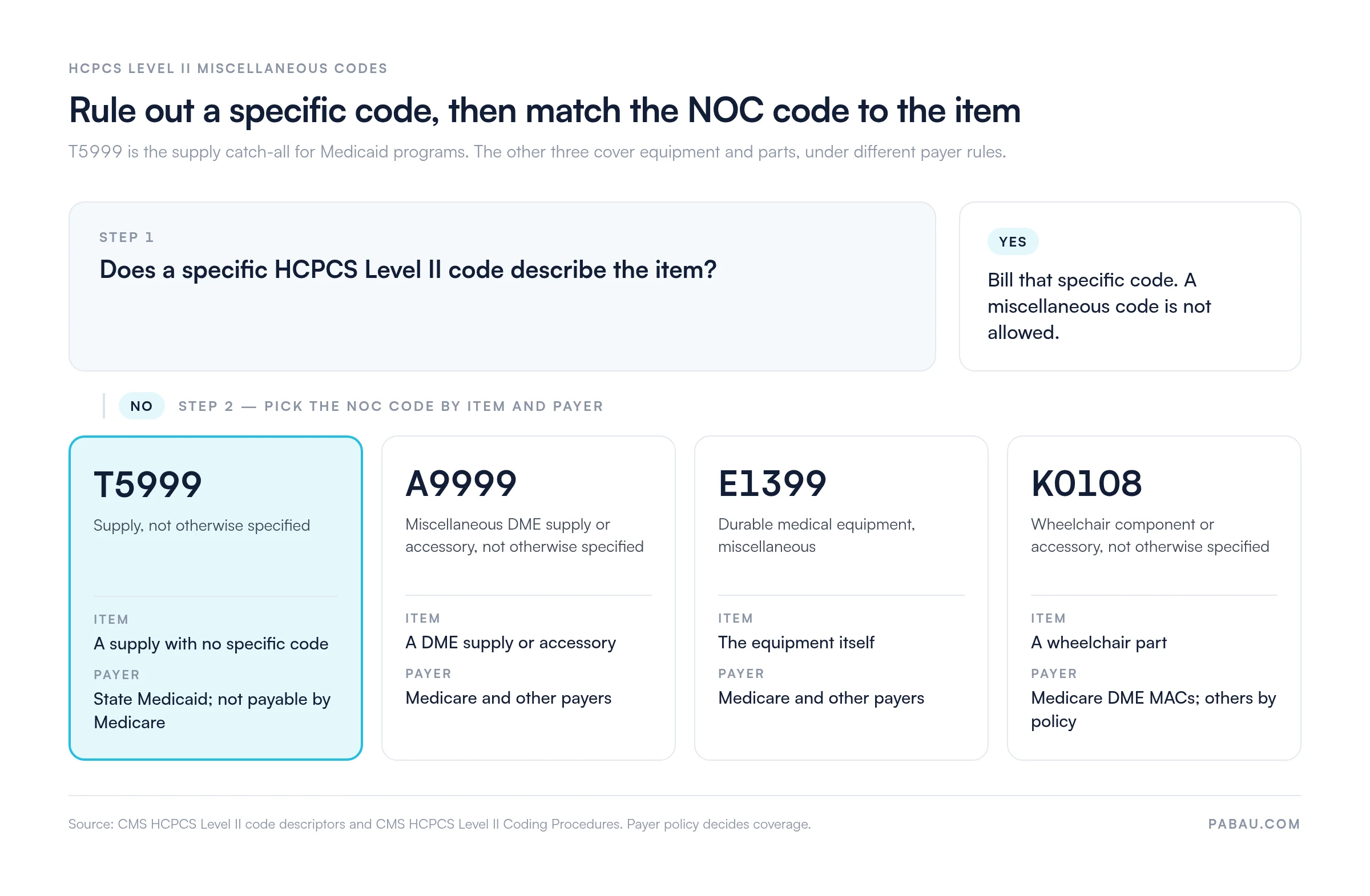
Each neighbor has its own billing rules. Our guide to A9999 covers Medicare DME supply claims, and K0108 covers unlisted wheelchair parts.
The American Academy of Professional Coders (AAPC) notes that a HCPCS Level II code does not guarantee coverage. Verify coverage with the payer first. When in doubt, send a written query to the payer’s provider relations team. Keep its response in the patient file as support for the code choice.
A T5999 claim needs a narrative item description, the right modifiers, and its supporting documents. Billing software that treats it like any other HCPCS code produces incomplete claims. Look for these capabilities when you assess a platform for NOC billing:
Pabau, a practice management platform with built-in claims management software, keeps those pieces in one system. It tracks the authorization code, dates, and sessions on the patient’s case and warns when one is missing. US claims go out as CMS-1500/837P claims through the Claim.MD clearinghouse.
Eligibility checks and electronic remittance advice come back against the same patient record. The clinical notes behind the letter of medical necessity are already there too, so nobody re-keys them for the claim.

Pabau tracks prior authorizations on the patient’s case and submits US claims through the Claim.MD clearinghouse. Eligibility checks and remittances come back against the same record.

T5999 is a fallback, and a T5999 claim is only as strong as the search that ruled out a specific code. Before reaching for it, make one more pass through the HCPCS Level II code set and check the item type against A9999, E1399, and K0108. A specific code paid on first submission beats a miscellaneous code that waits in manual review.
When T5999 is the honest answer, the claim stands or falls on paperwork collected before the item ships. Get the authorization, the letter of medical necessity, and the invoice on file first, and the review becomes a formality. Book a demo to see how Pabau keeps authorizations and claims together for Medicaid supply billing.

Need a broader grounding in medical billing? Medical billing fundamentals explains how claims move from service delivery to payment and where NOC codes fit in the cycle.
Dealing with T5999 denials after submission? Denial codes in medical billing breaks down the most common remittance adjustment reason codes and how to respond to each.
Want to understand how claims flow through a clearinghouse? Medical claims clearinghouse covers how electronic claims are validated, routed, and confirmed before reaching the payer.
HCPCS Code T5999 is the Level II code for a supply, not otherwise specified. State Medicaid agencies use it for supplies that have no specific HCPCS descriptor. It belongs to the T-code series (T1000-T5999), which CMS designates mainly for Medicaid use. Medicare does not pay T codes.
No. CMS states that T codes are not payable by Medicare. For a Medicare claim for a DME supply or accessory with no specific code, billers use A9999 instead, or E1399 for miscellaneous equipment.
Use HCPCS Code T5999 only after reviewing the full HCPCS Level II code set and confirming no specific code describes the supply. Common scenarios include newly FDA-cleared products without a permanent code, custom supplies, and rarely furnished items. If a more specific code exists, it must be used instead.
T5999 claims need a letter of medical necessity signed by the ordering provider, a supplier invoice, and clinical notes supporting the order. They also need written prior authorization from the Medicaid plan and a plain-language description of the item on the claim. Missing any of these is a leading cause of NOC code denials.
T5999 means “Supply, not otherwise specified” and sits in the T-code series used mainly by state Medicaid agencies. A9999 means “Miscellaneous DME supply or accessory, not otherwise specified” and is used by Medicare and other payers. Medicare does not pay T5999, and each Medicaid program sets which of the two it accepts.
Enter T5999 in Box 24D on a CMS-1500 for professional claims, or Form Locator 44 on a UB-04 for institutional claims. Include a brief description of the item in the narrative field and attach the required documentation. Apply any modifiers the plan requires, commonly KX, and get prior authorization before submission.