HCPCS code K0829: Extra heavy duty power wheelchair billing guide
HCPCS code K0829: Definition and official descriptor HCPCS code K0829 is the Hea...

Last Updated: Nov 24, 2026
V0980 is the CCSD code for open reduction of fracture of zygomatic complex of bones. UK private medical insurers such as Bupa, AXA Health, Aviva and Vitality use it to pay for the operation. It applies when the surgeon exposes the cheekbone fracture, repositions it under direct vision and fixes it, usually with miniplates.
A reduction done without exposing the fracture is V0930, the closed-reduction code. CCSD lists the two as an unacceptable combination, so only one belongs on the invoice for a given fracture.
Let Pabau's smart automation suggest the right codes, reduce claim denials, and keep your practice compliant—effortlessly.
Automate repetitive tasks and focus on what matters most—your patients.
Reduce coding errors and ensure compliance with the latest regulations.
Clean claims, fewer denials, and faster reimbursements.
Powerful insights and reporting to help your practice thrive.
HIPAA compliant SOC 2 certified GDPR-compliant Trusted by 4,000+ clinics worldwide

CCSD code V0980 covers open reduction of a zygomatic complex fracture. Closed reduction of the same fracture is V0930, and CCSD lists the two as an unacceptable combination.
UK private medical insurers such as Bupa, AXA Health, Aviva and Vitality use CCSD codes, and each one sets its own fee against V0980.
Pair V0980 with the WHO ICD-10 code S02.4 Fracture of malar and maxillary bones, plus a separate code for any orbital floor or mandible fracture.
Pabau, a practice management platform, keeps the CCSD code, ICD-10 diagnosis and authorisation reference on one patient record. The invoice then goes to the insurer through Healthcode.
CCSD code V0980 is the UK private-healthcare procedure code for open reduction of a fracture of the zygomatic complex, the cheekbone. AXA Health’s specialist code schedule lists its official descriptor as Open reduction of fracture of zygomatic complex of bones. Surgeons and anaesthetists use it to invoice private medical insurers for the operation.
CCSD stands for Clinical Coding and Schedule Development. The CCSD Group is made up of Bupa, AXA Health, Aviva and Vitality, and it maintains the schedule. Other UK insurers, such as WPA and The Exeter, recognise CCSD codes too. Our Bupa CCSD codes guide explains how the schedule works with insurer fees.
V0980 sits in chapter 6 of the schedule, Face, mouth, salivary and thyroid, under section 6.1, Face and Jaws. The code applies when the surgeon exposes the fracture through an incision, repositions the bone under direct vision and fixes it in place. A reduction done without exposing the fracture is V0930, the closed-reduction code.
The zygomatic complex, also called the zygomaticomaxillary complex or ZMC, forms the cheekbone. It joins the frontal bone above, the temporal bone at the arch, the maxilla in front and the sphenoid bone inside the orbit. A displaced ZMC fracture usually breaks at several of these joins at once, which is why it is often called a tripod or tetrapod fracture.
Not every ZMC fracture needs surgery, and not every operated one needs an open approach. Surgeons usually choose open reduction and fixation when one or more of these findings is present:
The operative note should record which of these findings applied. An insurer reviewing a V0980 invoice looks for the reason an open approach was needed.
The V0980 descriptor does not name an approach, so the code covers the open reduction whichever route the surgeon takes. The operative note should still name the approach, because it shows the fracture was exposed. The common routes are:
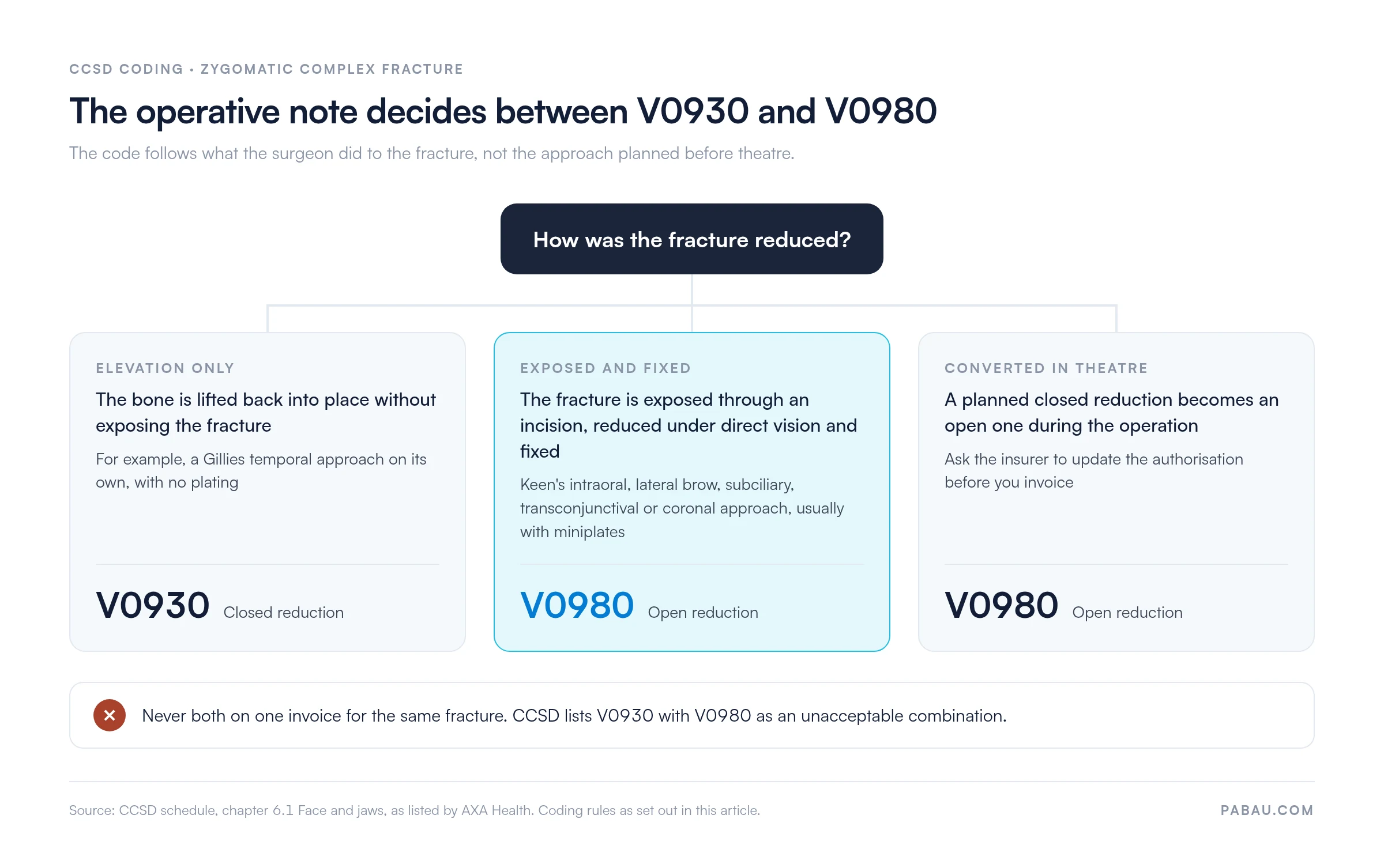
The Gillies temporal approach lifts a depressed bone from beneath the temporalis fascia without exposing the fracture. On its own it is a closed technique, so it points to V0930. When the surgeon uses it alongside an open approach and plates the fracture, V0980 is the code.
After the reduction, the surgeon usually fixes the fracture with titanium miniplates and screws at one or more points. The note should list each fixation point.
V0980 is the surgeon’s code for the open reduction. The table shows what falls within it and what is invoiced or coded on its own.
Insurers each apply their own rules to combined procedures. Check the CCSD technical guide before you add a second code to a V0980 invoice.
The most common coding error on a cheekbone fracture is picking the wrong side of the open and closed split. The table sets V0980 against its closed-reduction sibling.
CCSD lists V0930 and V0980 as an unacceptable combination, so only one belongs on the invoice for a given fracture. If a planned closed reduction becomes an open one in theatre, invoice V0980 and ask the insurer to update the authorisation. The diagram maps each operative-note finding to its code.
Concurrent injuries, such as an orbital floor or mandible fracture, carry their own CCSD codes. Our CCSD code guides explain individual codes across the schedule, so you can check each one before it goes on the invoice. Confirm the current code numbers in each insurer’s schedule or the Bupa code search before you invoice.
CCSD sets the codes, and each insurer sets its own fees against them. Bupa, AXA Health, Aviva, Vitality, WPA and The Exeter all publish separate schedules and benefit limits. The same V0980 operation can therefore pay a different amount, in pounds sterling, from one insurer to the next.
A surgeon who charges more than the insurer pays leaves the patient with a shortfall. Tell the patient about any shortfall in writing before the operation. When comparing UK medical billing software, check that it holds each insurer’s fee against the CCSD code.
Look up the V0980 fee in each insurer’s current schedule before you quote the patient. One insurer’s figure is not another’s, so record the shortfall conversation before you charge above the insurer’s rate.
UK private medical insurers expect pre-authorisation before surgery. Many ZMC fractures are repaired once facial swelling settles, which leaves time to authorise. Requirements differ between insurers and policies, so confirm them for each patient before you book theatre.
If the operation has to happen as an emergency, contact the insurer as soon as you can. Each insurer sets its own rules for emergency admissions. When you request authorisation, have the following ready:
Record the authorisation reference in the patient’s file and quote it on the invoice.
Every V0980 invoice needs a diagnosis code that matches the documented fracture. UK insurers use the WHO ICD-10 classification, not the US ICD-10-CM edition. WHO ICD-10 has no left or right sides at this level, so record the side in the operative note.
S02.4 is the usual pairing for V0980. Each extra fracture that the surgeon treats needs its own diagnosis code alongside its own procedure code.
UK insurers expect a consistent set of clinical documents before they pay a V0980 invoice. A missing document can be enough for the claim to be held.
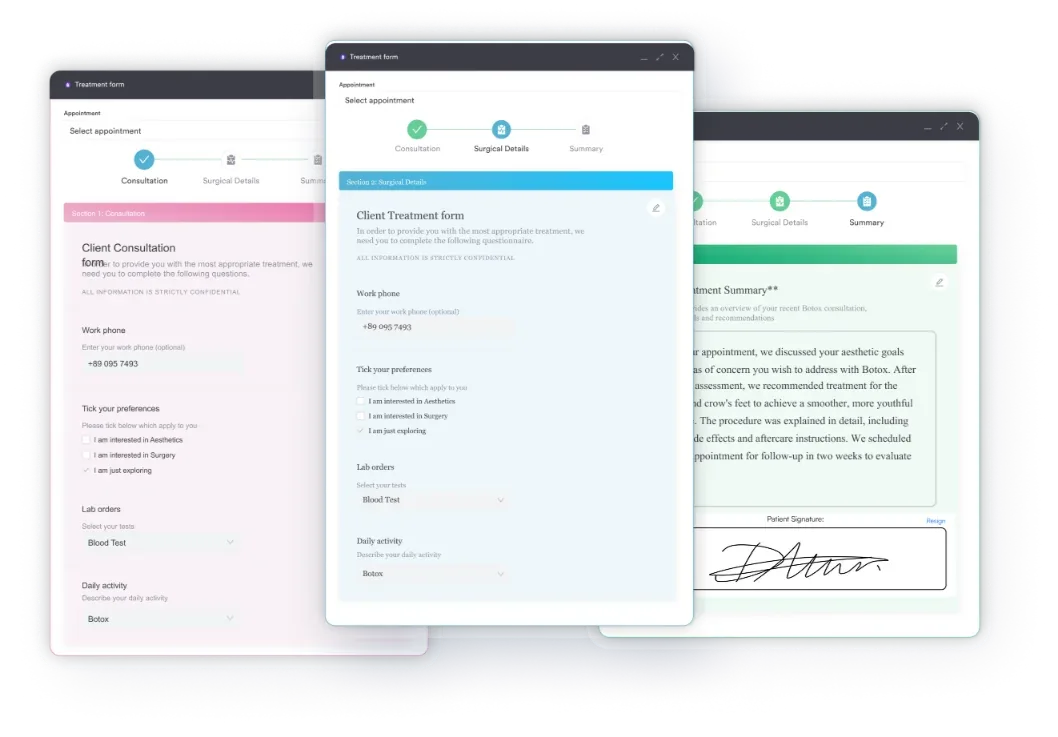
Digital clinical forms capture consent and surgical details at the point of care. The record is then complete before anyone raises the invoice.
CCSD has no US-style modifiers. When both cheekbones are repaired in one session, or V0980 is one of several procedures, each insurer applies its own rules. Some pay a second procedure at a reduced rate, so check the policy before you invoice.
For a bilateral case, make sure the authorisation covers both sides and the operative note records each one. For panfacial trauma, list each fracture with its own procedure and diagnosis code.
V0980 claims are rejected for a predictable set of reasons. Most are preventable with a check before the invoice goes out.
When a claim is rejected, ask the insurer for the reason in writing. Administrative errors can usually be corrected and resubmitted. A clinical rejection may need a formal appeal with more evidence.
Run a V0980 check before every invoice. Confirm the note shows an open approach and fixation, the authorisation covers V0980, and the ICD-10 code is S02.4. Make sure V0930 is not on the same invoice.
Billing errors on surgical codes like V0980 usually start before the invoice. The operative note is finished late, the authorisation reference sits in a separate inbox, or the diagnosis is chosen at billing time.
Pabau keeps all three on the patient record. Pabau’s claims management software holds the CCSD code, the ICD-10 diagnosis and the authorisation reference against the booking. The invoice is complete when it is raised, not patched together afterwards.
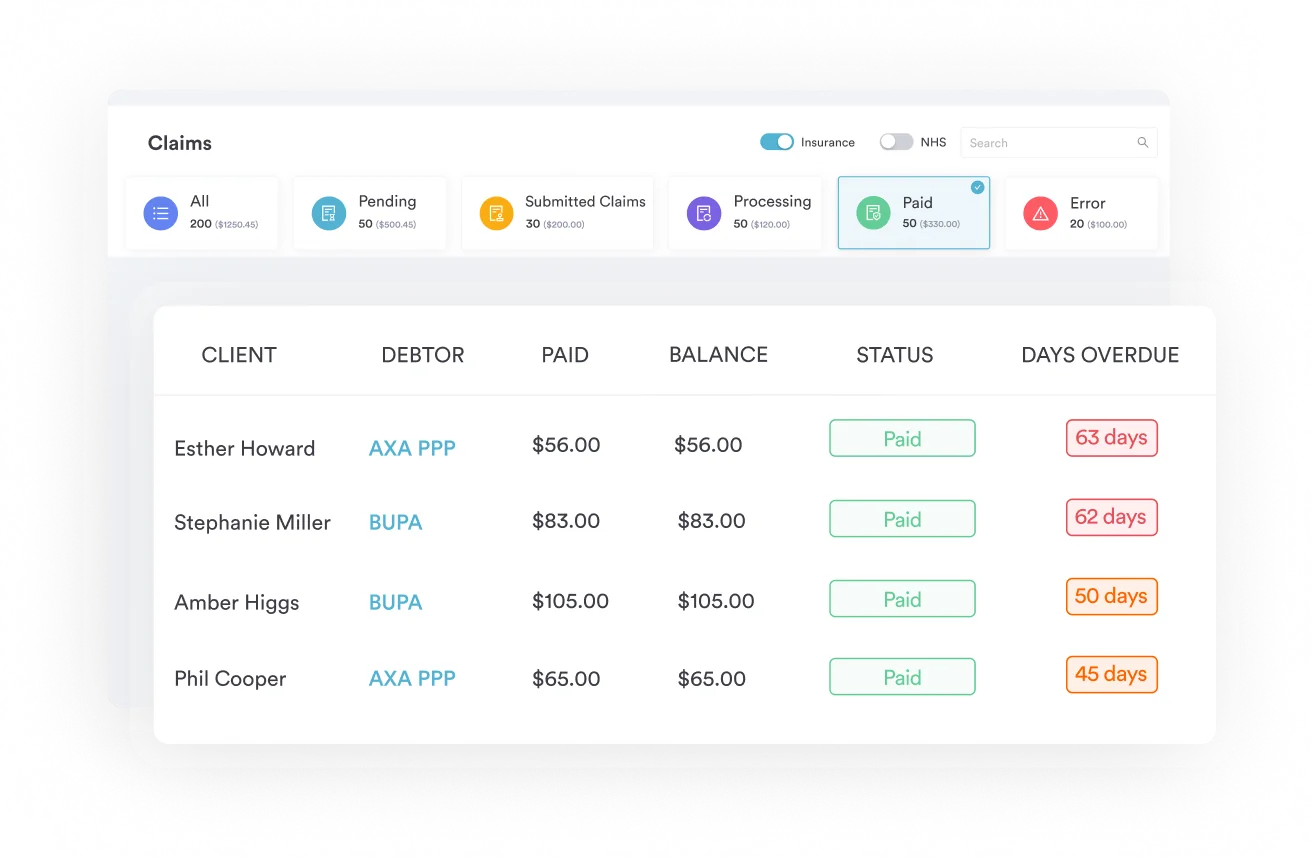
Invoices go to UK insurers electronically through Healthcode. The claims dashboard then shows which are pending, paid or rejected.

Pabau lets maxillofacial practices attach CCSD codes, ICD-10 diagnoses and authorisation references to the patient record. Every insurer invoice then goes out through Healthcode complete.

V0980 turns on one fact in the operative note: the fracture was exposed and fixed, not just elevated. Get that right, pair it with S02.4, and obtain authorisation before theatre. Miss any one of the three and the claim can stall, even when the repair was sound.
Practices that settle all three before surgery spend less time on insurer queries and get paid sooner. To see how Pabau keeps clinical records and insurer billing in one workflow, book a demo.

Need a broader CCSD billing reference? Bupa CCSD codes overview explains how the CCSD schedule works and how codes match insurer fee schedules.
Comparing billing platforms for a UK private practice? The best medical billing software in the UK reviews the leading options for insurer invoicing.
Looking up a neighbouring procedure? The CCSD code reference library lists Pabau’s guides to individual CCSD codes.
CCSD code V0980 is the UK private-healthcare procedure code for open reduction of a fracture of the zygomatic complex, the cheekbone. The surgeon exposes the fracture, repositions it and usually fixes it with plates. Closed reduction is a different code, V0930.
The CCSD Group insurers, Bupa, AXA Health, Aviva and Vitality, recognise V0980. WPA and The Exeter use CCSD codes too. Each insurer sets its own fee and authorisation rules against the code.
V0980 covers open reduction, where the fracture is exposed through an incision and usually plated. V0930 covers closed reduction, where the bone is elevated without exposing the fracture. CCSD lists the two as an unacceptable combination.
Yes, in most cases. UK private medical insurers expect authorisation before surgery, and many cheekbone fractures are repaired once swelling settles. After an emergency operation, contact the insurer as soon as you can and quote the reference on the invoice.
UK insurers use WHO ICD-10. The usual pairing is S02.4 Fracture of malar and maxillary bones. Add S02.3 for an orbital floor fracture or S02.6 for a mandible fracture when either is also treated.
The usual reason is an operative note that describes only a closed elevation. A missing authorisation reference and a diagnosis that does not match the fracture are next. A check before each invoice prevents most of them.