HCPCS code J7178: Hyaluronidase injection billing guide (2026)
HCPCS code J7178: Official descriptor and 2026 updates HCPCS code J7178 carries ...

Last Updated: Nov 20, 2026
T2032 is the HCPCS Level II code for residential care, not otherwise specified (NOS), waiver; per month. State Medicaid agencies use it to pay for residential support under a home and community-based services (HCBS) waiver, at one unit per month.
The per diem counterpart is T2033. Each state decides which residential service T2032 carries, its monthly rate and its modifiers, so the state waiver fee schedule is the deciding source.
Let Pabau's smart automation suggest the right codes, reduce claim denials, and keep your practice compliant—effortlessly.
Automate repetitive tasks and focus on what matters most—your patients.
Reduce coding errors and ensure compliance with the latest regulations.
Clean claims, fewer denials, and faster reimbursements.
Powerful insights and reporting to help your practice thrive.
HIPAA compliant SOC 2 certified GDPR-compliant Trusted by 4,000+ clinics worldwide

HCPCS code T2032 bills residential care, not otherwise specified, under a Medicaid HCBS waiver, at one unit per month.
T2033 is the per diem version of the same service, which some states use when a participant receives less than a full month.
Each state decides which residential service T2032 carries, so the waiver fee schedule sets the rate, modifiers and limits.
Waiver payments cannot cover room and board, so rent and food stay off the T2032 claim.
T2032 is a Medicaid-only T code, and it does not cover supported employment or job coaching.
HCPCS code T2032 is the Level II code for “residential care, not otherwise specified (NOS), waiver; per month.” The October 2026 CMS HCPCS file carries that descriptor, with T2033 listed beside it as the per diem version. State Medicaid agencies use it to pay for residential support under a home and community-based services (HCBS) waiver, one unit per month.
T codes are national codes that CMS created for state Medicaid agencies, so Medicare does not pay them. The AAPC Codify entry for T2032 places it in the waiver services range, T2012 to T2041. The assisted living waiver codes T2030 and T2031 sit beside it.
CMS publishes the HCPCS Level II code set in quarterly updates. For the current descriptor text, check the CMS HCPCS overview or the AAPC HCPCS code lookup.
T2032 covers residential support that a state waiver defines and no more specific HCPCS code describes. “Not otherwise specified” means the state, not CMS, fills in the service definition. In practice, states attach it to supported living and community living services for waiver participants.
Three published state fee schedules show how differently the same code is used:
Sources: Montana DDP fee schedule, Alabama ID waiver rate sheet and TennCare CHOICES rate chart. Rates change each year, so confirm the current schedule before you bill.
Activities inside the monthly rate can include help with daily living, supervision, medication support, community access and household skills. The exact list comes from your state waiver’s service definition.
Several services sit close to T2032 but are billed under other codes, or not billed to the waiver at all.
The unit decides between T2032 and T2033. Both describe the same residential care, NOS, under a waiver. T2032 pays once per month, and T2033 pays per day.
TennCare states the partial-month rule directly: bill T2032 monthly, or T2033 daily when a full month of service is not used. Other states set their own cut-off, so check the waiver manual.
Bill T2032 as one unit for each month of authorized service. The month only counts as full when the participant received residential support for all of it under your state’s rule.
A move-in, discharge or long hospital stay can leave a month incomplete. Some states switch you to T2033 for those days, and others prorate the monthly rate. Your waiver manual says which, and that rule decides the claim.
Modifiers on T2032 are set by each state, and the published examples vary widely:
Use the place of service code your state manual names for community residential settings. Attach only modifiers the fee schedule lists for T2032, because an unlisted one can reject the claim.
A monthly unit still needs documentation for each day of support behind it. The record has to show a full month of support, or show why you billed the partial month the way you did. Keep the daily service logs in one format, so each day can be checked against the month you bill.
Most state waiver manuals expect the T2032 record to include:
Federal rules require waiver services to follow a written person-centered service plan. A residential service the plan does not authorize is not billable, however well it is documented.
Plan for authorization before the first month of service. Rules differ by state and between fee-for-service Medicaid and managed care plans.
Re-check eligibility at the start of each month, because a lapse in Medicaid coverage voids that month’s claim. Build these checks into your medical billing compliance routine, so each month is cleared before the service starts.
Most T2032 denials trace back to the unit, the authorization or the rate contents. Building these checks into your denial management workflows catches them before submission. When a month does come back unpaid, the remittance advice names the reason with a claim denial code.
Run an eligibility check on the first day of every month a participant is in residential care. One lapsed day of Medicaid coverage can turn a full T2032 month into a partial one.
Each state Medicaid agency sets its own T2032 rate. There is no Medicare rate and no national fee schedule for T codes. The three published rates range from about $1,000 to over $3,000 a month for the same monthly unit:
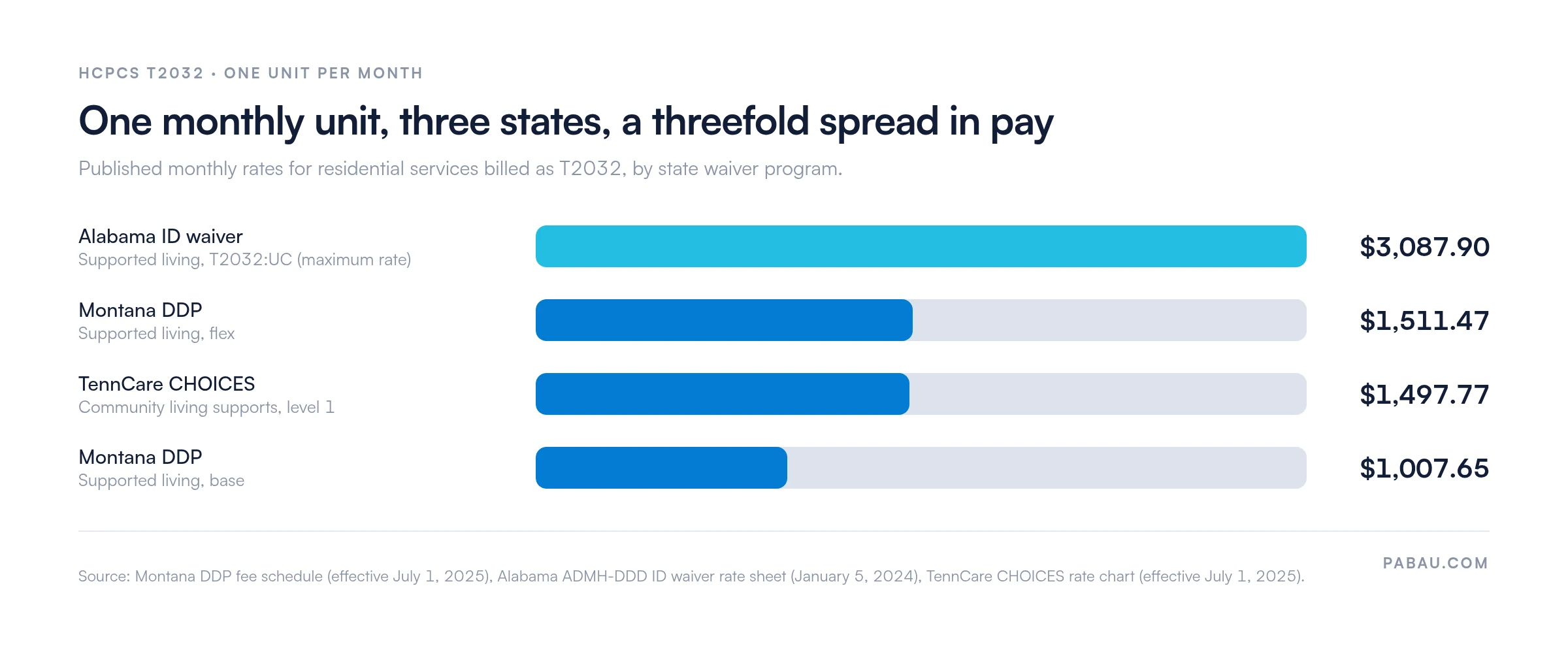
Managed care rates can differ from fee-for-service rates, and each plan may publish its own. The Medicare Informatics HCPCS tables explain code structure, but payment amounts come from the state fee schedule.
To find your state’s current T2032 rate:
A clean monthly T2032 claim follows the same seven steps every month.
Residential providers often track authorizations in one spreadsheet, service logs in another and claims in a third system. That split is where full-month bills for partial months slip through.
Pabau, a practice management platform with claims management, keeps those steps in one place. The prior authorization code, dates and sessions sit on the case, and Pabau warns when one is missing. US claims go out as CMS-1500 or 837P files through Claim.MD, with eligibility checks and ERA remittances.
Pabau’s automated workflows take routine follow-ups off your billing team, so they can focus on the month-end claim. The result is fewer denied months and less time spent on appeals.

Pabau tracks authorization codes and dates on each case and sends CMS-1500 claims with eligibility checks. Your team spots a missed day or a lapsed authorization before the claim goes out.

T2032 is a monthly code, and most of its billing risk sits at the edges of the month. Settle your state’s partial-month rule, its modifiers and its room-and-board limits before the first claim. Then check authorization and eligibility at the start of every month.
Do that, and the monthly unit becomes predictable income for your residential program. Book a demo to see how Pabau tracks waiver authorizations and claims in one place.

Need a foundation in Medicaid billing workflows? Revenue cycle management for healthcare practices explains how to structure the full billing lifecycle from eligibility through payment posting.
Looking to reduce claim denial rates across your programs? Denial codes in medical billing covers remittance remark codes, CARC categories, and appeal strategies for Medicaid and commercial payers.
Want to understand how superbills support waiver billing documentation? Superbill guide for healthcare practices explains how structured billing summaries can support service documentation requirements.
Billing assisted living rather than residential care? HCPCS code T2031 covers the per diem assisted living waiver code and when states use it.
Supporting a participant in work as well as at home? HCPCS code T2018 explains the supported employment waiver code that sits outside T2032.
HCPCS code T2032 is the Level II code for residential care, not otherwise specified (NOS), waiver; per month. State Medicaid agencies use it to pay for residential support under an HCBS waiver. One unit covers one month of service.
T2032 is billed per month, one unit for each month of service. The per diem version is T2033. Some states, such as Tennessee, use T2033 when a participant does not receive a full month.
Both codes describe residential care, not otherwise specified, under a waiver. T2032 pays one unit per month, and T2033 pays one unit per day. Never bill both for the same days.
No. Federal rules bar HCBS waiver payments for room and board. Rent, mortgage and food costs stay off the T2032 claim and are paid from other sources.
Each state sets its own modifiers. Montana uses CG when a legally responsible person delivers the service and GT for telehealth. Alabama bills supported living as T2032:UC. Check your state fee schedule.
No. T2032 is a residential care code. Supported employment and job coaching are billed with T2018 or T2019, or with H2023 to H2026, depending on the state.
No. T codes are created for state Medicaid agencies, and Medicare does not pay them. Bill T2032 to the state Medicaid waiver program or its managed care plan.