CPT Code 26410: Hand extensor tendon repair billing guide
CPT code 26410: Official descriptor and procedure overview CPT code 26410 report...

Last Updated: Nov 24, 2026
K0829 is the HCPCS Level II code for power wheelchair, group 2 extra heavy duty, captains chair, patient weight 601 pounds or more.
K0829 claims usually fail on documentation, not code selection. Three denial triggers recur. They are a missing face-to-face note, a prior authorization submitted after delivery, and a KX modifier without supporting records. This page covers modifiers, documentation, coverage criteria, reimbursement and CMS-1500 filing. Together they help billers get K0829 paid on the first submission.
Let Pabau's smart automation suggest the right codes, reduce claim denials, and keep your practice compliant—effortlessly.
Automate repetitive tasks and focus on what matters most—your patients.
Reduce coding errors and ensure compliance with the latest regulations.
Clean claims, fewer denials, and faster reimbursements.
Powerful insights and reporting to help your practice thrive.
HIPAA compliant SOC 2 certified GDPR-compliant Trusted by 4,000+ clinics worldwide

HCPCS code K0829 is a group 2 extra heavy duty power wheelchair with a captain’s chair seat, rated for patients weighing 601 pounds or more.
K0828 is the code most often confused with K0829. It shares the group and the weight tier but has a sling or solid seat and back.
Each Medicare claim carries RR, the KH, KI or KJ rental-month modifier, and KX when the LCD criteria are met. Using KX without supporting records can lead to denial, recoupment and audit.
CMS requires prior authorization for K0829 in every state and territory. Delivery before approval triggers automatic denial.
Pabau, a practice management platform, submits CMS-1500/837P claims through Claim.MD and tracks them in claims management.
HCPCS code K0829 is the Level II code for a group 2 extra heavy duty power wheelchair with a captain’s chair seat. It covers patients weighing 601 pounds or more. CMS’s master list entry for K0829 gives its descriptor as “Power wheelchair, group 2 extra heavy duty, captains chair, patient weight 601 pounds or more.” Each of its three parts is a separate coding decision, and each one has to match the chair on the delivery ticket.
K0829 belongs to the Medicare Part B category of power mobility devices (PMDs). Claims go to the DME Medicare Administrative Contractor (DME MAC) for the beneficiary’s region. The Power Mobility Devices LCD sets the coverage rules, and prior authorization applies in every state. CMS publishes changes to Level II codes in its HCPCS quarterly update files, so check the current file before relying on an older descriptor.
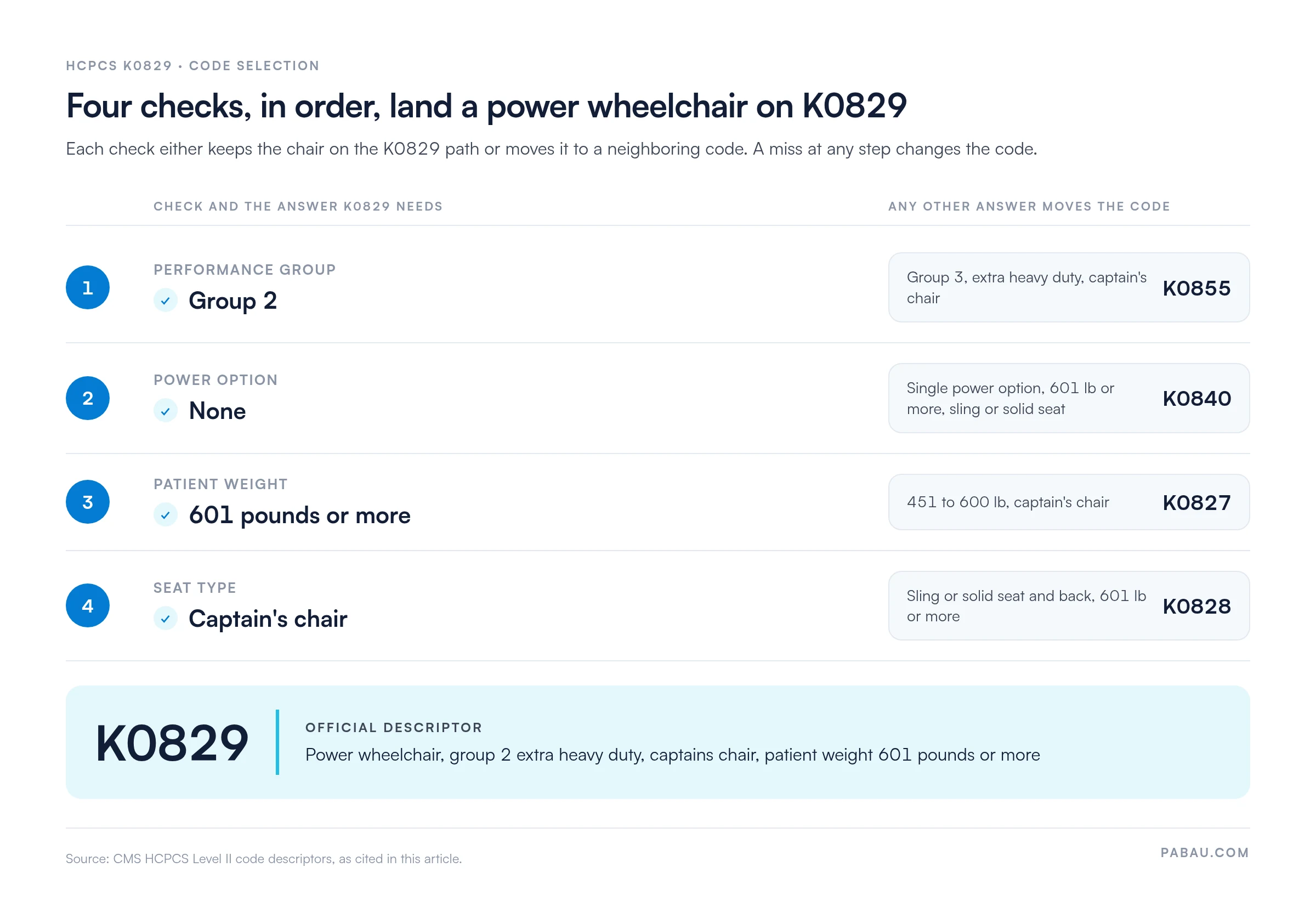
The weight tier is written into the descriptor, so there is no threshold to look up elsewhere. Extra heavy duty means 601 pounds or more. A captain’s chair rated for 451 to 600 pounds is K0827, the very heavy duty code, not K0829. The seat is the second test. A captain’s chair is a one-piece or two-piece automotive-style seat. An extra heavy duty group 2 chair with a sling or solid seat and back is K0828.
The code most often confused with K0829 is K0828. Both are group 2, both are extra heavy duty, and both are rated for 601 pounds or more. The only difference is the seat. The table sets K0829 against the codes that share one or two of its three attributes.
K0828 against K0829 is a seat decision, so the seat type needs to appear on the written order and on the delivery ticket. Bill K0828 for a sling or solid seat and back. Bill K0829 for a captain’s chair.
The other neighbors differ on group or weight. K0827 is the captain’s chair one tier down, for 451 to 600 pounds. K0855 is the group 3 extra heavy duty captain’s chair, covered only when the stricter group 3 criteria in the LCD are met. K0840 adds a single power option, and its descriptor specifies a sling or solid seat and back rather than a captain’s chair.
Lighter weight tiers sit well below K0829. K0824 is the group 2 heavy duty chair with a sling or solid seat and back, rated for 301 to 450 pounds. K0830 and K0831 are the group 2 standard seat elevator pair, rated up to and including 300 pounds. K0830 has a sling or solid seat and back, and K0831 has a captain’s chair.
K0835 is a group 2 standard chair with a single power option and a sling or solid seat and back. It is also rated for up to 300 pounds. Use the AAPC HCPCS code search to confirm current descriptors before billing. Taken together, these neighbors reduce code selection to four checks made in a fixed order.
Medicare Part B covers K0829 when the beneficiary meets the clinical eligibility criteria in the DME MAC LCD for Power Mobility Devices. Coverage is not automatic. The record must show that the patient cannot use a manual wheelchair and that a power wheelchair is medically necessary in the home. Run insurance eligibility verification before the order is placed, so no claim goes out for a beneficiary without coverage.
The core coverage requirements under CMS PMD policy are:
Coverage under other payers (Medicaid managed care, commercial insurers) varies by plan and state. Verify each payer’s PMD policy before billing K0829 to a non-Medicare payer.
Documentation failures are a common cause of K0829 denials. Under sound medical billing compliance requirements, the full documentation package must be in the supplier’s file before delivery, not assembled after the fact. The required file elements are:
Medicare requires DME suppliers to keep this documentation for at least 7 years from the date of service. Every element that substantiates the claim must exist in retrievable form before submission. Insufficient face-to-face notes are a common reason for denial.
Run a documentation checklist before every K0829 delivery, not after a denial. Build a supplier file that includes the face-to-face notes, written order, prior authorization approval, home assessment, and a signed delivery receipt. If any element is missing on delivery day, hold the delivery until the file is complete.
Medicare claims for K0829 carry a rental modifier, a rental-month modifier and, where the coverage criteria are met, KX. Leaving KX off a covered claim gets it denied. Using KX without supporting records can lead to denial, recoupment and audit.
The KX modifier tells the DME MAC that the supplier has verified every LCD coverage criterion. Medicare’s claims system needs it to pay K0829 at the full allowable. Without KX, the claim fails a coverage edit and is denied.
Before appending KX to a K0829 claim, the supplier file must hold a face-to-face evaluation supporting medical necessity and a compliant written order. It also needs home assessment notes and the prior authorization approval. Using KX without supporting records can lead to denial, recoupment and audit.
A standard power wheelchair such as K0829 is rental-only for Medicare. Since 2011, section 3136 of the Affordable Care Act and 42 CFR 414.229 have removed the purchase option for K0813 to K0831. Only complex rehab power wheelchairs, from K0835 up, can still be bought. Each monthly K0829 claim carries RR, the rental modifier, plus the modifier for that rental month:
Add KX where the coverage criteria are met. The month modifier has to match the rental month the claim covers.
The Medicare payment amount for HCPCS code K0829 is set by the DMEPOS fee schedule, which CMS publishes each year. DMEPOS fee schedule amounts are set by state. Verify the current allowable in the CMS DMEPOS fee schedule for the beneficiary’s state.
Under the capped rental methodology, Medicare pays a monthly rental for up to 13 months for a power wheelchair. Ownership then transfers to the beneficiary if the item remains medically necessary. Maintenance and servicing allowances continue after the transfer. The allowable for K0829 changes with each calendar year’s DMEPOS update, so pull the current fee schedule rather than relying on prior-year figures.
CMS requires prior authorization for K0829 in every state and territory. The group 2 range, K0820 to K0829, is on the required list for power mobility devices, per CGS Medicare’s prior authorization guidance. The DME supplier submits a prior authorization request to the DME MAC before delivering the chair. Delivery before a prior authorization decision, or after a denial without a successful appeal, ends in an automatic denial with no payment.
The prior authorization submission to the DME MAC must include:
The requirement covers every state and territory, so there is no state-by-state check for K0829. CMS can still add or change codes on its Required Prior Authorization List by notice. Check the current list before each new order rather than relying on an older copy.
The medical billing denial codes on a remittance show which part of the K0829 file failed. Common denial triggers for K0829 under Medicare include:
Medicare’s five-level appeals process applies to K0829 DME denials. A Level 1 appeal works best when it adds the missing documentation.
At Levels 1 and 2, the strongest appeals add the treating practitioner’s addendum to the face-to-face notes. They also include a written narrative from the practitioner explaining why the beneficiary’s mobility limitation meets the LCD criteria. Add any home assessment documentation that was left out of the original submission.
DME suppliers submit K0829 to the DME MAC on a CMS-1500 paper form or its 837P electronic equivalent. Structuring the claim correctly from the outset removes the mechanical denial triggers. A clean claim that clears the DME MAC’s front-end edits on the first pass avoids the cost of rework and appeal.
When stacking modifiers on K0829, put the pricing modifier (RR) first, then KH, KI or KJ, then KX. The PGM Billing HCPCS lookup tool and the CGS Medicare coding verification guidance both cover modifier stacking and place-of-service requirements for DME claims.
Enter the prior authorization reference number in Box 23 of the CMS-1500 whenever PA was obtained. Without it, the claim can deny for missing prior authorization even though the request was approved.
A K0829 chair produces up to 13 monthly claims, and each one needs the right month modifier. Many billing teams track that sequence in a spreadsheet beside the clearinghouse portal. A KI where KJ belongs, or a month nobody billed, only surfaces when the remittance comes back short.
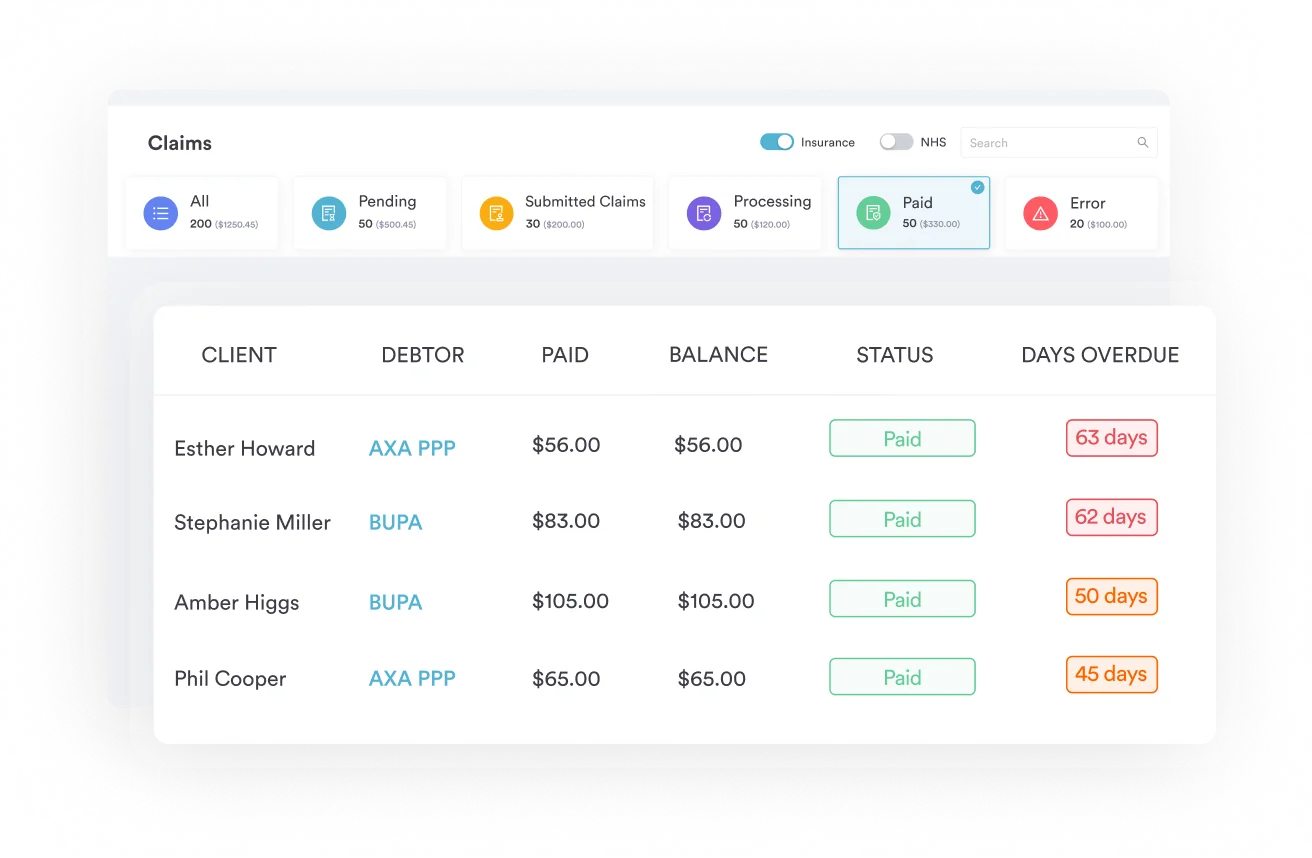
In Pabau’s claims management software, CMS-1500/837P claims go out through Claim.MD and are tracked in one list. Eligibility checks run before a claim is sent, and ERA remittances post back against the claim they pay.
Your team can see which claims came back unpaid without reconciling a spreadsheet. That means a denial gets worked while the supplier file is still to hand, not months later.

Pabau submits CMS-1500/837P claims through Claim.MD, checks eligibility first and posts ERA remittances back. Your team sees which claims are paid and which need work.

HCPCS code K0829 fits one chair: group 2, extra heavy duty, a captain’s chair, and a patient weight of 601 pounds or more. Change any one of those and the code changes with it. The usual miss is K0828, where the seat is a sling or solid seat and back. Check the seat and the weight tier against the written order first, because a perfect supplier file cannot rescue the wrong code.
Once the code is right, the claim stands on documentation. Prior authorization has to come before delivery in every state. The KX modifier needs the full LCD record behind it, and the rental modifier must match the rental month.
Build the supplier file before the chair leaves the warehouse, and the 13 rental claims that follow become routine. Book a demo to see how Pabau tracks each CMS-1500 claim from submission to remittance.

Struggling with claim rejections across your DMEPOS lines? Submitting a clean claim covers the field-level requirements that decide whether a claim clears the front-end edits before a reviewer ever sees it.
Want to understand how remittance data drives appeals decisions? Electronic remittance advice breaks down ERA transaction sets and CARC denial reason codes. It also shows how to map each remark code back to the documentation problem behind it.
Building an order checklist for DME? Durable medical equipment list gives you a ready-made record of the equipment a patient has been prescribed and supplied.
New to the claims cycle? What is medical billing explains the end-to-end claims process, from charge capture through remittance, that underpins every K0829 submission.
HCPCS code K0829 is the Level II code for a group 2 extra heavy duty power wheelchair with a captain’s chair seat. It covers patients weighing 601 pounds or more. DME suppliers use it to bill Medicare and other payers when the beneficiary meets the criteria in the Power Mobility Devices LCD.
The only difference is the seat type. Both codes cover a group 2 extra heavy duty power wheelchair for patients weighing 601 pounds or more. K0829 has a captain’s chair, while K0828 has a sling or solid seat and back. Bill the code that matches the seat named on the written order and the delivery ticket.
KX should be appended to K0829 on every Medicare claim where all LCD coverage criteria are documented and met. That record has to be in the supplier’s file at the time of billing. Using KX without supporting records can lead to denial, recoupment and audit. Leaving KX off when the criteria are met gets the claim denied by the claims system.
No. Medicare pays for K0829 as a capped rental only. Section 3136 of the Affordable Care Act removed the purchase option for standard power wheelchairs in 2011. Each claim carries RR plus KH, KI or KJ for the rental month. Ownership transfers to the beneficiary after 13 months of rental.
Yes. CMS requires prior authorization for K0829 in every state and territory, as part of the group 2 power wheelchair range K0820 to K0829. Submit the request to the DME MAC before delivery. Delivery before a prior authorization decision results in automatic non-payment.
The Medicare allowable for K0829 is set by the annual DMEPOS fee schedule and varies by state. The CMS HCPCS file lists K0829 as a capped rental item, so Medicare pays a monthly rental. Verify the current rate in the CMS DMEPOS fee schedule. Rates change each calendar year, so confirm the current allowable rather than a prior-year figure.
Common K0829 denial reasons include insufficient face-to-face documentation and a written order received after delivery. Missing prior authorization and a KX modifier without supporting records also cause denials. Wrong code selection is another, usually K0828 billed as K0829 or a chair rated below 601 pounds billed as extra heavy duty. A Level 1 appeal works best when it adds the missing documentation named in the remittance remark code.