

CCSD code G5100: Bypass of duodenum billing guide
CCSD code G5100 bills a bypass that leaves the duodenum in place CCSD code G5100...

Last Updated: Oct 16, 2026
HCPCS code T4538 is the Level II code for diaper service, reusable diaper, each diaper. State Medicaid programs use it to pay for a service that supplies reusable diapers, one unit per diaper.
That makes it unusual among the incontinence T codes, whose other members bill products sorted by type and size. The error to avoid is billing a disposable brief under T4538, since disposables have their own codes, such as T4521 to T4528. Medicare does not cover incontinence supplies, so coverage, units and prior authorization follow each state's Medicaid rules.
Let Pabau's smart automation suggest the right codes, reduce claim denials, and keep your practice compliant—effortlessly.
Automate repetitive tasks and focus on what matters most—your patients.
Reduce coding errors and ensure compliance with the latest regulations.
Clean claims, fewer denials, and faster reimbursements.
Powerful insights and reporting to help your practice thrive.
HIPAA compliant SOC 2 certified GDPR-compliant Trusted by 4,000+ clinics worldwide

HCPCS code T4538 bills a reusable diaper service under state Medicaid, one unit per diaper.
Its neighbors sort by product type and size, so T4537, T4539 and T4540 are reusable pads and briefs.
Billing a disposable brief or pull-on under T4538 is the core error, because disposables have their own codes.
Medicare does not cover incontinence supplies, so limits, modifiers and prior authorization follow your state’s rules.
Check your state fee schedule first, since not every Medicaid program lists T4538.
HCPCS code T4538 is a Level II national T code with the descriptor “Diaper service, reusable diaper, each diaper.” CMS created T codes for state Medicaid agencies, and this one took effect on January 1, 2005.
Read the descriptor closely. It names a service that supplies reusable diapers, and it counts each diaper as one unit. Medicare does not pay for it, because incontinence supplies are not a Medicare benefit.
Descriptors can change in the annual update. Confirm T4538 in the current CMS HCPCS Level II code set before you bill. Its neighbors in the series are listed in our procedure codes library.
T4538 fits one situation. A Medicaid member receives reusable diapers through a diaper service, and the claim counts each diaper supplied.
Bill under T4538:
Bill these under a different code:
The map below sorts the same items by disposable or reusable first, then by product type and size.
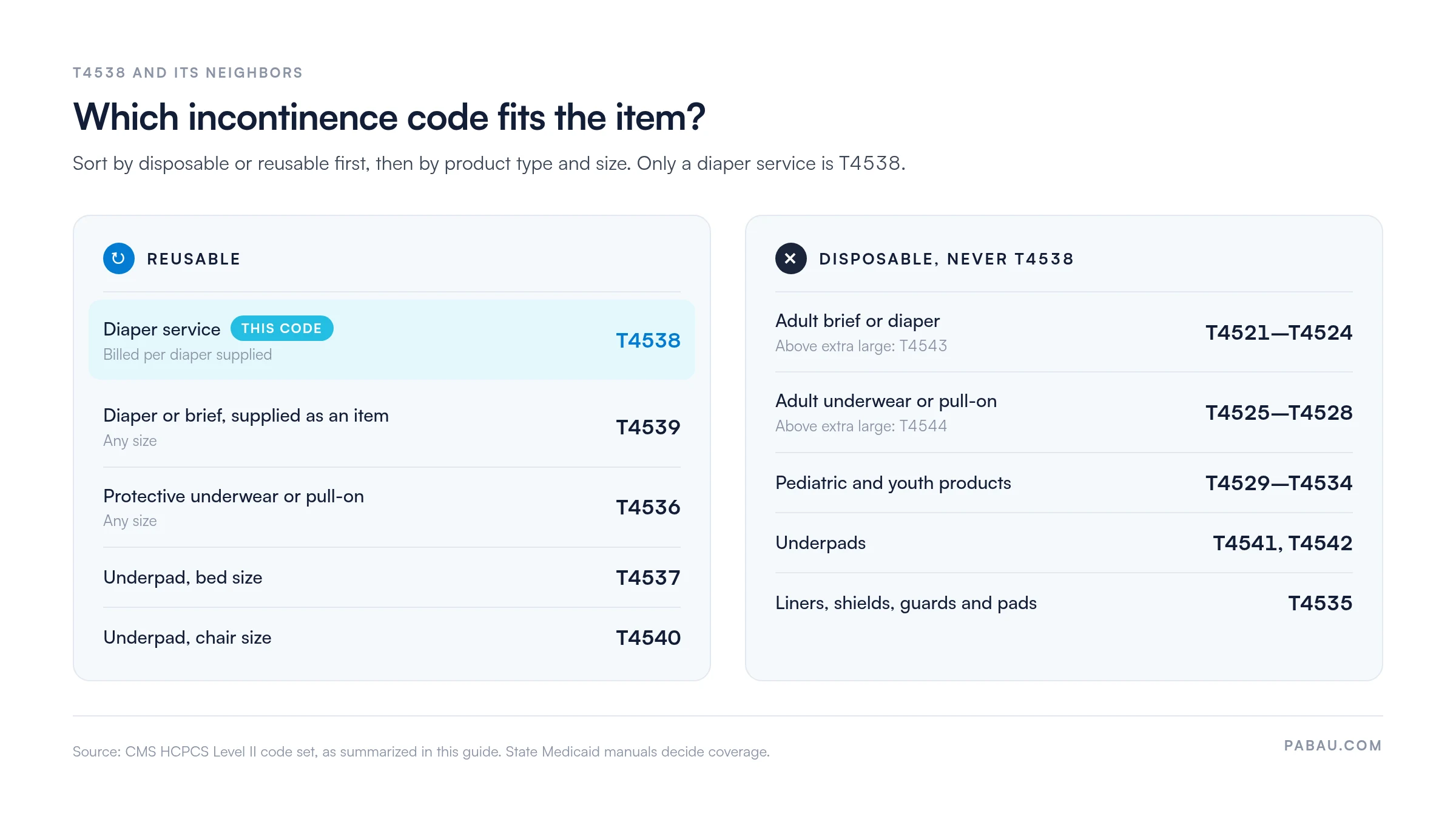
When a delivery slip names an adult disposable brief, start at T4521 and match the size from there.
The incontinence T codes run from T4521 to T4545. They split by disposable or reusable, product type and size. None of them sorts products by absorbency.
Watch the T4538 and T4539 split most closely. Both involve reusable diapers. Read side by side, T4539 describes the item and T4538 the service that supplies it. Your state manual decides how it applies that line, so check its definitions first. If the item turns out to be a reusable pull-on or bed pad, T4536 and T4537 each have their own guide.
State Medicaid is the main payer for T4538. The other payers matter mostly as places a claim should not go.
A clean T4538 claim depends on the paperwork behind it. Tick off each item before the claim leaves your office.
Keep the order, the authorization and the delivery records for as long as your state requires. Our guide to medical billing compliance covers what auditors usually ask to see.
Every T4538 claim follows the same basic path. Each step leaves a record the next step relies on.
One unit of T4538 equals one diaper. Bill the number of diapers supplied, not packs, bundles or deliveries.
There is no national monthly limit. Each state Medicaid program sets its quantity limits in its fee schedule or provider manual. Managed care plans may set their own on top.
Going over the limit usually needs prior authorization and a documented clinical reason. The rate follows the state fee schedule as well. Look up T4538 there before you agree a delivery schedule with a family.
No national modifier is required on T4538. Modifier rules come from your state Medicaid manual or your plan contract.
Be careful with modifiers borrowed from Medicare supply billing. They carry Medicare meanings that may not apply to a Medicaid diaper service.
Some states also publish their own program modifiers. If the manual is silent, leave the modifier off rather than guessing.
Most T4538 denials fall into a few patterns. A steady denial management routine sorts them by cause, so the fix lands once.
Any of these claims may be denied outright. Appeal and resubmission rules vary by state, so check the deadline before you rework one.
Denials show up at remittance, but the mistakes behind them happen much earlier. These are the ones to train out of your team.
Before the first claim for a new patient, read the order and the delivery slip side by side. If the slip names a disposable brand, T4538 is the wrong code. That one check stops the most common T4538 error before it reaches the payer.
The diagnosis must show why the patient needs incontinence products. These codes often appear on such orders. Each state keeps its own covered list, so treat them as examples, not a guarantee.
Confirm each code in the CDC ICD-10-CM browser tool before you submit. Code to the highest specificity the chart supports. If the note only says “incontinence,” R32 fits, but ask the practitioner to name the type first.
Offices that bill T4538 often keep the order, the diagnosis and the delivery slips in separate places. Claims then go out with a code that does not match the paperwork.
Pabau’s practice management software keeps the patient record, forms and notes together. In the US, its claims management connects to Claim.MD. Claims pre-fill from the record, with eligibility checks and remittance posting built in.
Choosing the right code and tracking authorizations stay with your billing team and your state manual. Pabau keeps the information they work from in one record.

Pabau pre-fills claims from the patient record and, in the US, submits them through Claim.MD with eligibility checks and remittance posting. See how it fits your billing workflow.

Treat T4538 as a narrow code. It pays for a reusable diaper service, one diaper at a time, and only where your state covers it.
Before the first claim, read the order and the delivery slip together. If either names a disposable product, use a disposable code instead. Then take limits, rates and authorization rules from your state manual, not a national summary.
That habit costs a few minutes per new patient. In return, it heads off the denial that would otherwise be set up on day one. Book a demo to see how Pabau keeps patient records and claim data together for your billing team.

Need to understand how denial patterns develop across a billing cycle? Denial management in healthcare covers how to track, sort and resolve claim denials across payer types.
Want a cleaner claim submission process end to end? Medical billing fundamentals explains the claims lifecycle from patient encounter to payment posting.
Looking to tighten your documentation compliance? Medical billing compliance guidance outlines the record retention and audit-readiness standards that protect suppliers during Medicaid reviews.
Waiting on a Medicaid approval before delivery? The prior authorization process sets out a step-by-step workflow for requesting and tracking approvals.
Seeing a general garment code on a payer’s list? HCPCS code A4520 explains the any-type incontinence garment code and where states still use it.
Some state Medicaid programs do, through T4538 for a diaper service or T4539 for reusable diapers. Coverage is a state decision. Check your state’s fee schedule and provider manual to see which reusable codes it lists.
No. Medicaid pays enrolled providers, not families. A supplier or diaper service enrolled with the state submits the claim, after the treating practitioner documents the need.
There is no national rate. Each state Medicaid program sets its own in its fee schedule, and managed care plans may pay differently. Medicare lists T4538 as non-covered, so its fee schedule gives no figure.
Usually, yes, but each state sets its own. Many programs cover children only above a set age, since young children need diapers regardless. Check your state manual before you take on a pediatric patient.



