

CCSD code G5100: Bypass of duodenum billing guide
CCSD code G5100 bills a bypass that leaves the duodenum in place CCSD code G5100...

Last Updated: Oct 16, 2026
T4539 is the HCPCS Level II code for incontinence product, diaper/brief, reusable, any size, each. It covers a washable diaper or brief, billed one garment per unit.
T4539 sits in the T4521-T4545 incontinence series that CMS created for state Medicaid agencies, so Medicare does not pay it. Reusable pull-on underwear bills separately as T4536. Most T4539 denials trace back to a missing prior authorization, units over the plan limit, or a diagnosis the state plan does not accept.
Let Pabau's smart automation suggest the right codes, reduce claim denials, and keep your practice compliant—effortlessly.
Automate repetitive tasks and focus on what matters most—your patients.
Reduce coding errors and ensure compliance with the latest regulations.
Clean claims, fewer denials, and faster reimbursements.
Powerful insights and reporting to help your practice thrive.
HIPAA compliant SOC 2 certified GDPR-compliant Trusted by 4,000+ clinics worldwide

HCPCS Code T4539 covers a reusable incontinence diaper/brief, any size, billed per item (each) to state Medicaid.
T4539 sits in the T4521-T4545 incontinence series, which CMS created for state Medicaid agencies, so Medicare does not pay it.
The most common coding mix-up is T4539 (reusable diaper/brief) vs T4536 (reusable pull-on underwear).
Prior authorization, quantity limits, and accepted diagnoses vary by state plan, so check the plan manual before you bill.
Top denial causes are a missing authorization, units over the plan limit, an unaccepted diagnosis, and a supplier not enrolled with the plan.
HCPCS Code T4539 is the Level II code for “incontinence product, diaper/brief, reusable, any size, each.” It describes a washable diaper or brief that the patient reuses after laundering. Each garment is one billing unit.
The code belongs to the T4521-T4545 incontinence supply series. CMS created T-codes for state Medicaid agencies, so each state program decides coverage and payment rather than Medicare. The code has been active and unchanged since January 1, 2005.
Because the descriptor says “any size,” every size of reusable diaper/brief falls under this one code. Record the size in the order and the patient record, not in the code choice. You can confirm the current descriptor in the NLM HCPCS Level II API, which draws on the CMS HCPCS file.
Billing T4539 for the wrong product style is a fast route to a denial or an audit finding. The lists below follow the CMS descriptors for T4539 and its neighboring codes.
Coders most often confuse T4539 with T4536, the reusable pull-on code. The table below lists the reusable codes in the series. It also shows the disposable briefs that T4539 is sometimes billed against, which start at T4521 for a small adult size.
The deciding question is how the garment goes on. A reusable product that the patient steps into like underwear is a pull-on and bills as T4536. A reusable product that wraps around and fastens like a diaper is a diaper/brief and bills as T4539.
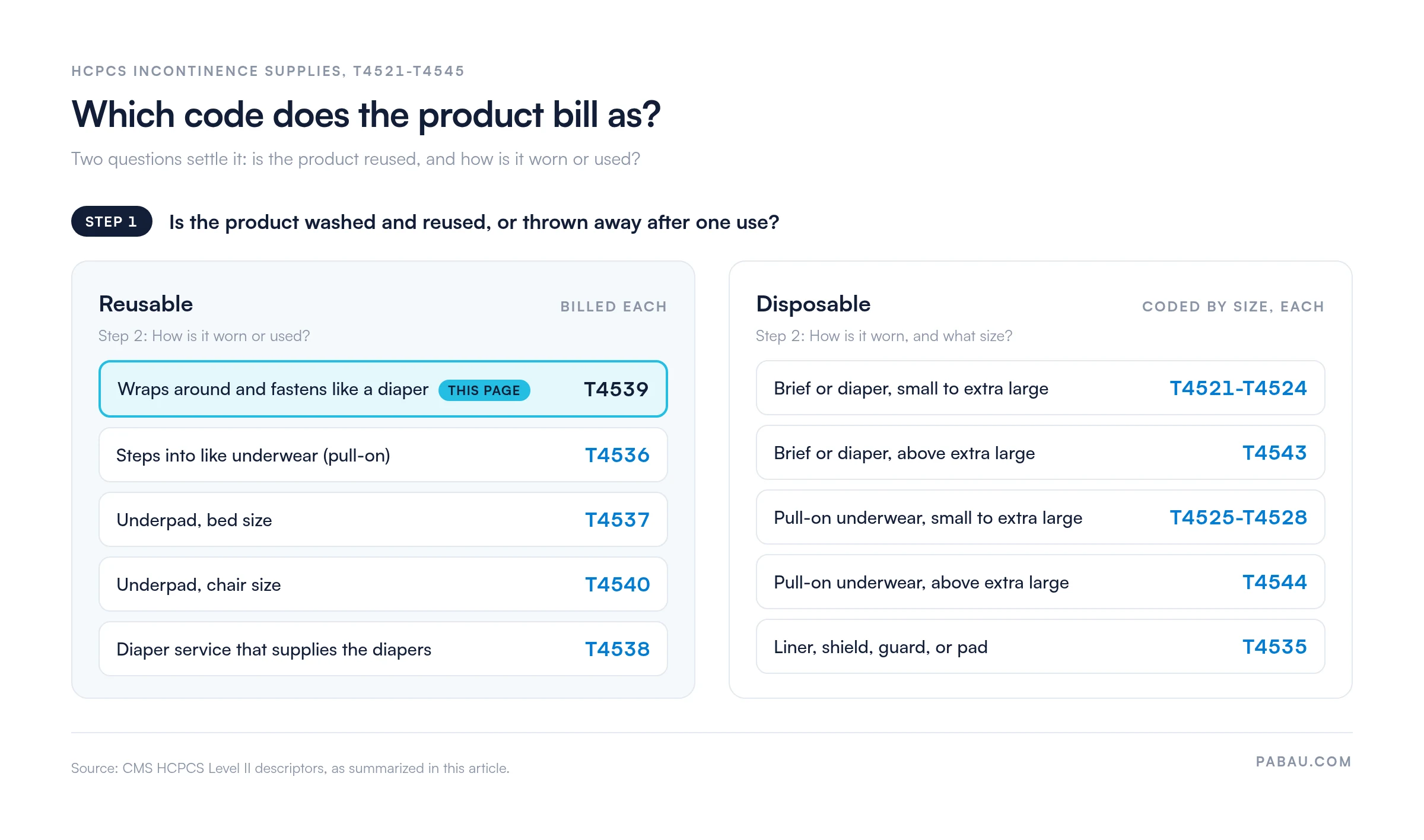
T4538 is a separate case. It bills a diaper service that supplies reusable diapers, per diaper, while T4539 bills the garment itself. Keep the product specification sheet on file so an auditor can see which style was dispensed.
Medicare does not pay T4539. Absorbent incontinence products fall outside the Medicare DMEPOS benefit, and CMS designates T-codes for state Medicaid agencies. A T4539 claim sent to Medicare fee-for-service will be denied as non-covered.
Coverage for T4539 comes from three sources:
Coverage rules, rates, and limits change at each state’s fiscal year update. Confirm coverage with the current state Medicaid authority before you dispense.
A T4539 claim without a documented qualifying diagnosis and a provider order invites a medical necessity denial. The patient record should support these elements before the claim goes out.
Many state plans require the order to be renewed periodically, often every 12 months, so check the plan’s renewal rule. Keep the ordering provider’s NPI and contact details with the order, because plans may ask suppliers to verify them in a post-payment audit. Our guide to medical billing compliance covers record-keeping in more depth.
This list reflects commonly accepted codes, not a payer-approved set. Diagnosis requirements are payer-specific, so confirm acceptance with the state Medicaid plan or MCO before you rely on any code. When the record names the incontinence type, choose that code over R32, which is the unspecified fallback. Full titles and coding notes for each diagnosis are in our searchable ICD-10-CM library.
Whether T4539 needs prior authorization depends on the member’s state Medicaid plan or MCO contract, and there is no federal standard. Some states require it for every incontinence supply code. Others require it only when a request goes above the plan’s quantity limit.
A prior authorization request for T4539 usually includes three items:
Ask the plan for its prior authorization criteria in writing before you submit. Many Medicaid MCOs publish authorization grids that list each supply code and what triggers a review. Checking the grid before each supply cycle prevents review delays and retrospective denials on claims you believed were exempt.
T4539 is billed per item, so one unit equals one reusable diaper/brief. Each state Medicaid program sets its own quantity limit and the period it applies to. Units above that limit without an approved override are a frequent cause of denials.
To find the limit for a specific member, check these sources in order:
Because reusable garments last through many wash cycles, plans often set limits over a longer period than for disposables. Confirm the period as well as the number before you schedule a resupply.
T4539 denials cluster around authorization, quantity, and enrollment errors, plus the occasional style mix-up with T4536. A clear denial management process should flag each trigger below before a claim leaves the billing queue.
Most state Medicaid plans do not require a modifier on T4539. Where a state uses its own modifiers for supply claims, its provider manual lists them, so follow that manual rather than Medicare conventions.
Billers coming from Medicare DMEPOS work often reach for the modifiers below. They are Medicare constructs, and Medicaid plans rarely use them for incontinence supplies.
T4539 has no Medicare fee schedule amount. Payment is set by the billing state’s Medicaid program and, for managed care members, by the MCO’s contracted rate.
Rates are paid per item and can change at each state’s annual fee schedule update. To find the current rate for T4539 in a specific state:
Do not quote a dollar amount to a patient or family until you have confirmed the current rate with the plan.
A clean T4539 claim follows the same checklist every cycle. Each step below prevents a common denial.
Build a monthly T4539 checklist. Confirm your enrollment with each state plan you bill and check that the authorization has not expired. Then verify the patient’s eligibility and match unit counts to the approved quantity. Running these four checks before submission prevents most T4539 denials.
Supply claims are often managed with a spreadsheet of submission dates and a separate payer portal for remittances. That makes it slow to spot a run of CO-119 or CO-151 denials across patients.
Pabau, the practice management software we build, includes claims management for submitting claims electronically and tracking remittances. In the US, claims go out through Claim.MD. Each remittance posts back against its claim, so you can see which T4539 lines were paid or denied.
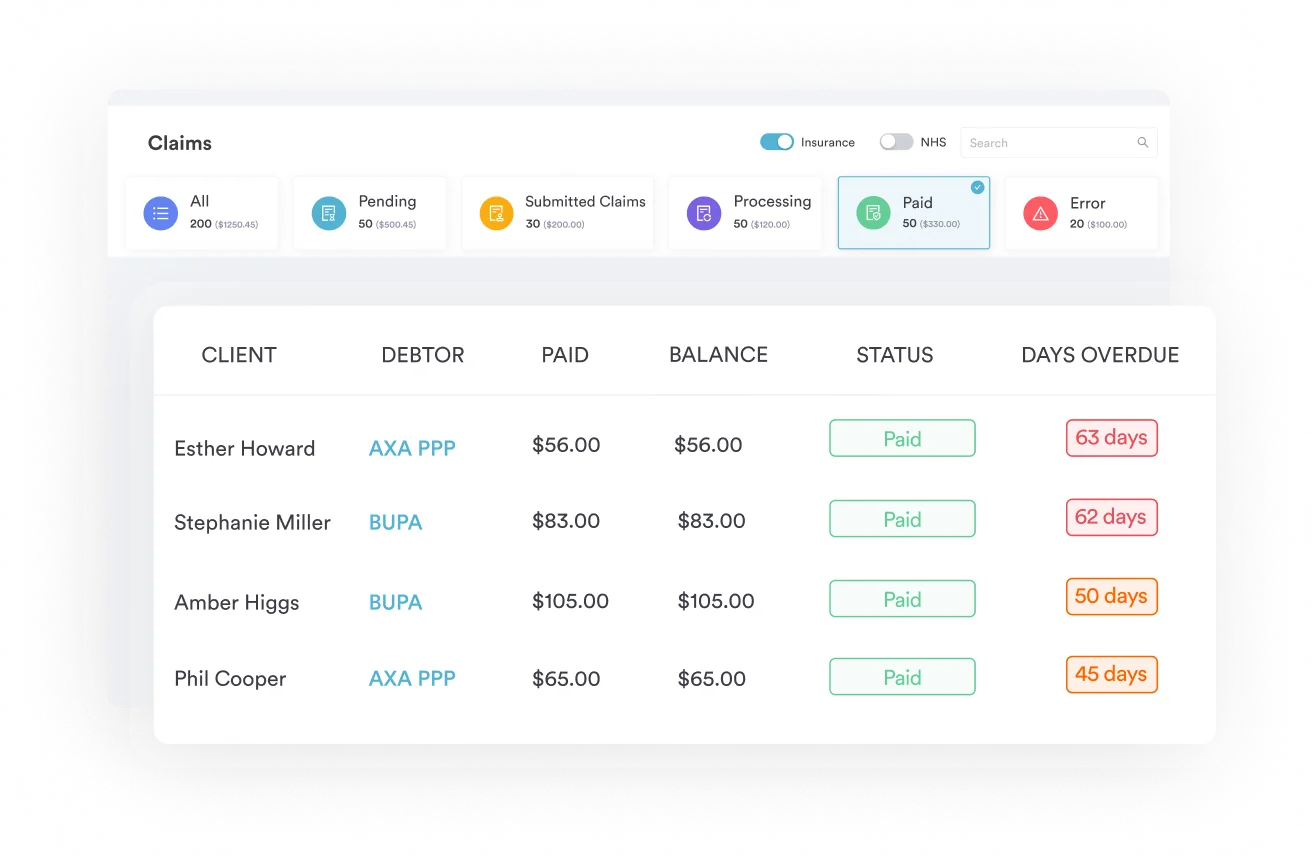
Reviewing those remittances each month shows whether denials share a cause, such as a lapsed enrollment or a plan limit that changed. You can then fix the cause rather than appealing each claim one by one.

Pabau’s claims management lets your billing team submit claims electronically and track each remittance. Denied T4539 lines surface quickly, so you can fix the cause.

Bill T4539 only when a reusable garment wraps around and fastens like a diaper. Record that style on the order and keep the specification sheet, so an auditor can see why the code fits. A pull-on, an underpad, or a diaper service each takes its own code.
Most T4539 problems after that are process problems. A current order, the plan’s authorization rule, its quantity limit, and active enrollment decide whether the claim pays. To see how Pabau handles claim submission and remittance tracking for your team, book a demo.

Need to understand how claim denials are categorized and appealed? Denial management in healthcare covers the full denial resolution workflow for medical billing teams.
Looking for a structured approach to Medicaid billing documentation? Medical billing compliance outlines documentation standards that reduce audit risk across payer types.
Want to understand the full revenue cycle behind incontinence supply billing? Revenue cycle management explains how each billing step connects from order to payment posting.
Billing the reusable underpad that often ships with these briefs? HCPCS code T4537 covers the bed-size reusable underpad and how state plans limit it.
Need the fallback diagnosis when the incontinence type is not documented? ICD-10 code R32 explains when unspecified urinary incontinence is the right code.
HCPCS Code T4539 covers a reusable incontinence diaper/brief, any size, billed per item. The full descriptor reads incontinence product, diaper/brief, reusable, any size, each. Reusable pull-on underwear bills as T4536, and disposable briefs bill under T4521-T4524 or T4543.
T4539 is a Medicaid code, and Medicare does not pay it. CMS created T-codes for state Medicaid agencies, and absorbent incontinence products fall outside the Medicare DMEPOS benefit. Coverage and rates come from each state Medicaid program or MCO.
T4539 is a reusable diaper/brief, while T4536 is reusable protective underwear that pulls on. Both cover any size and bill per item. Choose the code by how the garment goes on, and keep the product specification sheet on file.
T4540 is not a garment code. It covers a reusable protective underpad in chair size, while T4537 covers the bed-size reusable underpad. T4539 covers the reusable diaper/brief that the patient wears.
Prior authorization for T4539 depends on the state Medicaid plan or MCO. Some plans require it for every incontinence supply code, and others only when a request exceeds the quantity limit. Check the plan’s provider manual or authorization grid before you dispense.
Each state Medicaid program sets its own T4539 quantity limit and the period it covers. Find it in the state DME or supply provider manual, the state fee schedule, or the MCO authorization grid. Units above the limit need an approved override.
Commonly accepted ICD-10 codes include R32, N39.3, N39.41, N39.46, and R15.9. Acceptance is payer-specific, so confirm the list with the state Medicaid plan before you rely on any code.
Common causes are a missing or expired authorization, units over the plan limit, an unaccepted diagnosis, and a supplier not enrolled with the plan. Billing a pull-on or a disposable brief under T4539 also triggers denials.



