HCPCS Code T2042: Hospice routine home care billing guide
HCPCS Code T2042: Official descriptor and coverage definition HCPCS Code T2042 i...

Last Updated: Nov 2, 2026
T4529 is the HCPCS Level II code for pediatric sized disposable incontinence product, brief/diaper, small/medium size, each.
Two neighboring codes are easy to confuse with it. A larger child in the same tab-closure brief moves to T4530, and a small/medium child in a pull-on moves to T4531. Medicare never pays for T4529, because SSA §1862(a)(6) excludes incontinence supplies as personal comfort items. Claims go to state Medicaid, CHIP or a Medicaid managed care plan.
Let Pabau's smart automation suggest the right codes, reduce claim denials, and keep your practice compliant—effortlessly.
Automate repetitive tasks and focus on what matters most—your patients.
Reduce coding errors and ensure compliance with the latest regulations.
Clean claims, fewer denials, and faster reimbursements.
Powerful insights and reporting to help your practice thrive.
HIPAA compliant SOC 2 certified GDPR-compliant Trusted by 4,000+ clinics worldwide

T4529 bills one pediatric small/medium disposable brief or diaper to Medicaid, CHIP or a Medicaid managed care plan.
Size and style decide the code: a pediatric large brief is T4530, and a pediatric small/medium pull-on is T4531.
Medicare excludes incontinence supplies as personal comfort items under SSA §1862(a)(6), so a T4529 claim to Medicare will not be paid.
Most state plans require a physician order, a supporting ICD-10 diagnosis and prior authorization before the first delivery.
A child who grows or moves to pull-ons needs a new code, and usually a new order and authorization.
HCPCS Code T4529 is the Level II code for “Pediatric sized disposable incontinence product, brief/diaper, small/medium size, each.” One unit is one disposable brief or diaper.
The Centers for Medicare & Medicaid Services (CMS) maintains the code within the T4521-T4545 incontinence supply series of the HCPCS Level II code set. State Medicaid agencies, not Medicare, decide its coverage and payment.
A product qualifies for T4529 only when three facts hold at once. It is disposable, it is a brief or diaper that closes with side tabs or tape, and it is pediatric small or medium. Payers define the size bands, usually by waist measurement or weight. Check the state Medicaid or MCO provider manual for the exact cut-offs.
Two questions pick the pediatric code. The first is the child’s size band. The second is whether the product fastens with side tabs or pulls on like underwear. T4529 is the small/medium brief, one corner of a grid that runs from pediatric to adult sizes.
T4529 and T4533 are both brief styles. They differ only by size group, since T4533 covers youth sizes above pediatric large. T4529 and T4531 share a size band but differ in style. Record the size and style of each product dispensed in the delivery record, so the code can be checked against it.
A child rarely stays on T4529 for good. Growth moves a child into the pediatric large band, and the correct code becomes T4530. Gaining mobility or starting toilet training often moves the order from briefs to pull-ons, and the code becomes T4531. The diagram maps both moves and what each one sets off.
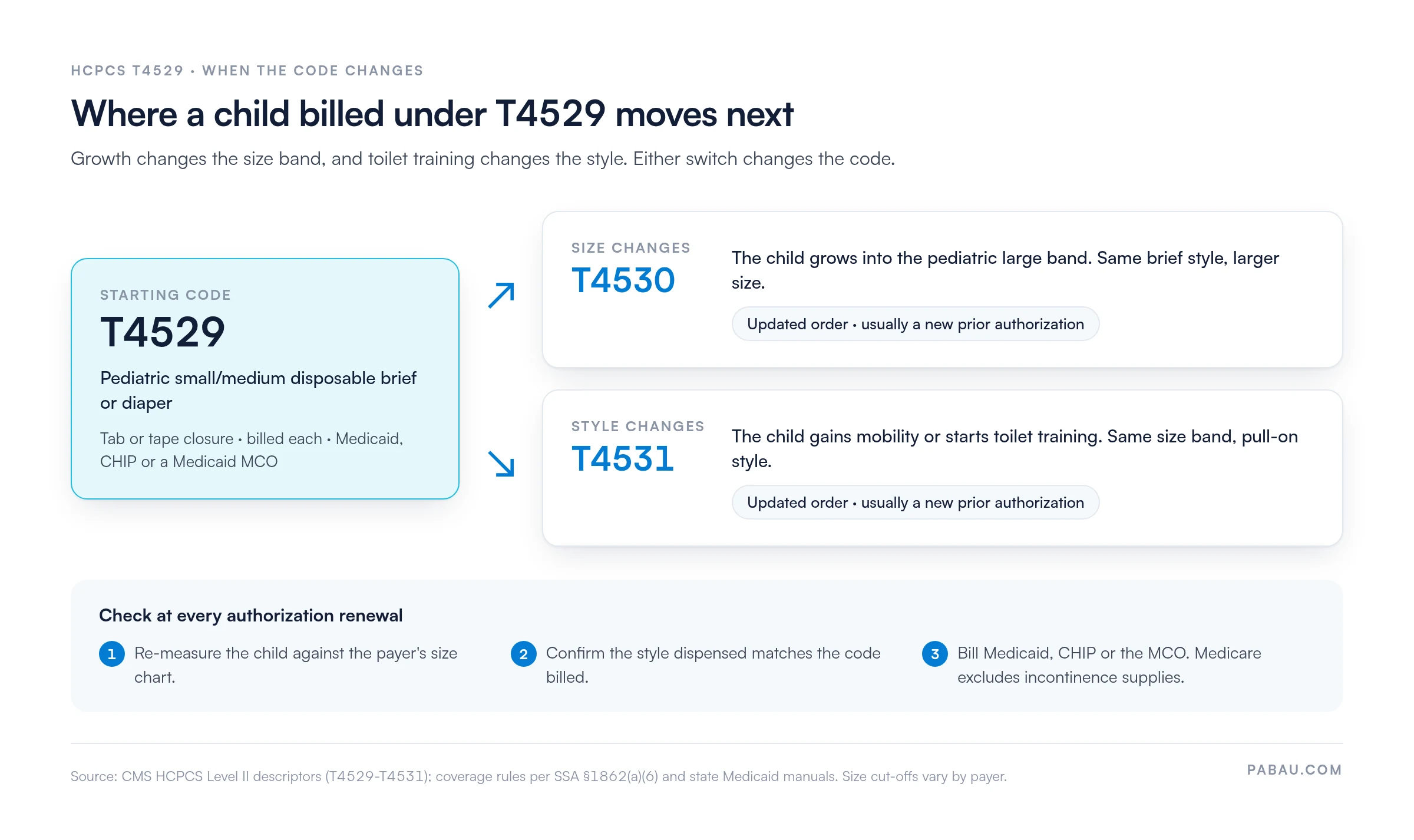
Either switch usually needs an updated physician order, and many plans treat it as a new prior authorization request. Re-measure the child at each authorization renewal and compare the result with the payer’s size chart. If a supplier ships large briefs but keeps billing T4529, the claim no longer matches the delivery record and fails on audit.
A4520 covers an incontinence garment of any type, billed each. Medicare does not pay for it for routine incontinence. Some state Medicaid programs and managed care plans still accept A4520. Where a plan accepts both, the size-specific T code is usually the better choice, because it shows exactly what was dispensed.
No, Medicare does not cover T4529. Section 1862(a)(6) of the Social Security Act excludes personal comfort items, and Medicare applies that exclusion to incontinence supplies. Medicare also does not accept T codes on claims. An appeal will not change the outcome, because the exclusion is written into the statute.
Coverage for T4529 comes from state Medicaid programs, Medicaid managed care organizations (MCOs) and the Children’s Health Insurance Program (CHIP). Run insurance eligibility verification before each delivery cycle, because Medicaid eligibility can change from month to month.
Many state programs set a minimum age for incontinence supplies, often 3 or 4 years, because diapers are developmentally normal in younger children. For beneficiaries under 21, Medicaid’s Early and Periodic Screening, Diagnostic and Treatment (EPSDT) benefit requires states to cover medically necessary care. A request above a standard limit can therefore be made under EPSDT, with documentation of the child’s need.
Every T4529 claim needs an ICD-10-CM diagnosis that establishes medical necessity. The treating clinician documents it in the child’s medical record and signs it. Confirm that each code is active in the current fiscal year code set before you submit.
Most state Medicaid plans and MCOs require prior authorization for incontinence supplies. Some states waive it for the first month’s supply, and others require it before the first delivery. Check the current state provider manual or the MCO’s authorization portal before you dispense.
A clean claim for T4529 starts with authorization in place before delivery. Standard prior authorization documentation includes:
Incomplete documentation is one of the most common reasons incontinence supply claims fail on audit. Keep these records for every claim, because Medicaid program integrity audits can request them after payment.
Modifier rules for T4529 come from each state plan, and many claims need none. Check the payer’s billing manual first, because a missing required modifier means resubmitting the claim.
One unit of T4529 is one disposable brief or diaper. Each state Medicaid program and MCO sets its own monthly limit, and the figure varies widely. Read the limit from the current provider manual for each payer, and never reuse a figure from another state.
Bill quantities above the limit only with an approved authorization, or an EPSDT request for a child under 21. Some states apply one combined limit across incontinence products, so briefs and liners share a monthly total.
T4529 denials follow predictable patterns, and most can be prevented while the claim is prepared. Good denial management in healthcare catches them before submission.
Before you submit a T4529 claim, check five points. Is the product a pediatric small/medium brief, not a large brief or a pull-on? Is the payer Medicaid or CHIP? Is the authorization current, and does it name this size and style? Does the ICD-10 code match the documented diagnosis? Is the proof of delivery signed, with a matching quantity?
T4529 has no Medicare fee schedule rate, because Medicare excludes incontinence supplies. Each state Medicaid program and MCO sets its own rate, and rates can change every year. Never estimate one state’s payment from another state’s fee schedule.
To look up the current rate for T4529:
Supply claims go wrong when the order, the size measurement and the claim sit in different systems. Pabau, the practice management platform we build, keeps them in one patient record, so the code billed can be checked against the chart.
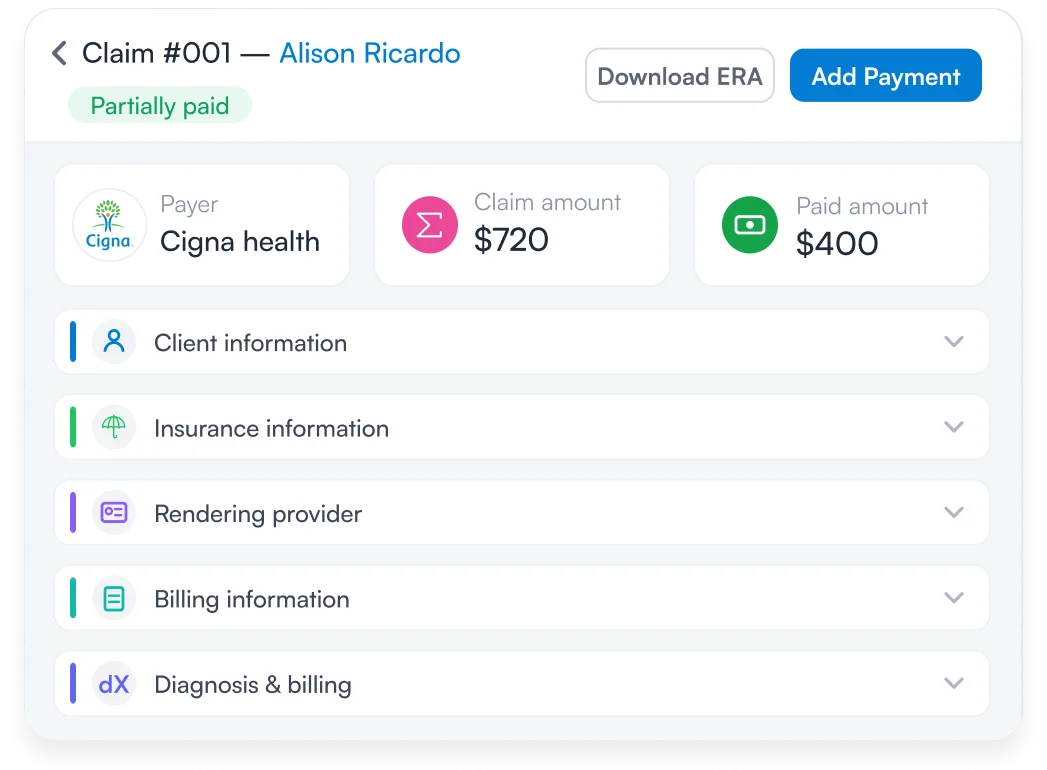
Pabau’s claims management software builds each claim from the patient record. The order, the diagnosis and the authorization details sit on the same record as the claim. Digital forms capture the child’s measurement and the signed proof of delivery straight into the file.
When a child moves from T4529 to T4530 or T4531, the team updates one record rather than three.

Pabau keeps orders, diagnoses, authorizations and claims in one patient record, so the code you bill matches the product you deliver. See how it works for supply-heavy practices.

T4529 is a narrow code. It fits a pediatric small/medium disposable brief, and only Medicaid, CHIP or a Medicaid managed care plan pays for it. Most denials come from a size change, a switch to pull-ons or a claim sent to Medicare.
Treat each authorization renewal as a check on size and style, and the code stays right as the child grows. Pabau keeps the order, the measurement and the claim in one record, which makes that check quick. Book a demo to see how Pabau supports supply billing in your practice.

Coding adult briefs as well? HCPCS Code T4521 starts the adult brief series and explains how the size bands work for older patients.
Looking for a broader view of the billing cycle? Revenue cycle management explains how supply billing fits into the practice’s end-to-end revenue workflow.
HCPCS Code T4529 covers one pediatric small/medium disposable incontinence brief or diaper, billed per item to Medicaid or CHIP. The product must be disposable, close with tabs or tape, and meet the payer’s pediatric small/medium size criteria. Larger sizes and pull-on styles use other codes.
The difference is size. Both cover pediatric disposable briefs or diapers, but T4529 is small/medium and T4530 is large. When a child grows into the large band, the code changes to T4530 and most plans need an updated order.
The difference is style. Both are pediatric small/medium, but T4529 covers briefs or diapers with side tabs and T4531 covers pull-on protective underwear. Check the product dispensed before choosing the code.
No. Both cover disposable briefs or diapers, but T4533 is for youth sizes above pediatric large. The two codes differ by size group, not by style.
No. Section 1862(a)(6) of the Social Security Act excludes personal comfort items, and Medicare applies it to incontinence supplies. Medicare also does not accept T codes, so bill T4529 to Medicaid, CHIP or a Medicaid managed care plan.
Many T4529 claims need no modifier. Some state plans require KX to attest that documentation is on file, NU for a new supply item, or a state-defined U modifier. Check the payer’s billing manual before you submit.
One unit is one disposable brief or diaper. Each state Medicaid program and MCO sets its own monthly limit. Quantities above it need prior authorization or, for a child under 21, a medical necessity request under EPSDT.
Common supporting codes include R32, N39.4x, R15.x, N31.x, Q05.x and G80.x. Some states also accept F98.0 or F98.1. The treating clinician must document the diagnosis in the child’s medical record.
Usually, yes. Most state Medicaid plans and MCOs require prior authorization for incontinence supplies, though the rules vary by state. Get approval before the first delivery, and again when the child changes size or style.
The most common reasons are a size or style mismatch, a claim sent to Medicare and a missing or outdated authorization. Quantity over the plan limit, an unsupported diagnosis and an unsigned proof of delivery also cause denials. Each can be caught before submission.