CCSD code A2720: Proximal gastric vagotomy billing guide
What is CCSD code A2720? CCSD code A2720 is the procedure billing code assigned ...

Last Updated: Oct 8, 2026
T4525 is the HCPCS Level II code for adult sized disposable incontinence product, protective underwear/pull-on, small size, each. It is a national T code established for state Medicaid agencies, billed one unit per pull-on, and traditional Medicare does not cover it.
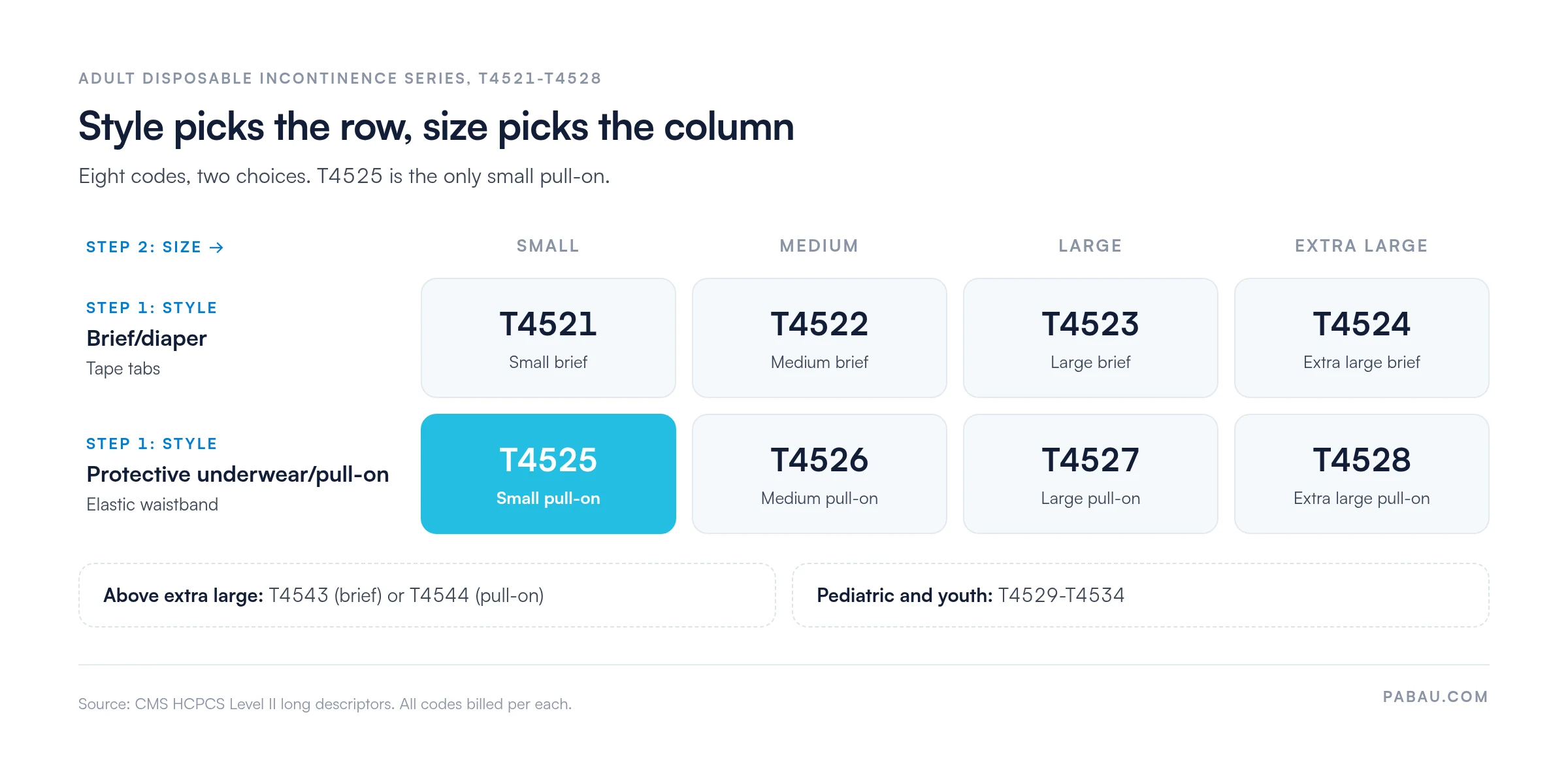
The adult T4521-T4528 series splits by style and size. T4521-T4524 are briefs/diapers from small to extra large, and T4525-T4528 are pull-ons in the same four sizes. A claim is coded correctly only when both match the product dispensed.
Let Pabau's smart automation suggest the right codes, reduce claim denials, and keep your practice compliant—effortlessly.
Automate repetitive tasks and focus on what matters most—your patients.
Reduce coding errors and ensure compliance with the latest regulations.
Clean claims, fewer denials, and faster reimbursements.
Powerful insights and reporting to help your practice thrive.
HIPAA compliant SOC 2 certified GDPR-compliant Trusted by 4,000+ clinics worldwide

HCPCS code T4525 describes adult sized disposable protective underwear (pull-on style) in a small size, billed per each unit.
Traditional Medicare Part B does not cover incontinence supplies, so Medicaid is typically the primary payer for T4525.
Billing the wrong size or the wrong style (brief vs. pull-on) is the leading denial trigger for T4525 claims.
Common ICD-10 pairings include R32, N39.3 and N39.46, and each state Medicaid policy sets which codes it accepts.
Pabau, the practice software we build, submits claims through Claim.MD and tracks remittance and denials in one place.
HCPCS code T4525 is the HCPCS Level II code for adult sized disposable protective underwear, the pull-on style, in a small size, billed per each. It belongs to the T-code section, which holds national codes established for state Medicaid agencies.
According to the CMS HCPCS Level II coding system, T4525 sits in the adult T4521-T4528 incontinence series and has been effective since January 1, 2005.
The official CMS descriptor for T4525 is: Adult sized disposable incontinence product, protective underwear/pull-on, small size, each. The CMS short descriptor reads “Adult size pull-on sm.” Each part of the long descriptor narrows the code, and none of it refers to absorbency.
T4525 covers adult disposable pull-on underwear in a small size. The pull-on style has an elastic waistband and is worn like regular underwear, which separates it from the tape-tab brief/diaper style coded T4521-T4524. Absorbency level does not change the code. Within the pull-on family, the size on the product label decides it.
Payers do not accept a product name as proof of size. The record should show the size ordered, and the dispensed product must match it on the manufacturer’s sizing chart. A small pull-on order filled with a medium product and billed under T4525 will not hold up on audit.
The most common miscoding in the adult incontinence series is crossing the two style families. T4524 is an extra large brief/diaper with tape tabs, while T4525 is a small pull-on. The two codes sit next to each other in the code list and get transposed, yet they differ on both style and size.
The decision rule has two steps, and the grid below maps both. Choose the style first: a brief/diaper with tape tabs, or protective underwear/pull-on. Then choose the size from the manufacturer’s sizing chart, using the patient’s measured waist and hip.
Patients above extra large move to T4543 (brief) or T4544 (pull-on), and pediatric or youth patients move to T4529-T4534. Never select a code from the product name alone.
Every T4525 claim requires a supporting ICD-10-CM diagnosis code that establishes medical necessity for incontinence supplies. Each state Medicaid program or plan sets the accepted ICD-10 codes in its own coverage policy. The following codes are broadly recognized across Medicaid programs, though individual state plans vary.
Always check the state Medicaid provider manual before submitting. Some states maintain a tighter accepted-code list than the table above. A T4525 claim paired with R32 will deny where the state plan requires a more specific N39.x code.
Incomplete documentation is the root cause of most T4525 denials that survive the initial coding check. Before submitting a claim, confirm the patient file contains all of the following. Sound billing compliance documentation starts with the physician order and works forward from there.
State Medicaid programs vary in their CMN requirements. Some states use a standardized form; others accept a signed clinical note that addresses the same elements. Verify the requirement with your state’s Medicaid provider manual before the first submission.
Traditional Medicare Part B does not cover incontinence supplies, including T4525. Disposable incontinence products fall outside the Medicare DME benefit by statute, so no local coverage policy can change that. A T4525 claim sent to traditional Medicare denies as a non-covered service.
Medicare Advantage (Part C) is the exception worth checking. Some plans add incontinence supplies as a supplemental benefit, with their own quantity limits and prior authorization rules. Verify the plan’s Evidence of Coverage before you supply products.
There is no Medicare fee schedule amount to benchmark T4525 against. Medicaid pays it from each state’s own fee schedule, and Medicare Advantage plans pay their contracted rates. Confirm the rate in effect on the date of service, since state schedules are updated on their own cycles.
Medicaid is typically the primary payer for incontinence supplies billed under T4525. Coverage is available under most state Medicaid plans, though the specific rules, quantity limits, and prior authorization requirements differ substantially from state to state. Medicaid managed care organizations (MCOs) add another layer: even within the same state, different MCO plans may apply different quantity caps and PA workflows.
Most Medicaid programs that cover T4525 set a quantity limit expressed as units per day or per month. The limit varies by state and plan, so take it from the state Medicaid provider manual rather than a national rule of thumb.
Quantities above the limit require documented medical necessity, usually a clinical justification from the ordering physician. Without that documentation, the excess units deny.
Commercial payers that cover incontinence supplies typically follow the Medicaid model: prior authorization for initial supply, quantity limits per month, and annual re-authorization. Coverage for T4525 under commercial plans is less consistent than under Medicaid. Verify benefits for each patient before dispensing, and check the plan’s own coverage policy for its accepted diagnoses.
State Medicaid provider manuals are the authoritative source for quantity limits and PA workflows. An HCPCS code lookup confirms the descriptor, but it carries no payer-specific coverage rules.
Most T4525 denials trace back to one of seven root causes. The pattern is consistent across Medicaid programs and commercial payers. Knowing the denial code on the remittance advice tells you which category you’re in. Effective denial management workflows fix each category at the step where it starts.
The medical billing denial codes reference page maps the CARC and RARC codes behind these denials to their categories.
Run a monthly audit of your T4525 remittance advice, grouped by denial reason code. If wrong-size or wrong-style denials cluster around one supplier or product line, check whether that product’s specification sheet states its style and size clearly. Flag those products for your team to re-confirm before the next supply cycle.
Many of the denial patterns above come from the billing workflow around a correctly chosen code. A biller who knows T4525 well still loses time when wrong-size and wrong-style rejections surface weeks later in a remittance file. Pabau’s claims management software shortens that loop.
Pabau pulls the patient, provider, and service details already on the record into a pre-filled claim. It submits the claim electronically through its Claim.MD integration and tracks the claim’s status. Remittance and denial reasons post back against the claim, so your team sees a T4525 rejection while the order is still fresh.
Code selection, the size on the order, and the diagnosis stay your team’s decisions. What changes is how quickly a wrong choice comes back to you. Repeat errors across a month of supply claims also become easier to spot. The medical billing process gets shorter when denials arrive in the same place the claim was built.

Pabau creates and submits your claims through Claim.MD, then tracks remittance and denials, so your team spots repeat T4525 rejections early. Book a demo to see the billing workflow.

T4525 is a narrow code: an adult disposable pull-on, small size, one unit per item. Most of its billing risk sits in the choice among the eight codes in the T4521-T4528 series, and that choice turns on style and size. Settle the style first, then the size from the manufacturer’s chart and the patient’s measurements, and the code follows.
Payer choice matters just as much. Traditional Medicare will not pay for T4525, so the claim belongs with Medicaid or a Medicare Advantage plan that offers the benefit. Each sets its own quantity limits and prior authorization rules, and those are worth checking before the first delivery rather than after the first denial.
Book a demo to see how Pabau submits your supply claims and tracks remittance and denials in one place.

Need a reference for how denials get categorized by reason code? Denial codes in medical billing covers CARC and RARC codes with corrective action guidance for each category.
Want to understand how the broader billing workflow connects to claims submission? What is revenue cycle management explains how incontinence supply billing fits into the end-to-end RCM process.
Looking for a reference on clean claim construction for medical supply providers? Clean claim requirements details the fields, modifiers, and documentation checks that prevent first-pass denials.
Billing the tape-tab style instead? HCPCS code T4521 covers the small adult brief/diaper, the style counterpart to T4525.
HCPCS code T4525 covers an adult sized disposable protective underwear (pull-on) product in a small size, billed per each unit. It does not cover tape-tab brief/diaper products (T4521-T4524) or larger adult pull-ons, which are coded T4526 (medium), T4527 (large), and T4528 (extra large).
T4524 is an adult disposable brief/diaper in extra large, while T4525 is an adult disposable pull-on in small. The two codes differ on both style and size, so using one in place of the other is a miscoding error that produces a denial.
No. Traditional Medicare Part B does not cover incontinence supplies, including T4525, as a standard DME benefit. Some Medicare Advantage plans do cover incontinence supplies as a supplemental benefit, but coverage, quantity limits, and prior authorization requirements vary by plan.
Quantity limits vary by payer and state. Many Medicaid programs set a daily or monthly cap, and the limit for your state must be confirmed in the state Medicaid provider manual. Quantities above the standard limit require documented medical necessity from the ordering physician.
Commonly accepted ICD-10-CM codes include R32 for unspecified urinary incontinence, N39.3 for stress incontinence (female) (male), N39.41 for urge incontinence, and N39.46 for mixed incontinence. Each state Medicaid program sets the exact accepted list in its own coverage policy. Check the state Medicaid provider manual before submitting.
Yes, in most states. Medicaid is the primary payer for incontinence supplies in the United States, and T4525 is covered under most state Medicaid plans. Coverage terms, monthly quantity limits, and prior authorization requirements differ by state and by Medicaid managed care plan. Confirm the specific rules in the applicable state provider manual.