HCPCS Code Q4175: Billing, coverage, and documentation guide
HCPCS Code Q4175: Code Description and Product Identity HCPCS Code Q4175 is the ...

Last Updated: Nov 20, 2026
T4530 is the HCPCS Level II code for pediatric sized disposable incontinence product, brief/diaper, large size, each. One unit is one brief or diaper, and the small/medium pediatric brief bills as T4529 instead.
T-codes are for state Medicaid use and are not payable under Medicare fee-for-service. Pediatric pull-ons bill as T4531 or T4532, and youth products as T4533 or T4534.
Let Pabau's smart automation suggest the right codes, reduce claim denials, and keep your practice compliant—effortlessly.
Automate repetitive tasks and focus on what matters most—your patients.
Reduce coding errors and ensure compliance with the latest regulations.
Clean claims, fewer denials, and faster reimbursements.
Powerful insights and reporting to help your practice thrive.
HIPAA compliant SOC 2 certified GDPR-compliant Trusted by 4,000+ clinics worldwide

HCPCS Code T4530 covers one pediatric-sized disposable brief or diaper in a large size, billed per unit.
Size and style set the code: T4529 is the small/medium pediatric brief, T4531 and T4532 are pediatric pull-ons, and T4533 and T4534 are youth products.
T-codes are for state Medicaid use and are not payable under Medicare fee-for-service.
Quantity limits and prior authorization rules vary by state and plan, so confirm both before each delivery.
Pabau’s claims management software tracks authorization status, dispensed quantities, and supporting documents to reduce T4530 denials.
HCPCS Code T4530 is the CMS HCPCS Level II code for a pediatric-sized disposable brief or diaper in a large size, billed per unit. The NLM HCPCS code table gives its official descriptor as “Pediatric sized disposable incontinence product, brief/diaper, large size, each.” T-codes are for state Medicaid use and are not payable under Medicare fee-for-service.
Each brief or diaper is one billable unit, so map every product in stock to its code before dispensing. A small or medium pediatric brief bills as T4529 instead. Pediatric pull-ons have their own pair, T4531 and T4532, and youth products move to T4533 and T4534.
T4530 covers one large disposable brief or diaper for a pediatric patient with a documented qualifying condition. Payers commonly accept diagnoses such as spina bifida or neurogenic bladder, but each state sets its own list. The coverage boundary has three parts: the pediatric population, the brief/diaper style, and the large size.
Covered under T4530: A large pediatric disposable brief or diaper, dispensed to a Medicaid-enrolled pediatric patient with a prescriber order and documented medical necessity.
Not covered under T4530:
Mapping the wrong product to T4530 is a common coding error. A medium pediatric brief billed as T4530 overstates the size, and a pull-on billed as T4530 carries the wrong style. Check the manufacturer’s size chart and product type against the HCPCS descriptor before submitting.
Six HCPCS codes split pediatric and youth disposable products by style and size. T4530 and T4529 share a style and differ only in size, which makes their boundary the easiest one to miscode. The grid below shows where each product lands.
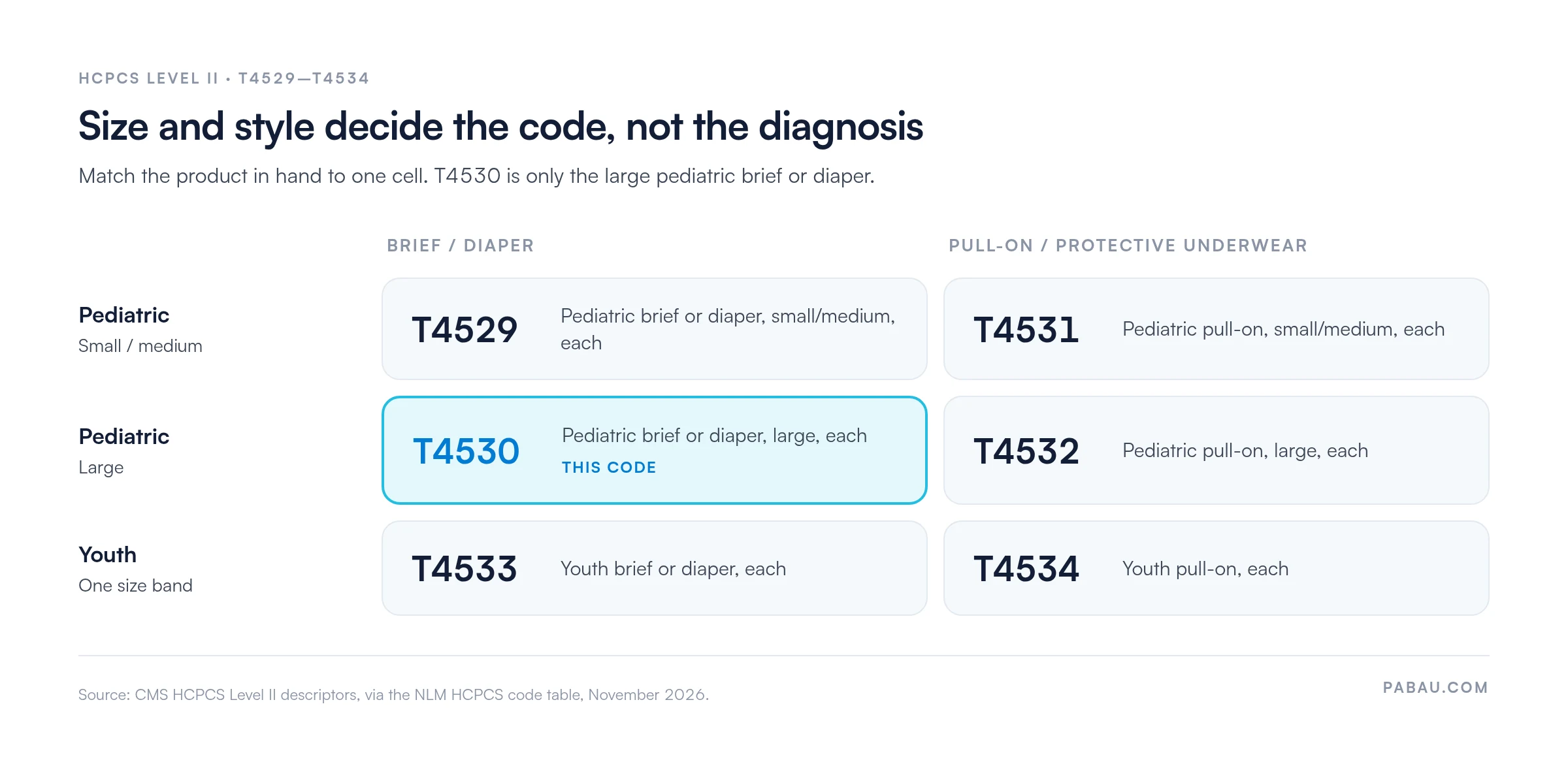
Every descriptor in this family ends in “each,” so all six codes bill per piece. The table gives the full CMS wording for each one.
The practical test has two questions. Is the product a brief or diaper, or a pull-on the patient steps into? Then which size band does the manufacturer assign it? A large pediatric brief is T4530, while a large pediatric pull-on is T4532.
When a patient outgrows pediatric sizing, switch to T4533 for briefs or T4534 for pull-ons. Billing T4530 for a youth-sized product is an upcoding risk that audits flag. Check the descriptors against the current AAPC HCPCS code listing each year, since CMS can revise wording in annual updates.
T4530 is reimbursed through state Medicaid programs. T-codes are for state Medicaid use and are not payable under Medicare fee-for-service, so a T4530 claim sent to Medicare will deny. The programs that may cover T4530 are:
Eligibility also depends on the state’s incontinence supply benefit design. Some states cover disposable diapers only for patients under a specified age, and others require a diagnosis from a defined list. Verify coverage rules against the state’s Medicaid provider manual before dispensing.
Many state Medicaid programs and managed care plans require prior authorization for incontinence supply codes, including T4530. Requirements vary by state and by plan, so confirm them before the first delivery. Dispensing without a required PA usually leads to a denied claim.
Standard PA documentation packages for T4530 include:
Managed care plans often run their own PA portals and timelines. Build PA tracking into your billing cycle so authorization status is confirmed before each monthly delivery. Pabau, the practice management platform we build, includes claims management software that tracks each authorization alongside the claim it covers.
Documentation for T4530 does two jobs. It supports the initial claim, and it protects the supplier during a Medicaid audit. The minimum record for each billing period includes:
Auditors check two documents first: a current, specific prescriber order and a matching proof of delivery. A CMN signed 18 months ago and never renewed will not satisfy an audit.
Keep a renewal calendar and flag orders nearing expiry before the next delivery cycle. Consistent billing compliance documentation reduces audit exposure for supply codes like T4530.
T4530 is billed per brief or diaper (each), and state Medicaid programs set monthly quantity limits for incontinence supplies. Limits vary by state and plan, and the allowed quantity can depend on age, diagnosis, and program design. Units billed above the limit without an approved override are denied.
When a patient’s clinical needs exceed the standard monthly limit, you can request a quantity limit override (QLO). Supporting documentation for a QLO typically includes:
Wait for the QLO approval before dispensing extra units. Excess units billed before the override is approved are denied, even with strong clinical justification on file.
HCPCS Code T4530 reimbursement rates are set by each state Medicaid program. CMS publishes no national Medicare rate for T-codes, because they are not payable under Medicare fee-for-service. Rates vary across states and can also differ between fee-for-service Medicaid and managed care plans in the same state.
Go directly to your state Medicaid agency’s current fee schedule rather than a secondary source. Most state Medicaid programs publish their HCPCS fee schedules on the agency website, typically updated quarterly or annually. For a managed care member, the plan’s contracted rate applies, so check each plan’s provider contract separately.
Use the PGM Billing HCPCS lookup tool or the NLM HCPCS API to confirm T4530’s current status and descriptor before looking up your state’s rate. Descriptors occasionally change in annual HCPCS updates. Billing under an outdated descriptor can cause a rejection even when the code itself remains active.
T4530 denials cluster around a few documentation and authorization failures. The table maps common denial scenarios to their typical reason codes and the corrective action.
A structured approach to denial management treats each denial category as a process to fix upstream. Recurring CO-15 denials usually trace back to a lapsed PA renewal process. Fix the renewal workflow and those denials stop recurring.
Before submitting any T4530 claim, run a three-point check. Confirm the PA is active and covers the billing period. Verify the quantity billed falls within the approved monthly limit. Then confirm the product matches the T4530 descriptor: a pediatric brief or diaper in a large size. These checks catch three of the denial categories above before a claim leaves your system.
Five operating habits keep high-volume T4530 billing clean. Each one targets a denial or audit finding covered above.
Knowing the common denial codes helps billers read the reason codes on T4530 remittances and act on them systematically. A clean-claim protocol built around the denial patterns above prevents more denials than reactive corrections do.
Supply billing often splits prescriber orders, PA approvals, delivery receipts and claims across separate files. When a PA lapses or a monthly limit is reached, the billing team then learns about it from a denial.
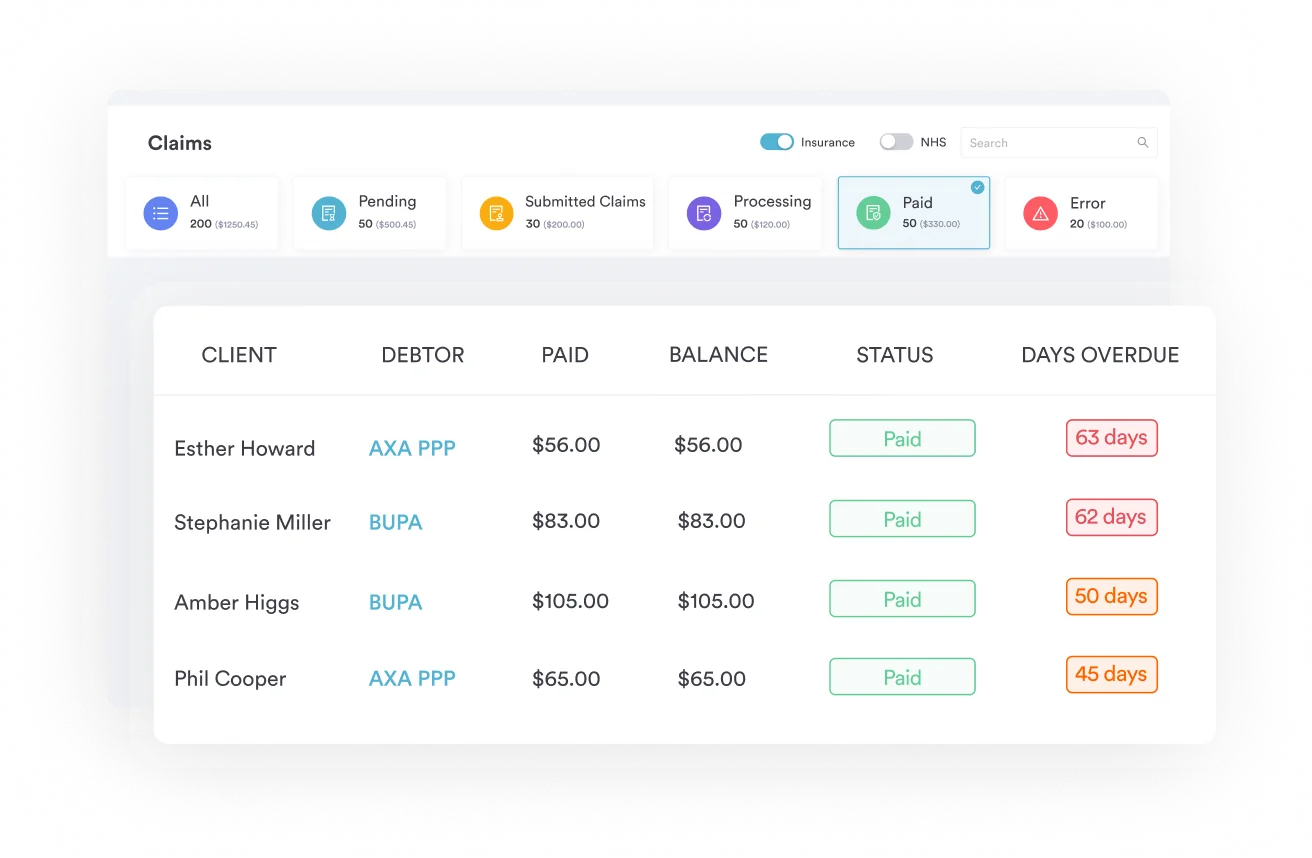
Pabau keeps the prescriber order, PA approval and delivery record on the patient’s file, next to the claim. Claims move through pending, submitted, processing and paid statuses, so a denial or overdue payment is visible as soon as it lands.
The result is fewer denied T4530 claims and a complete patient file ready when a Medicaid auditor asks for one.

Pabau’s claims management tools help you track authorization status, monitor quantity limits, and keep the documentation trail that supports T4530 claims from submission through audit.

T4530 rewards precision. Before billing, confirm three facts. The product is a pediatric brief or diaper, it is a large size, and the Medicaid plan has authorized the quantity.
Put those checks at the dispensing stage, where they cost minutes, instead of in denial follow-up, where they cost weeks. A crosswalk that maps every SKU to T4529 through T4534 settles the code before the product ships. A PA calendar protects next month’s claim.
Book a demo to see how Pabau keeps T4530 authorizations, deliveries and claims on one patient record.

Need help understanding what a clean Medicaid supply claim looks like? Clean claim fundamentals explains the elements payers check before processing any supply claim.
Looking to strengthen your overall billing compliance posture? Medical billing compliance covers the documentation standards that apply across Medicaid supply programs.
Want a broader overview of how supply code billing fits into the revenue cycle? Revenue cycle management explains how individual code submissions connect to your practice’s financial outcomes.
HCPCS Code T4530 covers one pediatric-sized disposable brief or diaper in a large size, billed per unit to state Medicaid programs. The patient needs a qualifying diagnosis, such as neurogenic bladder or spina bifida. Small/medium briefs bill as T4529, pediatric pull-ons as T4531 or T4532, and youth products as T4533 or T4534.
T4530 is a large pediatric brief or diaper, and T4531 is a small/medium pediatric pull-on. They differ in both style and size. A large pediatric pull-on bills as T4532, and a small/medium pediatric brief bills as T4529.
No. T-codes are for state Medicaid use and are not payable under Medicare fee-for-service. A T4530 claim sent to Medicare will deny. Bill state Medicaid fee-for-service programs, Medicaid managed care organizations, or CHIP plans that cover incontinence supplies.
Often, yes. Many state Medicaid programs and managed care plans require prior authorization for incontinence supplies, including T4530. Requirements, documentation checklists, and timelines vary by state and plan, so confirm with the payer before dispensing.
No. T4530 is specific to pediatric-sized products. Dispensing a pediatric-sized diaper to an adult would be clinically inappropriate, and the payer’s eligibility data would flag the patient’s age. Adult incontinence products are billed under separate HCPCS codes.
Quantity limits are set by each state Medicaid program or plan, and they vary by state and plan. The allowed quantity can also depend on the patient’s age and diagnosis. Units billed above the approved limit without an approved override are denied.