HCPCS code T2048 – Long-term residential behavioral health with room and board
Code Definition
T2048 is the HCPCS Level II code for long-term, non-acute residential behavioral health care with room and board, billed per diem. CMS describes it as care in a residential treatment program where the stay is typically longer than 30 days.
Medicare does not recognize T-series codes, so T2048 claims go to state Medicaid programs or Medicaid managed care plans. The room and board inside the per diem is what separates T2048 from H0019, which bills the same long-term care without it.
Related Information
Level
Level II
Category
T — National codes established for state Medicaid agencies
Status
Active since October 1, 2003
Billable
No
Code also known as
Long-term residential treatment per diem, room and board included
Save time. Improve accuracy. Get paid faster.
Automate coding with Pabau
Let Pabau's smart automation suggest the right codes, reduce claim denials, and keep your practice compliant—effortlessly.
Long-term residential behavioral health with room and board
Codes
Suggested by Pabau AI
T2048Long-term residential behavioral health with room and board
HCPCS Code Suggestion
AI
Suggested code
T2048Long-term residential behavioral health with room and boardHigh match
Confidence score
98%
Why this code?
Matches patient diagnosis
Supported by clinical notes
Commonly used for this condition
Why practices choose Pabau
Save hours every week
Automate repetitive tasks and focus on what matters most—your patients.
Improve accuracy
Reduce coding errors and ensure compliance with the latest regulations.
Get paid faster
Clean claims, fewer denials, and faster reimbursements.
Grow with confidence
Powerful insights and reporting to help your practice thrive.
HIPAA compliant•SOC 2 certified•GDPR-compliant•Trusted by 4,000+ clinics worldwide
Key takeaways
HCPCS code T2048 bills one day of long-term, non-acute residential behavioral health treatment, and the per diem includes room and board.
Room and board is the dividing line: a long-term program that bills room and board separately uses H0019 instead.
Medicare does not recognize T-series codes, so each state Medicaid program sets its own T2048 rate, rules and coverage.
Every billed day needs a progress note, a current treatment plan and an authorization that covers that date.
Intellectual disability waiver services such as residential habilitation and supported employment bill under T2016, T2018 or T2019, never T2048.
What HCPCS code T2048 covers
HCPCS code T2048 covers one day of long-term, non-acute residential behavioral health treatment, with room and board included in the per diem. CMS describes it as care in a residential treatment program where the stay is typically longer than 30 days. The code sits in the T-series of HCPCS Level II, the national codes set up for state Medicaid agencies.
Residential programs that treat substance use disorders, mental health conditions, or both bill T2048. The person lives on-site, and one daily rate pays for the treatment program plus housing and meals. That bundled room-and-board share is what sets T2048 apart from the H-series residential codes.
What one T2048 day includes depends on the state’s service definition. Programs billing it typically provide:
Individual and group therapy delivered under the treatment plan.
Case management, relapse prevention and recovery skills work.
A supervised residential setting staffed around the clock.
Room and board, meaning housing and meals, inside the same per diem.
The 30-day figure in the descriptor describes the expected length of stay for this level of care. States decide whether a stay that ends earlier can still bill T2048.
What T2048 does not cover
T2048 is narrow, and several services that look close to it bill under other codes.
Acute or hospital-level care: inpatient psychiatric care and hospital withdrawal management are acute services, so they fall outside a non-acute residential per diem.
A separate room-and-board charge: T2048 already pays for housing and meals, so a second accommodation line for the same day duplicates payment.
Short-term residential stays: a stay that is short-term by design fits H0018, which excludes room and board.
Services for intellectual or developmental disabilities: residential habilitation and supported employment are waiver services billed under T2016, T2018 or T2019.
Outpatient services from the same program: the per diem pays for the program’s treatment that day, so billing those sessions separately risks a duplicate-payment edit.
Days the person is not in residence: leave or bed-hold days bill only where the state has a written bed-hold rule.
Billing units and per diem rules for T2048
One unit of T2048 equals one day, so a 45-day stay bills as 45 units. The number of therapy hours on a given day does not change the unit count. The descriptor fixes the unit at per diem, so hourly or per-session billing is always a unit error.
Billing variable
Rule
What to check
Unit of service
One unit per day (per diem)
Whether your state counts the admission day, the discharge day, or both
Room and board
Included in the T2048 rate
No separate accommodation line for the same day
Claim form
Institutional (837I or UB-04) or professional (837P or CMS-1500)
Which form your state or MCO requires for residential treatment
Revenue code
1002 for chemical dependency or 1001 for psychiatric residential treatment, on institutional claims
Whether the payer wants T2048 reported alongside the revenue code
Place of service
55 (residential substance abuse treatment facility) or 56 (psychiatric residential treatment center), on professional claims
That the place of service matches the program’s license
Rate
Set by each state fee schedule or MCO contract
There is no national fee schedule for T2048
Authorized days
Set by the prior authorization
Days billed against days approved for the current period
Medicare does not recognize T-series codes, so the CMS physician fee schedule carries no T2048 rate. Find the rate in your state Medicaid fee schedule or your MCO contract instead. A commercial plan may accept the code, but get that confirmed in writing before you bill.
How T2048 differs from H0017, H0018, H0019 and the waiver codes
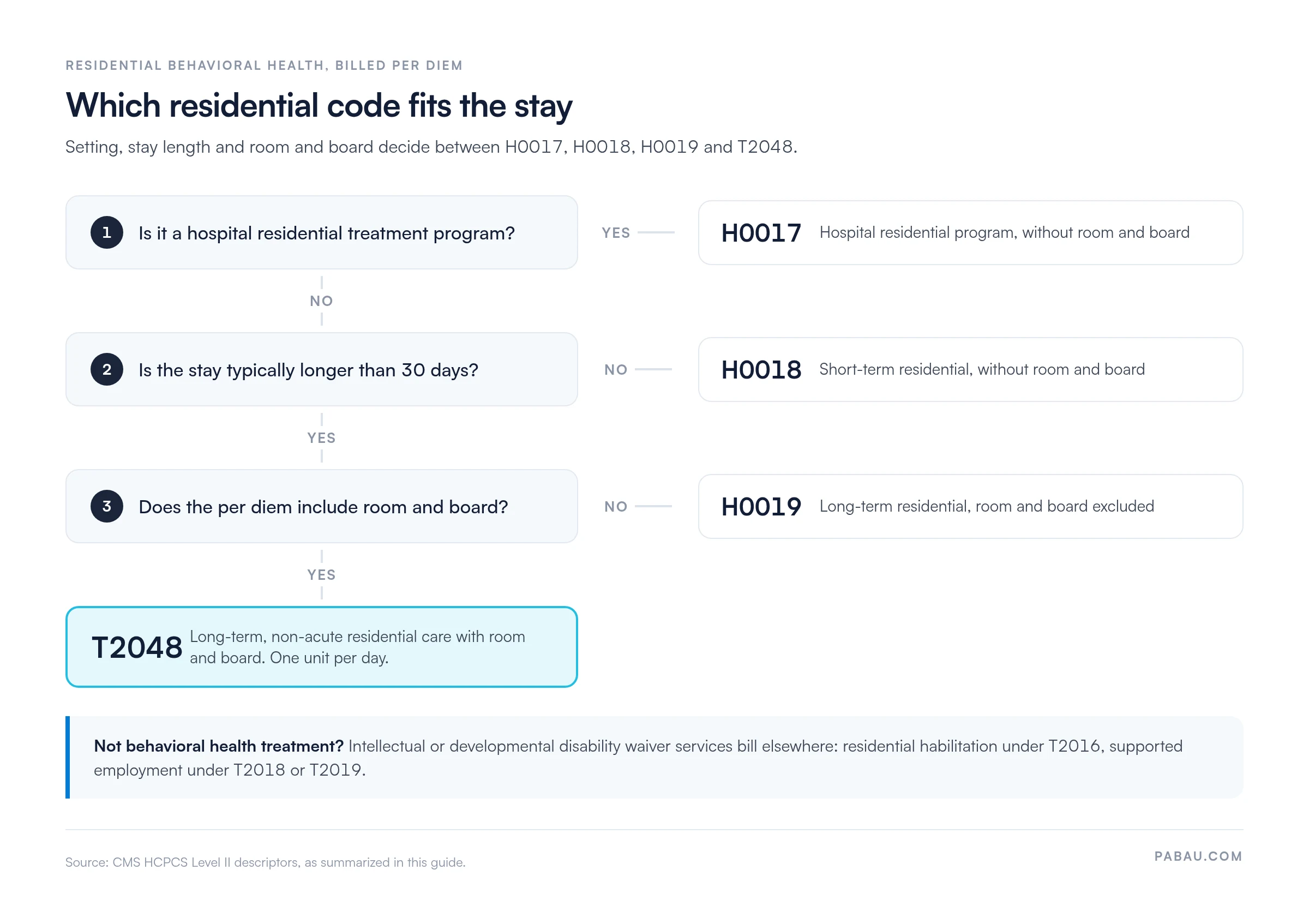
Two questions decide the code. Is the stay long-term, and does the per diem include room and board? T2048 fits only when the answer to both is yes. A hospital-based program is ruled out before either question, as the diagram below shows.
Once a hospital program is ruled out, stay length and room and board leave one residential code standing. Based on CMS HCPCS Level II descriptors.
Code
CMS descriptor (long-stay rows condensed)
How it differs from T2048
T2048
Behavioral health; long-term care residential (non-acute, stay typically longer than 30 days), with room and board, per diem
The reference point: long-term, non-acute, room and board included
H0019
Behavioral health; long-term residential (non-medical, non-acute, stay typically longer than 30 days), without room and board, per diem
Same long-term level of care, but room and board is excluded
H0018
Behavioral health; short-term residential (non-hospital residential treatment program), without room and board, per diem
Short-term stay, room and board excluded
H0017
Behavioral health; residential (hospital residential treatment program), without room and board, per diem
Hospital-based program, room and board excluded
T2016
Habilitation, residential, waiver; per diem
Waiver residential habilitation for intellectual and developmental disabilities, not behavioral health treatment
T2018 and T2019
Habilitation, supported employment, waiver; per diem (T2018) or per 15 minutes (T2019)
Waiver supported employment, unrelated to residential treatment
The most common mix-up is between T2048 and HCPCS code H0019. Where a state pays treatment and housing separately, H0019 plus a separate room-and-board arrangement is correct. Billing T2048 and a room-and-board line for the same day pays for the housing twice.
The waiver codes sit in a different program entirely. T2016 residential habilitation and the supported employment codes serve people enrolled in an intellectual or developmental disability waiver. You can compare their full descriptors in our HCPCS procedure codes library.
Documentation requirements for T2048 claims
Each billed day needs evidence that the person was in residence and received the treatment the plan describes. Auditors review the record day by day, so a missing note puts that day’s payment at risk of recoupment.
Admission assessment: a diagnostic and level-of-care assessment showing residential treatment is needed, often scored against the ASAM Criteria in substance use programs.
Individualized treatment plan: signed, current and specific about goals and interventions, then updated on the schedule your state sets.
Daily progress notes: one note per billed day recording participation and clinical status. Copied-forward notes are an audit flag.
Continued-stay reviews: periodic reassessments explaining why the person still needs residential care rather than a lower level of care.
Census or attendance records: proof of residence on each billed day, with leave days recorded separately.
Prior authorization record: the authorization number, the approved date range and the number of approved days.
Consent to disclose: for substance use disorder records, a consent that meets 42 CFR Part 2 before records go to a payer.
Sound medical billing compliance means keeping these records for the retention period your state Medicaid agency sets. It also means being able to produce them quickly when an auditor asks.
Prior authorization requirements
Medicaid programs and MCOs commonly require prior authorization before a T2048 admission, and they approve a set number of days. The request usually includes the diagnosis, the level-of-care assessment and the treatment plan.
Continued stays are reauthorized through concurrent review before the approved days run out. Track each end date, because days delivered after a lapse are hard to recover.
Pro Tip
Set a reminder well before each T2048 authorization ends, so the continued-stay review goes in on time. Retroactive authorization rules vary by plan, and some plans will not cover days delivered after a lapse.
ICD-10 diagnosis codes that support T2048
The diagnosis on a T2048 claim must justify long-term residential behavioral health treatment. Payers look for a substance use diagnosis from F10–F19, a serious mental illness from F20–F39, or both when the program treats co-occurring conditions.
ICD-10-CM code
Description
When it fits a T2048 claim
F10.20
Alcohol dependence, uncomplicated
Primary diagnosis in residential alcohol use disorder treatment
F11.20
Opioid dependence, uncomplicated
Residential opioid use disorder treatment, often alongside medication treatment
F15.20
Other stimulant dependence, uncomplicated
Methamphetamine and other stimulant use disorders
F19.20
Other psychoactive substance dependence, uncomplicated
Polysubstance use that no single-substance code describes
F20.9
Schizophrenia, unspecified
Long-term residential mental health treatment when the record documents no subtype
F25.0
Schizoaffective disorder, bipolar type
Residential programs for serious mental illness
F33.2
Major depressive disorder, recurrent severe without psychotic features
Co-occurring depression, usually listed as a secondary diagnosis
Code to the highest specificity the record supports. An unspecified code invites a records request when the assessment documents a specific diagnosis. Intellectual disability codes (F70–F79) do not establish medical necessity for T2048 on their own.
Modifiers used with T2048
T2048 has no national modifier requirement, but many state Medicaid programs use modifiers to identify the program type or population. Leaving off a modifier your state requires gets the claim denied.
Modifier
Description
When it applies
HF
Substance abuse program
Identifies residential substance use disorder treatment where the state asks for it
HE
Mental health program
Identifies residential mental health treatment
HH
Integrated mental health and substance abuse program
Programs treating co-occurring conditions together
HA
Child or adolescent program
States that pay adolescent residential treatment at a separate rate
HB
Adult program, non-geriatric
States that separate adult and adolescent rates
U1–U9
Medicaid level of care, as defined by each state
Meaning varies by state, so check the state modifier table
Modifier rules differ between states and change with fee-schedule updates. Confirm them in the current state provider manual or MCO billing guide before each new authorization period.
State Medicaid variations for T2048
T2048 has one national descriptor but no national billing policy. Each state decides whether to use the code, which programs may bill it, and what it pays.
Whether the state uses T2048: some states pay long-term residential treatment through H0019 and handle room and board separately. In those states, T2048 is not on the fee schedule.
Who funds room and board: federal Medicaid matching does not cover it outside inpatient facilities. CMS set out that rule for Section 1115 substance use demonstrations in SMD #17-003. A state paying a bundled T2048 rate decides how that share is funded.
The IMD exclusion: Medicaid generally cannot pay for adults aged 21 to 64 in an institution for mental diseases with more than 16 beds. Larger programs need a Section 1115 waiver or another authority first.
Covered population: states differ on whether T2048 covers adults, adolescents or both. They also differ on whether the program must treat substance use, mental illness or co-occurring conditions.
Provider requirements: state licensure is the baseline, and some states also require accreditation or a certified level of care.
Rate: a state fee schedule or an MCO contract sets the per diem, and no rate carries over from one state to another.
Before billing, pull your state’s residential treatment service definition and fee schedule. If a managed care plan runs the benefit, read its provider manual too.
Common denial reasons for T2048 and how to avoid them
Most T2048 denials trace back to a short list of causes, and each one can be caught before submission.
Missing or expired authorization: the claim carries no valid authorization number, or covers days outside the approved range. Fix: confirm the number, dates and remaining days before each claim.
Wrong residential code: T2048 billed for a short-term stay, or for a program that bills room and board separately. Fix: check stay type and the room-and-board arrangement at admission.
Duplicate room and board: a separate accommodation line sits on a T2048 day. Fix: remove it, because the per diem already includes housing and meals.
Unit errors: hours or sessions billed instead of days, or a discharge day billed where the state excludes it. Fix: count calendar days under your state’s rule.
Unsupported diagnosis: the diagnosis does not justify residential care, such as an intellectual disability code alone. Fix: match the claim to the admission assessment.
Missing modifier: a program-type or state modifier the payer requires is absent. Fix: map required modifiers to each payer in your billing setup.
Thin daily notes: the record does not support each billed day, which surfaces later as a recoupment. Fix: review notes against the census before the claim goes out.
Building these checks into the pre-submission workflow beats managing claim denials after the remittance arrives.
Pro Tip
Review remittances weekly rather than monthly. A repeated T2048 denial usually points to one workflow problem, and catching it in week two saves reworking a full month of claims.
How to submit a clean T2048 claim: step-by-step
A clean T2048 claim depends on doing these steps in order, starting before the admission.
Verify Medicaid eligibility: confirm active coverage for every month of the stay. Insurance eligibility verification at admission prevents a whole category of denials.
Confirm prior authorization: check the authorization number, the approved date range and the days remaining.
Confirm the code fits: the stay must be long-term and non-acute, with room and board inside the per diem under your state’s definition.
Check the documentation: make sure each billed day has a signed progress note and falls under a current treatment plan.
Count the units: bill one unit per day, applying your state’s admission and discharge day rule.
Add modifiers and location codes: attach any required modifiers, plus the place-of-service code or the revenue code your claim form needs.
Submit on the required form: send an 837P or an 837I, as your state requires. On a CMS-1500, the authorization number goes in item 23.
Review the remittance: read the 835 for adjustment codes. CO-15 means a missing or invalid authorization number, CO-4 a modifier problem, and CO-50 a medical necessity denial.
How Pabau keeps T2048 per diem claims clean
Residential billing teams often track authorizations in one spreadsheet, notes in another system and claims in a clearinghouse portal. A missing authorization number then shows up only when the remittance comes back denied.
Pabau, the practice management platform we build, keeps patient records, forms and claims in one system. In the US, its claims management software connects to Claim.MD for electronic submission, eligibility checks and ERA posting.
Before a claim goes out, Pabau checks that details such as authorization codes are filled in. The Send button stays disabled until they are, so a T2048 claim reaches Medicaid complete.
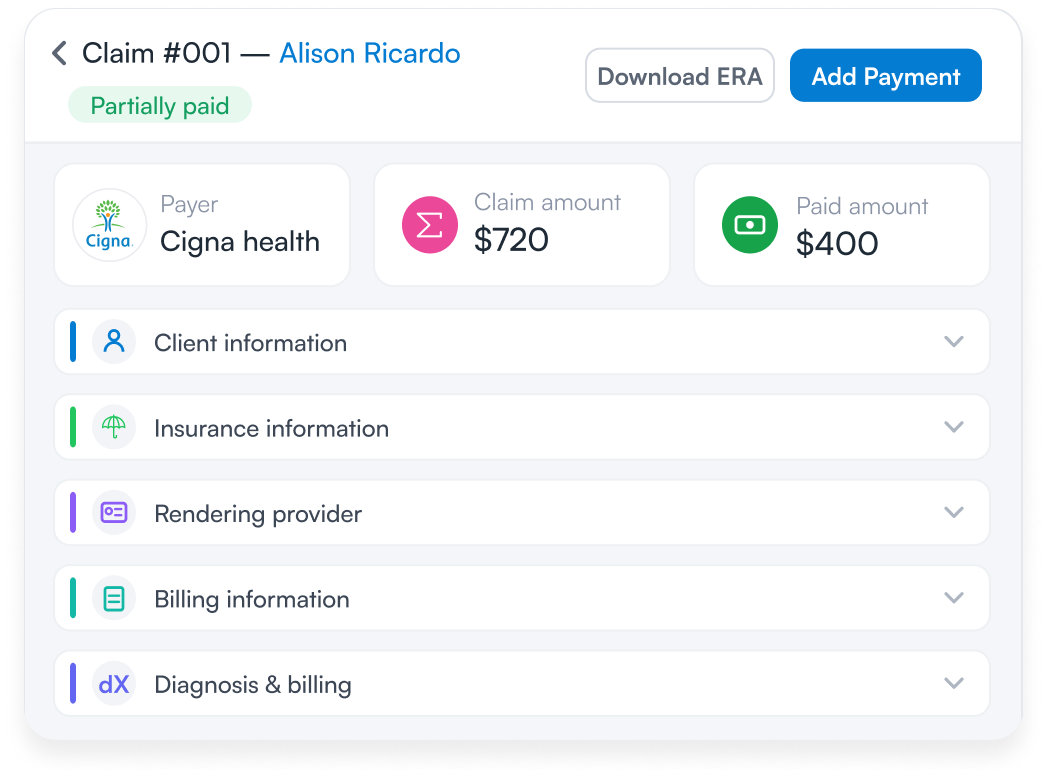
Pabau’s claim record shows the payer, billed amount and paid amount together, so a short-paid T2048 claim stands out once the ERA posts.
Send cleaner T2048 claims to Medicaid
Pabau checks each claim for missing details such as authorization codes before it leaves, then tracks its status through to payment. Your team spends less time reworking denied residential days.
The decision that matters on T2048 is the room-and-board question. When a long-term, non-acute program’s per diem includes housing and meals, T2048 fits. When the state pays them separately, H0019 does, and disability waiver services never belong here.
Make that call at admission, document every billed day, and watch authorization dates, and most T2048 denials never happen. Book a demo to see how Pabau keeps residential behavioral health claims complete before they reach Medicaid.
Continue your research
Need to understand denial resolution workflows?Denial codes in medical billing covers the CARC and RARC codes most commonly returned on Medicaid claims, including those triggered by T2048 denials.
Managing revenue cycle compliance for your program?What is revenue cycle management explains the end-to-end billing process and where T2048 fits within a Medicaid provider’s claim lifecycle.
Looking for a clean-claim checklist?Clean claim requirements outlines the fields and data elements that must be correct before any Medicaid claim, including T2048, passes clearinghouse edits.
Frequently asked questions
What does HCPCS code T2048 cover?
T2048 covers one day of long-term, non-acute residential behavioral health treatment, with room and board included in the per diem. It applies to residential programs treating substance use disorders, mental health conditions or both, where the stay is typically longer than 30 days.
What is the difference between T2048 and H0019?
Both codes describe long-term, non-acute residential behavioral health treatment billed per diem. T2048 includes room and board in the rate, while H0019 excludes it. Use H0019 where the state pays or funds room and board separately.
Does Medicare cover T2048?
No. T-series HCPCS codes are national codes for state Medicaid agencies, and Medicare does not recognize them. T2048 is billed to state Medicaid fee-for-service programs or Medicaid managed care plans.
How many units of T2048 can be billed?
One unit equals one day of residential stay, so a 45-day stay bills as 45 units. Check whether your state counts the admission day, the discharge day or both, and never bill more days than the authorization approves.
Can T2048 be used for supported employment or residential habilitation?
No. Those are Medicaid waiver services for people with intellectual or developmental disabilities. Residential habilitation bills under T2016, supported employment per diem under T2018, and supported employment per 15 minutes under T2019.
Which ICD-10 codes support a T2048 claim?
Substance use diagnoses from F10–F19 and serious mental illness diagnoses from F20–F39 are the usual primary diagnoses. Code to the highest specificity the assessment supports, and list co-occurring conditions as secondary diagnoses.