HCPCS code Q4154: Biovance billing, Medicare rate and denial guide
HCPCS code Q4154: definition and code details HCPCS code Q4154 is a Level II cod...

Last Updated: Oct 6, 2026
99451 is the CPT code for an interprofessional telephone/Internet/electronic health record assessment and management service by a consultative physician or other qualified health care professional. It includes a written report to the patient's treating/requesting physician or other qualified health care professional, with 5 minutes or more of medical consultative time.
The consulting specialist bills it, while the requesting provider reports 99452 for their side of the exchange. Most 99451 denials trace to three problems. The wrong provider bills it, the chart has no time record, or the written report is missing.
Let Pabau's smart automation suggest the right codes, reduce claim denials, and keep your practice compliant—effortlessly.
Automate repetitive tasks and focus on what matters most—your patients.
Reduce coding errors and ensure compliance with the latest regulations.
Clean claims, fewer denials, and faster reimbursements.
Powerful insights and reporting to help your practice thrive.
HIPAA compliant SOC 2 certified GDPR-compliant Trusted by 4,000+ clinics worldwide

CPT code 99451 is billed by the consulting specialist, while the requesting or treating provider bills 99452.
The consult needs at least 5 minutes of medical consultative time by telephone, internet, or EHR, never face to face.
A written report to the requesting provider must be in the medical record, so verbal-only consults do not qualify.
Codes 99446-99449 and 99451 are limited to once per 7 days per patient, and 99452 to once per 14 days.
Pabau’s claims management software logs consult time, stores the written report, and submits the 99451 claim electronically.
CPT code 99451 is an interprofessional telephone/internet/electronic health record assessment and management service provided by a consultative physician. It includes a written report to the requesting provider and requires 5 minutes or more of medical consultative time.
The code belongs to the 99446-99452 family, which the American Medical Association (AMA) created for interprofessional consults. These codes pay a specialist for advising a treating provider without a face-to-face patient encounter.
The exchange is usually asynchronous. The requesting provider sends the patient’s clinical information electronically, and the consulting specialist reviews it and writes a response. A live video or phone call is not required, and the patient is not present.
Qualifying time includes reviewing the patient’s records and preparing the written response. Telephone or electronic discussion that shapes the clinical opinion counts as well. Time spent on administrative tasks does not. The 5-minute threshold is the floor, and 99451 has no upper time limit.
The consulting specialist bills 99451, not the requesting or treating provider. Mixing up those two roles is the most common source of confusion in the 99446-99452 family, and a frequent cause of denials.
The consulting provider must not have an established treatment relationship with the patient for the condition being consulted on. If the specialist is already managing the same condition, the encounter is not an interprofessional consultation and 99451 does not apply.
99451 and 99452 are two sides of the same consultation. 99451 captures the consulting specialist’s work, while 99452 captures the requesting provider’s referral time. Both codes can be billed for the same patient, but by different providers.
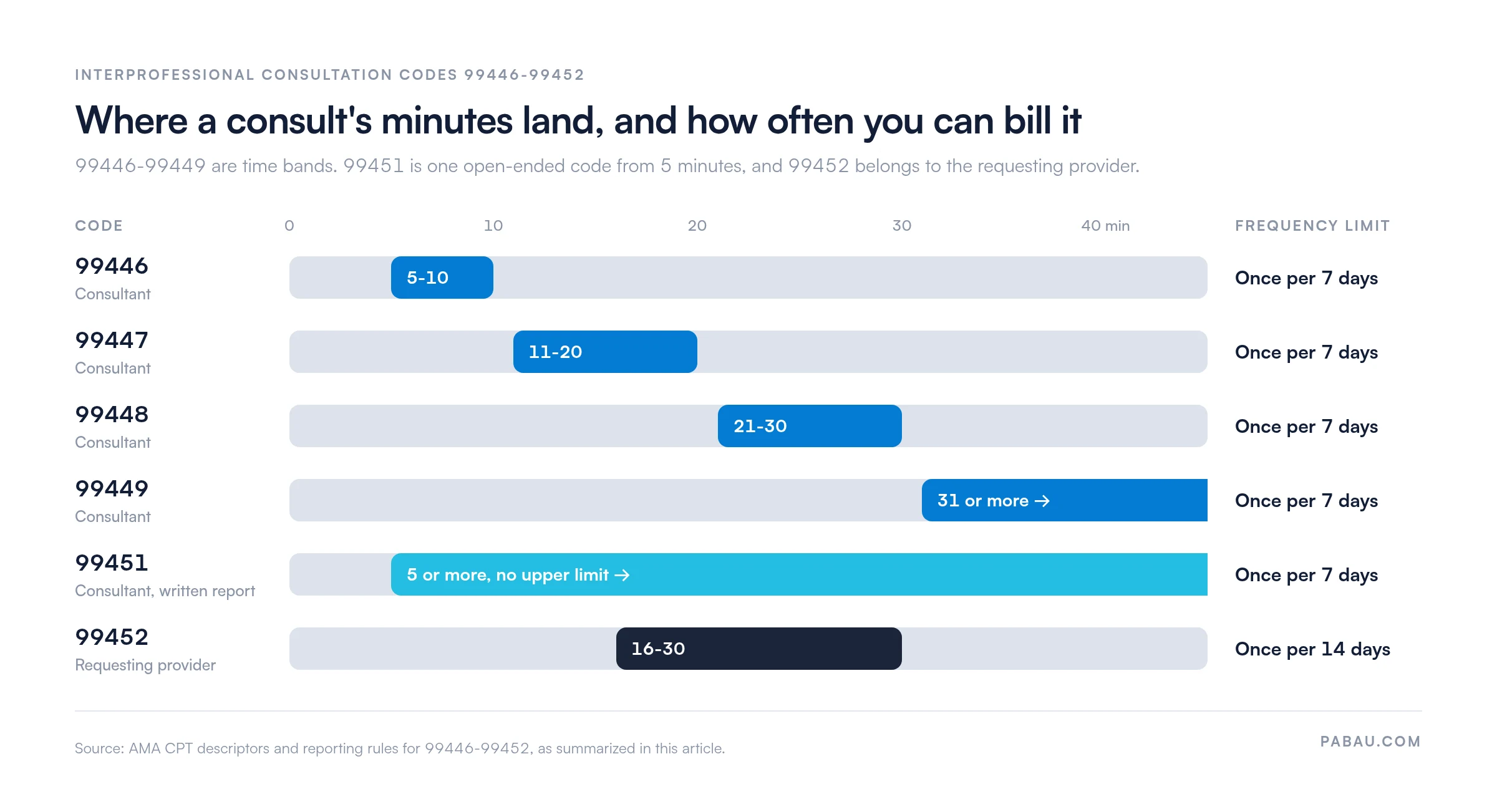
Codes 99446-99449 and 99451 are all billed by the consulting specialist. Codes 99446-99449 are time-banded, while 99451 is a single code for 5 minutes or more. Code 99452 is the one code for the requesting provider’s work. Picking the right code depends on documenting the time spent.
Because 99451 starts at 5 minutes and has no upper limit, a short review and a long one report the same single code. The chart below shows where each code’s time window sits, and how often each one can be billed. Check current descriptors in the AAPC Codify CPT lookup before billing, since the AMA updates the code set every year.
Missing documentation is the usual reason 99451 claims fail audit. The medical record must contain each of the following before the claim is submitted, and the exchange itself should run through a HIPAA-compliant channel.
The written report is not optional. Payers that audit 99451 claims routinely request this document as proof the consultation occurred. A phone call that ends without a written summary in the chart is not billable under 99451, regardless of time spent.
Document the start and stop time of the consultation in the chart, not just the total minutes. Auditors find a single time total harder to substantiate than a specific window (e.g., ‘9:14 a.m. to 9:22 a.m., 8 minutes’). This small change significantly reduces your exposure on records review.
Medicare covers CPT code 99451 under the CMS Physician Fee Schedule, which updates reimbursement rates annually. The national non-facility rate for 99451 has typically ranged from approximately $18 to $25, depending on the year and locality. Verify the current rate in the CMS fee schedule tool before billing, since rates adjust each January 1.
Commercial payer coverage for the 99446-99452 family is not universal. Some major payers cover these codes under telehealth benefit carve-outs, and others do not recognize them at all. Before billing any commercial plan, pull the payer’s medical policy for interprofessional consultations and confirm the code is listed as covered.
The AMA and CMS limit codes 99446-99449 and 99451 to once per 7 days per patient per consulting provider. Code 99452 has a separate limit of once per 14 days. The 7-day window begins on the date the consultation is performed, not when the written report is sent.
A 14-day rule also applies. Codes 99446-99449 and 99451 are not reportable when the consultation leads to a transfer of care. The same applies when it leads to a face-to-face visit within the next 14 days or at the next available appointment.
They are also not reportable if the consultant saw the patient face to face in the prior 14 days. In those cases, the specialist reports the visit itself, such as office consultation code 99242 where the payer accepts consultation codes.
CPT code 99451 is inherently asynchronous, so real-time telehealth modifiers are generally not applicable. That said, some payers require specific modifiers for claims processing. Always confirm payer-specific modifier requirements in the payer portal or medical policy before submission.
Denials for interprofessional consultation codes cluster around predictable documentation failures. The denial management workflows that work for other E&M codes apply here, but 99451 has a few unique failure points. Our guide to denial codes in medical billing explains the CARC code each failure returns on the remittance.
E-consult workflows are where 99451 earns its keep for specialist practices. The code only pays when the workflow is correctly documented, so the step sequence matters as much as the descriptor. Accurate medical billing documentation at each step prevents the denials described above.
The requesting provider independently bills 99452 for their own preparation and follow-up time if they meet the 16-minute threshold. The two claims are linked by patient and date but submitted by separate providers under separate NPIs.
The documentation burden for 99451 is moderate but precise. Time, the written report, the platform, and the provider role must all appear in the record, or the claim is at risk. Integrated claims management software reduces that risk by keeping the documentation and the claim submission in the same system.
In Pabau, the practice management and billing platform we build, consult time is logged against the patient record. The written report sits in the chart next to the original request. Claims go out electronically through the medical claims clearinghouse integration, which runs eligibility checks and electronic remittance for US payers.

Pabau keeps the written report, time log, and claim data in one place, so your 99451 submissions go out clean and your denials go down. See how the workflow runs in a live demo.

CPT code 99451 pays specialists for advice they often give away as a curbside favor. To collect it, treat each e-consult like a billable visit. Log start and stop times, send the written report before you bill, and check the 7-day and 14-day windows against your schedule.
The trade-off is payer variation. Medicare covers the code, but commercial coverage is patchy, so confirm each payer’s policy before you build an e-consult service around it.
Pabau keeps the consult record, written report, and claim data in one place, so 99451 claims go out complete. Book a demo to see how it handles interprofessional consults from request to payment.

Need to understand how clearinghouse submission works for specialist claims? Medical claims clearinghouse guide explains how electronic claim routing reduces denials and accelerates reimbursement.
Want to reduce denial rates across your billing workflow? Denial management in healthcare covers the systematic approach to tracking, appealing, and preventing claim rejections.
Looking for a full breakdown of clean claim requirements? Clean claim best practices details the fields and documentation standards that keep claims out of the denial queue.
CPT code 99451 covers an interprofessional assessment and management service by a consulting specialist, with at least 5 minutes of consultative time. It requires a written report to the requesting provider. The exchange happens by telephone, internet, or EHR, with no face-to-face patient encounter.
CPT 99451 is billed by the consulting specialist for their review and written response. CPT 99452 is billed by the requesting or treating provider for 16-30 minutes of referral time. Both codes can be billed for the same patient, by different providers under separate NPIs.
CPT 99451 can be billed once per 7 days per patient per consulting provider. That 7-day limit applies to 99446-99449 and 99451 only, while 99452 is limited to once per 14 days. A new clinical question on a different condition may support a separate consult if the documentation clearly distinguishes the two.
Yes, Medicare reimburses CPT code 99451 under the Physician Fee Schedule. The national non-facility rate has typically ranged from approximately $18 to $25, depending on the year and locality. Verify the current rate in the CMS fee schedule tool before billing, since rates update each January 1.
The medical record must show the total minutes of consultative time, ideally with start and stop times. It also needs the written report to the requesting provider, the date of service, the clinical question, and the platform used. Verbal-only consultations without a written report do not qualify.
The most common denial reasons are a treating provider billing 99451 instead of 99452, a missing written report, and undocumented time. Claims also fail when the 7-day limit is exceeded without a new clinical question. Payers that do not cover interprofessional consultation codes deny them as well.