HCPCS code Q4154: Biovance billing, Medicare rate and denial guide
HCPCS code Q4154: definition and code details HCPCS code Q4154 is a Level II cod...

Last Updated: Oct 6, 2026
88173 is the CPT code for cytopathology, evaluation of fine needle aspirate; interpretation and report. It covers the pathologist's final read of FNA material and the written report, billed once per anatomic site.
Collection is billed separately under 10005-10012 or 10021. On-site adequacy checks are billed under 88172 and add-on 88177, and both can appear on the same claim as 88173.
Let Pabau's smart automation suggest the right codes, reduce claim denials, and keep your practice compliant—effortlessly.
Automate repetitive tasks and focus on what matters most—your patients.
Reduce coding errors and ensure compliance with the latest regulations.
Clean claims, fewer denials, and faster reimbursements.
Powerful insights and reporting to help your practice thrive.
HIPAA compliant SOC 2 certified GDPR-compliant Trusted by 4,000+ clinics worldwide

CPT code 88173 covers the pathologist’s final cytopathologic interpretation of FNA specimens, not the collection or the imaging guidance.
88173 is billed once per anatomic site per date of service, not once per needle pass.
88172 bills the first on-site evaluation episode at a site, and add-on 88177 bills each additional episode at the same site.
88172 and 88173 may be billed together on the same date of service by the same pathologist.
Pabau’s claims software runs validation checks before every claim is sent, so missing insurer details are fixed before submission.
CPT code 88173 is the code a pathologist bills for interpreting fine needle aspirate (FNA) material and writing the diagnostic report. The American Medical Association descriptor reads: Cytopathology, evaluation of fine needle aspirate; interpretation and report. Specimen collection, imaging guidance, and on-site adequacy checks each have their own codes.
The FNA cytopathology codes are 88172, 88173, and add-on 88177. Each one covers a separate step in the FNA encounter. That’s why one patient visit can produce claims for more than one of them without triggering an unbundling edit.
The performing laboratory must hold CLIA certification for cytopathology to bill CPT code 88173. Claims submitted without a valid CLIA number are typically rejected at the clearinghouse, before they reach payer adjudication.
CPT code 88173 covers the pathologist’s review of cytologic material obtained by fine needle aspiration. That includes stained smears, cell blocks, and cytocentrifuge preparations, plus the written interpretation and report.
Four services the code does not cover:
CPT 88172 covers the immediate on-site cytologic evaluation that checks specimen adequacy during the FNA procedure. It’s billed per site, for the first evaluation episode. CPT code 88173 covers the final interpretation after all passes are complete, billed once per anatomic site.
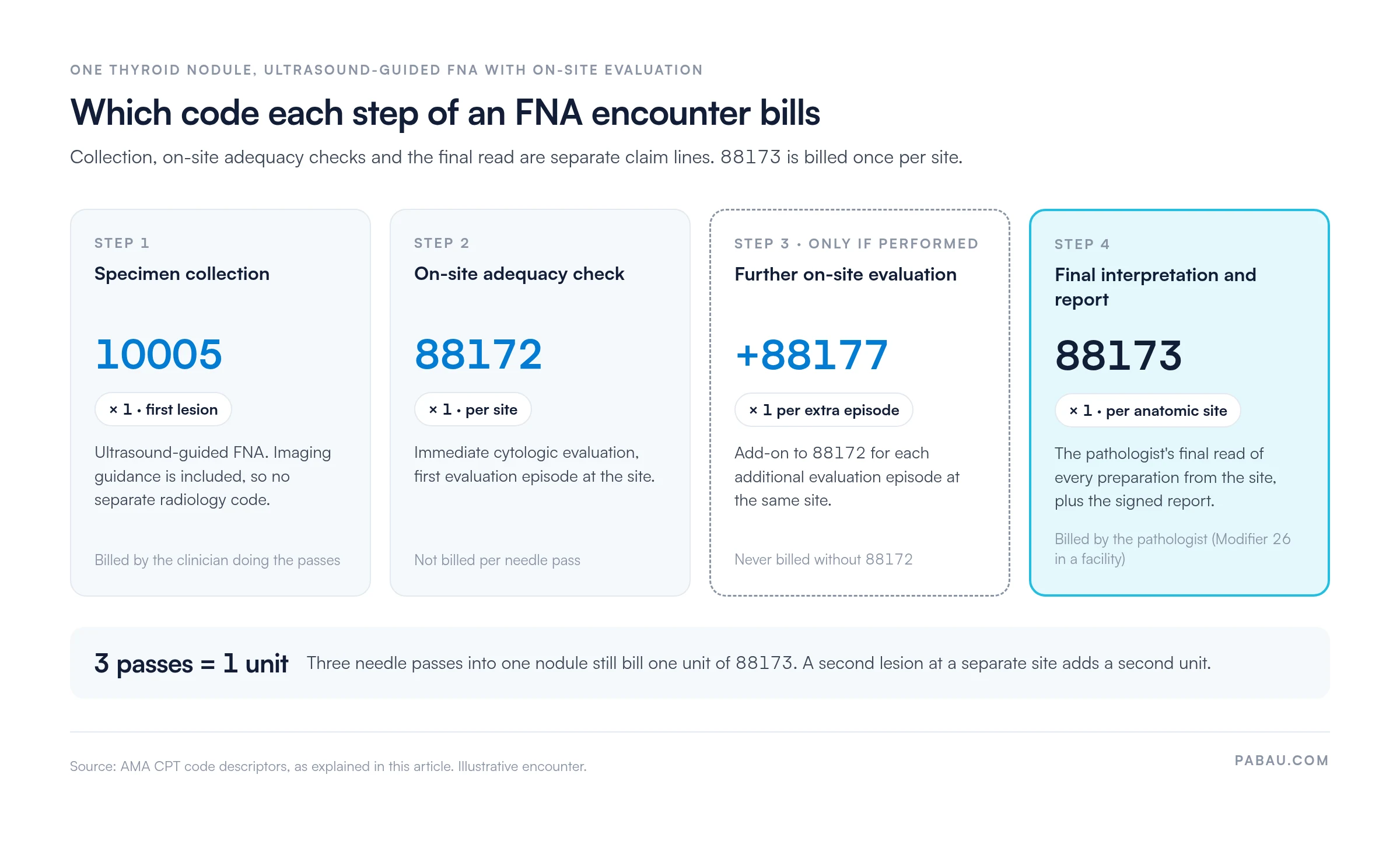
The two codes aren’t mutually exclusive. A thyroid FNA with three ultrasound-guided passes and on-site ROSE can legitimately generate these claim lines:
The National Correct Coding Initiative (NCCI) does not bundle 88172 and 88173 as mutually exclusive codes. Payers generally accept both on the same date of service, in line with AAPC and American Society of Cytopathology guidance. The flow below shows which code each step of that thyroid encounter bills.
CPT 88305 is a Level IV surgical pathology code for grossly and microscopically examined tissue specimens. CPT code 88173 covers cytologic preparations from FNA. The specimen type decides the code, not the organ or body site.
An FNA of a thyroid nodule yields cytologic smears and possibly a liquid-based preparation, so it’s billed as 88173. A thyroid lobectomy specimen processed in paraffin, sectioned, and stained for histologic review is 88305.
Sometimes a clinician takes both an FNA and a core needle biopsy from the same lesion in one session. Then both codes apply: 88173 for the cytologic material, and 88305 (or higher) for the core tissue processed as a surgical specimen. Billing 88305 for cytologic smear material is a miscoding that payers deny.
Knowing the whole FNA code family protects against both under-billing and unbundling audits. The cytopathology codes (88172, 88173, and add-on 88177) cover the lab-side work. The procedure codes (10005-10012 and 10021) cover the clinical collection.
The AMA restructured the FNA collection codes in 2019, adding the 10004-10012 range alongside a revised 10021. Ultrasound-guided collection of a first lesion, billed as 10005, is the pairing coders see most often with 88173. Claims that pair 88173 with a deleted pre-2019 FNA code are rejected as invalid.
Four billing rules govern CPT code 88173 across most payers, and they’re the points auditors check first.
Audit your claim before submission. Confirm the procedure code (10005-10012 or 10021), units that match anatomic sites rather than passes, and the CLIA number on file. A missing or mismatched CLIA number fails at the clearinghouse before the payer ever sees the claim.
Medicare reimburses CPT code 88173 under the Medicare Physician Fee Schedule (MPFS), administered by the Centers for Medicare and Medicaid Services. Rates are updated every year and adjusted by geographic locality. To find this year’s figure, search for 88173 in the CMS Physician Fee Schedule lookup tool and select your locality.
The Modifier 26 professional-component rate for 88173 is lower than the global rate, since the technical component stays with the facility. Physician-owned labs typically bill the global rate. Pathologists reading for hospital-based labs bill Modifier 26 only.
Verify the applicable rate in the current MPFS data file before setting your fee schedule. You can also use the FastRVU 2026 RVU lookup to review the work, practice expense, and malpractice RVU breakdown for 88173 by locality.
Commercial rates vary by payer and contract, and are often higher than Medicare. The electronic remittance advice (ERA) for each paid claim shows the payer’s allowed amount. Comparing those amounts against your contracts shows which payers underpay.
Most commercial payers and Medicare cover CPT code 88173 without prior authorization when medical necessity is documented. Coverage is linked to the clinical indication for the FNA rather than to the cytopathology interpretation itself.
Some managed care plans require authorization for the FNA procedure (10005-10012), which then covers the interpretation codes by extension. Plans that require authorization for 88173 specifically are uncommon, though some self-insured employer plans do. Verify authorization requirements with the payer for every patient before the FNA encounter.
Most denials on CPT code 88173 are preventable. Denial management workflows catch these patterns before the claim reaches the payer. When one slips through, the CARC code on the remittance names the reason, and our guide to decoding denial codes explains each one.
A clean claim for FNA pathology matches the procedure code to the interpretation code. It also carries valid CLIA credentials and the right unit count before it leaves the practice.
The pathology report must support 88173 at the code level, beyond showing that a cytologic review took place. Payers auditing cytopathology claims look for the elements below, and a missing one is grounds for recoupment.
Claims management software catches missing claim details before submission, but the pathologist’s report stays the primary source. A superbill that carries each item gives billing staff a complete trail.
Practices using a medical claims clearinghouse can validate code pairing and required fields electronically before the claim goes out. That beats discovering the error on a remittance 30 days later.
Review your pathology report template against the documentation checklist above. A templated cytopathology report can pre-populate specimen source, preparation types, and the adequacy statement. That cuts dictation time per case and keeps each required element on the page.
Without software support, billing staff check each 88173 claim by hand. They match units to sites, pair the collection code with the interpretation code, and confirm the insurer details. Every rejection that slips past them adds a resubmission and another wait for payment.
In Pabau, validation checks run in the background every time a claim is sent. If a detail the insurer needs is missing, such as a membership number or an authorization code, the Send button stays disabled until it’s fixed.
US practices send claims electronically through Claim.MD to thousands of US insurance payers. Real-time eligibility checks, claim status tracking, and ERA remittances sit in the same dashboard. Payments post against the right invoice without rekeying, so your billing team spends its time on coding questions instead of chasing missing fields.

Pabau checks every claim for missing insurer details before it’s sent, then tracks it through Claim.MD to payment. See how it handles cytopathology billing from invoice to remittance.

CPT code 88173 rarely gets denied for clinical reasons. It gets denied because the claim around it is wrong. The usual causes are units counted by pass, a missing collection code, or a CLIA number outside the cytology specialty.
Build the per-site unit rule into charge entry, and treat 88172, 88177 and 88173 as separate lines you expect to see together. Then check each pathology report against the documentation list before the claim leaves the practice.
Book a demo to see how Pabau’s claim validation catches missing details on cytopathology claims before they reach the payer.

Need to understand how claim submissions flow to payers? Pabau’s Claim.MD clearinghouse overview explains how electronic claims are validated, submitted, and reconciled for US practices.
Want to reduce your overall denial rate across all codes? Electronic remittance advice (ERA) guide covers how to read 835 ERA files and use CARC denial codes to systematically reduce payment delays.
Billing FNA alongside pathology for multiple specialties? Revenue cycle management fundamentals outlines the end-to-end workflow from encounter documentation through payment posting.
Collecting the aspirate without imaging? CPT code 10021 covers palpation-guided FNA of the first lesion, the collection code that pairs with 88173 when no imaging is used.
CPT code 88173 covers the pathologist’s interpretation and report for fine needle aspiration specimens, including stained smears, cell blocks, and cytocentrifuge preparations. It does not include specimen collection, imaging guidance, or on-site adequacy assessment, which are billed under separate codes.
CPT 88172 covers rapid on-site cytologic evaluation (ROSE) for specimen adequacy during the FNA procedure, billed per site for the first evaluation episode. Add-on 88177 covers each additional episode at the same site. CPT 88173 covers the final interpretation after all passes are complete, billed once per anatomic site. Both 88172 and 88173 may appear on the same claim.
CPT 88173 is billed once per anatomic site per date of service, not per needle pass. Three passes into a single thyroid nodule generate one unit of 88173. Two distinct lesions, for example a thyroid nodule and a cervical lymph node, generate two units. Billing one unit per pass is a common audit trigger for this code.
Medicare reimbursement for CPT 88173 is set annually under the Medicare Physician Fee Schedule and varies by geographic locality. The professional component rate (Modifier 26) is lower than the global rate billed by physician-owned labs. Use the CMS Physician Fee Schedule lookup tool to find current-year rates for your locality.
Modifier 26 (professional component) is used when a pathologist bills the interpretation and the hospital or lab bills the technical component. No modifier is needed when the pathologist’s practice owns the lab and bills both components. Modifier 59 may be needed to show distinct procedural services when several cytopathology codes appear on one claim.
Yes. CPT 10005 covers the ultrasound-guided FNA collection of the first lesion and is billed by the clinician performing the needle passes. CPT 88173 covers the pathologic interpretation that follows, billed by the pathologist or laboratory. The two codes represent distinct services with no NCCI bundling edit between them, so they’re routinely submitted together.
The most common reason is billing units per pass rather than per anatomic site. Other causes include a missing FNA procedure code (10005-10012 or 10021) on the same claim, and 88305 billed for cytologic material that should be 88173. Missing or expired CLIA certification for cytopathology, and no ICD-10 code supporting medical necessity, also lead to denials.