HCPCS code T1503: Medication administration billing guide
HCPCS code T1503 pays for one non-oral medication visit HCPCS code T1503 reports...

Last Updated: Oct 9, 2026
T2014 is the HCPCS Level II code for habilitation, prevocational, waiver; per diem. It pays for one day of work-readiness training for a person with an intellectual or developmental disability (IDD). The person must be enrolled in a Medicaid home and community-based services (HCBS) waiver. T-codes are established for state Medicaid agencies, and Medicare does not pay them. Your state sets the rate, modifiers and authorization rules.
The costliest mistake is confusing prevocational habilitation with supported employment (billed under T2018 or T2019). The second is a daily note that records attendance but not progress. Below, you'll find what T2014 covers, how a claim moves and a checklist to run before you submit.
Let Pabau's smart automation suggest the right codes, reduce claim denials, and keep your practice compliant—effortlessly.
Automate repetitive tasks and focus on what matters most—your patients.
Reduce coding errors and ensure compliance with the latest regulations.
Clean claims, fewer denials, and faster reimbursements.
Powerful insights and reporting to help your practice thrive.
HIPAA compliant SOC 2 certified GDPR-compliant Trusted by 4,000+ clinics worldwide

T2014 bills one day of prevocational habilitation per unit, under a Medicaid HCBS waiver such as a Section 1915(c) waiver.
The code covers work-readiness skill building for people with IDD, not job placement. Once a job starts, the service belongs to the supported employment codes (T2018 per diem, T2019 per 15 minutes).
Every claim needs prior authorization, a current person-centered plan and goal-referenced daily notes, though states set the exact standards.
Each state sets its own T2014 rate, modifier rules and minimum service time for a billable day.
Claims software catches missing fields before a claim leaves. Pabau’s claims management software pre-fills claim forms from the record, offers HCPCS code lookup, and checks required fields, such as authorization numbers, before sending.
HCPCS code T2014 carries the official descriptor “Habilitation, prevocational, waiver; per diem.” It sits in the T-code series of HCPCS Level II.
CMS established these codes for state Medicaid agencies, and Medicare does not pay them. Some commercial payers recognize them, so check before you assume a denial. The CMS HCPCS overview explains how the code set is maintained.
Here are the billing basics at a glance:
The descriptor is short, so the harder question is which services fit inside it.
T2014 pays for structured training that builds general work-readiness skills. The person has IDD and is enrolled in a Medicaid HCBS waiver. The aim is to prepare them for community employment, not to place them in a job.
Covered activities usually include:
Every activity must sit under an approved waiver service plan. States describe these services as preparatory. So your notes should show skills moving forward, not just problems being managed.
A common audit finding is T2014 billed for a service that belongs to another code. Watch for these exclusions:
The job is the dividing line. If the person isn’t placed yet and the service builds skills to get there, bill T2014. If they have a job and the support happens at it, bill T2018 or T2019, whichever your state authorizes.
T2015 often gets mistaken for the job-support code. It isn’t one. T2015 is simply the per-hour version of T2014.
Habilitation T-codes share similar wording, so mix-ups are easy. The table compares T2014 with the codes billers confuse it with most. Confirm current descriptors in the AAPC HCPCS code lookup before you bill.
One question settles most of these choices, as the diagram below shows.
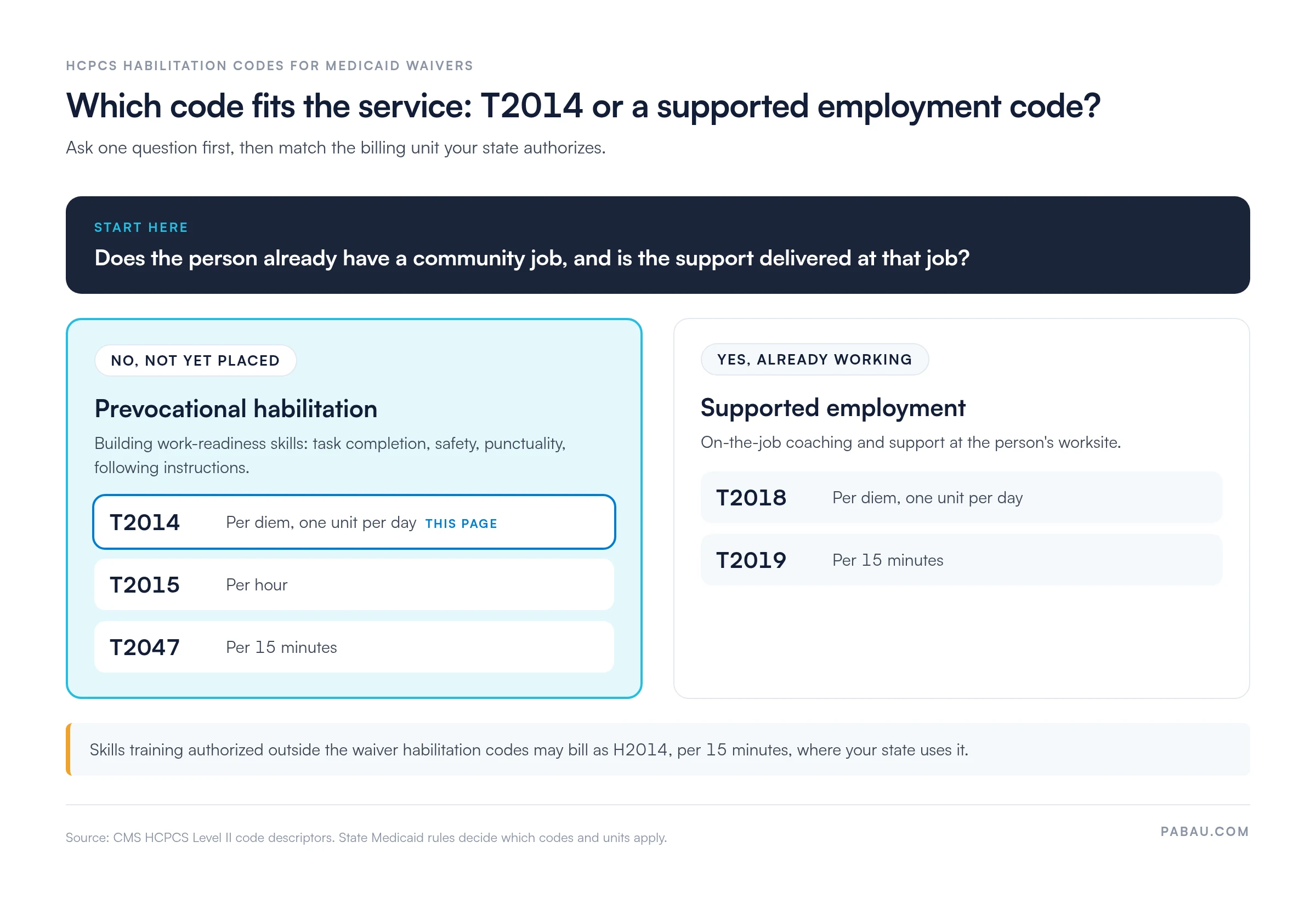
H2014 trips up new billers as well. It bills in 15-minute units, so a three-hour session is 12 units. T2014 for that same day is one unit. Never swap the two codes.
Before billing T2014, confirm the person hasn’t moved from skill building into a job. If a job has started, even informally, the correct code shifts to the supported employment code your state authorizes (T2018 or T2019). Record the transition date in the service plan. Then update the prior authorization before the next billing cycle.
T2014 is billed per diem. One unit equals one calendar day of service, however many hours the person attends. Here’s how a clean claim moves, step by step:
Don’t bill a day the person missed, even if staff prepared materials or planned activities. The unit reflects a day of service delivered to the person.
Each state sets its own modifier rules for T2014. No universal list exists, so check your state’s current billing guide. These are the modifiers you’ll meet most often:
Each state Medicaid program sets its own documentation rules. Still, most HCBS waiver programs expect the records below. A missing one often leads to denial, or to recoupment after an audit. That’s why sound billing compliance habits matter for prevocational providers.
Auditors look for notes that could describe any person on any day. Compare these two:
The strong note names the goal, the skill, the person’s response and the next step. That’s what ties the billed day to the plan.
T2014 is a Medicaid code. T-codes are established for state Medicaid agencies, and Medicare does not pay them, though some commercial payers recognize them. For a person with both Medicare and Medicaid, bill T2014 to Medicaid under the waiver authorization.
Prior authorization usually follows this pattern, though details vary by state and managed care organization:
There is no national rate for HCPCS code T2014. Each state Medicaid program sets it. Where managed care applies, the state and its managed care organizations (MCOs) negotiate it. Tracking those rates is part of revenue cycle management for waiver providers.
Rates usually reflect staff time, supervision ratios and program overhead. States that update their HCBS rate structures publish the new figures on their Medicaid agency websites. Always confirm the rate in effect for your billing period.
The PGM Billing HCPCS lookup tool is a useful starting point. Treat any rate you find there as an estimate until your state’s fee schedule confirms it.
Good denial management starts with knowing which errors cause the most rejections. The table pairs each common denial with its fix.
When a claim comes back, the remittance advice carries a reason code. Our breakdown of the denial codes billers see explains each one and the usual response.
A quick check before submission catches the denials above before a payer does. Confirm each item:
Many waiver providers still build T2014 claims by hand. Staff copy authorization numbers from one system and attendance from another. One missing field can send the claim back weeks later.
Pabau, the practice management platform we build, pre-fills the claim from the record and validates required fields such as the authorization number before submission. Its claims management software also offers HCPCS code lookup. Staff can check T2014 against its descriptor before the claim goes out.
The result is fewer claims bounced for a blank field, and less time spent reworking them.
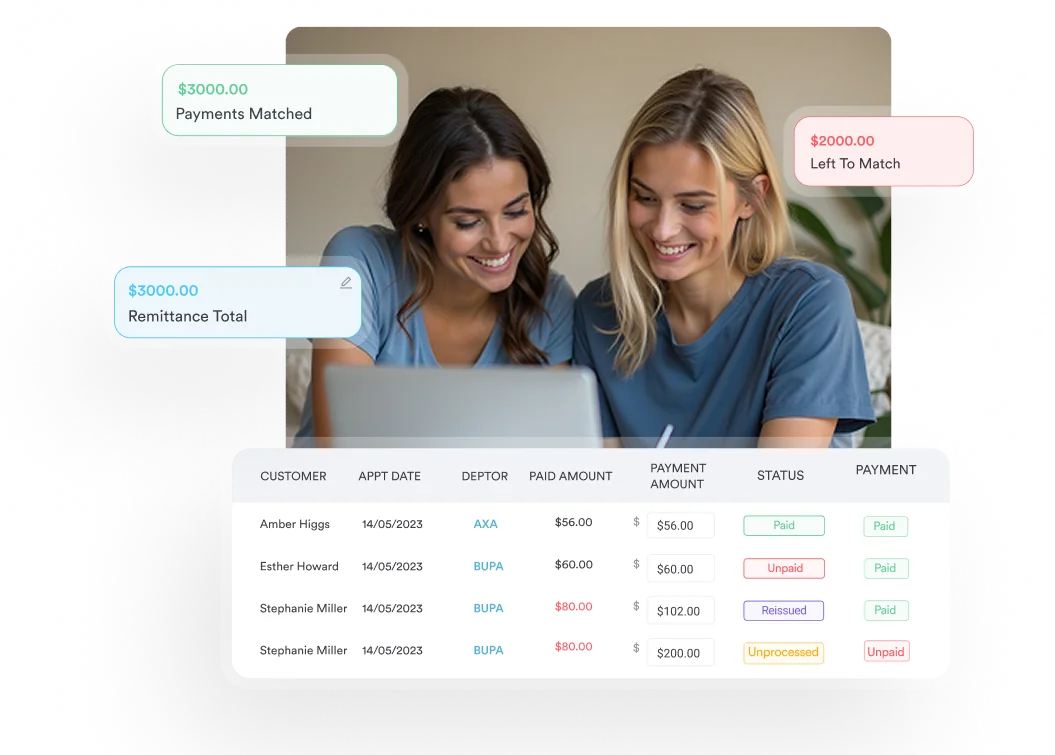

Pabau’s claims management software pre-fills claim forms from the record, offers HCPCS code lookup, and checks required fields before submission. Book a demo to see how it supports your waiver claims.

T2014 rewards providers who keep two lines clear. Skill building before a job is T2014, and support at a job is T2018 or T2019. And a note that shows progress toward an ISP goal is what makes the day billable.
So check job status at every plan review, and run the checklist before each submission. That habit keeps the common T2014 denials off your remittance advice.
Pabau pre-fills claim forms from the record and validates required fields before you submit. Book a demo to see how it could cut rework on your waiver claims.

Billing day habilitation alongside prevocational services? HCPCS code T2020 covers day habilitation billed per diem under a waiver.
Need the hourly educational habilitation code? HCPCS code T2013 explains how educational habilitation is billed per hour.
Supporting people in a residential setting too? HCPCS code T2016 walks through residential habilitation billed per diem.
Want a process for working denied claims? Denial management in healthcare covers how to find, appeal and prevent claim rejections.
Building an audit-ready Medicaid billing operation? Medical billing compliance outlines the documentation standards Medicaid providers are held to.
Both codes bill prevocational habilitation under a waiver. T2014 is billed per diem, one unit per day. T2015 is billed per hour, and T2047 bills the same service in 15-minute units. Your state’s waiver decides which unit you use.
The claim needs an ICD-10-CM code for the qualifying disability. Common examples are F70 to F79 for intellectual disabilities and F84.0 for autistic disorder. Your state’s waiver lists the diagnoses that establish eligibility.
CMS treats prevocational services as a step toward competitive, integrated employment, not a permanent placement. Some states cap how long a person can receive them. Others require a yearly review of progress toward a job.
Most waiver providers bill T2014 on the CMS-1500 or its electronic version, the 837P. Some states route waiver claims through their own portal instead. Check your state’s provider manual for the required format.
Staff of a provider agency enrolled in the state’s waiver program deliver T2014 services. States set staff qualifications, which often include background checks and direct support training. The agency then bills under its own NPI.