CPT code 63081: Vertebral corpectomy, cervical spine
CPT code 63081: official descriptor and procedure overview CPT code 63081 descri...

Last Updated: Oct 6, 2026
T2018 is the HCPCS Level II code for habilitation, supported employment, waiver; per diem.
State Medicaid agencies use it to pay for one day of supported employment under a home and community-based services waiver. The service helps a participant get and keep a job in an integrated work setting. Medicare does not pay T2018, and each state sets the rate and the rules for a billable day.
Let Pabau's smart automation suggest the right codes, reduce claim denials, and keep your practice compliant—effortlessly.
Automate repetitive tasks and focus on what matters most—your patients.
Reduce coding errors and ensure compliance with the latest regulations.
Clean claims, fewer denials, and faster reimbursements.
Powerful insights and reporting to help your practice thrive.
HIPAA compliant SOC 2 certified GDPR-compliant Trusted by 4,000+ clinics worldwide

HCPCS Code T2018 is habilitation, supported employment, waiver; per diem, billed as one unit per day of service.
It is a state Medicaid code for home and community-based services waivers, and Medicare does not pay it.
T2019 covers the same supported employment service in 15-minute units, so the state waiver decides which of the two you bill.
Each state sets the T2018 rate, the minimum service time for a billable day, and its own modifier rules.
Every billed day needs an authorized service plan and a dated service log that supports the claim.
HCPCS Code T2018 is the Level II code for “Habilitation, supported employment, waiver; per diem.” It pays for one day of supported employment services delivered under a state Medicaid home and community-based services (HCBS) waiver. CMS added the code on October 1, 2003.
T2018 sits in the T-code section of HCPCS Level II, which CMS reserves for state Medicaid agencies. The CMS HCPCS overview explains how Level II codes are maintained.
T codes cover services that Medicaid programs need to bill but that Medicare does not pay for. To compare T2018 with neighboring Level II entries, browse our HCPCS guides for billers.
Supported employment helps a waiver participant get and keep a job in an integrated work setting. Most participants have an intellectual or developmental disability, though states also use it in other waivers. The goal is paid work in the community, alongside coworkers without disabilities.
Services that state waivers commonly bill under T2018 include:
Federal rules limit what the waiver can fund. The service plan must show the support is not available through vocational rehabilitation under the Rehabilitation Act or special education under IDEA. Waiver funds also cannot pay employer incentives or wage subsidies.
Providers enrolled with the state Medicaid agency as supported employment providers bill T2018. They are often community agencies serving people with developmental disabilities. The participant must be enrolled in the waiver, and the service plan must authorize supported employment.
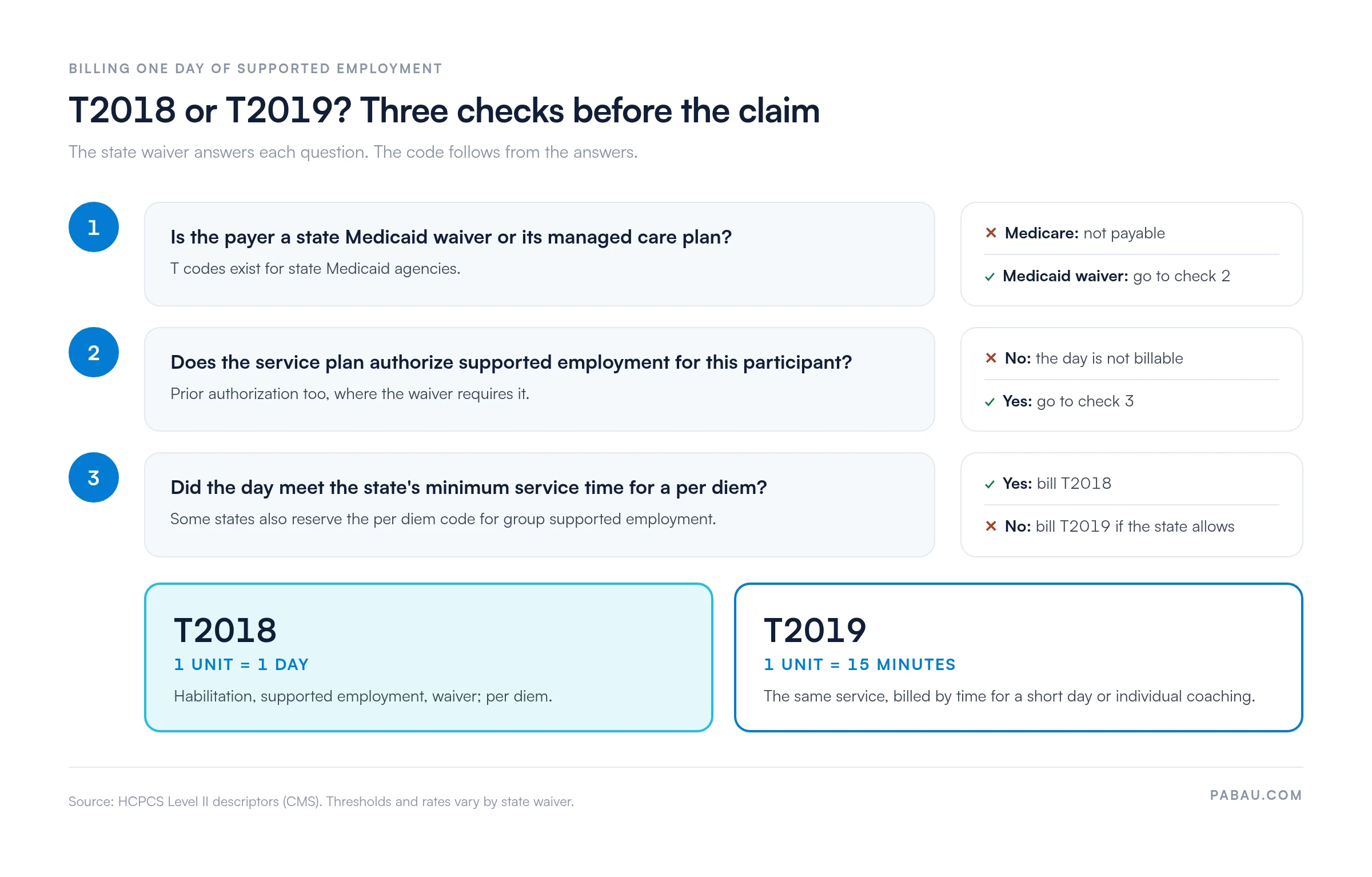
One unit of T2018 equals one day of service. Many states also set a minimum number of service hours before a day becomes billable. Where the state allows it, a day that falls short can be billed with T2019 in 15-minute units instead.
States choose how to use the two codes. Some reserve the per diem code for group supported employment and bill individual job coaching by the 15-minute unit. Check your state waiver manual before you set up the service in your billing system. The three checks below show how a typical waiver splits a day between the two codes.
The habilitation codes T2012 through T2021 pair each waiver service with a daily and a timed unit. The table lists the closest neighbors of T2018.
Prevocational services and day habilitation under T2020 build skills in a program setting rather than at a community job. Some state Medicaid programs bill supported employment under behavioral health benefits with H2023 or H2024 instead.
T2018 has no national fee schedule. Each state Medicaid agency sets the per diem rate in its waiver, so the amount differs between states. Some states also pay different rates for individual and group supported employment.
Medicare does not pay T2018, so a Medicare claim carrying the code is denied. Commercial plans rarely recognize T codes. Medicaid managed care plans that deliver long-term services and supports may cover T2018 under their state contract.
Find your rate in the state Medicaid fee schedule or the waiver provider manual. Managed care plans may set their own rate within that contract.
No modifier is required nationally for T2018. State Medicaid programs decide which modifiers apply, and many use them to separate service types. For example, a state may define a modifier for group service or for a specific waiver.
The U1 to UD modifiers are reserved for state Medicaid agencies to define. The same modifier can mean different things in two states. Use only the modifiers your state manual lists for T2018 claims.
Each billed day must match an authorized service and a record of what happened that day. Medicaid auditors compare the claim with the service plan and the daily notes. Keep these records on file:
Records must meet the retention period in your state Medicaid provider agreement. For the wider rules, see this guide to medical billing compliance requirements.
Most T2018 denials trace back to a mismatch between the claim and the authorization. These are the errors to check before you submit:
Tracking these patterns across claims is part of denial management in healthcare.
Supported employment providers often track attendance on paper and enter claims by hand afterward. That makes it easy to bill a day the log does not support. It also makes it hard to see when a participant nears the authorized number of days.
Pabau, the practice management platform we build, keeps the schedule, the daily notes, and the forms in one participant record. Job coaches can record each session as it happens, and billing staff work from the same data.
In the US, claims management in Pabau submits the claims your team prepares through Claim.MD and tracks their status. Your billers still choose the codes, units, and modifiers from the state manual. Pabau keeps the claim and its supporting record together, so your team can pull the day’s notes quickly when an audit request arrives.

Pabau keeps schedules, daily notes, and forms in one record, then submits and tracks your claims. See how it supports waiver billing.

Treat T2018 as a daily unit that only your state waiver can define. The waiver sets what counts as a billable day, what it pays, and which modifiers apply. Start from your state manual, and set up T2018 and T2019 to match it.
Payment then depends on the paperwork behind each day. A service log that matches the plan and the authorization is what holds up when Medicaid audits the claim.
Book a demo to see how Pabau keeps waiver service records and claims in one place for supported employment providers.

Billing the 15-minute version of this service? HCPCS code T2019 explains units, modifiers, and state rules for timed supported employment.
Working with other habilitation waiver codes? HCPCS code T2020 covers day habilitation billed per diem under a Medicaid waiver.
Struggling with recurring Medicaid denials? Denial management in healthcare walks through root-cause analysis and appeal workflows.
Need a refresher on how claims move through billing? What is medical billing covers the claim lifecycle from service to payment.
HCPCS Code T2018 covers one day of supported employment under a state Medicaid HCBS waiver. The service helps a participant get and keep a job in an integrated community setting, through job coaching and ongoing support.
Both codes describe the same supported employment service. T2018 is billed per day, and T2019 is billed in 15-minute units. Your state waiver decides when each one applies.
No. T2018 is a T code for state Medicaid agencies, and Medicare does not pay it. State Medicaid waiver programs and Medicaid managed care plans are the usual payers.
You bill one unit of T2018 per day of service. Many states set a minimum number of service hours before a day counts, so check your state waiver manual.
Keep a service plan that authorizes supported employment and a daily service log for each billed day. The log should show the date, times, worksite, staff, and support given.
There is no national rate for T2018. Each state Medicaid agency sets the per diem rate in its waiver fee schedule, and some pay more for individual than group support.