HCPCS code T2014: Prevocational habilitation billing guide
HCPCS code T2014 pays for one day of prevocational training HCPCS code T2014 car...

Last Updated: Oct 9, 2026
T2004 is the HCPCS Level II code for non-emergency transport by commercial carrier, billed as a multi-pass. In practice, that usually means a bus or transit pass covering several rides to medical appointments.
The fact that matters most is that T2004 is a Medicaid-only T-code. Medicare does not pay it, and there is no national rate. Each state decides what a pass covers, what one unit means, and what it pays. Billers who skip the state manual risk unit errors, missing authorizations, and denied claims. Below, you'll find the scope, prior authorization rules, claim fields, and the fixes that get a denied T2004 claim paid.
Let Pabau's smart automation suggest the right codes, reduce claim denials, and keep your practice compliant—effortlessly.
Automate repetitive tasks and focus on what matters most—your patients.
Reduce coding errors and ensure compliance with the latest regulations.
Clean claims, fewer denials, and faster reimbursements.
Powerful insights and reporting to help your practice thrive.
HIPAA compliant SOC 2 certified GDPR-compliant Trusted by 4,000+ clinics worldwide

HCPCS code T2004 reports non-emergency transport by commercial carrier on a multi-pass basis, typically a pass that covers several rides.
T2004 is a T-code for state Medicaid agencies, so Medicare does not pay it and there is no national rate.
Each state Medicaid program defines the pass type, the billing unit, and the rate, so check the state provider manual first.
Missing prior authorization and incomplete pass or appointment records are common reasons T2004 claims are denied.
HCPCS code T2004 is a Level II code for non-emergency transport by commercial carrier, billed on a multi-pass basis.
The official descriptor reads: Non-emergency transport; commercial carrier, multi-pass. It belongs to the T-code range of the Healthcare Common Procedure Coding System (HCPCS), which was established for state Medicaid agencies.
“Multi-pass” typically refers to a pass that covers several rides on a commercial carrier, such as a bus or transit pass. CMS does not publish a definition of the term. Each state Medicaid program decides what a pass covers, what one unit means, and how the code is billed.
The closest neighbor is T2003, the general code for Non-emergency transportation; encounter/trip. The difference lies in how the service is bought. T2004 is a pass, and T2003 is one trip. Neither descriptor refers to the number of people riding in the vehicle.
Each term in the descriptor narrows what T2004 can be used for. Here’s what each one means day to day, and how it changes the claim.
T2004 has a narrow scope, and a claim outside it is likely to be denied. Use the two lists below as a quick scope check.
Typically covered under T2004:
Not covered under T2004:
Taxi rides deserve their own check. They have a separate code, A0100, so a cab voucher generally belongs on a different claim line.
The T2001-T2007 range splits non-emergency transport by service type. The table maps the closest codes to their official descriptors, and our HCPCS code library lists the full set.
Pick the code that matches how the state purchased the service. A pass bought for a beneficiary is usually T2004, and an individual trip is usually T2003. If your state manual assigns transit passes to a different code, follow the manual.
T2004 is a Medicaid code. T-codes were established for state Medicaid agencies, and Medicare does not pay them. Medicare Advantage plans may offer transportation as a supplemental benefit, but each plan sets its own terms.
States run the NEMT benefit in one of two ways. The Medicaid agency may run it directly, or it may contract a managed care organization (MCO) or NEMT broker. Where a broker runs it, the broker approves requests and picks the mode of transport. That choice decides whether a pass or a single trip gets billed.
Prior authorization: Most state Medicaid programs and MCOs require prior authorization (PA) for NEMT services, including T2004. Requirements commonly include:
A pass or trip provided without an approved PA is a frequent cause of T2004 denials. If approval came too late, check whether your state accepts a post-service request. Then document why the travel could not wait. Our walkthrough of the prior authorization process covers request timing in more depth.
Record the prior authorization number before the pass is issued or the appointment travel is booked. Many states will not authorize NEMT services retroactively, so a missing PA number is hard to fix on appeal. Build a PA check into your scheduling step.
Medicaid programs and NEMT brokers want proof that a pass was issued for covered medical travel. Keep these six records on file, ready for an audit request:
Keep these records for the retention period your state Medicaid program sets. Store them with the claim, so an auditor can match each pass to its authorization and appointments.
Three parts of a T2004 claim depend on state rules: the unit, the CMS-1500 fields, and any modifiers. Check each one against your Medicaid provider manual before you submit.
Units: Each state defines what one unit of T2004 represents, and the pass type it applies to. Confirm the unit definition in the state fee schedule or provider manual before you set up a billing template. A unit mismatch leads to underpayment, or to an overpayment finding on audit.
CMS-1500 fields: Report T2004 in Box 24D and the date of service in Box 24A. Box 24B takes the place of service code your state’s NEMT rules require, commonly 99 for other place of service. The PA number goes in Box 23. The rendering provider or transport company NPI goes in Box 24J.
Modifier rules for T2004 are set by each Medicaid program or MCO. The table covers modifiers that state manuals sometimes require. Verify each one against your state’s NEMT provider manual before you apply it.
State-assigned U-series modifiers vary the most. What U3 means in one state’s NEMT program may differ entirely in another, so never assume a modifier definition carries across state lines.
Clean T2004 billing starts well before the claim. Records that are missing at billing time are hard to rebuild later. The flow below shows each step, and the point where it most often stalls.
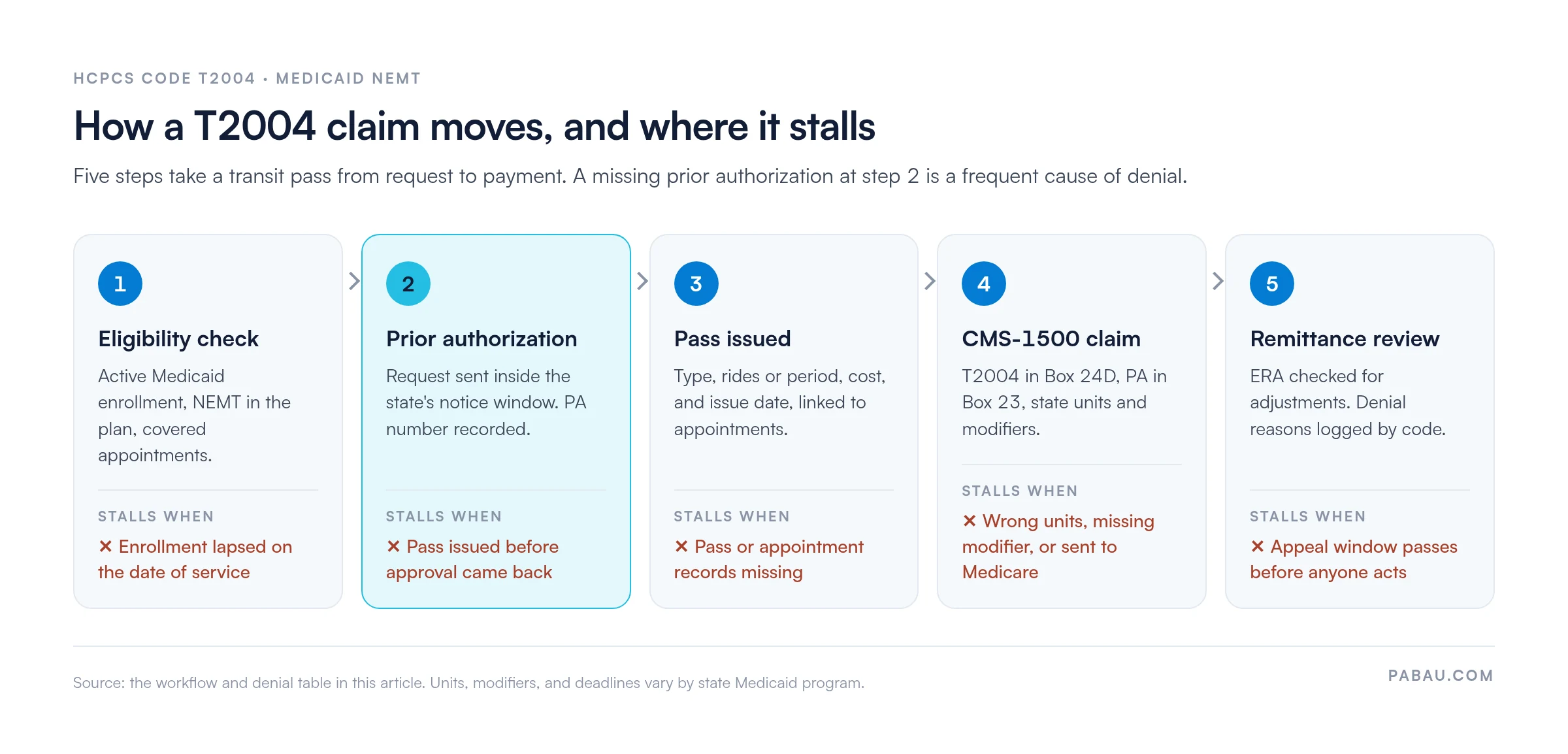
Take an illustrative case. A Medicaid patient needs rides to physical therapy twice a week for a month. The NEMT broker approves a transit pass instead of individual trips. Here’s how that pass becomes a paid claim:
If the claim comes back short, the electronic remittance advice carries the adjustment codes that explain why. Start any fix there.
A quick check before each T2004 claim leaves the office catches the most common errors. Confirm that:
T2004 has no national CMS reimbursement rate. HCPCS T-codes are paid under state Medicaid fee schedules, and each state sets its own rates. The rate may also depend on the pass type and the unit the state defines.
To find your rate, search the Medicaid agency’s published fee schedule or the NEMT broker’s contracted rate schedule. State portals, such as Wisconsin’s ForwardHealth portal, publish updated fee schedules. Rates also differ when a managed care plan pays instead of the state paying fee-for-service.
Don’t use another state’s published rate as a proxy. Rates for the same T-code can differ widely between states. Billing against a neighboring state’s schedule leads to underpayment disputes.
T2004 denials tend to come from a short list of problems. Fix each one at its source rather than claim by claim, and repeat denials drop across your Medicaid claims.
Medicaid appeal windows vary by state, typically from 30 to 90 days after the date of the remittance advice (RA). Verify the window in your state’s provider manual before the deadline passes.
Pabau, the practice management platform we build for healthcare practices, does not dispatch vehicles or manage transit passes. It helps when your practice books Medicaid patients who rely on NEMT, or bills Medicaid claims of its own.
Each appointment record holds the date, time, and address that brokers ask for in a confirmation. Through Pabau’s claims management software, the CMS-1500 is pre-filled from the patient record. Required fields, such as authorization numbers, are checked before a claim can be sent.
US claims go through Claim.MD, with eligibility checks, ERA posting, and claim-status tracking built in. Fewer claims come back for missing data, so your team spends less time on rework.
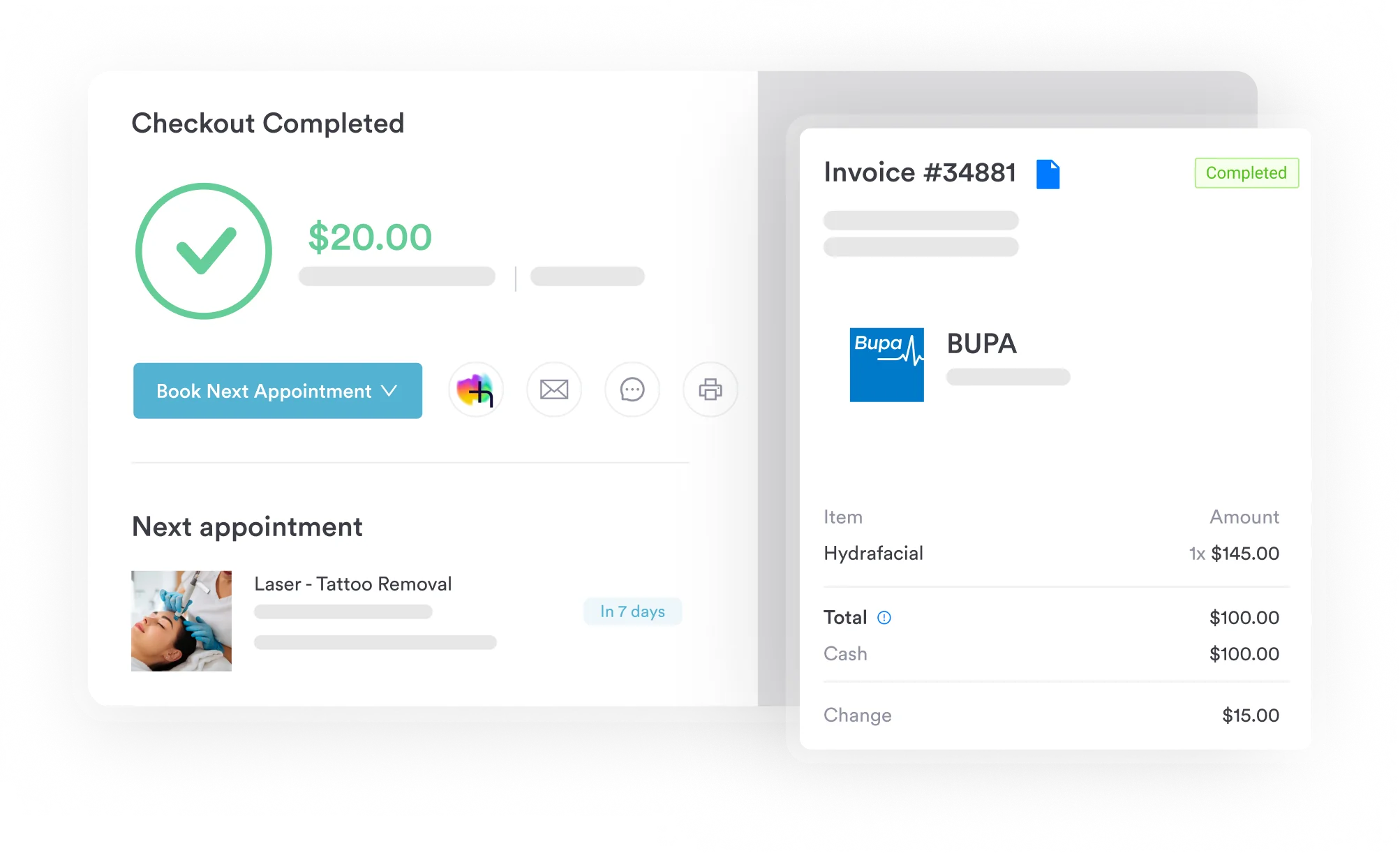

Pabau pre-fills claims from the patient record and checks required fields, such as authorization numbers, before submission. Your team spends less time fixing rejected claims.

T2004 rewards billers who read the state manual first. CMS defines the code in one line and leaves the details to each Medicaid program. Your state’s provider manual is the working definition.
The effort is front-loaded. Confirm the pass type and unit, secure the PA number, and tie the pass to covered appointments before anyone files. Do that, and the usual denial triggers are handled before the claim exists.
Book a demo to see how Pabau keeps appointment records and claim fields in step for your Medicaid billing.

Need to understand how NEMT claims flow through a clearinghouse? Medical claims clearinghouse guide explains how electronic claims are validated and routed to Medicaid payers.
Billing individual trips rather than passes? HCPCS code T2003 covers the general per-trip code for non-emergency transportation.
Want to catch enrollment problems before the pass is issued? Insurance eligibility verification shows how to check coverage before every visit.
Seeing the same T2004 denials month after month? Denial management in healthcare breaks down the causes of denials and how to prevent repeats.
Worried about missing a resubmission deadline? Timely filing limits by payer lists the windows for initial claims, corrected claims, and appeals.
The transport side usually bills it. The enrolled NEMT provider, broker, or agency that issues the pass submits the claim. A medical practice rarely bills T2004 itself, but its appointment confirmations often support the claim.
No. Taxi transport has its own code, A0100, for non-emergency transportation by taxi. T2004 covers a pass on a commercial carrier, such as a bus or transit system. Check which code your state assigns to each mode.
T2004 has been a valid HCPCS Level II code since April 1, 2002. It remains active, so state Medicaid fee schedules still list it under that number.
T2003 is the general per-trip code for non-emergency transportation. T2004 covers a multi-pass on a commercial carrier, typically good for several rides. The codes differ in how the service is bought, not in how many people ride.
No. T-codes were established for state Medicaid agencies, and Medicare does not pay them. Some Medicare Advantage plans offer transportation as a supplemental benefit under their own billing rules.