HCPCS code T2014: Prevocational habilitation billing guide
HCPCS code T2014 pays for one day of prevocational training HCPCS code T2014 car...

Last Updated: Oct 9, 2026
T2007 is the HCPCS Level II code for transportation waiting time, air ambulance and non-emergency vehicle, one-half (1/2) hour increments. Each unit pays for 30 minutes that a vehicle or crew waits for a Medicaid patient, billed on top of the trip code.
T2007 has no national fee schedule. Medicare lists it with pricing indicator 00 and does not pay it, so each state Medicaid program sets its own rate, unit rules and paperwork. A clean claim counts units from the driver log, records why the vehicle waited, and links the wait to its trip.
Let Pabau's smart automation suggest the right codes, reduce claim denials, and keep your practice compliant—effortlessly.
Automate repetitive tasks and focus on what matters most—your patients.
Reduce coding errors and ensure compliance with the latest regulations.
Clean claims, fewer denials, and faster reimbursements.
Powerful insights and reporting to help your practice thrive.
HIPAA compliant SOC 2 certified GDPR-compliant Trusted by 4,000+ clinics worldwide

HCPCS code T2007 bills transportation waiting time in 30-minute units, on top of the code for the trip itself.
T2007 is a Medicaid state-agency T-code with no national fee schedule. Medicare does not pay it, so each state sets the rate.
Every wait needs logged arrival and departure times, a reason for waiting, and a link to the transport claim it belongs to.
Most T2007 denials come from unit counts that don’t match the log, or from waiting billed with no linked trip.
Wheelchair van trips bill under A0130 and stretcher van trips under T2005, never under T2007.
HCPCS code T2007 covers the time a non-emergency vehicle or air ambulance crew spends waiting for a Medicaid patient. One unit equals each 30 minutes of waiting. You bill it in addition to the transport code, never in place of it.
The code belongs to the HCPCS Level II T-code series. The Centers for Medicare and Medicaid Services (CMS) created these codes for state Medicaid agencies, and T2007 took effect on January 1, 2003. Medicare lists it with pricing indicator 00, so Medicare does not pay it. Each state decides whether it covers the wait and at what rate.
A typical case is a driver who stays on site through a dialysis session, then drives the patient home. Some states pay for that wait when it costs less than sending a second vehicle.
HCPCS Level II codes come from CMS, not the AMA, which owns CPT. CMS updates the code set every year. State agencies then set their own T-code policies through manuals and bulletins. If claim basics are new to you, start with medical billing fundamentals.
Keep this table next to your fee schedule. It holds the facts that decide whether a T2007 line pays.
Billers relying on AAPC’s HCPCS code lookup should still read their state manual. States decide how a partial half hour counts and whether waiting units are capped.
T2007 applies when a vehicle waits for a Medicaid patient during a covered medical visit. The wait must belong to a transport that the payer also covers.
Most T2007 coding errors start when billers treat it as a ride code. T2007 never describes the vehicle or the distance. Instead, it adds waiting time to a trip billed under one of the codes below. In many state programs, that base trip is T2003, billed per encounter.
T2007 vs. T2001: These two get mixed up often. T2001 pays for an attendant or escort, and it is not a per-mile code. T2007 pays for the vehicle’s waiting time. So a long dialysis trip with an escort can carry three lines, if your state allows it.
Enrolled Medicaid transportation providers bill T2007. In broker-model states, the NEMT broker may bill it instead. Either way, the biller must be enrolled in the state where the trip happens.
Dual-eligible patients may still have waiting time paid through Medicaid’s NEMT benefit. Medicare never adjudicates T2007, so there is nothing to cross over. Send T2007 straight to the Medicaid payer.
Each state Medicaid program sets its own T2007 rate. There is no national fee schedule. Some states also limit how many waiting units a single trip or day can carry.
Check the PGM Billing HCPCS lookup tool and your state fee schedule portal for current rates. Last year’s rate, or another state’s rate, creates audit risk, because Medicaid payments must follow the state plan rate.
Many states require prior authorization for NEMT, and some ask for it on waiting time specifically. The rules differ by state plan and managed care contract. A wait billed without required authorization can deny even when the trip pays.
Auditors look closely at waiting time, because minutes are easy to inflate. Your log has to prove when the wait started, when it ended, and why it happened. Strong medical billing compliance habits apply to every waiting unit you bill.
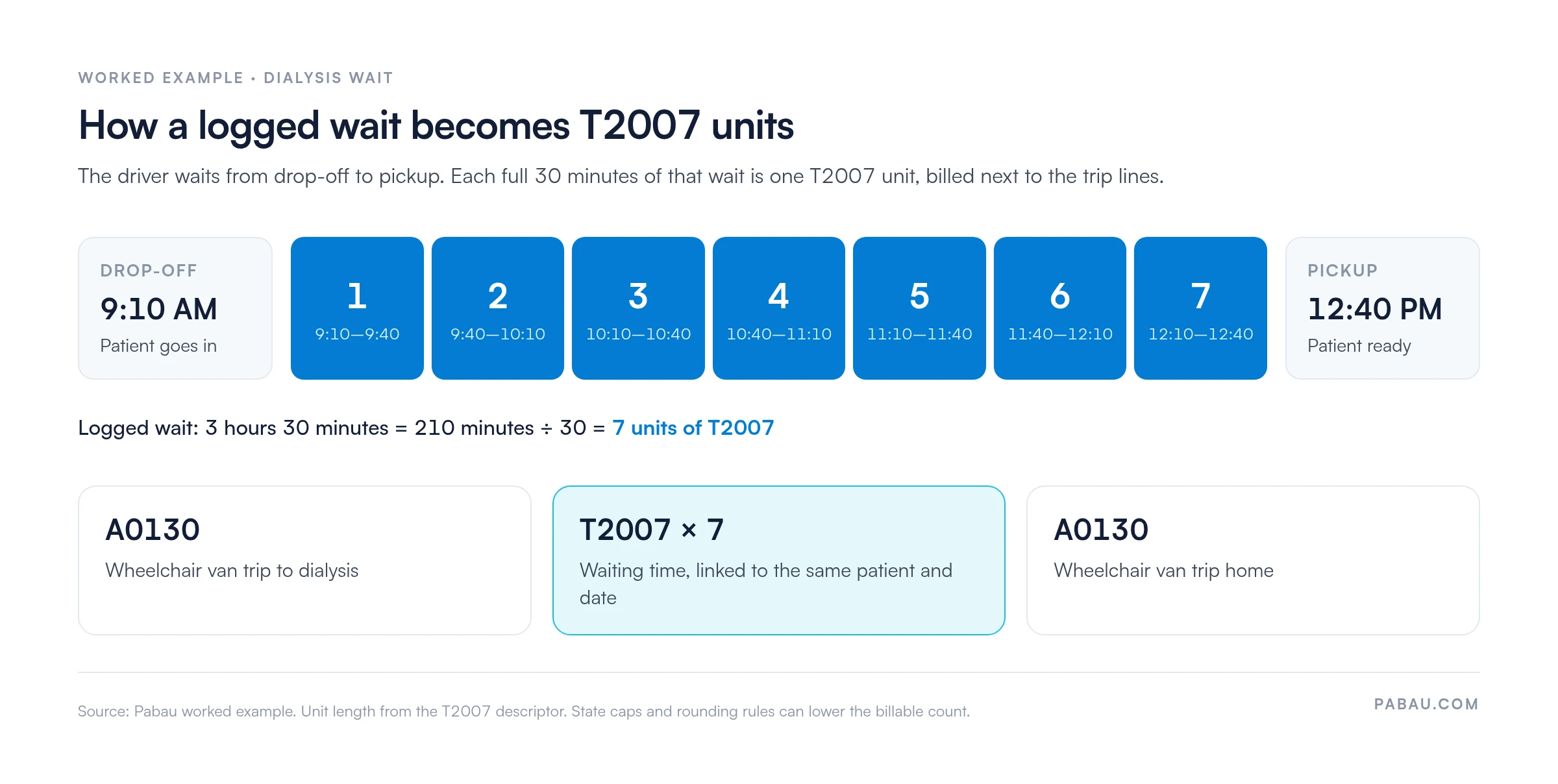
A wheelchair van drops a patient at dialysis at 9:10 AM The driver waits on site. The patient is ready at 12:40 PM, so the wait lasted 3 hours and 30 minutes.
That is seven half-hour units of T2007. The same claim also carries the trip lines, here A0130 out and back, if your state bills that code. If the state caps waiting at fewer units, bill the cap and keep the full log. The timeline below shows how the log turns into claim lines.
T2007 has no national modifier rule. Each state Medicaid manual lists what it wants, if anything. A missing required modifier denies the line just like a wrong unit count.
Check the Medicare Informatics HCPCS tables and your state NEMT provider manual before you set modifiers. The table shows common patterns, not rules for any one state.
Before billing T2007 in a new state, pull its NEMT provider manual. Note the waiting-time modifiers, unit caps and rounding rule. Then set them as state-level defaults in your billing system, so driver logs turn into clean claims.
A clean T2007 claim depends on a few fields that billers tend to rush. A structured medical billing workflow catches most of them before the payer does.
T2007 denials follow a few clear patterns. Applying denial management strategies before claims go out saves far more time than working appeals afterward.
First, decide whether you need a corrected claim or a formal appeal. A corrected claim, often sent with frequency code 7, fixes a data error such as a wrong unit count or missing modifier. A formal appeal disputes a decision on authorization or coverage.
Appeal deadlines typically range from 60 to 180 days, but they vary by state and MCO contract. The denial codes on your remittance advice point you to the right path. Include the original claim number, the driver log, and the linked trip details.
Track every T2007 denial by reason code, state and payer. After a month or two, patterns appear, such as one MCO rejecting partial units. Fix the pattern once, and the same denial stops repeating.
Many billing teams still type waiting units by hand from paper driver logs. That is where unit mismatches and orphaned waiting lines usually start.
Pabau, the practice management and billing platform we build, pulls patient, treatment and insurer details from the record into a pre-filled submission. Required fields, such as the authorization number, must be complete before the claim can be sent.
In the US, claims go out through Claim.MD, with eligibility checks, remittance posting and claim status tracking in one place. Your team spots a denied waiting line quickly, so the fix starts before the filing window closes.

Pabau pre-fills claims from the patient record and checks required fields, like authorization numbers, before they go out. Your team then tracks status and remittance in one place.

T2007 is a small code with a narrow job. It pays for time, not distance or vehicle type, and only next to a trip the payer also covers. Treat every wait as a timed event with a start, an end and a reason, and most unit denials stop.
Start with your state manual. Note its rounding rule, unit cap and modifiers, then build them into your driver logs and claims software defaults. Book a demo to see how Pabau keeps waiting-time claims complete and tracked from submission to payment.

Need a broader overview of NEMT billing fundamentals? What is medical billing explains the end-to-end revenue cycle relevant to transportation and healthcare providers.
Working through a high volume of claim rejections? Denial management in healthcare covers systematic approaches to reducing rejection rates across payer types.
Want a reference for the denial codes on your remittance advice? Denial codes in medical billing breaks down the most common CARC and RARC codes and what corrective action each requires.
Billing the trip the wait belongs to? HCPCS code T2003 covers the per-trip NEMT code that many states pair with waiting time.
Adding an escort to the ride? HCPCS code T2001 explains how attendant and escort lines are billed.
Yes. The T2007 descriptor names both air ambulance and non-emergency vehicles. Coverage still depends on your state Medicaid program, so check whether it pays air ambulance waiting under T2007 before you bill.
Medicare uses A0420, ambulance waiting time (ALS or BLS), in half-hour increments. T2007 is the Medicaid T-code for waiting time, and Medicare does not pay it.
There is no national limit. Some states cap units per day or per trip, and others set none. Check your state manual, bill up to any cap, and keep the full driver log on file.
Yes, Medicaid claims normally carry an ICD-10-CM code. Use the diagnosis that supports the medical visit the patient attended while the vehicle waited.
Yes. T2007 took effect on January 1, 2003, and remains in the HCPCS Level II code set. Not every state covers it, so confirm coverage in your NEMT manual first.