

HCPCS Code E0272: Foam rubber mattress billing guide
HCPCS Code E0272: official descriptor and code overview HCPCS Code E0272 is the ...

Last Updated: Nov 6, 2026
T2002 is the HCPCS Level II code for non-emergency transportation; per diem. Transportation brokers and non-emergency medical transportation (NEMT) providers use it to bill one flat daily rate for a Medicaid beneficiary's transport on that date.
Per-trip billing uses T2003 instead, and T2001 covers a patient attendant or escort. T2002 belongs to the T-series, the national codes CMS maintains for state Medicaid agencies, so Medicare fee-for-service does not pay it.
Let Pabau's smart automation suggest the right codes, reduce claim denials, and keep your practice compliant—effortlessly.
Automate repetitive tasks and focus on what matters most—your patients.
Reduce coding errors and ensure compliance with the latest regulations.
Clean claims, fewer denials, and faster reimbursements.
Powerful insights and reporting to help your practice thrive.
HIPAA compliant SOC 2 certified GDPR-compliant Trusted by 4,000+ clinics worldwide

HCPCS Code T2002 bills non-emergency transportation as a per diem, one flat daily rate for the beneficiary’s transport that day.
T2002 is Medicaid-only, and Medicare fee-for-service does not pay non-emergency transport under this code.
T2003 bills a single one-way trip and T2001 bills an attendant or escort.
Adding per-trip T2003 units to a T2002 day bills the same trips twice.
Prior authorization requirements vary by state Medicaid program and managed care organization.
Claims software such as Pabau checks eligibility and validates each claim before it reaches your clearinghouse.
HCPCS Code T2002 describes non-emergency transportation; per diem. CMS assigns it to the T-code series, national codes established for state Medicaid agencies to bill services that Medicare and CPT codes do not address. The unit of service is one day.
One unit covers the beneficiary’s non-emergency transport for that date, so an outbound trip and its return are not billed as separate T2002 units. Each state Medicaid program defines exactly what its daily rate includes.
The T-series is published and maintained by CMS as part of the HCPCS Level II code set. Unlike CPT codes, T-codes are not licensed through the AMA. They are free to use in the CMS annual HCPCS release files, and the neighboring transport codes sit in our HCPCS code library.
T2002 covers ground-based non-emergency transportation for Medicaid beneficiaries traveling to or from a Medicaid-covered service appointment. The trip is not medically urgent, and the beneficiary is ambulatory or can travel in a standard vehicle. The billing unit is one day, paid at a flat rate, rather than one trip or one mile.
The exclusion that matters most is per-trip billing on a per diem day. A T2002 unit already pays for that day’s transport, so adding T2003 units for the same beneficiary and date bills the same trips twice.
State Medicaid programs and MCOs routinely deny claims that carry both codes. Whether mileage can be added on top of a per diem depends on the state, so check the fee schedule before billing S0215 with T2002.
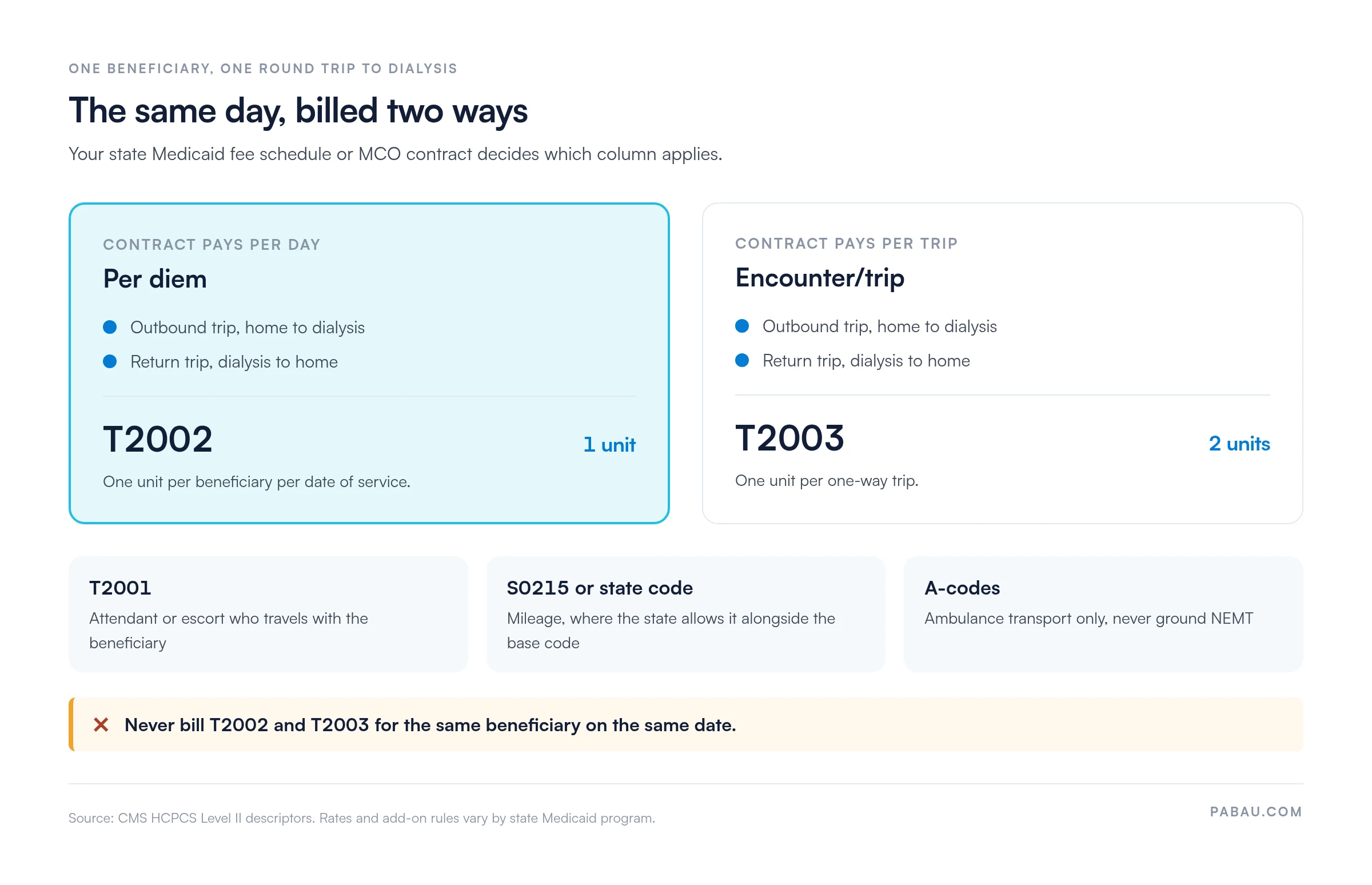
T2002 bills a whole day of transport at a flat rate, while T2003 bills one one-way trip. T2001 is a different kind of code. It bills a patient attendant or escort who travels with the beneficiary, not mileage.
The choice between T2002 and T2003 depends on whether the state Medicaid program or MCO contract pays per day or per trip. Billing both for the same transport on the same date is duplicate billing in any state.
Check your state Medicaid fee schedule or MCO contract before selecting a code. When the contract pays one rate per beneficiary per day, T2002 is correct. When it pays for each one-way trip, use T2003. Bill mileage with S0215 or your state’s own code, never with A0425, which is ground ambulance mileage.
The same round trip shows how much the contract changes the claim line.
Documentation for T2002 claims must prove Medicaid eligibility on the date of service, a covered appointment behind each trip, and medical necessity for the transport. Sound revenue cycle management collects this paperwork before the vehicle moves, while the driver and the referring provider are still easy to reach.
Keep trip logs for the full Medicaid records retention period, which ranges from five to ten years depending on the state. OIG audits of NEMT programs routinely target missing or inconsistent trip documentation.
T2002 prior authorization rules are state-specific. There is no uniform federal requirement, because CMS lets states design their own NEMT benefits. One state may require PA for every trip, while another delegates authorization entirely to its transportation broker network.
Conducting insurance eligibility verification before each trip confirms that the beneficiary is currently enrolled in Medicaid and that NEMT is covered under their specific plan. This is especially important for Medicaid managed care enrollees, whose MCO may have different PA workflows than the state’s fee-for-service program.
Pull the prior authorization number from the transportation broker’s confirmation before the trip departs. Claims submitted without a valid PA number cannot be corrected after the fact in most state Medicaid programs. Build a pre-trip documentation checklist that captures the PA number, beneficiary Medicaid ID, and appointment confirmation in a single step.
Modifiers append additional information to T2002 without changing the code itself. Not all modifiers change the reimbursement rate, and some are informational only. Use only the modifiers your state Medicaid program or MCO explicitly accepts, because unsupported modifiers can trigger claim edits or denials.
TP and TQ are not mutually exclusive with T2002, but verify the billing manual before stacking multiple modifiers on a single claim line. Some state systems accept only two modifiers per line.
There is no national reimbursement rate for T2002. Because NEMT is a Medicaid benefit, each state sets its own fee schedule rate through its published fee schedule or through MCO contracts. Rates vary widely, and urban markets with higher transportation costs typically carry higher rates than rural programs. Before billing, confirm which rate table applies to the beneficiary and whether a contract rate overrides the published fee schedule.
Because NEMT is a historically high-fraud area flagged in OIG work plans, state programs audit trip-level documentation against paid claims. Reimbursement can be recouped on a post-payment audit if documentation does not support each billed trip.
T2002 denials cluster around four root causes: missing authorization, weak documentation, duplicate billing, and eligibility errors. Effective denial management in healthcare requires mapping each denial code to a specific corrective action rather than resubmitting the same claim unchanged.
Place of service (POS) 99, other place of service, is the POS state Medicaid programs such as Oregon’s assign to non-ambulance transportation, including T2002.
It describes the transport service itself, not the destination facility. POS 41 (ambulance, land) is reserved for a vehicle equipped and staffed for lifesaving, so it belongs on ambulance A-code claims.
The most common POS error on NEMT claims is entering the receiving facility’s POS. Examples are POS 11 for office and POS 22 for outpatient hospital.
Incorrect POS is easy to miss in claim scrubbing because it does not always trigger a front-end edit. Many states catch it only on post-payment review, which leads to recoupment requests months after the original payment.
Submitting a clean T2002 claim requires getting the sequence right. The same clean claim checks apply here as for any other code. Errors caught before submission cost nothing. Errors found after payment cost time, staff hours, and sometimes the payment itself.
Check code details and descriptors with the PGM Billing HCPCS lookup tool or the NLM HCPCS code search API before finalizing the claim.
Run a batch eligibility check every Monday morning against your scheduled transport list for the week. Catching a lapsed Medicaid enrollment before the trip is far cheaper than a denied claim. It also spares a beneficiary a missed dialysis appointment.
Many NEMT billing teams track authorization numbers, eligibility checks and trip logs across separate spreadsheets and broker portals. That split makes it easy to send a T2002 per diem without its PA number. It also lets a T2003 line slip onto a day the per diem already paid.
In Pabau, the eligibility check, the authorization code and the claim sit on the same patient record. Its claims management software checks insurance eligibility before the trip and validates each claim before it goes to your clearinghouse.
Electronic remittance advice then posts against each claim line. Denial patterns show up across trips and dates of service, so your team fixes the cause once instead of appealing the same error every week.

Pabau checks eligibility, stores prior authorization codes and validates every claim before it leaves. Your NEMT billing team spends less time chasing denials and more time getting paid.

Before you bill a single T2002 unit, read your state fee schedule or MCO contract and settle whether it pays per day or per trip. That one answer decides every claim line that follows, and getting it wrong turns a whole month of trips into duplicate billing.
The trade-off is front-loaded work. Capturing the PA number, eligibility result and trip log before dispatch costs a few minutes per trip. A recoupment after an audit costs the payment itself.
If your team handles high-volume Medicaid transportation billing, book a demo to see how Pabau keeps each T2002 claim clean before it goes out.

Need to understand the broader medical billing process? What is medical billing explains the end-to-end workflow from patient encounter to payment posting.
Dealing with recurring claim rejections? Denial codes in medical billing breaks down the most common CARC codes and how to resolve each one.
Billing stretcher van mileage? HCPCS code T2049 covers non-emergency stretcher van transport billed per mile.
Want to reduce claim errors before submission? Medical billing compliance covers the documentation and audit standards that protect your practice from post-payment recoupment.
HCPCS Code T2002 is the Medicaid billing code for non-emergency transportation billed as a per diem, one flat rate per beneficiary per day. It covers ground-based, non-urgent transport to and from Medicaid-covered medical appointments. Emergency ambulance transport, per-trip billing (T2003), escorts (T2001), mileage (usually S0215) and trips not linked to a covered service fall outside it.
T2001 bills a patient attendant or escort who travels with the beneficiary, while T2002 bills the beneficiary’s non-emergency transport as a flat daily rate. T2001 is not a mileage code. A per-trip rate uses T2003 instead, and mileage usually goes on S0215 or a state-specific code.
Prior authorization requirements for T2002 vary by state Medicaid program and managed care organization. Some states require PA for every trip, while others delegate authorization to a transportation broker. There is no uniform federal requirement. Check your state Medicaid provider manual or contact the transportation broker managing the NEMT program before dispatching any trip.
The most commonly used modifiers with T2002 are TP (medical transport, unloaded vehicle) and TQ (basic life support transport by a volunteer ambulance provider). Some states also require program-specific modifiers identified in their provider manuals. Use only modifiers your Medicaid payer explicitly accepts, because unsupported modifiers trigger claim edits or denials.
The top denial reasons for T2002 are missing or expired prior authorization and no medical necessity documentation. Duplicate billing with per-trip T2003 units on the same date of service is another. Claims also fail on an invalid ICD-10 diagnosis code, a beneficiary who was not Medicaid-eligible, the wrong place of service code, or a modifier error.
T2002 is billed per day, not per mile or per trip. One unit covers the beneficiary’s non-emergency transport for that date of service, as the state defines it. Per-trip billing uses T2003, and mileage usually uses S0215 or a state-specific code. State Medicaid programs set their own rules, so check the fee schedule first.




