HCPCS Code E0272: Foam rubber mattress billing guide
HCPCS Code E0272: official descriptor and code overview HCPCS Code E0272 is the ...

Last Updated: Nov 6, 2026
T1006 is the HCPCS Level II code for alcohol and/or substance abuse services, family/couple counseling. It covers sessions that treat the family unit around one member's substance use disorder (SUD).
T-codes are Medicaid codes, and Medicare does not cover T1006. Reimbursement, documentation and prior authorization rules all vary by state Medicaid program. Most denials trace back to three errors. Coders confuse T1006 with the H-code family, write a thin family session note, or skip a state-required SUD modifier.
Let Pabau's smart automation suggest the right codes, reduce claim denials, and keep your practice compliant—effortlessly.
Automate repetitive tasks and focus on what matters most—your patients.
Reduce coding errors and ensure compliance with the latest regulations.
Clean claims, fewer denials, and faster reimbursements.
Powerful insights and reporting to help your practice thrive.
HIPAA compliant SOC 2 certified GDPR-compliant Trusted by 4,000+ clinics worldwide

T1006 covers family/couple counseling sessions built around one member’s substance use disorder (SUD), not individual therapy for the patient with SUD.
T-codes are Medicaid codes, so Medicare does not reimburse T1006 and commercial payers rarely cover it.
A missing HF modifier and a lapsed SUD treatment plan are the two most common denial triggers.
Provider eligibility, units, prior authorization and rates are all set by each state Medicaid program, so the state billing manual has the final word.
Pabau, the practice management platform we build, validates each claim before submission and keeps prior authorization codes attached to the appointment.
HCPCS code T1006 is defined by the Centers for Medicare and Medicaid Services (CMS) as “alcohol and/or substance abuse services, family/couple counseling.” It belongs to the HCPCS Level II T-code series, which CMS assigns to Medicaid and other state and local programs. The session addresses the substance use disorder of an identified family member. General family therapy with no SUD focus does not qualify.
T1006 applies when the family session treats the substance use disorder of an identified member, as documented in an active SUD treatment plan. The other family members in the room do not need an SUD diagnosis of their own.
T1006 is often confused with the H-code series, which also covers SUD and behavioral health services under Medicaid. The deciding factor is the therapeutic recipient. T1006 treats the family unit, while H-codes treat the individual or a group.
An individual session for the person with SUD goes on H0004, and a clinician-led group of unrelated patients goes on H0005.
Outside Medicaid, the same family session usually goes on 90847 with the patient present, or 90846 without. The chart below runs both decisions in order.
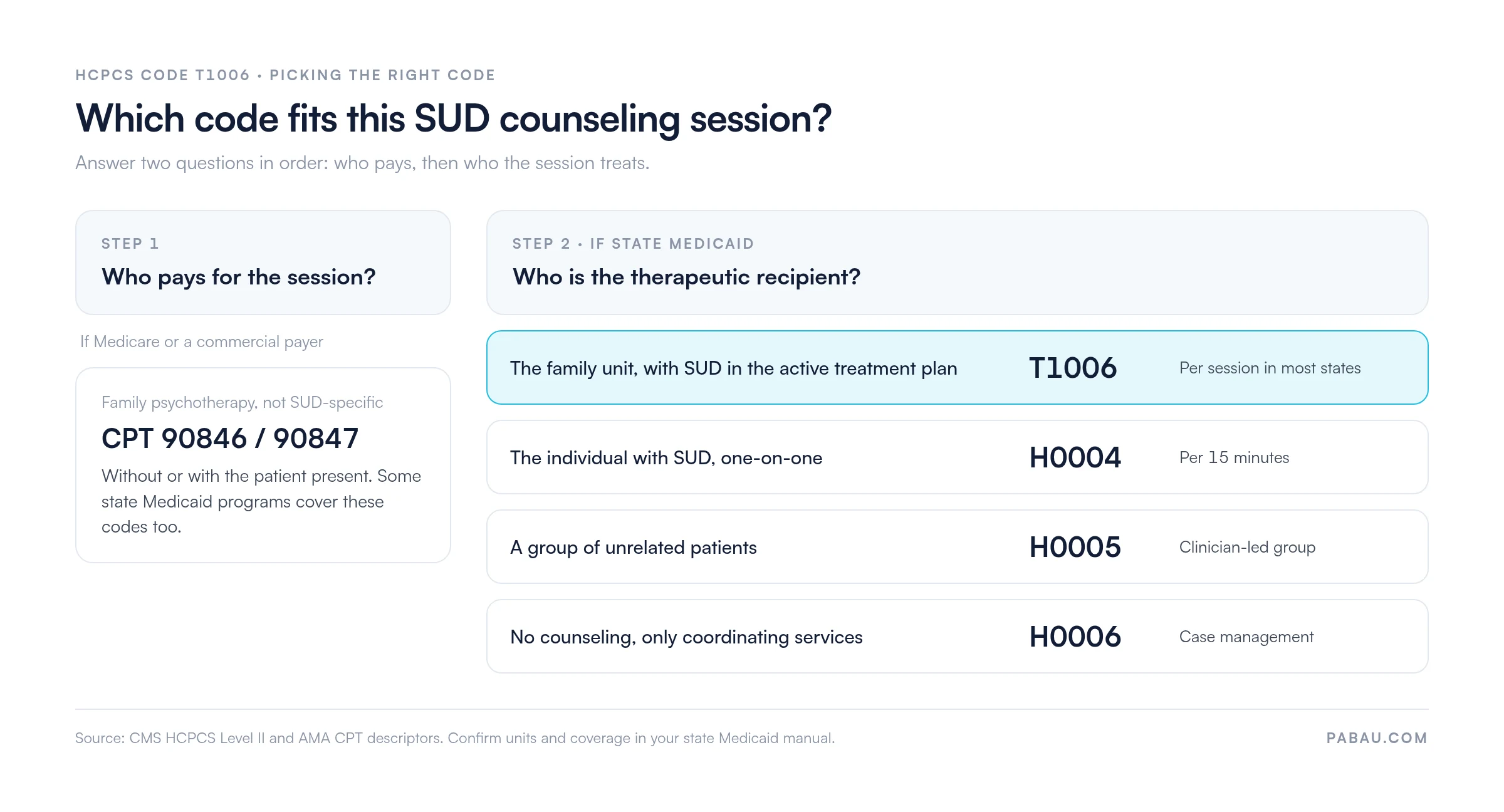
Upcoding risk sits in one scenario. A family member sits in on what was really an individual session, and the claim goes out as T1006. The session note must confirm the family counseling purpose, name every participant and reference the SUD treatment plan.
Provider eligibility for T1006 is set by each state Medicaid program. The following types are commonly authorized, though your state may impose additional credentialing or enrollment requirements.
The provider must be enrolled in the state Medicaid program as an SUD service provider. General behavioral health enrollment is not enough. Submitting T1006 under a provider number without SUD program enrollment is a leading cause of denials.
Accepted POS codes vary by state Medicaid plan. Commonly accepted settings are POS 11 (office) and POS 53 (community mental health center). POS 57 and POS 72 cover non-residential and residential substance abuse treatment facilities. Confirm accepted POS codes against your state’s T1006 billing manual before submitting.
Documentation failures account for a large share of T1006 audits and post-payment recoveries. Every session note must support the medical necessity of family counseling within the SUD treatment episode. The treatment plan carries the identified member’s diagnosis, such as F10.20 for uncomplicated alcohol dependence. Structured session templates make it harder to skip a required field at the time of service.
42 CFR Part 2 imposes stricter confidentiality requirements on SUD records than standard HIPAA. Your practice’s HIPAA framework needs 42 CFR Part 2 controls added for SUD documentation. That includes written consent before records are disclosed to other providers or payers.
Run a weekly audit of T1006 claims before submission. Confirm each claim has a treatment plan dated before the session, every participant named in the note, and the required modifier. Catching missing documentation pre-submission costs minutes; recovering a denied claim can take weeks.
Modifiers signal to the payer which program type or delivery method applied to the session. Using the wrong modifier or omitting a required one will trigger an automatic denial in most state Medicaid systems.
HF is the most commonly required modifier for T1006, but its use is not universal. Some state Medicaid programs do not require HF and will reject it when the provider lacks a matching program enrollment. Check modifier requirements against your state Medicaid billing manual rather than appending HF by default.
Prior authorization for T1006 depends on the state Medicaid program and, in some cases, the patient’s managed care organization (MCO). Some states authorize a set number of family counseling sessions per treatment episode without a separate PA request. Others require PA for every block of sessions.
Confirm PA requirements with the patient’s own Medicaid plan as well as the state Medicaid agency, because MCO contracts vary. A missing PA is one of the hardest denials to overturn, since the service was delivered before authorization existed.
T1006 denials cluster around a small set of repeatable errors. Track them by claim adjustment reason code (CARC) and remittance advice remark code (RARC) to see which one hits your practice most. Our guide to reading denial codes explains each code family.
When a T1006 claim is denied, read the CARC and RARC on the remittance advice to find the specific reason. A standard medical appeal form keeps the request and its attachments in one packet. Then follow these steps.
Log each corrected claim against its original denial reason. A pattern across several claims usually points to one fix upstream, such as an enrollment record, a modifier rule or a note template.
T1006 reimbursement is set by each state Medicaid fee schedule. Rates vary widely across states and are updated annually. The figures below are illustrative only, so verify current rates with your state Medicaid agency or fee schedule portal before budgeting.
These ranges are illustrative. Medicare does not reimburse T1006. Commercial payers rarely cover T-codes, though some MCO behavioral health carve-outs include T1006, so verify with the specific plan. Always pull the current rate from your state’s official Medicaid fee schedule portal.
Many states now permit T1006 family counseling by telehealth under expanded Medicaid telehealth parity policies. Billing it differs from in-person delivery in four ways.
Telehealth billing errors for T1006 usually involve the wrong POS code (POS 11 instead of POS 02) or a missing telehealth modifier. Both trigger automatic denials that need a corrected claim rather than an appeal. Record the POS and delivery mode when the session is booked, so the claim inherits them.
Before billing your first T1006 telehealth session, download your state Medicaid SUD billing manual and search for ‘telehealth’ and ‘T1006’ together. If the code is not explicitly listed as telehealth-eligible, call the provider line before submitting. A denied telehealth claim cannot be converted to an in-person claim retroactively.
Most SUD programs bill T1006 from three places. The session note sits in the EHR, the authorization number sits in an email, and the claim gets keyed into a clearinghouse portal. Every handoff is a chance to drop a modifier, a participant name or the PA code.
Pabau runs those steps in one record. Each prior authorization is stored as a case, and its code follows the booked session onto the claim. Pabau’s claims software for billing teams opens the claim pre-filled from the invoice and validates it for missing or invalid details. In the US, the claim then goes to Claim.MD.
When a claim comes back rejected, Pabau flags it as needing action and shows the reason. Your team fixes the modifier or the note while the session is still fresh, and payments settle from the ERA file.

Pabau validates each claim before it reaches your clearinghouse and keeps prior authorization codes attached to every booked session. Your billing team corrects errors before Medicaid sees them.

T1006 pays reliably once three facts are settled before the first session. The payer is state Medicaid, the provider is enrolled as an SUD program, and the family session sits inside an active treatment plan. Get those right and most remaining denials are paperwork you can correct.
Start with your state Medicaid billing manual, then build the HF modifier, the POS rules and the session limits into your note template. The trade-off is a few minutes of setup per program against weeks of appeals later. If you are still learning the wider claim cycle, our guide to medical billing basics covers each stage.
Book a demo to see how Pabau carries the authorization, the note and the modifier onto every T1006 claim.

Billing an individual SUD session instead? HCPCS code H0004 covers the per-15-minute counseling code for the patient with SUD.
Need the CPT route for a non-Medicaid payer? CPT code 90846 explains family psychotherapy billed without the patient present.
Coordinating services rather than counseling? HCPCS code H0006 walks through alcohol and drug case management billing.
Waiting on a Medicaid authorization? The prior authorization process breaks down each step from request to approval.
Want to understand denial management more broadly? Denial management in healthcare breaks down how to build a systematic denial tracking and appeals process.
HCPCS code T1006 is the Medicaid billing code for alcohol and/or substance abuse services, family/couple counseling. It covers sessions whose clinical focus is a family member’s substance use disorder. It does not cover individual therapy for the person with SUD, general family therapy without an SUD focus, or group sessions with unrelated patients.
T1006 covers family counseling sessions where a family member’s SUD diagnosis is the clinical focus. H0004 covers individual behavioral health counseling and therapy for the person with SUD, billed per 15-minute unit. Use T1006 when the family unit is the therapeutic recipient, and H0004 for one-on-one sessions with the identified patient.
Prior authorization requirements for T1006 vary by state Medicaid program and managed care organization. Some states authorize a fixed number of family counseling sessions per treatment episode without PA. Others require PA for each authorization period. Check with the patient’s own Medicaid plan, not just the state agency, before the first session.
Commonly accepted POS codes are POS 11 (office) and POS 53 (community mental health center). POS 57 and POS 72 cover non-residential and residential substance abuse treatment facilities. For telehealth sessions, use POS 02 or POS 10 depending on the patient’s location. Confirm accepted POS codes with your state Medicaid billing manual.
No direct CPT crosswalk exists for T1006. The closest CPT codes are 90847 (family psychotherapy with patient present) and 90846 (family psychotherapy without patient present), and neither is SUD-specific. They are billed to Medicare and commercial payers, and some state Medicaid programs cover them too, so check the state manual. Use T1006 where your state Medicaid program requires it for SUD family counseling.
The most frequent T1006 denials come from six errors. They are a missing or incorrect modifier (commonly HF), a provider not enrolled in a certified SUD program, and no active treatment plan on file. The other three are a note documenting individual rather than family counseling, the wrong place of service code, and a missing prior authorization. All except the PA failure can usually be corrected, while PA denials are rarely overturned on appeal.