HCPCS Code G0163: Skilled nursing observation and assessment
What is HCPCS Code G0163? HCPCS Code G0163 is a deleted Level II code for skille...

Last Updated: Oct 15, 2026

CPT code 90846 covers family psychotherapy without the identified patient present, with an official AMA descriptor of 50 minutes.
The CPT time rule sets the floor at 26 minutes of face-to-face family psychotherapy, so a shorter session is not billable as 90846.
Patient presence is the whole test. Bill 90847 if the identified patient attends, and 90846 if only family members do.
Medicare covers 90846 under Part B, and your own Medicare Administrative Contractor decides which ICD-10-CM diagnoses support it.
Pabau’s claims management software ties session documentation to electronic claim submission, so codes like 90846 are not re-entered by hand.
CPT code 90846 covers family psychotherapy without the identified patient present, with an official descriptor of 50 minutes. The billable floor is 26 minutes of face-to-face time. It is also one of the most frequently miscoded psychotherapy codes, because coders swap it with 90847.
This reference sets out the official descriptor, who can bill it, and how 90846 differs from 90847. Reimbursement by payer, documentation requirements, ICD-10 pairings, and the errors behind most denials follow. It also carries our Code Selection Snapshot, a single table that resolves 90846 against every neighboring psychotherapy code.
CPT code 90846 covers a family psychotherapy session of 26 minutes or longer, held with family members while the identified patient is not present.
The full 90846 code description in the American Medical Association code set reads “family psychotherapy (without the patient present), 50 minutes”. The AMA files it under “Other Psychotherapy”. Attendees are the family members, caregivers, or significant others involved in the care of an identified patient (IP) who does not attend.
The 26-minute floor comes from the CPT time rule. That rule lets you report a time-defined code once the midpoint of its stated time has passed. Half of 50 minutes is 25, so the session has to run past that. APA Services publishes the same threshold for 90846 and 90847: 26 or more minutes.
There is no upper band. A 50-minute session and a 75-minute session both bill one unit of 90846. The practical discipline is documenting start and end times on every family note.
Any clinician licensed to deliver psychotherapy independently can bill 90846, subject to state licensure limits and each payer’s credentialing decision.
Confirm the position with every payer before you bill, because credentialing and scope of practice do not always agree. A payer that credentials an LMFT for individual therapy may still leave the family codes off that contract.
Unlicensed clinicians billing under a supervisor must follow their payer’s incident-to billing rules. Medicaid-enrolled providers should check state-specific coverage, because Medicaid treatment of 90846 varies by state.
The identified patient’s presence decides which code applies, with 90847 for sessions the patient attends and 90846 for sessions without the patient.
The conjoint version of the same 50-minute service is 90847, and both codes share the 26-minute floor. Confusing the pair is the most common reason family therapy claims get denied or flagged for audit.
Edge case to document: the encounter stops qualifying for 90846 the moment the identified patient has contact with the therapist. A brief appearance in the waiting area counts. Switch to 90847 and document the patient’s participation. You can instead bill 90846 for the portion before patient contact, where a split-session approach is clinically supported and your payer accepts it.
Three questions resolve almost every psychotherapy code choice, and they run in this order. We call the answer the Code Selection Snapshot, and it is the lookup we hand to billing teams who keep landing on 90846 by default.
The table below holds all six of those decision inputs in one place, for 90846 and every code it competes with.
Only the 90846 rate is quoted as a figure here, because it is the one this article sources from the CMS Physician Fee Schedule. Look every other code up in the same fee schedule rather than trusting a round number. Medicare’s behavioral-health telehealth flexibilities are now permanent, so the psychotherapy codes above are not waiting on an extension.
Three rows in the snapshot cause most of the mistakes. The 90832 CPT code and its 45- and 60-minute siblings all need the patient in the room. None of them substitutes for a family-only session. The 90840 CPT code is an add-on to 90839, so it cannot be attached to 90846 either. The 90853 CPT code description covers group psychotherapy other than a multiple-family group, which rules it out for one family.
The 90792 CPT code differs from 90791 by one element: a medical services component, such as a prescribing decision or a physical examination. Coders who treat the two as interchangeable tend to under-bill the psychiatrist.
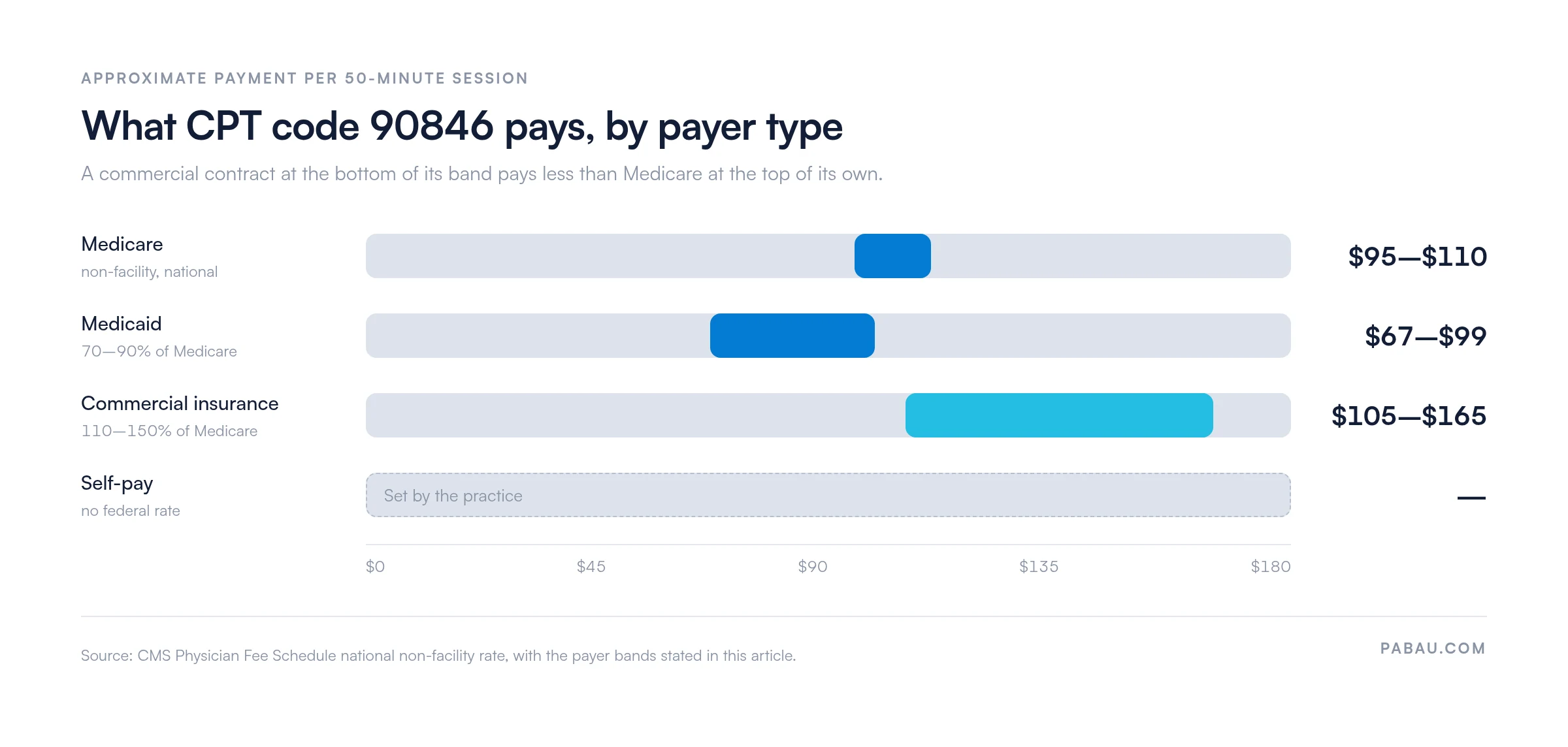
Medicare pays roughly $95 to $110 for 90846 in a non-facility setting, and other payers price off that figure.
The CMS Physician Fee Schedule publishes the national non-facility rate annually. Treat it as the floor when you benchmark a commercial contract, not as the going rate.
Laid out on one scale, those percentages produce a wide spread for the same 50-minute session. The chart below applies the table’s percentage bands to the Medicare range.
RVU breakdown for 90846, using approximate 2025 values:
Confirm all four figures against the current CMS relative value file before you use them in a rate calculation. The conversion factor and your locality’s geographic indices both change every year.
Medicare covers 90846 under Part B as an outpatient mental health service, with beneficiaries paying 20% coinsurance after the Part B deductible.
Unlike some psychotherapy codes, 90846 does not require the Medicare beneficiary to be in the room, because the session is designed for the family. The claim still travels under the beneficiary’s own coverage.
The Mental Health Parity and Addiction Equity Act (MHPAEA) applies to most commercial payers. Coverage limits on 90846 therefore cannot be more restrictive than the limits on comparable medical or surgical benefits.
A compliant 90846 note records the session date, the start and end times, the identified patient’s diagnosis, who attended, and why the patient was absent.
Thin documentation is the second denial trigger, right behind a miscoded patient-presence field. A standing note template for family sessions keeps these elements consistent across every clinician in a practice.
The claim is filed under the identified patient, not the family members who showed up. On the CMS-1500 form, Box 2 carries the identified patient’s name and Box 1a carries their insured ID number. Box 21 carries the identified patient’s ICD-10-CM diagnosis, and Box 24D carries 90846 with any modifier.
Attendees never appear as the patient on the claim. Attendee names belong in the session note instead, which is where a payer looks during an audit.
For audit protection, also record that the identified patient consented to the family session, or why consent was not obtained. HIPAA minimum-necessary standards govern how much patient information is shared with family members during the session.
Clinicians billing under supervision must document the supervising provider’s involvement per their payer’s incident-to requirements. Name the supervisor in the note itself rather than in a separate log.
Document why the identified patient was excluded from this session. A note reading ‘family meeting’ with no clinical explanation is a red flag in a payer audit. One sentence usually settles it. ‘Session held without IP to address caregiver burnout and reinforce the safety plan’ does the job.
Every 90846 claim carries an ICD-10-CM diagnosis for the identified patient, most often an adjustment disorder, a mood disorder, or a Z63 family-problem code.
The diagnosis must describe the patient’s condition, never the family’s. That code is what justifies family therapy as medically necessary within the patient’s treatment plan.
Which diagnoses actually support medical necessity is set locally, not nationally. Palmetto GBA publishes a local coverage determination for outpatient psychotherapy, LCD L39853. Its companion billing article, A59723, lists the ICD-10-CM codes that support these services in that jurisdiction. Check your own Medicare Administrative Contractor’s equivalent policy before you rely on any code list, including this one.
A secondary Z code from the Z63 family works as an additional diagnosis when family dynamics are a treatment focus. Avoid the Z code on its own. Most payers want a mental or behavioral health diagnosis as the primary code on a psychotherapy claim. The wider ICD-10-CM code set is where you confirm the fourth and fifth characters a payer expects.
A telehealth 90846 session carries modifier 95 with place of service 02 or 10, while an in-office session needs no modifier at all.
Getting that pairing right is the difference between a paid claim and a claims-editor rejection. None of the codes below is interchangeable with another.
The place of service code has to match the setting. Office sessions use POS 11. Telehealth sessions use POS 02 or POS 10. POS 02 covers telehealth other than in the patient’s home, and POS 10 covers the patient at home. Pairing modifier 95 with POS 11 triggers an edit.
In the mental health practices we onboard, 90846 denials cluster into a short list of patterns. Each one is visible in the session note before the claim goes out. Catching a pattern at documentation takes a minute, and catching it on appeal takes a month.
Run a monthly audit of your 90846 claims against your session notes. Pull 10 random claims and check four fields. Was the patient’s absence documented, and was the time noted? Does the ICD-10 code belong to the identified patient, and does the modifier match the service location? This 20-minute check catches the common patterns before they become payer audits.
Family therapy billing errors have two root causes. Documentation gets captured separately from claim generation, and codes get typed in a second time by hand. Practice management software like Pabau closes both by keeping the note and the claim in one system.
Pabau’s claims software for therapists connects clinical session notes to the claim workflow, so the documentation supporting a 90846 claim travels with the submission. The patient-presence field and the session time already sit on the note, so a coder reads them rather than recalling them.
For practices submitting to US payers, Pabau sends electronic claims through Claim.MD, our US clearinghouse partner. The integration supports CMS-1500 submissions, real-time eligibility checks, and electronic remittance advice. Your team can verify the identified patient’s coverage before the session, and denial reason codes arrive automatically for follow-up.
Billing that lives in the same system as the notes removes the manual steps where coding errors start.

Pabau connects clinical documentation directly to claim generation, so your team spends less time re-entering codes and more time on patient care. See how it works for mental health practices.

Two fields decide whether a 90846 claim survives. Was the identified patient in the session, and did the face-to-face time pass 26 minutes? Answer both in the note and the coding decision makes itself.
The trade-off worth remembering is that 90846 has no upper time band. A long, complex family session pays the same as a standard one. The value of the code sits in billing it correctly and often, rather than in stretching one encounter.
Pabau ties session documentation to claim generation, so nobody transcribes codes from notes. For practices billing 90846 regularly, the clean-claim rate improves once documentation and claim live in the same system. Book a demo to see how Pabau handles family therapy billing end to end.

Need to verify credentialing before billing 90846? Insurance credentialing for mental health providers covers the step-by-step process for getting credentialed with major payers.
Want to understand how ERA remittances work after claim submission? Electronic remittance advice explained covers how 835 ERA files reduce manual payment posting for psychotherapy codes.
Seeing repeat denials on family therapy claims? Denial management in healthcare sets out how to work a denial queue and stop the same reason code recurring.
Want more of your claims paid on first submission? What makes a clean claim explains the fields payers check before a claim is accepted for processing.
CPT code 90846 is used for family psychotherapy sessions of 26 minutes or longer in which the identified patient is not present. Therapists bill it when working with family members, caregivers, or significant others to support the patient’s treatment without the patient attending.
The identified patient is absent during a 90846 session and present during a 90847 session. Both codes cover family psychotherapy of 26 minutes or longer, but patient attendance decides which code applies. Billing 90846 when the patient is present is a compliance violation and a common cause of claim denial.
Sometimes, but never automatically. 90837 covers individual psychotherapy and 90846 covers family psychotherapy without the patient. A payer can accept both on one date when each reflects a distinct, separately documented session. Where a payer applies an NCCI procedure-to-procedure edit to the pair, the second code needs a modifier such as 59. The note has to show two separate sessions. Some payers decline same-day psychotherapy pairs outright, so confirm the policy before you bill.
A 90846 session must run at least 26 minutes of face-to-face family psychotherapy, and the AMA descriptor sets 50 minutes as the typical length. There is no upper limit, so a 90-minute session still bills one unit of 90846. Record start and end times on every family note.
Yes, Medicare covers CPT code 90846 under Part B as an outpatient mental health service. Beneficiaries pay 20% coinsurance after the Part B deductible. The national non-facility rate runs roughly $95 to $110, so verify the current year in the CMS Physician Fee Schedule lookup.
Modifier 95 is the standard telehealth modifier for 90846 under Medicare. Pair it with place of service 02 or 10, depending on where the family members are located. Modifier GT is used by some state Medicaid programs. The interactive complexity add-on code 90785 (not a modifier) can be appended when significant communication challenges are present.
Rarely. 90846 fits a couples session only when one partner is the identified patient and the other attends without them, which is unusual. The couples therapy CPT code you reach for is normally 90847, because both partners usually attend together. Document the identified patient designation and the session structure either way.
Common ICD-10 pairings include F43.20 (adjustment disorder) and Z63.0 (problems in relationship with spouse or partner). Z63.8 covers other problems related to the primary support group, and F90.0 (ADHD) suits pediatric family sessions. The diagnosis must reflect the identified patient’s condition, not the family members attending. Your own Medicare Administrative Contractor publishes the list that governs medical necessity.
Medicaid coverage of CPT code 90846 varies by state. Most states include it in outpatient mental health benefits, often at 70-90% of the Medicare rate. Coverage rules, prior authorization requirements, and provider eligibility still differ. Check your state Medicaid agency’s fee schedule directly before billing.