CCSD code XR940: Foreign body retrieval billing guide
CCSD code XR940 is the UK private healthcare code for retrieval of a foreign bod...

Last Updated: Nov 26, 2026
T1007 is the HCPCS Level II code for alcohol and/or substance abuse services, treatment plan development and/or modification. It reports the session in which a qualified clinician builds or revises a patient's substance use disorder treatment plan.
CMS added T1007 in July 2001 as a national T code for state Medicaid agencies. Medicare Part B does not separately price it, so each state Medicaid program sets the unit, eligible provider types, modifiers, and rate.
Let Pabau's smart automation suggest the right codes, reduce claim denials, and keep your practice compliant—effortlessly.
Automate repetitive tasks and focus on what matters most—your patients.
Reduce coding errors and ensure compliance with the latest regulations.
Clean claims, fewer denials, and faster reimbursements.
Powerful insights and reporting to help your practice thrive.
HIPAA compliant SOC 2 certified GDPR-compliant Trusted by 4,000+ clinics worldwide

HCPCS Code T1007 reports alcohol and/or substance abuse treatment plan development and/or modification, a service state Medicaid programs pay for.
The CMS HCPCS file gives T1007 pricing indicator 00 and coverage code I, so Medicare Part B does not pay it separately.
State Medicaid programs set the unit, often 15 minutes, along with eligible clinicians, modifiers, and same-day rules.
Bill T1007 only when a documented encounter with the patient creates or changes the treatment plan or problem list.
A note that names each plan element added or changed, with minutes and a signature, is what holds up on audit.
HCPCS Code T1007 is the Level II code for alcohol and/or substance abuse services, treatment plan development and/or modification. CMS lists it in its quarterly HCPCS update files. AAPC’s code listing places it in the alcohol and substance abuse services range, T1006 through T1012.
Behavioral health programs use it for the session where a clinician writes a new substance use disorder (SUD) treatment plan or revises an existing one. The code names the planning work itself. Assessment, counseling, and case management each carry their own HCPCS Level II codes.
The descriptor carries no time unit, unlike neighbors such as H0004, which CMS defines per 15 minutes. Each payer fills that in, so the same session can bill differently from one state to the next.
T1007 covers time spent with the patient creating a new SUD treatment plan or changing an existing one. Orange County’s 2026 DMC-ODS billing guide for California’s Drug Medi-Cal Organized Delivery System (DMC-ODS) applies it to problem list changes too.
The guide adds a practical rule. When a counseling session leads to a change in the plan or problem list, it recommends coding that session as T1007.
Each state Medicaid program decides which clinicians may report T1007. Most programs split licensed practitioners from supervised counselors, then add exclusions.
California’s DMC-ODS shows how detailed those rules get. The Orange County guide lets licensed practitioners of the healing arts (LPHAs) and non-LPHA counselors bill it, with these exceptions:
Other programs may limit plan development to licensed clinicians, or require a licensed supervisor to co-sign a counselor’s plan. Confirm the rendering provider type in your state manual before you schedule staff for these sessions.
Medicare Part B does not separately price T1007. The October 2026 CMS alpha-numeric HCPCS file lists it with pricing indicator 00 and coverage code I, not payable by Medicare.
Medicare pays for SUD care under other codes, so a Medicare claim for T1007 is not the route to payment. For a patient with both Medicare and Medicaid, check your state’s coordination of benefits rule before you bill.
State Medicaid programs are where T1007 gets paid. Each one sets its own rules for these five points:
Managed care plans that run Medicaid benefits can add their own limits on top of the state rules. Read the plan’s payment policy as well as the state fee schedule.
There is no national T1007 rate. Each state publishes its own fee schedule, and managed care contracts can pay a different rate again.
South Dakota Medicaid’s FY27 substance use disorder fee schedule, effective June 1, 2026, lists T1007 in 15-minute units. South Dakota assigns the code to collateral contacts and referral rather than plan development. California’s DMC-ODS counts minutes instead.
The Orange County guide sets an 8-minute minimum and no maximum. Shorter sessions go on a non-billable code, and the note must justify the minutes claimed.
Before your first T1007 claim, pull three items from your state manual: the unit definition, the allowed provider types, and the modifier list. Build them into your claim template once, so denials stop repeating.
T1007 modifiers come from state manuals, not from a national rule. Most fall into four groups: provider credential, program, level of care, and delivery mode.
The Orange County DMC-ODS guide lists 18 allowable modifiers for T1007. Your state may allow fewer, and a modifier it does not recognize can deny the line.
A T1007 note has to show that the plan itself changed. A line reading treatment plan reviewed does not prove a billable service.
Keep the prior version of the plan on file. An auditor compares the two to confirm a modification took place, and an unchanged plan billed as modified invites recoupment.
T1007 sits beside several codes that describe nearby work. The choice turns on what happened in the session, so match the note to the descriptor. The path below runs those checks in order, starting with whether the H0001 assessment has happened yet.
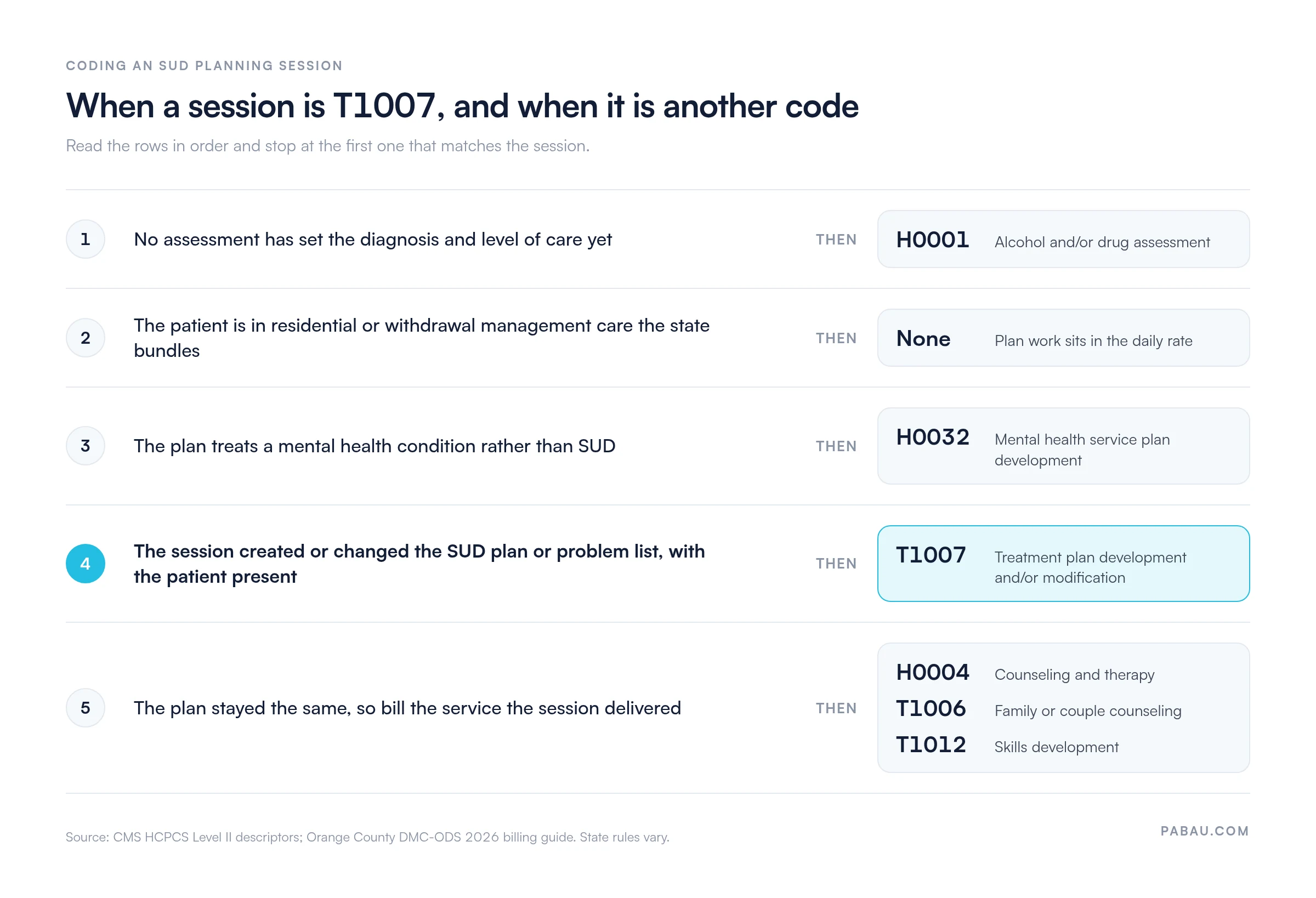
H2023 needs a word of its own. Some references have described T1007 as supported employment, and that is wrong. Supported employment bills under H2023 or a waiver code such as T2019, and T1007 never stands in for either.
Most T1007 denials trace back to a state rule the claim did not follow. The table maps the frequent ones to a fix, and the denial management guide covers the wider workflow.
A quarterly sample of T1007 notes checked against their claims catches most of these patterns early. It also supports the medical billing compliance program your Medicaid contract expects.
Treatment plan sessions create paperwork in three places: the plan, the session note, and the claim. When each lives in a separate tool, the plan version, the minutes, and the billed units drift apart.
Pabau, a practice management platform with behavioral health charting, keeps them on one patient file. Your team can build the treatment plan as a form template with the problem list, goals, and interventions. The clinician completes and signs it in the session.
Pabau’s claims management software then submits the claim with the codes, units, and modifiers your billers enter, and tracks it to payment. Your team chooses the code, and Pabau keeps the note and the plan lined up behind it.

Pabau keeps the treatment plan, the session note, and the Medicaid claim on one patient record. Your billers submit T1007 with the units and modifiers they set, then track it to payment.

T1007 pays for one specific piece of SUD care: the session where the treatment plan is written or changed. Billed that way, it is a clean code. Billed as counseling, assessment, or employment support, it becomes an audit finding.
The rules that decide payment sit in your state manual. Pull its unit rule, provider list, and modifiers once, build them into your templates, and make every plan note show what changed.
Book a demo to see how Pabau keeps SUD treatment plans, session notes, and Medicaid claims on one record.

Need a framework for clean claim submission? Clean claim requirements in medical billing covers the field-by-field elements that keep behavioral health claims out of the denial queue.
Struggling with remittance codes after T1007 denials? Electronic remittance advice (ERA) explained walks through reading 835 transaction files and matching CARC codes to corrective actions.
Want to benchmark your denial rate? Denial codes in medical billing provides a reference guide to CARC and RARC codes across behavioral health claim types.
HCPCS Code T1007 is the Level II code for alcohol and/or substance abuse services, treatment plan development and/or modification. It reports a session in which a clinician creates or revises a patient’s SUD treatment plan. It sits in the T1006-T1012 alcohol and substance abuse services range.
No. T1007 covers substance use disorder treatment plan development and modification. Supported employment is a separate service, billed under codes such as H2023, supported employment per 15 minutes, or the waiver code T2019.
No. The CMS HCPCS file gives T1007 pricing indicator 00, not separately priced by Part B, and coverage code I, not payable by Medicare. State Medicaid programs and their managed care plans are the payers that use it.
The CMS descriptor sets no time unit, so each state decides. Many Medicaid programs count 15-minute units. California’s DMC-ODS counts minutes with an 8-minute minimum, so check your state fee schedule.
Each state sets the eligible provider types. California’s DMC-ODS, as described in Orange County’s 2026 guide, allows licensed practitioners and non-LPHA counselors. It excludes medical assistants, peer support specialists, and pharmacists.
Modifiers come from state manuals. Common groups cover the clinician’s credential, such as HM, HN, HO, or HP, and the program, such as HD or HG. Others mark the level of care or telehealth delivery with 93 or 95.
The note should show the time spent, the reason for the session, and the diagnosis. It should list the problems, goals, and interventions added or changed, plus the patient’s participation and the clinician’s signature. Keep the prior plan version for comparison.