CPT code 21011: Excision of soft tissue tumor of the face
CPT code 21011: Official descriptor and procedure overview CPT code 21011, as pu...

Last Updated: Oct 8, 2026

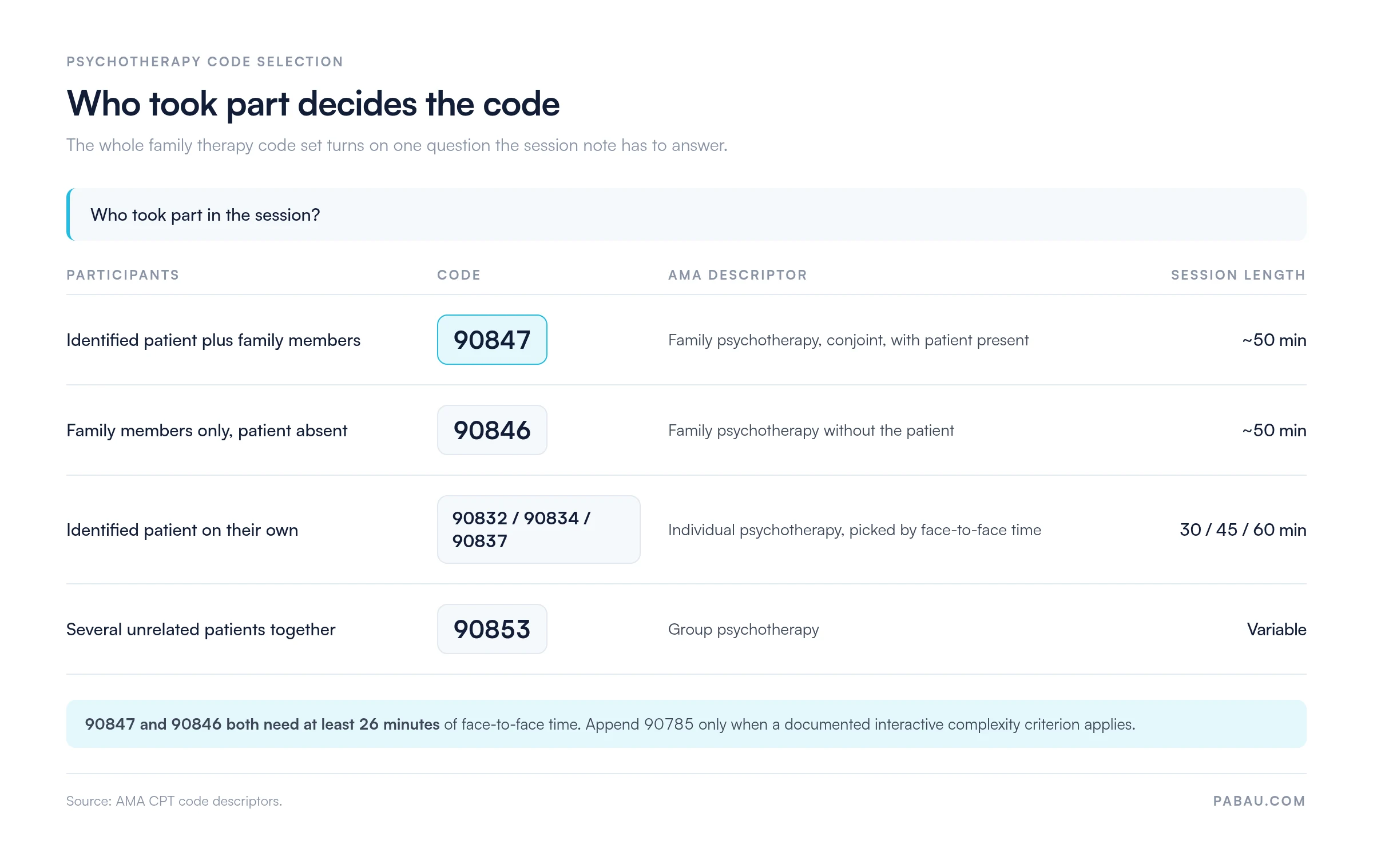
CPT code 90847 is the AMA code for conjoint family psychotherapy with the identified patient present, running approximately 50 minutes.
Use 90847 when the patient participates and 90846 when the family meets without them. Mixing the two up is the top cause of family therapy denials.
Medicare covers 90847 only for an identified patient with a covered DSM diagnosis. It does not cover couples therapy as standalone relationship counseling.
Practice management software like Pabau links session documentation to the billing and claims workflow. That keeps the patient-presence detail attached to the claim.
CPT code 90847 is the American Medical Association‘s code for conjoint family psychotherapy with the identified patient present. Bill it when the patient takes part in the session. When the family meets without the patient, the code is 90846.
The AMA descriptor reads: “Family psychotherapy (conjoint psychotherapy) (with patient present), 50 minutes.” That phrase “with patient present” is the billing trigger. The identified patient has to be an active participant, not someone sitting in the waiting room.
The descriptor sets the session at approximately 50 minutes of face-to-face time. Time-based billing rules require at least 26 minutes of direct contact to bill the code.
The code applies to both couples therapy and family therapy, as long as the patient with the covered diagnosis takes part. Practices bill it across a wide range of clinical presentations.
The 90847 vs 90846 distinction is where most billing errors originate. Both codes cover family psychotherapy sessions lasting approximately 50 minutes. The only difference is patient participation.
Both codes require an identified patient with a covered diagnosis as the clinical anchor for billing. Neither one works for a session with no identified patient. Pure relationship counseling without a diagnosable condition is usually not a covered benefit.
Provider eligibility for CPT code 90847 depends on state licensing, payer credentialing requirements, and CMS enrollment rules. These provider types generally qualify, but check each payer contract before you submit a claim.
A claim submitted under a provider who is not credentialed with that payer for family therapy codes denies on eligibility alone. Keeping credentials current in your mental health EMR software stops that at the point of entry. State licensing boards and individual payer contracts can restrict which credentials qualify, so verify with the payer before the first claim.
Reimbursement for CPT code 90847 varies by payer, geographic location, and whether the session is delivered in a facility or non-facility setting. The figures below reflect the 2025-2026 Medicare Physician Fee Schedule (PFS).
Commercial payer rates are negotiated separately and can run higher or lower. Always verify current rates through the CMS Physician Fee Schedule lookup before billing.
These are approximate national averages. Geographic practice cost indices adjust Medicare rates by locality. Use the CMS fee schedule lookup with your specific ZIP code and provider specialty to pull the exact payment amount applicable to your practice.
Commercial payers often pay a multiple of the Medicare rate, typically 100% to 160%. The exact figure varies by contract.
Medicare Part B covers CPT code 90847 when it is medically necessary for an identified Medicare beneficiary who has a covered DSM diagnosis. The key compliance point: Medicare does not cover couples therapy as a standalone relationship counseling benefit.
The session must be clinically indicated for the identified patient’s diagnosed condition. The patient has to be the focus of treatment, not just a participant in a general relationship intervention.
Medicaid coverage varies by state. Some state programs cover conjoint family therapy under behavioral health benefits. Others restrict coverage to individual therapy codes, or require prior authorization for family sessions. Check your state Medicaid program’s behavioral health billing manual before submitting 90847 claims.
Verify Medicare eligibility and the covered diagnosis before each family therapy session. A 90847 claim with no active covered DSM diagnosis for the identified patient denies on medical necessity. Retroactive corrections take time you do not have. Use Pabau’s insurance eligibility verification to confirm coverage before the appointment.
Insufficient documentation is the second-most-common reason family therapy claims deny. For CPT code 90847, the clinical record must demonstrate both medical necessity and patient presence. Missing either element creates an audit risk even when the session was clinically appropriate.
HIPAA documentation standards for medical offices require that session notes are kept securely and carry enough detail to reconstruct the clinical encounter.
Practices maintaining medical billing compliance standards use session note templates with a built-in patient-presence confirmation field. When that field is part of the standard note structure, therapists cannot complete documentation without confirming whether the identified patient attended.
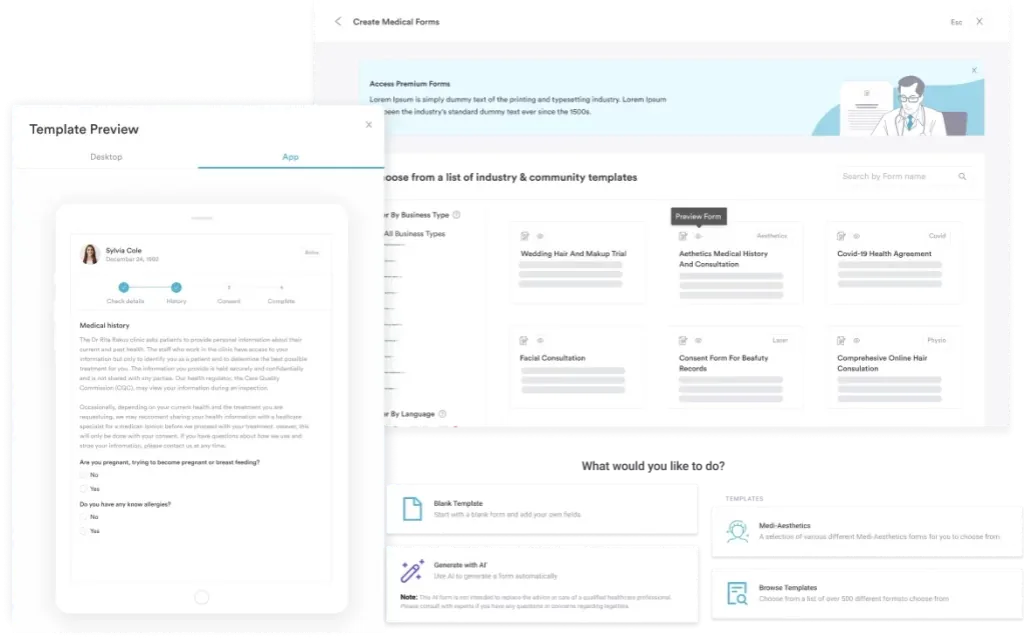
This removes the most common root cause of 90847 denials. Digital forms built into your practice management workflow enforce the structure at the point of documentation, before the claim is submitted.
Yes. CPT code 90847 is eligible for telehealth billing under current CMS rules. The code was added to the Medicare telehealth services list during the COVID-19 Public Health Emergency and has been extended through subsequent legislation. Check the code against the current CMS telehealth services list every year, because Congress decides how long these extensions run.
A telehealth 90847 claim has to carry the correct place-of-service code. Use POS 02 when the patient is somewhere other than their home. Use POS 10 when the patient is at home. An incorrect POS code denies the claim on its own, whatever the clinical picture.
Commercial payer policies on telehealth family therapy vary more than Medicare’s. Some plans require audio-video delivery and will not accept audio-only for behavioral health codes. Confirm the requirements with each payer before the session.
CPT code 90785 is an add-on code for 90847. Append it when one or more interactive complexity criteria are present in the session. Billing it without meeting the criteria is an audit risk, because the documentation has to support each one you claim.
The AMA defines four conditions that qualify for the interactive complexity add-on, and the AAPC’s CPT code reference lists them alongside the code. At least one must be present and documented in the session note.
Only one criterion has to apply, and the note must name which one. Appending 90785 to a documented 90847 claim raises the reimbursement for the session. Practices that record the add-on without naming the criterion are exposed in an audit, even when it was clinically justified.
Family therapy practitioners frequently need to select between codes across the broader psychotherapy code family. The table below covers the codes most commonly used alongside or instead of CPT code 90847.
The individual therapy codes (90832, 90834, 90837) are billed per patient. They cannot stand in for a family therapy code when family members are in the room. Bill 90837 for a session the patient’s partner also joined and you underbill it, while misreporting what you delivered.
The whole decision comes down to who was in the room, and how long the session ran.
CPT code 90847 has a well-documented set of denial patterns. Each one has a specific prevention step.
Effective denial management for family therapy codes starts before the claim is submitted. Practices that audit a random sample of 90847 notes each month catch weak documentation before it reaches claims volume.
When a denial does occur, the corrected claim should include the documentation element that was missing the first time. Payers re-adjudicate corrected claims, so a well-documented appeal recovers revenue that a first denial would have cost you.
Manual code selection at billing entry is where the 90847/90846 mix-up usually happens. A therapist finishes a family session and hands off to a biller. If the session type is not clear in the documentation, the biller has to guess, or defaults to the code used last time.
That handoff is where the medical billing workflow breaks down. Practice management software like Pabau captures the session type in the clinical record itself. The biller reads it straight off the record. When the note states that the identified patient took part, whoever codes the claim has the answer in front of them.
Pabau links session documentation to claim submission in one workflow. Rather than exporting notes to a separate billing system, the clinical record attaches to the claim before it goes out. That includes the patient-presence confirmation and the session time.
Claims route through Pabau’s Claim.MD integration, which validates them against payer edits before submission and returns electronic remittance data. The electronic remittance advice workflow means a denial is actionable the same day it comes back.
For therapy practices running high session volumes, superbill generation is another place manual work creates errors. Auto-populated superbills pull from the confirmed session type, provider credentials, and diagnosis codes. That makes it far less likely a claim goes out as 90847 when the note supports 90846.
A therapy practice management workflow should connect every step from appointment type to claim submission. No biller should have to reconstruct clinical context from scratch. A clearinghouse integration that scrubs claims before transmission catches payer-specific edit failures before they become denials.

Pabau links session documentation to your billing and claims workflow and submits claims through Claim.MD. Your team spends less time fixing denials and more time with patients.

The line between 90847 and 90846 is one detail wide, and it sits in the session note rather than in the claim. Practices that get paid reliably for family therapy are the ones that made patient presence impossible to leave out of the note.
So the fix is upstream of billing. Put a required patient-presence field in the note template, document start and stop times, and tie the session to an active treatment plan. Do that and the coding question answers itself.
Pabau links session documentation to billing and claim submission in one workflow, which closes the manual handoff where 90847 and 90846 get swapped. Book a demo to see how a family therapy session travels from note to paid claim.

Need to understand mental health billing requirements? Mental health EMR software covers the documentation and billing workflows specific to behavioral health practices.
Want to reduce claim denials across your practice? Denial management in healthcare explains the most common denial patterns and how to build a systematic appeal process.
Looking for guidance on HIPAA-compliant documentation? HIPAA documentation standards for medical offices covers what belongs in a compliant session record.
CPT code 90847 is the AMA billing code for conjoint family psychotherapy with the identified patient present, covering sessions of approximately 50 minutes. Licensed therapists, psychologists, psychiatrists, and social workers bill it when the patient with the covered diagnosis takes part.
Yes, Medicare Part B covers CPT code 90847 when the session is medically necessary for an identified Medicare beneficiary with a covered DSM diagnosis. Medicare does not cover couples therapy billed as standalone relationship counseling. The identified patient must be the clinical focus, and the family therapy must support their diagnosed condition.
Yes, under current CMS rules CPT code 90847 is eligible for telehealth billing using POS 02 or POS 10 depending on the patient’s location. Telehealth eligibility has been extended through congressional legislation following the COVID-19 Public Health Emergency. Verify current CMS telehealth policy annually, because this status can change.
The most common mistake is billing 90847 when the identified patient was not present. In that case the correct code is 90846. Other frequent errors include notes that do not confirm patient presence, and missing treatment plan linkage. Inadequate time documentation and appending 90785 without documented criteria also cause denials. Each error has a specific documentation fix that prevents the denial before submission.