

HCPCS Code G0163: Skilled nursing observation and assessment
What is HCPCS Code G0163? HCPCS Code G0163 is a deleted Level II code for skille...

Last Updated: Oct 15, 2026
HCPCS code S0601 is the Level II code for screening proctoscopy, a rectal scope exam in a patient without symptoms. The Blue Cross Blue Shield Association maintains it as a temporary S-code for commercial and other non-Medicare payers. It has been effective since January 1, 2000.
Payer acceptance is the fact that decides the claim. Medicare does not pay S-codes, so Medicare screening claims use G-codes such as G0104 instead. Once the patient reports symptoms, the exam turns diagnostic and moves to CPT 45300. Getting either call wrong means a denial. The sections below follow the claim from the payer check through to appeal.
Let Pabau's smart automation suggest the right codes, reduce claim denials, and keep your practice compliant—effortlessly.
Automate repetitive tasks and focus on what matters most—your patients.
Reduce coding errors and ensure compliance with the latest regulations.
Clean claims, fewer denials, and faster reimbursements.
Powerful insights and reporting to help your practice thrive.
HIPAA compliant SOC 2 certified GDPR-compliant Trusted by 4,000+ clinics worldwide

HCPCS code S0601 means screening proctoscopy, a scope exam of the rectum in a patient without symptoms.
The BCBSA maintains S0601 for non-Medicare payers, and Medicare does not pay it.
For Medicare screening, look at G-codes such as G0104 for flexible sigmoidoscopy.
Symptoms or findings make the exam diagnostic, which moves the claim to CPT 45300.
Pair S0601 with a screening diagnosis such as Z12.12, plus any family or personal history code.
HCPCS code S0601 reports a screening proctoscopy. The provider passes a proctoscope to view the rectum and anal canal in a patient with no symptoms. The visit looks for disease early, so the whole claim rests on that screening intent.
S0601 is a Level II S-code. The Blue Cross Blue Shield Association (BCBSA) maintains the S-series for commercial and other non-Medicare payers. The code has been effective since January 1, 2000, and sits in the S0601-S0622 screenings and examinations range.
Because S-codes sit outside Medicare, the payer controls most of what happens to an S0601 claim. Some plans list the code and pay it. Others reject S-codes outright and want a CPT or G-code instead. Check the plan’s code policy before the appointment, not after the denial.
Load these fields into your fee schedule and charge master once, then review them yearly. Confirm the descriptor each year on the AAPC Codify S0601 page or in your payer’s manual.
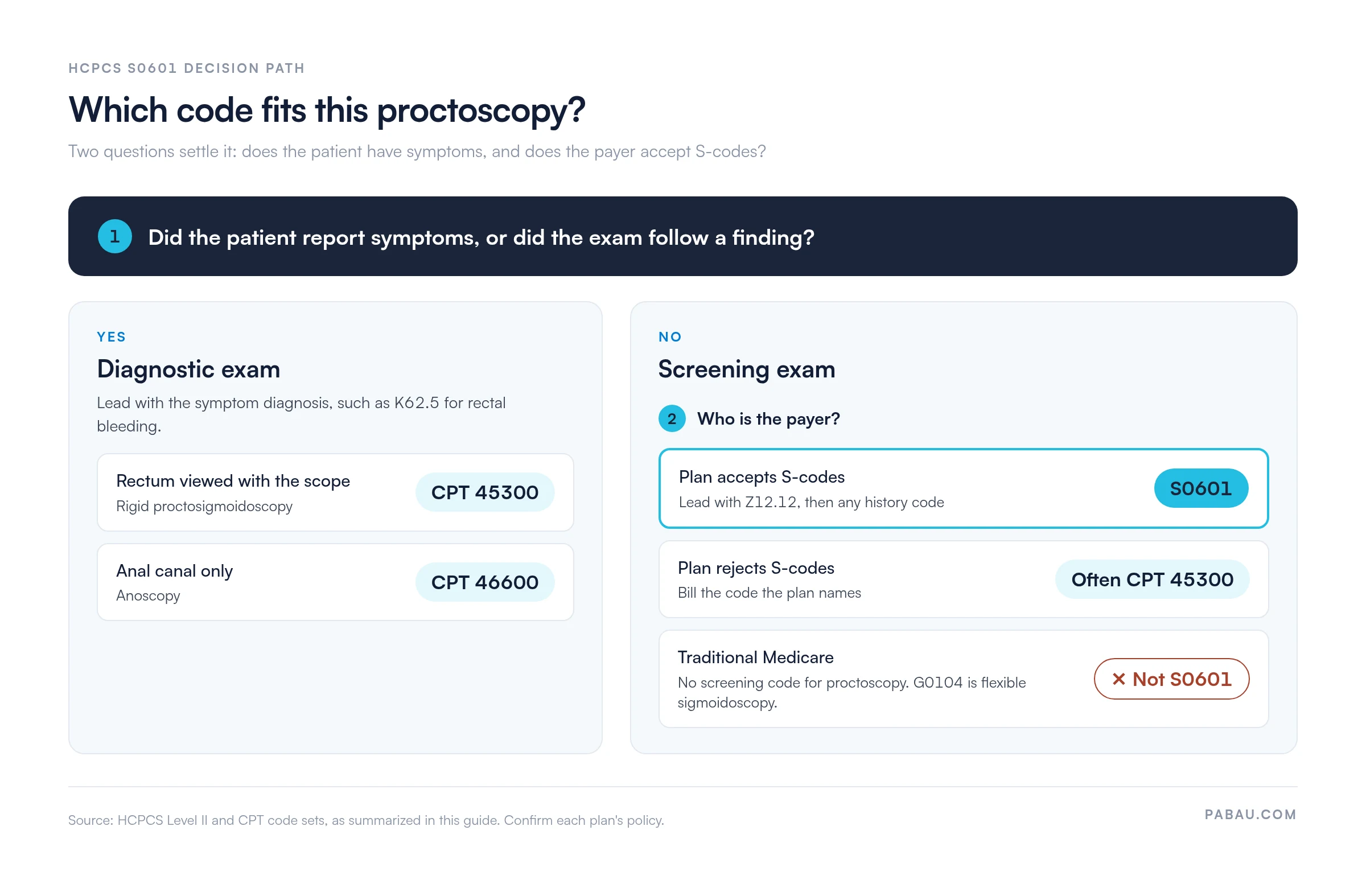
S0601 fits one narrow scenario. The patient is well, the exam is preventive, and the payer accepts S-codes. Once any of those conditions changes, a different code usually applies, and the path below shows which one.
S0601 covers:
S0601 does not cover:
Decide screening or diagnostic before you code. If the patient reports rectal bleeding at check-in, the exam is diagnostic. Code it as CPT 45300 and lead with the symptom diagnosis, not a Z12 screening code.
Here is how that plays out. A 52-year-old on a commercial plan comes in for screening because her father had colorectal cancer. She reports no symptoms, so the claim carries S0601 with Z12.12 first and Z80.0 second. If she mentions bleeding at check-in, the same exam becomes CPT 45300 with K62.5 first.
Good medical billing compliance starts with this choice. Billing a diagnostic exam as screening can draw an audit finding, even when the claim pays.
Many commercial plans accept S0601, and traditional Medicare never does. Everyone else in between sets their own rule. Use the table as a starting point, then confirm with each plan.
Traditional Medicare will not pay S0601. Medicare covers colorectal screening through G-codes instead. G0104 reports a screening flexible sigmoidoscopy, while G0105 and G0121 report screening colonoscopy.
Medicare has no screening code for proctoscopy itself. If a Medicare patient has symptoms, code the diagnostic service, such as CPT 45300.
The USPSTF colorectal screening recommendation does not list proctoscopy among its screening tests. So a commercial plan may not waive cost-sharing for S0601. Tell the patient about possible out-of-pocket costs before the visit.
Most payers expect S0601 with no modifier. The exam has no left or right side, and it is not a bilateral service. Add a modifier only when the payer’s policy asks for one.
An unneeded modifier can trigger a denial on its own. When the payer policy is silent, leave the line clean.
Payers rarely require prior authorization for a screening proctoscopy. Still, rules differ by plan, so confirm before the service date. A quick portal check takes minutes and protects the claim.
If a plan does ask for authorization, it usually wants:
Build the check into insurance eligibility verification for every screening visit. Record the answer, even when it is “not required.”
An S0601 claim needs a diagnosis from the ICD-10-CM code set that shows screening intent. Lead with the screening encounter code. Then add any history code that explains why this patient needs the exam. Confirm each code in the CDC ICD-10-CM tool before billing.
A symptom code, such as K62.5 for rectal bleeding, signals a diagnostic exam. In that case, switch to CPT 45300 rather than pairing the symptom with S0601.
The note has to show a screening exam from start to finish. Before you bill, confirm the record includes:
A complete note also supports clean claim submission. Fixing a record before submission takes far less time than an appeal.
Most S0601 coding errors come from mixing up screening and diagnostic codes.
Check exact CPT descriptors against the AMA code set each year, since the table only summarizes them. When the exam stays in the anal canal, the CPT 46600 guide covers anoscopy modifiers and payment.
S0601 has no Medicare payment amount, so the CMS Physician Fee Schedule will not help here. Instead, each payer sets its own rate.
Rates change each year. Pull the current schedule before you quote a patient or set an expected payment.
An S0601 claim passes through several hands before the money arrives. Each handoff is a point where screening intent can get lost.
Most problems start at step two. A symptom mentioned to a nurse but missing from the provider’s note leaves the coder guessing.
Run through these six checks on every S0601 claim.
The same six errors account for most of the rework on these claims. Each one is cheap to catch at the desk:
Most S0601 denials trace back to the payer or the diagnosis. These are the usual causes:
Effective denial management starts with the remittance advice. The adjustment reason code tells you which fix the payer expects.
Screening claims fail when the payer check, the diagnosis, and the note live in separate places. A coder then has to chase each piece before the claim can go out.
Pabau, the practice management platform we build, keeps the visit note, signed consent, and claim in one patient record. Billing teams then create and submit claims through its claims management software, which connects to Claim.MD in the US.
Your coder can then check the screening reason and the Z12.12 pointer against the note before submission. Corrections happen at the desk, before the payer ever sees the claim.

Keep the screening note, consent, and claim in one patient record, then submit through Pabau’s Claim.MD integration in the US.

S0601 rewards one early decision. Settle screening or diagnostic before you pick a code, and most errors never happen.
From there, the payer drives the rest. Confirm it accepts S-codes, lead with a Z12 screening code, and skip modifiers it never asked for. That routine turns a niche code into a predictable claim.
If S-code denials keep landing on your desk, start with the check-in question. Book a demo to see how Pabau keeps the note, consent, and claim together for screening visits.

Need to understand what drives claim denials? Denial management in healthcare covers the denial lifecycle, from root cause analysis to appeals that recover revenue.
Want a structured reference on how medical billing works? What is medical billing walks through the revenue cycle, so your team sees where HCPCS codes fit.
Looking to tighten your claim submission process? Clean claim submission outlines what every claim needs before it leaves your practice.
Framing the screen as colorectal instead? ICD-10 code Z12.11 explains when the colon screening code leads the claim.
Screening a Medicare patient instead? HCPCS code G0121 covers screening colonoscopy for patients who are not at high risk.
A proctoscopy views the rectum and anal canal through a short scope. A sigmoidoscopy reaches further, into the sigmoid colon, usually with a flexible scope. Each has its own codes, so the extent recorded in the note decides what you bill.
Yes, S0601 remains an active Level II code. S-codes can be added, revised, or deleted in the quarterly HCPCS updates, so confirm its status each January.
S-codes were created for the Blue Cross Blue Shield Association and the Health Insurance Association of America, now AHIP. They report services that have no other national code. Medicare does not use them, but many commercial plans do.
Yes, if the visit addresses a separate problem. Bill the E/M service with modifier 25 and document it apart from the screening exam. A routine pre-exam check does not qualify.
Often, yes. Proctoscopy is not among the USPSTF colorectal screening tests, so a plan may apply a copay, coinsurance, or deductible. Quote the patient’s likely share before the visit.




