CPT code 34812: Open femoral artery exposure for endovascular repair
CPT code 34812: Official descriptor and procedure overview CPT code 34812 is off...

Last Updated: Nov 19, 2026
V2306 is the HCPCS Level II code for spherocylinder, trifocal, plano to plus or minus 4.00d sphere, over 6.00d cylinder, per lens. It covers one trifocal lens that corrects astigmatism, billed as one unit for each lens dispensed.
The code sits in the V2300-V2399 trifocal lens range. Assignment turns on two values from the lab invoice: a sphere within plano to plus or minus 4.00 diopters and a cylinder over 6.00 diopters. Each lens line also carries an RT or LT modifier.
Let Pabau's smart automation suggest the right codes, reduce claim denials, and keep your practice compliant—effortlessly.
Automate repetitive tasks and focus on what matters most—your patients.
Reduce coding errors and ensure compliance with the latest regulations.
Clean claims, fewer denials, and faster reimbursements.
Powerful insights and reporting to help your practice thrive.
HIPAA compliant SOC 2 certified GDPR-compliant Trusted by 4,000+ clinics worldwide

HCPCS Code V2306 covers one spherocylinder trifocal lens with a plano to plus or minus 4.00 diopter sphere and a cylinder over 6.00 diopters.
Both powers must fit. A cylinder of 6.00 diopters or less points to V2303 to V2305, and a sphere stronger than plus or minus 4.00 diopters starts at V2307.
Bill one unit per lens, so a pair of trifocals takes two claim lines.
Every V2306 line needs modifier RT (right eye) or LT (left eye). A missing modifier is one of the most common reasons these claims are denied.
Medicare Part B does not routinely cover spectacle lenses. It pays for V2306 only under narrow exceptions, such as glasses after cataract surgery with an intraocular lens.
HCPCS Code V2306 is a Healthcare Common Procedure Coding System (HCPCS) Level II supply code for one spherocylinder trifocal lens.
The Centers for Medicare and Medicaid Services (CMS) owns it, and CMS’s HCPCS Level II program decides every addition, revision and deletion to these codes.
The sphere power runs from plano to plus or minus 4.00 diopters, and the cylinder power is over 6.00 diopters. The code sits in the V2300-V2399 trifocal lens range.
The code describes a single lens only. When both eyes are dispensed, two units are billed, one for each eye, each carrying its own laterality modifier. The HCPCS code library covers the neighboring lens codes too, so you can check the code next door before you bill.
The official descriptor for V2306 reads: Spherocylinder, trifocal, plano to plus or minus 4.00d sphere, over 6.00d cylinder, per lens. It encodes four facts a coder must confirm before billing. They are the lens type (spherocylinder, which corrects astigmatism), the focal design (trifocal), the sphere range and the cylinder band.
Both ranges must match. A lens with a minus 2.50 diopter sphere and a 6.50 diopter cylinder belongs to V2306. The same sphere with a 5.00 diopter cylinder belongs to V2305.
A sphere stronger than plus or minus 4.00 diopters takes the lens out of V2306 altogether. Rounding the cylinder to fit V2306 is a coding error that exposes the practice to audit risk. Always confirm the dispensing lab’s sphere and cylinder specification before code selection.
The per-lens billing unit is a frequent source of confusion. V2306 is billed once per lens dispensed. A bilateral pair of trifocal lenses generates two line items on the claim, one carrying modifier RT and one carrying modifier LT. Billing the pair as a single unit is a duplicate-service error that triggers denials.
V2306 has tight edges on both powers, and each neighboring lens type has its own code. Check the lens against both lists before you bill.
V2306 covers:
V2306 excludes:
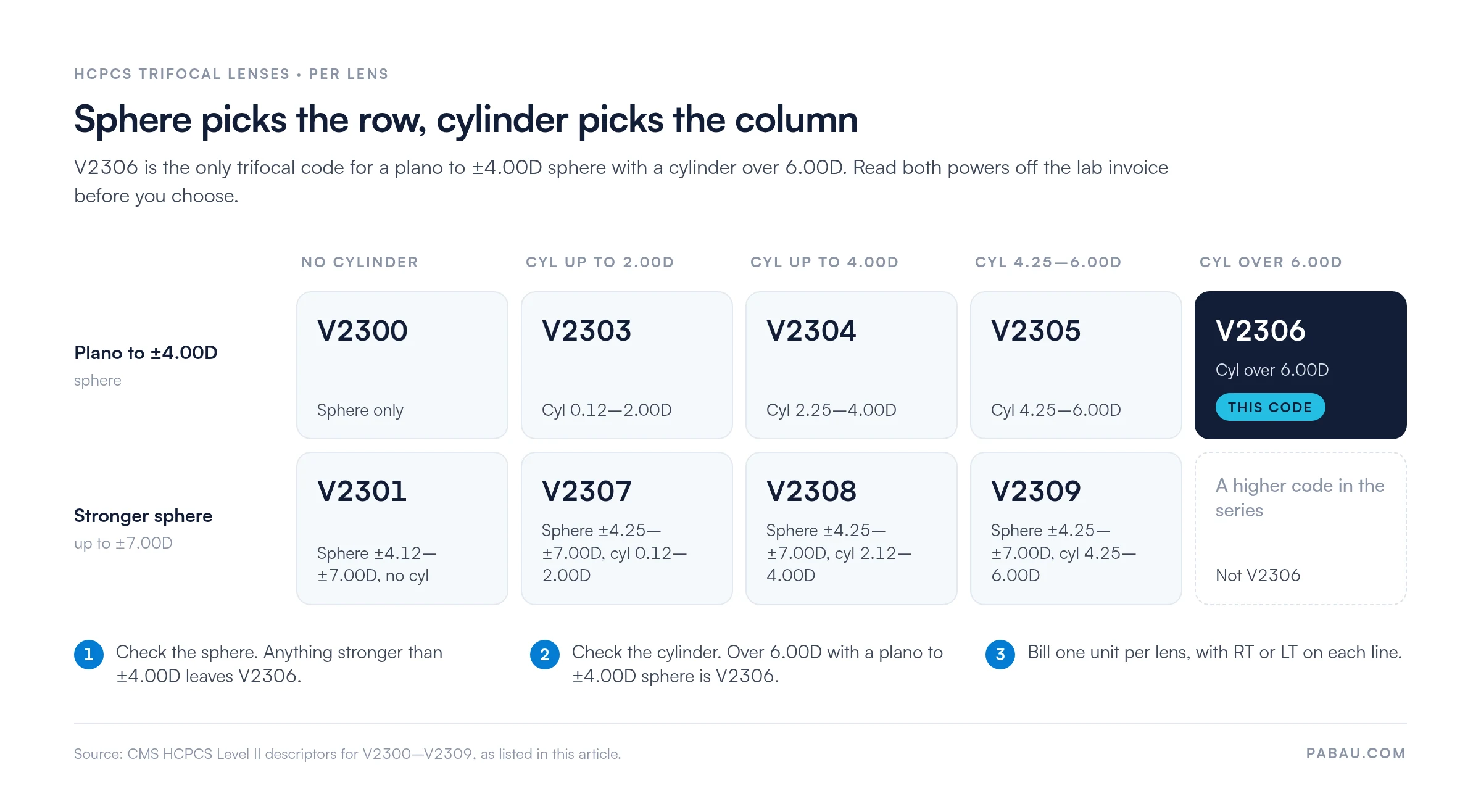
V2306 is the last of four spherocylinder codes that share a plano to plus or minus 4.00 diopter sphere. Within that group, the cylinder band decides the code, and V2306 takes every cylinder over 6.00 diopters. The band just below it, 4.25 to 6.00 diopters, is V2305.
Lenses with no cylinder use the sphere-only codes, and stronger spheres start at V2307. Billing an adjacent code when the cylinder falls in V2306’s band, or the other way round, is a code-selection error that draws denials. The AAPC HCPCS code lookup shows the current descriptor text for each code.
Common error: Coders read the sphere power and stop there. A lens documented at minus 3.00 diopters sphere with a 6.50 diopter cylinder belongs to V2306, because the cylinder sits over 6.00 diopters. Always read both values on the lab invoice before selecting the code. The grid below maps each sphere and cylinder band in the series to its code.
Medicare Part B does not routinely cover spectacle lenses, including trifocal lenses billed under HCPCS Code V2306. Routine vision care falls outside the Part B benefit structure under Section 1862(a)(7) of the Social Security Act. Submitting V2306 to Medicare for a standard spectacle dispensing will result in a non-covered benefit denial.
A narrow exception applies when the lens qualifies as a prosthetic device. Under the applicable National Coverage Determination, Medicare Part B covers one pair of eyeglasses or contact lenses after cataract surgery with an intraocular lens implant.
Trifocal lenses dispensed in this context can be billed under V2306 when the sphere and cylinder fall within its ranges. A valid post-surgical prescription and proof of delivery must also be on file.
The claim routes to the patient’s designated Medicare Administrative Contractor (MAC). Different MACs publish Local Coverage Determinations (LCDs) that may impose additional documentation requirements beyond the national standard. Reviewing the applicable LCD before submission reduces the risk of a local policy denial.
Accurate claim preparation for V2306 means confirming five elements before the claim leaves the practice. Missing any one of them is a correctable error that delays payment.
Modifiers RT and LT are required on every V2306 claim line to identify which eye the lens was dispensed for. Submitting without a modifier triggers an edit that most MACs and commercial payers will reject as incomplete claim data.
Some commercial vision payers impose additional modifier requirements beyond RT/LT. Always check the payer’s current coverage policy before submission. When in doubt, contact the payer’s provider relations line to confirm modifier requirements for ophthalmic supply codes before submitting a batch.
Documentation for V2306 serves two purposes. It shows that the dispensed lens matches the billed code. It also supports medical necessity when the payer requires it, notably in the Medicare post-cataract exception. Auditors reviewing HCPCS Code V2306 claims look for the following records.
Filing these records at the time of dispensing is part of a wider medical billing compliance routine. It saves a scramble when a MAC audit letter arrives.
Before submitting V2306 claims in bulk, run a pre-submission audit on a sample of five to ten records. Confirm that every line item has the sphere and cylinder powers documented, the matching RT or LT modifier applied, and a proof-of-delivery signature on file. Catching a systematic error before submission prevents a batch denial that requires individual appeal.
Most V2306 denials fall into a small number of repeatable patterns. Identifying the denial reason code on the Explanation of Benefits (EOB) or Electronic Remittance Advice (ERA) points directly to the corrective action. Practices with good denial management in healthcare fix each pattern in the workflow, so the same denial stops coming back.
Coverage for HCPCS Code V2306 varies by payer class. Knowing which class applies before you submit avoids denials that no appeal can overturn.
MAC jurisdiction differences within Medicare add another layer of variation. Each MAC publishes its own LCDs, and coverage requirements, documentation standards, and audit focus areas can differ between contractors covering adjacent states.
Use the Medicare Informatics HCPCS tables to cross-reference code coverage guidance by jurisdiction before submitting batches of V2306 claims. The PGM Billing HCPCS lookup tool provides a free search against current CMS data to confirm active code status and descriptor text annually.
Building a sustainable revenue cycle around HCPCS Code V2306 means knowing which payer class each patient falls under before the lenses are ordered. For revenue cycle management teams with mixed payer populations, that eligibility check at intake matters most. It prevents the costliest denials, where the payer never covered the service at all.
Without a connected system, a V2306 claim draws on three separate records: the signed prescription, the lab invoice and a billing portal. Each handoff is a chance to key the wrong cylinder band or drop a modifier.
Pabau keeps those records on the patient file. Its built-in claims software for optometrists works from that same record. US practices send CMS-1500 claims through the Claim.MD clearinghouse, run eligibility checks and post ERA remittances back to the account.
Your team sees a routine Medicare dispense at the eligibility check, before the lenses are ordered. And because the prescription and the claim sit on the same record, the billed band is easy to match against the lens your patient received.

Pabau keeps the prescription, the dispensing record and the CMS-1500 claim on one patient file. Your team checks eligibility first and spends less time fixing lens denials.

V2306 rewards a two-step habit. Read the sphere, then the cylinder, and only then pick the code. A plano to plus or minus 4.00 diopter sphere with a cylinder over 6.00 diopters is V2306, billed once per lens with RT or LT.
The costlier mistake happens before coding starts. Check the payer class before the lenses are ordered, because Medicare won’t pay V2306 for a routine dispense. Keep the prescription, lab invoice and proof of delivery together, and the claim holds up in an audit.
Book a demo to see how Pabau keeps lens prescriptions, eligibility checks and V2306 claims on one patient record.

Need a broader grounding in medical billing fundamentals? What is medical billing explains how supply codes like V2306 fit into the full claim lifecycle from encounter to payment posting.
Seeing a pattern of unresolved denials across your V code claims? Denial management in healthcare covers the workflow changes that convert recurring denial patterns into systematic fixes rather than individual appeals.
Enrolling a new optometrist to dispense lenses? Physician credentialing checklist walks through the payer enrollment steps that keep supply claims from rejecting at the front end.
HCPCS Code V2306 is a Level II supply code for one spherocylinder trifocal lens. The sphere runs from plano to plus or minus 4.00 diopters, and the cylinder is over 6.00 diopters. It is billed one unit per lens dispensed. It sits in the V2300-V2399 trifocal lens range maintained by CMS.
V2306 covers a sphere of plano to plus or minus 4.00 diopters combined with a cylinder over 6.00 diopters. Both values must fit. The same sphere with a 4.25 to 6.00 diopter cylinder belongs to V2305. A sphere stronger than plus or minus 4.00 diopters moves the lens out of V2306. Always confirm both values on the lab invoice before selecting the code.
V2306 is billed per lens, not per pair. A bilateral order generates two separate claim line items. One carries modifier RT for the right eye, and the other carries modifier LT for the left eye. Billing both lenses as a single unit is a duplicate-service error that triggers denials.
Medicare Part B does not cover V2306 for routine spectacle dispensing. A narrow coverage exception applies when the lens is dispensed as a prosthetic device following cataract surgery in which an intraocular lens was inserted. Outside that exception, Medicare will deny V2306 as a non-covered benefit under Section 1862(a)(7) of the Social Security Act.
Modifier RT (right eye) and modifier LT (left eye) are required on every V2306 claim line. Each lens gets its own line item with its own modifier. Submitting a V2306 line without a laterality modifier results in a claim rejection for incomplete data at most MACs and commercial payers.
The most common V2306 denial is a wrong cylinder band or sphere range. Either the cylinder is 6.00 diopters or less, or the sphere is stronger than plus or minus 4.00 diopters. Other frequent causes are a missing RT or LT modifier and a bilateral pair billed as one unit. Medicare claims without a qualifying post-cataract indication, and claims routed to the wrong MAC, are denied too.
V2305 and V2306 share the same sphere range, plano to plus or minus 4.00 diopters. V2305 covers a cylinder of 4.25 to 6.00 diopters, while V2306 covers any cylinder over 6.00 diopters. Both are per-lens codes requiring RT/LT modifiers. Billing V2305 for a lens with a 6.50 diopter cylinder is a code-selection error that draws denials.