

CCSD code G5100: Bypass of duodenum billing guide
CCSD code G5100 bills a bypass that leaves the duodenum in place CCSD code G5100...

Last Updated: Oct 16, 2026
S0176 is the HCPCS Level II code for hydroxyurea, oral, 500 mg. Some commercial payers and Medicaid programs use it to bill take-home hydroxyurea as a drug supply. It counts in 500 mg units, so a 1,000 mg dose bills as two units, and it carries no administration service.
The payer decides most claims. Medicare fee-for-service does not pay S0176, and most plans bill hydroxyurea on a pharmacy claim by National Drug Code (NDC) instead. Pick the wrong route and the claim comes back denied, so confirm the benefit before you code.
Let Pabau's smart automation suggest the right codes, reduce claim denials, and keep your practice compliant—effortlessly.
Automate repetitive tasks and focus on what matters most—your patients.
Reduce coding errors and ensure compliance with the latest regulations.
Clean claims, fewer denials, and faster reimbursements.
Powerful insights and reporting to help your practice thrive.
HIPAA compliant SOC 2 certified GDPR-compliant Trusted by 4,000+ clinics worldwide

HCPCS code S0176 describes oral hydroxyurea, 500 mg, as a drug supply with no injection or administration service attached.
One unit equals 500 mg, so a 1,000 mg dose bills as two units, whatever the capsule count.
Medicare fee-for-service does not pay S0176, and Part D or retail pharmacy claims bill hydroxyurea by NDC instead.
Some commercial payers and Medicaid programs accept S0176 on medical claims, but acceptance and prior authorization rules vary by plan.
Most S0176 denials trace back to the wrong benefit, miscounted units, or an NDC that doesn’t match the strength dispensed.
HCPCS code S0176 is a temporary national Level II code for hydroxyurea, oral, 500 mg. It sits in the S-series, which CMS maintains for commercial payers and some Medicaid programs rather than for Medicare. The code took effect on January 1, 2002, and is still active.
Hydroxyurea is an oral medicine that patients take at home as capsules or tablets. Its FDA-approved uses include sickle cell anemia and resistant chronic myeloid leukemia.
It is also approved for certain head and neck squamous cell cancers, given alongside chemoradiation. S0176 lets a plan price that drug on a medical claim when it wants the supply billed there.
S0176 pays for the hydroxyurea itself. Because the patient swallows the medicine at home, there is no injection, infusion, or administration step built into the code. So you don’t pair it with a J-code, and you don’t add an injection administration code to the line.
That keeps the scope narrow and predictable. Here’s how it breaks down on a claim:
Supportive care drugs sit on their own claim lines too. An oral antiemetic such as prochlorperazine bills under S0183, with its own 5 mg unit, rather than under the hydroxyurea supply.
The neighboring codes follow the same pattern. S0177 covers oral levamisole, and S0178 covers oral lomustine, each with its own unit size. If the drug on the prescription isn’t hydroxyurea, S0176 is the wrong code.
Units are where most S0176 claims go wrong. One unit equals 500 mg of hydroxyurea, whatever form the patient takes home. Work out the total milligrams dispensed first, then divide by 500.
Hydroxyurea also comes in strengths that don’t divide neatly by 500, such as 200 mg, 300 mg, and 400 mg capsules. When the total leaves a part unit, follow the plan’s rounding rule. Some payers accept whole units only, so check the provider manual before you round.
Next, make the units agree with the NDC quantity. A claim showing 60 units beside 30 capsules of 500 mg will draw questions, because those capsules only make 30 units.
Before you code anything, decide which benefit pays. Hydroxyurea is a self-administered oral drug, so most plans cover it under the pharmacy benefit. The pharmacy bills the plan with the NDC, and no HCPCS code appears on that claim.
Medicare works the same way. Part D plans and retail pharmacy claims use the NDC, not S0176. On the medical side, S0176 carries coverage indicator I, so Medicare fee-for-service won’t pay it and typically rejects the line.
S0176 belongs on a medical claim only when a plan tells you to use it. Some commercial payers and Medicaid programs do, often when the practice dispenses the drug itself. Acceptance, prior authorization, and covered diagnoses are plan-specific, so verify them for each plan. The decision path below puts these rules in the order you check them.
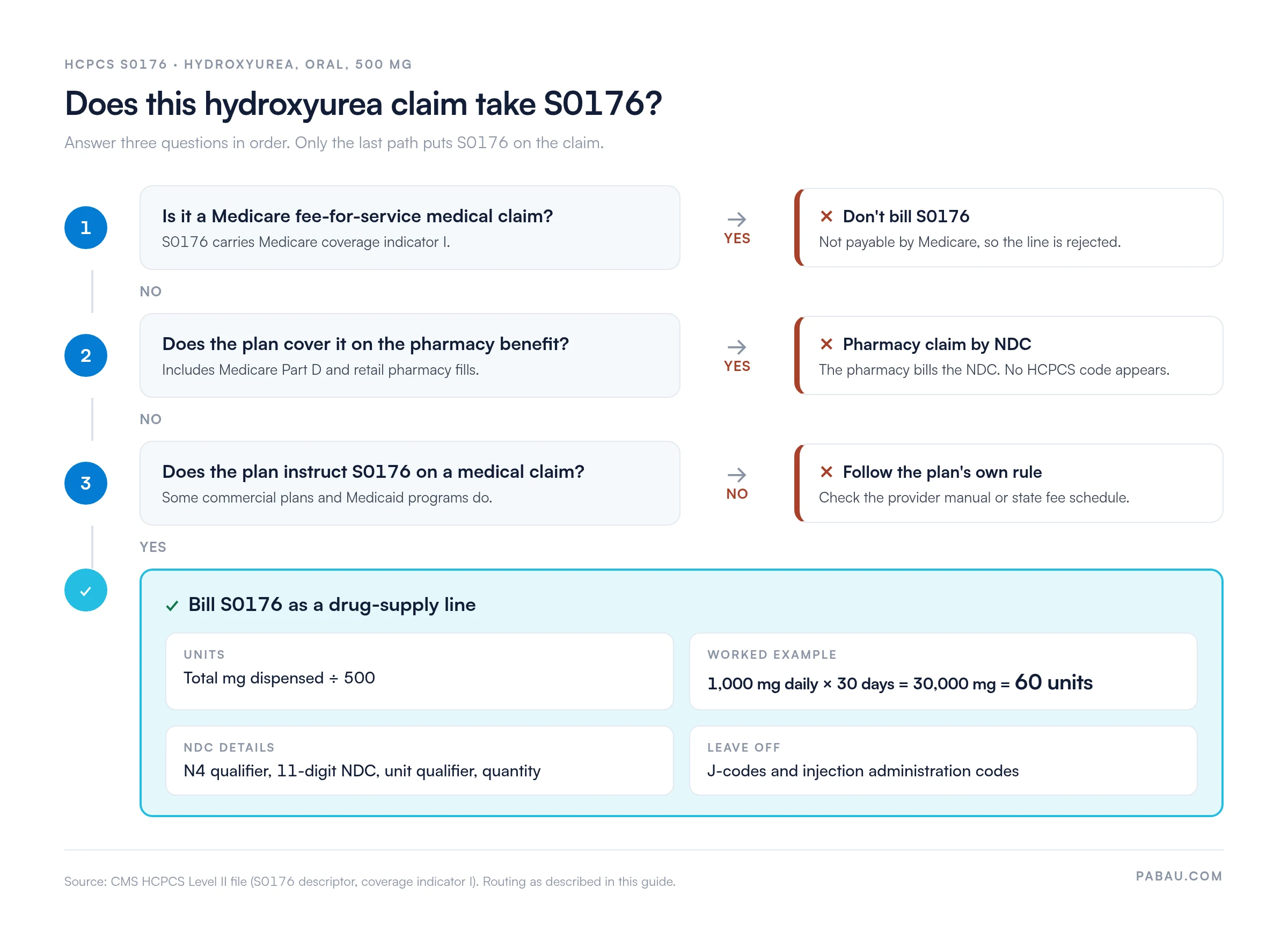
The quickest way to settle the benefit question is insurance eligibility verification before the drug is dispensed. It also tells you whether the plan wants prior authorization.
With the benefit settled, the claim itself follows a fixed sequence. Each step feeds a field the payer checks later.
On a paper CMS-1500 form, those NDC details go in the shaded area of item 24A. Electronic claims carry them in the drug identification loop of the 837P file. If the details are missing, many plans deny the line before a person reviews it.
A two-minute review catches most problems before the payer does. Check each point against the claim and the dispensing record:
These checks map directly to the documentation side of medical billing compliance. Every field on the claim should trace back to the prescription or dispensing record.
Even careful billers slip on the same few points with this code. Watch for these:
Keep a short payer grid for hydroxyurea. For each plan you bill, record whether it pays through the pharmacy or medical benefit, whether it accepts S0176, and how it rounds part units. Review the grid when plan years renew.
When a denial does land, start with the reason code on the remittance. The guide to denial codes in medical billing explains how to read each one. A steady denial management routine then turns repeat errors into fixes upstream.
Payers check the diagnosis against their covered-indication list for hydroxyurea. Code the condition the prescriber documented, at the highest specificity ICD-10-CM allows.
For sickle cell anemia, that means a code from the D57 sickle-cell disorders category. For chronic myeloid leukemia, it usually means a code from C92.1, BCR/ABL-positive. Head and neck cancers code to the documented primary site.
Off-label use is where claims get harder. Some plans allow it with prior authorization and supporting notes, while others exclude it. Check the plan’s drug policy before you dispense, not after the claim denies.
Because Medicare doesn’t pay S0176, CMS publishes no national payment amount for it. The CMS HCPCS overview covers the code set, not commercial rates. Each commercial contract or state Medicaid fee schedule sets its own rate per unit.
To find your rate, check the fee schedule addendum in your payer contract. Then compare remittances across plans. A per-unit payment far below your acquisition cost is worth raising at contract renewal.
Most S0176 errors start when claim details get retyped from the prescription record. Pabau, the practice management platform we build, pre-fills the claim form from the patient record. The HCPCS code and diagnosis come straight from what the clinician documented.
Its claims management software also checks that required claim fields are complete before you send. US practices submit through Claim.MD, with eligibility checks and remittance posting in the same place. You still decide the benefit, units, and NDC, but you enter them once.

Pabau pre-fills claims from the patient record and checks required fields before submission, so S0176 claims leave your practice complete.

S0176 has one narrow job, pricing oral hydroxyurea in 500 mg units for the plans that ask for it. Bill it as a drug-supply line, never as an injection service, and the usual denials mostly disappear.
The decision that matters most comes before coding. Confirm the benefit first. If the plan pays hydroxyurea through the pharmacy, leave S0176 off the claim entirely. If it doesn’t, count units from total milligrams and keep the NDC in step with them.
Book a demo to see how Pabau pre-fills drug-supply claims from the patient record and checks required fields before they reach the payer.

Want every claim to pass on the first submission? What is a clean claim? sets out the fields and checks that let a payer process a claim without follow-up.
Does your plan want approval before you dispense? The prior authorization process walks through each step from request to approval number.
Need to read the payment that comes back? Electronic remittance advice explains how to read an 835 and match each line to its claim.
Billing another oral cancer drug? HCPCS code J8510 covers oral busulfan, with its own unit size and coverage rules.
Hydroxyurea is an antineoplastic drug, so payers may group it with oral oncology drugs, even when it treats sickle cell anemia. That grouping can bring specialty pharmacy rules or prior authorization. Check how the plan classifies it before you bill.
Hydroxyurea is sold as Hydrea, Droxia, and Siklos, and as generics. Hydrea comes in 500 mg capsules, while Droxia comes in 200, 300, and 400 mg capsules. Siklos comes in 100 mg and 1,000 mg tablets. S0176 counts every oral form in 500 mg units.
Medicaid programs typically cover hydroxyurea through the pharmacy benefit, billed by NDC. A few list S0176 on a medical fee schedule instead. Your state’s provider manual says which route applies.
Add a leading zero to the short segment so the code reads in a 5-4-2 format. For example, 12345-678-90 becomes 12345-0678-90. Drop the hyphens on the claim itself.
Yes. S0176 has been active since January 1, 2002, and remains a valid Level II code. S-codes can change in any quarterly HCPCS update, so check the current file each year.



