HCPCS code J3471: Hyaluronidase ovine injection billing guide
HCPCS code J3471: Descriptor, code type, and quick-reference data HCPCS code J34...

Last Updated: Oct 14, 2026
HCPCS code R0076 describes transporting a portable EKG machine to a facility or location, reported per patient. It covers the trip to a nursing home or similar site, not the tracing or its interpretation.
Here's the catch for billing teams. Medicare Part B never pays R0076 separately. CMS has bundled the transport cost into the EKG payment since January 1, 1997. Put it on a Medicare claim and the line denies as bundled. Commercial plans set their own rules, so every portable EKG claim starts with the same question. Who is the payer?
Let Pabau's smart automation suggest the right codes, reduce claim denials, and keep your practice compliant—effortlessly.
Automate repetitive tasks and focus on what matters most—your patients.
Reduce coding errors and ensure compliance with the latest regulations.
Clean claims, fewer denials, and faster reimbursements.
Powerful insights and reporting to help your practice thrive.
HIPAA compliant SOC 2 certified GDPR-compliant Trusted by 4,000+ clinics worldwide

HCPCS code R0076 covers moving a portable EKG machine to a facility, per patient, not the tracing or its interpretation.
Medicare Part B never pays R0076 separately. CMS has bundled it into the EKG payment since January 1, 1997.
Its fee schedule status is B, so no modifier, ABN, or local policy turns it into a paid line.
Commercial and Medicaid payers set their own rules. Where one recognizes R0076, bill one unit per patient.
Pabau, the practice management platform we build, pre-fills claims from the patient record and checks required fields before sending.
HCPCS code R0076 is the Level II code for transporting a portable EKG machine to a facility or location, reported per patient. It lives in the R section of the Healthcare Common Procedure Coding System maintained by CMS. That section holds only three codes: R0070, R0075, and R0076.
R0070 and R0075 cover portable x-ray equipment and personnel. R0076 is the only one for EKG equipment, and it describes logistics. Getting the machine to the patient is the service, while the clinical test goes on other lines.
In practice, its payment status matters more than its wording. Medicare hasn’t paid R0076 separately since January 1, 1997, because the transport cost sits inside the EKG payment. That single rule shapes each decision below, starting with the descriptor itself.
The official CMS descriptor for R0076 reads: Transportation of portable EKG to facility or location, per patient. Those last two words set the unit of service. A trip that serves four residents counts as four units wherever a payer pays it.
Here are the reference details to check before R0076 goes near a claim.
R0076 billing errors usually start with reading the code too broadly. So it helps to separate what the code describes from what belongs on other lines.
Here’s how that plays out. A portable EKG service visits a skilled nursing facility and records tracings on three residents. On a Medicare Part B claim, the service reports only the EKG codes, such as CPT 93005 for each tracing. The interpreting physician then reports CPT 93010 for each report.
R0076 stays off that Medicare claim, because its value is already inside those payments. For a commercial plan whose written policy recognizes R0076, the same visit would carry three units, one per resident.
R0076 travels alongside the EKG procedure codes, which is exactly why it gets swapped for them. The table shows what each code covers and how Medicare treats it.
R0076 is a logistics code. Billing it in place of 93005 is a coding error, since the tracing is the payable service. A supplier also can’t swap in R0070 or R0075 for an EKG trip. Noridian’s portable x-ray transportation guidance says those codes must not be billed for portable EKG services.
Medicare Part B never pays HCPCS code R0076 separately. The Medicare Claims Processing Manual, Chapter 13, §90.3 sets the rule. Since January 1, 1997, Medicare Administrative Contractors (MACs) have been barred from paying it. The rule covers portable x-ray suppliers and any other entity that transports EKG equipment.
On the Physician Fee Schedule, the code carries status indicator B, meaning always bundled. Payment for the transport is included in the covered EKG service, whether that’s CPT 93000, 93005, or 93010. The CMS Physician Fee Schedule lookup shows no separate payment amount for R0076.
The rule is national, too. It holds across Medicare billing in every MAC jurisdiction, locality, and year, and no local coverage determination changes it.
Remove R0076 from your Original Medicare charge templates altogether. Your portable EKG team then reports only the EKG service codes, and a bundled line never reaches a Medicare claim to be denied.
Outside Original Medicare, the answer changes from payer to payer. Some commercial plans follow Medicare and bundle the transport. Others pay it under set conditions, so a written policy that recognizes R0076 is the only basis for billing it.
Four questions settle most commercial R0076 claims before the transport date.
Does the plan need prior authorization? Some commercial payers require it before the service date, and retroactive approval is rarely granted. Check before you schedule the transport.
Which destinations qualify? Many payers limit R0076 to skilled nursing facilities (SNFs) or long-term care facilities. A trip to a private home or assisted living site may deny under those definitions.
Which place of service (POS) code goes on the claim? Use the POS code for the destination facility, not the billing provider’s address. A mismatched POS code is a common trigger for edits on these claims.
How often should you recheck? Payer policies update every year. Before each new plan year, search the payer’s provider portal for R0076 or portable EKG transportation, then reread the bulletin.
Where a non-Medicare payer recognizes R0076, consistent records are the fastest way to prevent denials. Sound medical billing compliance builds this checklist into every portable EKG visit. That beats rebuilding records after a claim is questioned.
Before you submit, confirm the record and the claim show each of these:
The transport log does the heavy lifting. Signed at the facility on the date of service, it records arrival time, patients served, and the equipment serial number. The same log also supports the EKG codes on Medicare claims, even though R0076 isn’t billed there.
Modifiers report circumstances that affect coverage or financial liability. R0076’s problem is neither, because national payment policy bundles it. The table shows why each common Medicare liability modifier falls short.
Commercial claims work differently. Follow the modifier rules in each payer’s written R0076 policy. Don’t carry Medicare liability modifiers onto those claims unless the payer asks.
The biggest cause is billing R0076 to Medicare at all. The rest are process slips, and a structured denial management process catches them before they repeat across a billing cycle.
A clean portable EKG claim starts with the payer check. That one answer decides whether R0076 belongs on the claim at all. The diagram maps both paths, and the steps below walk through them in order.
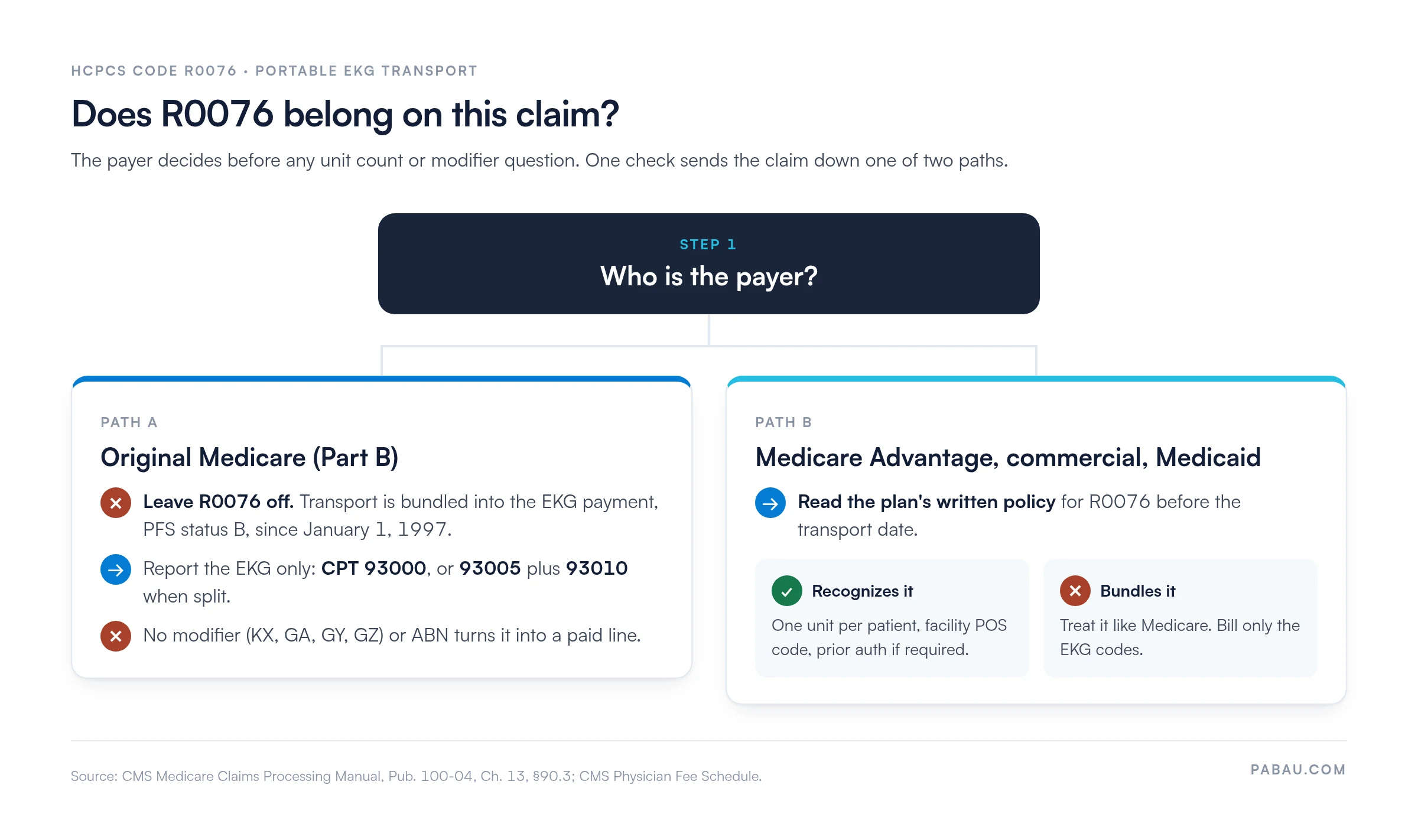
Portable EKG billing splits by payer, and making that call by hand on every claim is where errors creep in. Medicare bundles R0076, while a commercial plan may pay it.
Pabau’s claims tools for billing teams pre-fill each claim from the patient record. The codes attached to the EKG service land on the charge lines automatically. A built-in CPT and HCPCS lookup lets your team confirm a descriptor before it goes out. The claim won’t send until required fields, such as member numbers and authorization codes, are complete.
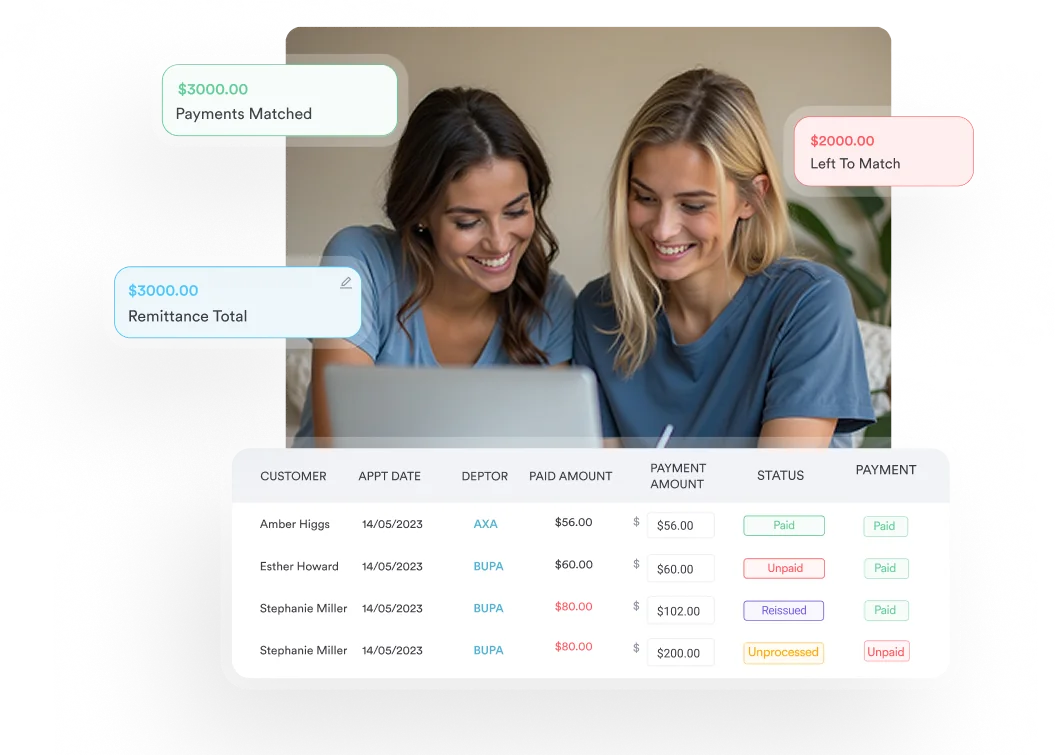
On US claims, Pabau submits through Claim.MD, with real-time eligibility checks, claim-status tracking, and remittance posting. A bundling denial shows up the day it posts. Your team can then fix the charge template before the next batch.

Pabau pre-fills claims from the patient record and checks required fields before submission, so your portable EKG billing goes out complete.

Medicare does pay for portable EKG transport, just never as R0076. It pays inside the EKG service, and it has since January 1, 1997. That makes the payer check your first coding decision, ahead of any unit count or documentation question.
So settle it once. Strip R0076 from your Original Medicare charge templates, and handle commercial payers one written policy at a time. Your denial queue shrinks, and R0076 only appears on claims where it can be paid.
Book a demo to see how Pabau keeps portable EKG claims complete, from the patient record to submission.

Billing an x-ray trip on the same visit? HCPCS code R0075 explains the portable x-ray transport code for trips that serve more than one patient.
Want the full picture on Part B claims? Medicare billing walks through how claims, bundling, and contractor rules fit together.
Need a framework for handling denied claims systematically? Denial codes in medical billing covers the CARC and RARC reason codes most likely to appear on R0076 rejections.
Unsure how HCPCS codes fit into the broader billing ecosystem? What is medical billing explains how HCPCS Level II codes, claim forms, and payer edits work together in practice.
Looking to tighten your overall revenue cycle? What is revenue cycle management outlines the end-to-end workflow from patient eligibility through payment posting.
No. CPT has no code for moving EKG equipment. R0076 is the only code for it, and it sits in HCPCS Level II rather than CPT. The EKG itself is reported with CPT 93000, or with 93005 and 93010 when the tracing and the read are split.
Status B means Medicare treats the code as bundled. Its payment is always included in the payment for other services, which here is the EKG. Even if relative value units appear next to the code, Medicare doesn’t use them to pay it.
No. Medicare considers the transport already paid through the EKG service, so there’s no separate charge to pass on. An Advance Beneficiary Notice doesn’t apply either, because R0076 isn’t denied as not reasonable and necessary.
The descriptor names only the EKG equipment. That differs from R0070 and R0075, which cover portable x-ray equipment and personnel. Under Original Medicare, neither the trip nor the technician’s time is paid separately. Commercial payers define what their R0076 payment includes.
Not to Original Medicare, wherever the EKG happens. Commercial plans that pay R0076 often limit it to SNFs or long-term care facilities. A home visit may fall outside that definition, so check how the plan defines a facility or location first.