

CCSD code G5100: Bypass of duodenum billing guide
CCSD code G5100 bills a bypass that leaves the duodenum in place CCSD code G5100...

Last Updated: Oct 16, 2026
R0075 is the HCPCS Level II code for transporting portable x-ray equipment and personnel when more than one patient is seen. It covers trips to a home, nursing home or other facility, and it is billed per trip rather than per patient.
A Medicare-certified portable x-ray supplier bills R0075 when two or more patients are x-rayed at the same address in one trip. Each claim carries a patient-count modifier, from UN for two patients to US for six or more. Medicare divides one transport payment by that count. When only one patient is seen, the correct code is R0070.
Let Pabau's smart automation suggest the right codes, reduce claim denials, and keep your practice compliant—effortlessly.
Automate repetitive tasks and focus on what matters most—your patients.
Reduce coding errors and ensure compliance with the latest regulations.
Clean claims, fewer denials, and faster reimbursements.
Powerful insights and reporting to help your practice thrive.
HIPAA compliant SOC 2 certified GDPR-compliant Trusted by 4,000+ clinics worldwide

R0075 covers transport of portable x-ray equipment to a location where two or more patients are served in one trip. R0070 is the single-patient code.
Each R0075 claim carries one patient-count modifier (UN, UP, UQ, UR or US), and Medicare divides a single transport payment by that count.
Only Medicare-certified portable x-ray suppliers may bill R0075. Physician offices and hospitals cannot bill this code separately.
A trip log listing every patient name, date of service and facility address is the critical audit document for any R0075 claim.
Practice management software like Pabau keeps orders, patient records and claim status together, so each R0075 claim can be tracked to payment.
HCPCS code R0075 is a Level II transportation code in the R-series that the Centers for Medicare and Medicaid Services (CMS) maintains. The table below gives its official descriptor word for word. The code pays for the supplier’s cost of moving the x-ray machine to a site where staff examine several patients in one visit.
R0075 is one of three codes in the HCPCS R-series. R0070 covers single-patient x-ray trips, and R0075 covers multi-patient trips. Meanwhile, R0076 covers transport of portable EKG equipment, which Medicare no longer pays separately.
Take a supplier that images six residents at one skilled nursing facility (SNF) in a single visit. It reports R0075 with modifier US on each resident’s claim, and Medicare splits one transport payment across them. Billing six separate R0070 trips instead is a common error on these codes.
R0070 covers transport to a location serving a single patient. R0075 covers transport to a location that serves two or more patients in the same trip. What decides it is the patient count at one facility address on that date. However, the number of stops in a supplier’s workday does not matter.
A supplier that visits three facilities in one day and images one resident at each files three separate R0070 claims, not one R0075. R0075 applies only when a single location serves multiple patients in a single trip. The moment staff image a second patient at the same SNF during that visit, the trip qualifies for R0075 instead of R0070.
Only Medicare-certified portable x-ray suppliers may bill HCPCS code R0075. CMS Conditions of Participation require suppliers to hold a supplier number specifically for portable x-ray services before submitting any R-series transportation claim. Physician offices that happen to own x-ray equipment cannot bill R0075 on their own behalf. Likewise, hospitals providing portable x-ray services to inpatients do not bill this code separately. The facility rate bundles the transportation cost instead.
Supplier certification is a binary gate. If the supplier number on the claim does not belong to a Medicare-enrolled portable x-ray entity, the MAC denies the claim outright. For this reason, confirm the supplier’s enrollment is current before each trip, alongside each patient’s eligibility.
R0075 is payable when a supplier transports portable x-ray equipment to non-hospital settings where multiple patients reside or receive care. The most common qualifying locations are skilled nursing facilities, nursing facilities, assisted living facilities, and group homes. Private residences qualify if the supplier images two or more patients at the same address in a single trip, which is uncommon but not impossible.
Hospital settings do not qualify. This includes hospital inpatient units, hospital-based SNF swing beds where the hospital bills SNF care under its own provider number, and outpatient hospital departments. The place-of-service (POS) code entered on the CMS-1500 must match where the supplier took the x-rays.
Each Medicare Administrative Contractor (MAC) sets its own payment rate for R0075. Standard relative value units don’t produce a national Medicare Physician Fee Schedule (MPFS) amount for this code. Instead, MACs base the rate on cost data from portable x-ray suppliers and review it at least every five years. In the years between reviews, they update it using an index such as the Medicare Economic Index.
Because each MAC prices the code locally, a supplier in rural Nebraska receives a different amount than one in metropolitan Chicago. MACs must publish preliminary rates at least 90 days before a new calendar year and final rates before they take effect. So pull the current R0075 rate from your MAC’s fee schedule each year. The patient-count modifier then divides that single payment, so each claim receives only its share.
Check your MAC’s locality-adjusted rate for R0075 every January by pulling a fee schedule lookup for your specific jurisdiction. National averages published by commercial coding tools may not match your actual payment amount, and submitting claims based on incorrect rate expectations delays reconciliation.
The trip log is the single most important document for any R0075 claim. It must list every patient served at the location during that trip. Each entry needs the full name, Medicare beneficiary identifier, date of service, x-ray procedure performed and service address. Without a complete trip log, an auditor cannot confirm that more than one patient received care, and the claim fails the basic definition of R0075.
In addition, physician orders must accompany the trip log. Each patient imaged requires a signed order from the treating or ordering physician that specifies the clinical reason for the portable x-ray. The supplier must also retain documentation of its own Medicare certification. Keeping these records for seven years, the usual Medicare standard, protects against retroactive audit findings. Trip logs hold protected health information, so store them under the same HIPAA safeguards as the rest of the patient record.
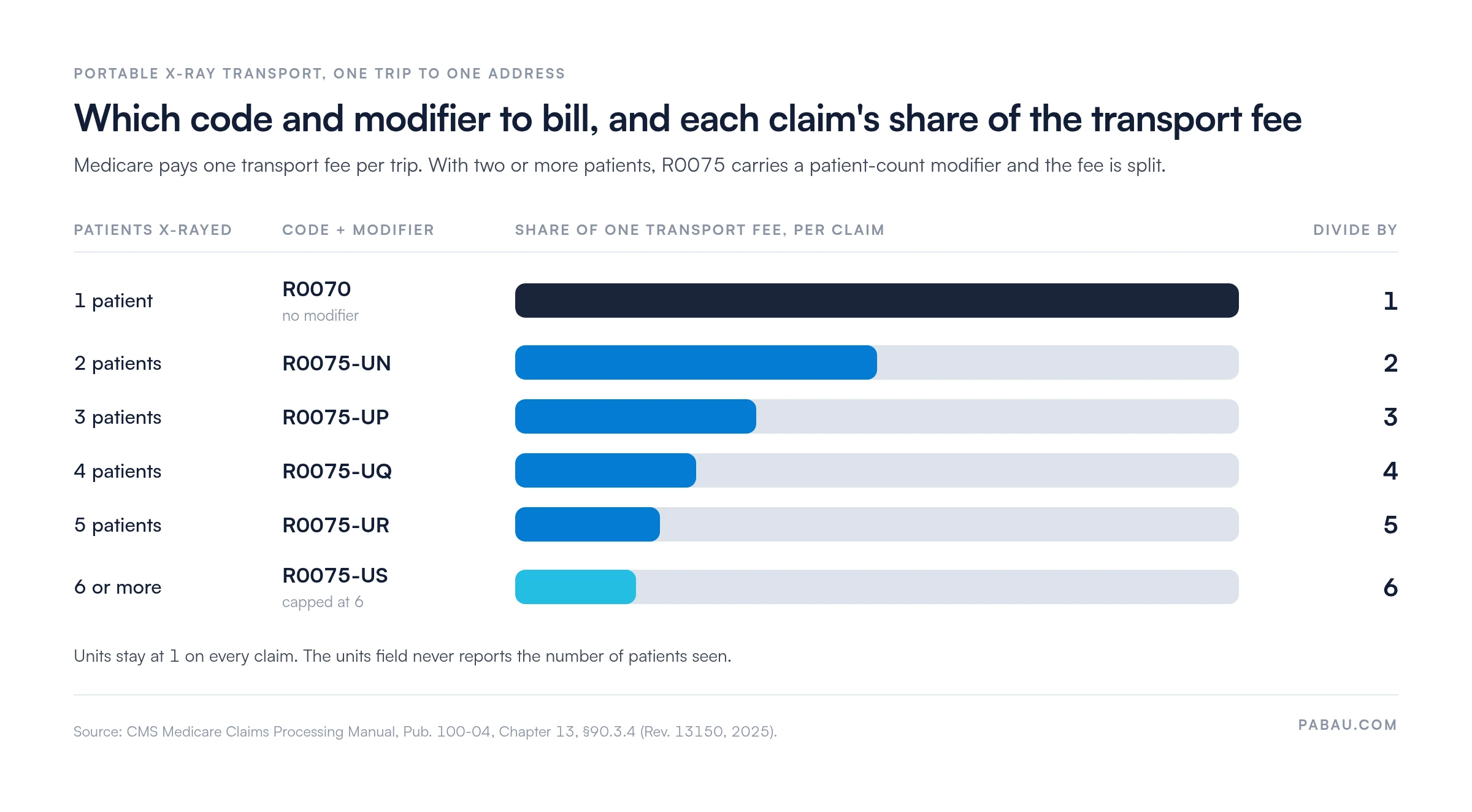
Every R0075 claim needs a modifier that tells Medicare how many patients the supplier x-rayed at the location on that trip. CMS defines them in the Medicare Claims Processing Manual, Chapter 13, Section 90.3.4. Report only one of the five with R0075.
The chart below shows how the patient count sets both the code and each claim’s share of the transport fee. Report the units field as 1 on each claim. In fact, CMS states that billers must never use the units field to count the patients served on a trip.
Two payment-liability modifiers can also apply in specific situations.
GA modifier (Waiver of liability statement issued, as required by payer policy): attach GA when the supplier has issued an Advance Beneficiary Notice (ABN). Suppliers issue one when coverage of the transport is uncertain. This modifier protects the supplier from liability if Medicare denies and shifts financial responsibility to the patient.
GY modifier (item or service statutorily excluded, or not a Medicare benefit) goes on a claim known to be non-covered. Suppliers typically file one for payer records, or when a commercial insurer wants a claim on file even for excluded services. Incorrect modifier use is a common denial trigger. MAC-specific rules vary, so check your MAC’s guidance or call its provider outreach line when in doubt.
Most R0075 denials fall into a small number of predictable categories, and catching them before submission costs far less than working appeals. The denial codes on the MAC’s remittance advice tell you which category a rejected claim falls into.
A pre-submission check that compares the trip log against each claim’s code and modifier catches the first three of these before the MAC sees them.
Claim submission for R0075 follows a set sequence. MACs check each of these records during post-payment review, so a skipped step becomes an audit finding.
A superbill template with a dedicated R0075 checklist reduces the chance of a missing field reaching the MAC.
Medicare Part B is the primary and most consistently reliable payer for R0075. Coverage beyond Medicare is variable and requires payer-specific verification before assuming reimbursement.
Medicaid: Each state determines its own coverage of portable x-ray transportation under Medicaid. Some state Medicaid programs, including Wisconsin’s ForwardHealth, explicitly cover portable x-ray services and recognize the HCPCS R-series codes. Others do not cover the transportation allowance separately or have no fee schedule entry for R0075. Never assume Medicaid coverage without checking the specific state’s fee schedule or submitting a prior authorization request.
Commercial payers: Most commercial insurers do not have a formal published policy for R0075. Some follow Medicare coverage logic as a default. Others, however, treat portable x-ray transportation as non-covered or bundle it into the facility or professional fee. Therefore, prior authorization is advisable before providing a portable x-ray service under a commercial plan, particularly for non-Medicare patients in SNFs or assisted living facilities. The AAPC provides a searchable HCPCS code reference that some billing teams use to verify coverage notes before submitting non-Medicare claims.
For any non-Medicare claim involving R0075, call the payer’s provider services line before the trip and document the coverage confirmation with a reference number. This takes two minutes and eliminates an unrecoverable write-off if the payer has no fee schedule entry for the code.
Many suppliers keep trip logs on paper and claims in a separate billing tool. A missing order or a wrong patient-count modifier then surfaces only when the remittance comes back. By then, the visit is weeks old and staff have to rebuild the details from memory.
Practice management software like Pabau keeps patient records, signed orders and appointments in one system. Its claims management software submits claims electronically from those records and tracks each one to payment. As a result, your team can see at a glance which R0075 claims are pending, paid or denied.
The result is fewer claims reworked after a denial, and a clear audit trail when a MAC asks for the trip log behind a payment.

Pabau keeps orders, patient records and claim submissions in one system. Portable x-ray suppliers can submit R0075 claims and follow each one through to payment.

R0075 pays one transport fee for a multi-patient trip, and Medicare splits it across the patients seen. Every billing decision on this code rests on one fact: how many patients the supplier x-rayed at that address on that trip.
Capture that count on-site, carry it into the modifier on every claim, and keep the orders and trip log where an auditor can find them. That trade of a few minutes of paperwork per visit is what keeps a MAC from clawing back R0075 payments in post-payment review. Book a demo to see how Pabau keeps R0075 orders, patient records and claim status in one place.

Need a framework for managing claim denials systematically? Denial management in healthcare walks through the full denial prevention and appeal workflow for medical billing teams.
Want to understand how clearinghouses process HCPCS claims? Medical claims clearinghouse explains how 837P transactions reach MACs and what happens when an edit fires.
Looking to tighten your pre-submission billing process? Clean claim submission covers the elements every claim must have before it leaves your practice.
Reconciling payments after each portable x-ray batch? Electronic remittance advice explains how to read CARC and RARC codes on an 835 and act on them.
Want a checklist that travels with every trip? Superbill covers the fields a claim needs before it reaches the billing team.
HCPCS code R0075 covers the transportation allowance paid to a Medicare-certified portable x-ray supplier. It applies when equipment and personnel travel to a location where a site serves two or more patients in a single trip. It does not cover the x-ray procedure itself, interpretation, or supply costs.
No. R0075 requires that a facility address serve two or more patients in a single trip. Billing R0075 for a single-patient visit is a coding error and a common denial reason. Use R0070 when a site serves only one patient.
Every R0075 claim requires a completed trip log listing each patient’s name, Medicare ID, date of service, and procedure performed. Signed physician orders for each patient and the supplier’s Medicare certification documentation must also be on file. Missing any of these elements is a leading cause of claim denial and audit findings.
Every R0075 claim needs one patient-count modifier. Use UN for two patients, UP for three, UQ for four, UR for five and US for six or more. GA applies when the supplier issued an Advance Beneficiary Notice. GY applies when the service is non-covered and the supplier files the claim for the record.



