

CCSD code G5100: Bypass of duodenum billing guide
CCSD code G5100 bills a bypass that leaves the duodenum in place CCSD code G5100...

Last Updated: Oct 16, 2026
R0070 is the HCPCS Level II code for transportation of portable x-ray equipment and personnel to home or nursing home, per trip to facility or location, one patient seen.
Three questions decide whether the claim is paid. Does the patient count call for R0070 or R0075? What documentation has to travel with the claim? And which fee schedule sets your rate?
Let Pabau's smart automation suggest the right codes, reduce claim denials, and keep your practice compliant—effortlessly.
Automate repetitive tasks and focus on what matters most—your patients.
Reduce coding errors and ensure compliance with the latest regulations.
Clean claims, fewer denials, and faster reimbursements.
Powerful insights and reporting to help your practice thrive.
HIPAA compliant SOC 2 certified GDPR-compliant Trusted by 4,000+ clinics worldwide

HCPCS code R0070 covers transportation of portable x-ray equipment and personnel to a home or nursing home. Bill it once per trip when one patient is seen.
Use R0070 when one patient is seen on the trip, and R0075 when more than one patient is seen. Confusing the two is the most common denial trigger.
R0070 requires a physician order, documented medical necessity, and evidence of homebound or qualified-facility status before Medicare Part B will cover the claim.
Practice management software like Pabau runs validation checks on the details insurers need before a claim is submitted, so errors surface earlier.
According to the Centers for Medicare and Medicaid Services (CMS), HCPCS code R0070 sits in the Diagnostic Radiology Services range of HCPCS Level II. The official descriptor is: Transportation of portable x-ray equipment and personnel to home or nursing home, per trip to facility or location, one patient seen.
Every word in that descriptor matters for billing. “Per trip” means the code is billed once per transport event, not once per x-ray performed. “One patient seen” is the patient-count qualifier that separates R0070 from its sibling code, R0075.
The R section holds one more transportation code. R0076 covers transport of a portable EKG to the patient’s facility or location. Never report R0070 for an EKG trip. Medicare has bundled that transport into the covered EKG service since 1997, so it is not paid separately.
One distinction matters more than the rest. R0070 does not fall under the physician fee schedule. CMS updates the transportation rates annually on a separate portable x-ray fee schedule. Anyone looking R0070 up in a standard physician fee schedule tool may find no result at all, or stale data.
The choice between R0070 and R0075 is a decision suppliers make on every trip. A wrong pick does more than trigger a denial. If the wrong code is billed and paid, it creates overpayment liability that a contractor can recoup later.
The patient count is set by how many patients are seen at that facility or location on that trip. It has nothing to do with how many x-rays are performed. A supplier who visits a nursing home and images three residents bills R0075 once. If only one patient is seen, R0070 applies however many x-rays that patient receives.
The decision, and the paperwork it commits you to either way, looks like this.
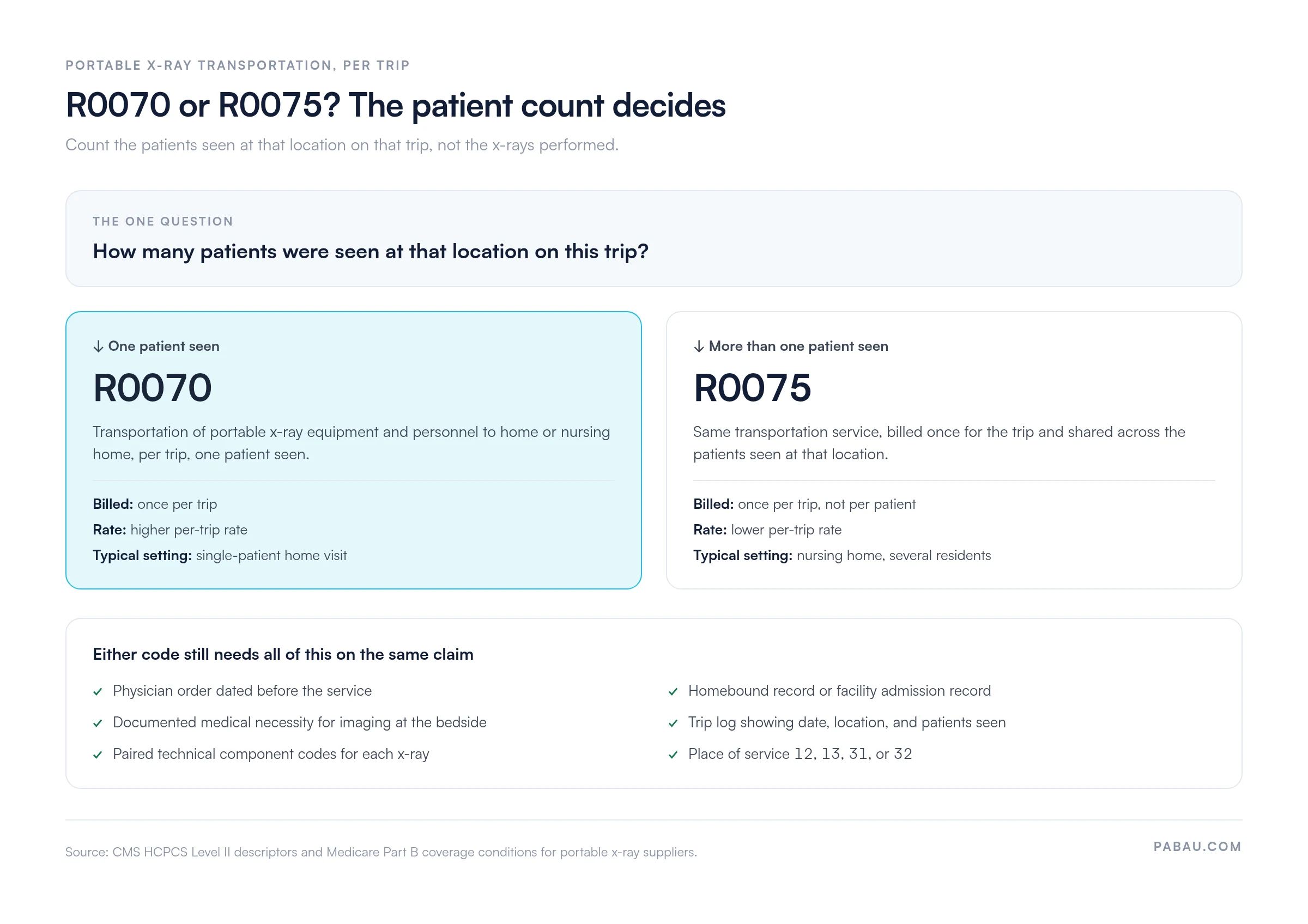
Log the patient count on every trip record as a matter of routine. That single field is what a contractor reads when it decides whether the code you billed was the right one.
Medicare Part B covers portable x-ray transportation under R0070 when specific conditions are met. Coverage is not automatic. Each element below has to be documented before the claim is submitted.
Running insurance eligibility verification before each trip surfaces coverage problems while you can still act on them. A patient who no longer meets homebound criteria makes the whole claim non-billable, and so does lapsed Part B coverage. Catching either one before the van leaves saves a wasted trip.
Only enrolled portable x-ray transportation suppliers can submit claims using R0070. That supplier type is distinct from radiology practices, hospital outpatient departments, and individual physicians. Suppliers need a valid Medicare supplier number and must meet the certification standards for portable x-ray equipment and personnel in 42 CFR Part 486. Enrollment requirements vary slightly by MAC jurisdiction, so verify your status with your own MAC before billing.
Portable x-ray transportation claims carry more rules than their single line on the form suggests. Several of those rules interact, and missing any one of them fails the claim.
Practice management software like Pabau can absorb part of that checking. Pabau’s claims management runs validation checks each time you submit a claim, confirming that the details insurers need are present before it goes out.
Audit your trip logs against billed claims monthly. If a log shows several patients seen at a nursing home on one date and R0070 was billed, that is an immediate compliance flag. R0075 should have been used. Catching it in an internal audit costs far less than a MAC review finding it first.
Missing documentation is the leading cause of post-payment denials and Recovery Audit Contractor (RAC) findings on portable x-ray claims. Gather each element below before the trip and verify it at the time of service. Keep it in the patient file for at least seven years.
Many suppliers keep these records in paper files, or in systems that do not talk to each other. Retrieval then drags when a MAC asks for them. Verifying all five elements in one place before submission is what lowers post-payment audit exposure. Check how your workflow handles them per trip, rather than waiting for a denial to reveal the answer.
R0070 reimbursement comes from the portable x-ray fee schedule, which CMS updates annually. The physician fee schedule sets payment through relative value units (RVUs). The portable x-ray fee schedule works differently, setting flat per-trip amounts that are then adjusted by geographic locality. CMS publishes the payment rules for the transportation component in Chapter 13 of the Medicare Claims Processing Manual.
The CMS physician fee schedule lookup tool is still worth using, but only for the paired technical component codes for the x-rays themselves. It will not return a rate for R0070. For the transportation rate, use the CMS portable x-ray fee schedule publication and your MAC’s version of it.
Specific 2026 dollar amounts vary by MAC jurisdiction and locality, so this article does not publish fixed rates. Rates taken from a commercial aggregator can lag CMS updates by months. Verify against the current CMS published fee schedule before using a rate in billing or in a contract negotiation.
R0070 rates are not uniform across the United States. CMS applies a locality-based geographic adjustment that reflects what it costs to operate in each area. A supplier in San Francisco is paid a different rate than one in rural Alabama for the identical code, trip, and documentation.
To find your own locality rate, open your MAC’s provider portal, go to its fee schedule tools, and filter by the portable x-ray transportation category. Most MACs publish these as downloadable files, updated each January. The AAPC listing for the R0070 to R0076 range is a useful reference point, though the official MAC publication remains the authority for billing.
Errors on portable x-ray transportation claims cluster around a handful of predictable mistakes. A pre-submission checklist prevents most of them.
Read your remittance advice against the published denial codes to see which of these six is driving your pattern. That turns a general resolve to be more careful into one fix aimed at one cause.
Run a quarterly crosswalk of your R0070 claims against your trip logs. Count the patients seen per trip on each date, then compare that with whether R0070 or R0075 was billed. Any mismatch is both a compliance risk and a billing error to correct before a MAC audit surfaces it.
Most portable x-ray suppliers still run transportation billing on spreadsheets, paper trip logs, and end-of-day batch submissions. Every claim then rests on a biller remembering what the payer wants to see.
Practice management software like Pabau moves that checking into the submission itself. Pabau’s tools for cleaner claims management run validation in the background every time you submit, confirming that the details insurers need are in place. Claims are pre-filled from the patient record, so the patient, treatment, and insurer details match what was documented at the visit.
A single dashboard then tracks each claim through five statuses, from pending and submitted through processing, paid, and error. Where a direct payer connection exists, claims go out electronically from that same view, with eligibility checks and remittance posting handled in one place.
For a supplier billing several trips a day, the outcome is a much shorter feedback loop. A rejected claim shows up while the trip is still fresh in the record. That is when it is cheapest to correct, and when the trip log is still easy to check against what was billed.

Pabau’s claims management runs validation checks before you submit, pre-fills claims from the patient record, and tracks every claim through five statuses. See how that fits a portable x-ray billing workflow.

R0070 is a narrow code with clear rules, and most of the money lost on it goes to four predictable mistakes. The wrong patient count, a missing technical component code, the wrong place of service, and thin documentation account for the bulk of denials.
All four are settled before the claim is created, not after it comes back denied. A trip log that records the patient count, and an order dated before the service, close two of them at no cost. The locality rate is worth one annual check against your MAC’s January file.
For a supplier running several trips a day, the constraint is doing that check by hand on every claim. Book a demo to see how Pabau validates portable x-ray claims before they reach the payer.

Want to understand how the broader claims process works? What is medical billing covers the full lifecycle from patient encounter through payment posting, with context on how transportation codes fit into the revenue cycle.
Seeing recurring denials across your HCPCS claims? Denial management in healthcare explains how to build a systematic appeals and prevention workflow that works across code types.
Need a clearer picture of your reimbursement timeline? Electronic remittance advice breaks down how ERA files reveal payment decisions, adjustment codes, and denial reasons at the claim line level.
HCPCS code R0070 is a Medicare billing code for transportation of portable x-ray equipment and personnel to a patient’s home or nursing home. It is billed per trip when only one patient is seen at that location. R0070 sits in the Diagnostic Radiology Services range of HCPCS Level II. It is paid from CMS’s portable x-ray fee schedule, not the physician fee schedule.
R0070 is billed when one patient is seen per trip. R0075 is billed when more than one patient is seen at the same location on the same trip. Both cover transportation of portable x-ray equipment and personnel, and the patient count decides which one applies. Billing R0070 when several patients were seen is overcoding, and it creates overpayment liability.
Only Medicare-enrolled portable x-ray transportation suppliers can bill R0070. Individual physicians, hospitals, and outpatient radiology practices are not eligible to bill this code. Suppliers need a valid Medicare supplier number and must meet the certification standards in 42 CFR Part 486. Verify your enrollment with your Medicare Administrative Contractor before submitting claims.
You need a valid physician order that predates the service, plus homebound documentation or a facility admission record. You also need a trip log showing the date, the location, and the number of patients seen. Add procedure documentation for each x-ray performed, and a record of why outpatient imaging was not possible. Keep all of it for at least seven years.
Yes, Medicare Part B covers R0070 when five conditions are met. The patient is homebound or in a qualified facility, a physician order is on file, and medical necessity is documented. The supplier is Medicare-enrolled, and the transportation code is billed on the same claim as the technical component codes. Missing any one of them results in denial.
CMS applies a geographic locality adjustment to R0070, so the payment rate varies by MAC jurisdiction and locality. Suppliers in higher-cost urban areas are typically paid more than those in rural areas. Rates are updated annually. Check your own locality rate through your MAC’s provider portal, or the CMS portable x-ray fee schedule publication for the current year.



