Inpatient billing cheat sheet
An inpatient billing cheat sheet is a quick reference for the codes and claim ru...

Last Updated: Oct 19, 2026
Q4180 is the HCPCS Level II code for Revita, per square centimeter (add-on, list separately in addition to primary procedure). Revita is a bioengineered skin substitute applied to chronic non-healing wounds, and the code identifies the product supplied. A separate primary procedure code covers the application itself.
Units equal the wound area in square centimeters measured at the time of application. Medicare coverage sits under LCD L35041, which sets eligible wound types, documentation standards, and application limits.
Let Pabau's smart automation suggest the right codes, reduce claim denials, and keep your practice compliant—effortlessly.
Automate repetitive tasks and focus on what matters most—your patients.
Reduce coding errors and ensure compliance with the latest regulations.
Clean claims, fewer denials, and faster reimbursements.
Powerful insights and reporting to help your practice thrive.
HIPAA compliant SOC 2 certified GDPR-compliant Trusted by 4,000+ clinics worldwide

HCPCS code Q4180 describes Revita, a bioengineered skin substitute billed per square centimeter as an add-on code.
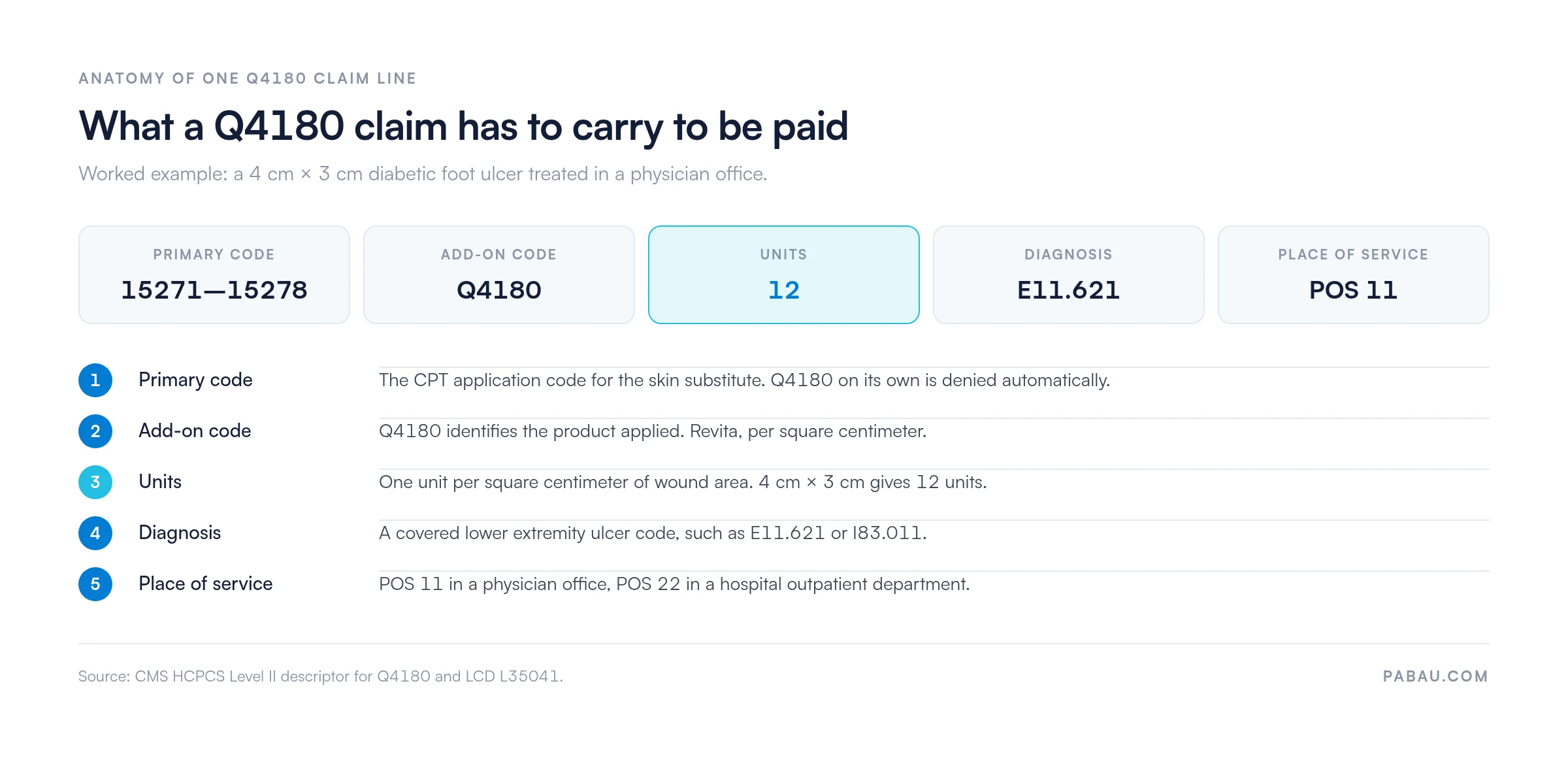
Medicare coverage follows LCD L35041, which covers lower extremity diabetic foot ulcers and venous leg ulcers.
Units of service equal the wound area in square centimeters, so every application visit needs a documented measurement.
Submitting Q4180 without a primary application procedure code produces an automatic denial.
Practice management software like Pabau builds the claim from the patient record, so unit counts match the documented wound area.
HCPCS code Q4180 is a Level II Healthcare Common Procedure Coding System code for Revita, a bioengineered skin substitute applied per square centimeter. It is reported as an add-on to a primary wound care application procedure.
The Centers for Medicare and Medicaid Services (CMS) uses Level II HCPCS codes for products, supplies, and services that CPT codes do not describe. Q4180 sits in the skin substitute group used for chronic non-healing wounds.
Because Q4180 is an add-on code, it cannot be submitted without a primary application procedure code. A claim carrying Q4180 alone is denied automatically. The code is used in physician offices, outpatient hospital departments, and wound care practices under Medicare Part B.
Medicare reimbursement for Q4180 is calculated per square centimeter, so total payment depends on the wound surface area documented at application. Rates are published annually in the Medicare Physician Fee Schedule (MPFS) final rule.
Fee schedule rates change each calendar year, so verify current figures with the CMS Physician Fee Schedule lookup tool before billing. The table below sets out the rate structure. Confirm this year’s published amounts with CMS.
Place of service moves the money here. A 10 cm² wound billed at the non-facility rate pays differently from the same code billed in a hospital outpatient department.
Medicare coverage for HCPCS code Q4180 is governed by LCD L35041, Application of Bioengineered Skin Substitutes to Lower Extremity Chronic Non-Healing Wounds. Coverage is never automatic. A claim has to demonstrate medical necessity through documented wound characteristics and prior treatment history.
The LCD covers wounds of the lower extremity only. Two wound types fall inside its stated scope, diabetic foot ulcers and venous leg ulcers. Coverage applies when all of the following criteria are met:
Commercial payers follow separate policies. Blue Cross Blue Shield entities publish their own bioengineered skin substitute coverage criteria, which may differ from the Medicare LCD. Many commercial payers require prior authorization before Q4180 is applied.
Confirming payer requirements before the procedure protects against retrospective denials. Proper insurance eligibility verification before each visit should check for an active skin substitute benefit. It should also confirm whether prior authorization is in effect.
Every Q4180 claim requires a covered ICD-10-CM diagnosis code that establishes medical necessity under LCD L35041. Submitting without one, or pairing Q4180 with an acute wound code, produces an automatic denial. The table below lists the diagnosis categories billers meet most often. Verify the full current code list in LCD L35041 through the CMS Medicare Coverage Database.
Code to the highest level of specificity available. An unspecified code such as L97.109, used when a more specific code applies, signals incomplete documentation and can trigger medical review. Tie the diagnosis code to the documented wound measurements in the same note, and the claim stands up to audit.
Billing Q4180 correctly requires the right primary application procedure code and an accurate unit count based on measured wound area. The steps below follow the standard Medicare billing sequence for skin substitute add-on codes.
Done properly, the claim line carries five pieces of information, and each one is a separate denial risk.
Claims management software that builds the claim from the patient record keeps the Q4180 unit count tied to the measurement recorded at the visit. Re-keying it into a separate billing system is where the two drift apart.
Calculate wound area at every visit, even when the wound looks unchanged. Payers audit unit counts against documented measurements. A claim showing 15 units of Q4180 with no wound measurement in the clinical note is an audit flag and a likely denial. Make wound measurement part of the application workflow itself.
Thin documentation is the second leading cause of Q4180 denials, behind incorrect add-on code billing. LCD L35041 and most commercial payer policies specify what the medical record must contain at each application encounter. Meeting those requirements upfront removes the need for retrospective appeals.
One structured charge document that captures wound measurements, product lot information, and procedure codes keeps the record complete under audit. For practices treating several chronic wound patients, documentation templates tied to each visit type turn that into a habit.
Q4180 belongs to a family of Q-series HCPCS codes covering bioengineered skin and soft tissue substitutes. Each code identifies a specific product, so billers must use the code matching the product actually applied. Submitting the wrong Q-code is a billing compliance violation. The AAPC HCPCS code lookup carries current descriptors for the full Q-code skin substitute family.
Using Q4131 when Revita was applied misrepresents the product supplied, whichever LCD the products fall under. Each product code must match the product administered and documented in the clinical record. For practices handling several skin substitute products, product-specific billing templates reduce cross-coding errors. Reviewing the denial codes that follow a wrong product code helps billing teams spot these errors during remittance review.
Medicare LCD L35041 sets the coverage framework for Q4180. Commercial and Medicaid coverage follows separate payer-specific policies.
Blue Cross Blue Shield entities in several states publish medical policies for bioengineered skin and soft tissue substitutes that name Q4180 among covered codes. Their coverage criteria, application limits, and prior authorization requirements differ from Medicare’s. Practices billing commercial payers should not assume LCD L35041 criteria carry across.
For practices serving patients across several payer types, a payer-specific authorization matrix for skin substitute codes cuts the volume of preventable denials. Catching a payer policy mismatch at the pre-authorization stage costs far less than appealing it after submission.
Six errors account for the bulk of Q4180 denials, and each one is preventable at charge entry.
A pre-submission audit covering those six points catches the overwhelming majority of Q4180 denials before they happen. The discipline belongs at the documentation and charge capture stages, well before the billing desk.
Run five checks at charge entry. Is the primary procedure code present? Do the units match the wound measurement in the chart? Is a covered ICD-10-CM code attached? Are the product lot and expiry documented? Does the place of service match the care setting? The whole pass takes about thirty seconds and removes the leading denial causes for this code.
A Q4180 error usually surfaces on the remittance advice, weeks after the application visit. By then the measurement that justified the unit count sits several notes back in the chart.
Practice management software like Pabau pulls the patient, treatment, and insurer details straight from the patient record into a pre-filled claim submission. The wound measurement and the product lot recorded at the visit stay attached to the encounter the claim is built from.
Every claim then moves through the same stages on one dashboard, from pending through submitted and processing to paid or error. A wound care team sees which Q4180 lines are still unpaid, without opening a separate billing system. An error gets picked up while the visit is still recent enough to correct the documentation.

Pabau pulls patient, treatment, and insurer details from the patient record into a pre-filled claim, then tracks every submission through to payment. Your team spends less time on billing admin.

Q4180 denials come from a short list. The missing primary code, the wrong unit count, the wrong ICD-10 pairing, and thin documentation account for most of them.
Fix the workflow once and the code stops being a problem. Build the five-point check into charge entry, keep the wound measurement in the note it belongs to, and the claims go out clean.
Book a demo to see how Pabau keeps wound measurements, documentation, and Q4180 claim submissions in one system.

Need a framework for reducing claim denials across your practice? Denial management in healthcare covers the workflow controls that prevent the most common billing errors before they reach the payer.
Want to understand how skin substitute billing fits into the broader revenue cycle? Revenue cycle management explains the end-to-end process from patient registration through payment posting.
Worried about audit exposure on skin substitute claims? Medical billing compliance sets out the documentation controls that hold up when a payer reviews a paid claim.
Want fewer reworked claims across the practice? Clean claim submission explains what a payer needs on the first pass, and what causes a rejection.
HCPCS code Q4180 is used to bill for Revita, a bioengineered skin substitute applied to chronic non-healing wounds. It is reported per square centimeter as an add-on code alongside a primary wound care application procedure. Medicare covers it under LCD L35041 for lower extremity diabetic foot ulcers and venous leg ulcers.
Q4180 is an add-on code. It must be reported alongside a primary wound application procedure code, typically from the CPT 15271-15278 series. Submitting Q4180 without a primary code will result in an automatic claim denial.
Q4180 is billed per square centimeter of wound area. The number of units reported equals the total wound surface area measured in square centimeters at the time of application. Accurate wound measurement documentation in the clinical note supports the unit count on the claim.
LCD L35041 (Application of Bioengineered Skin Substitutes to Lower Extremity Chronic Non-Healing Wounds) governs Medicare coverage for Q4180. It specifies covered wound types, documentation requirements, application frequency limits, and the ICD-10-CM diagnosis codes that establish medical necessity.
Under traditional Medicare, prior authorization is not required nationally for Q4180, though individual Medicare Advantage plans may impose it. Most commercial payers do require prior authorization. Verify with each payer before the application appointment.
The closest codes are Q4186 (Epifix, per square centimeter) and Q4187 (Epicord, per square centimeter). Both describe amniotic or umbilical cord-derived skin substitute products. Q4131 covered Epifix or Epicord under one descriptor until 1 January 2019, when it split into Q4186 and Q4187. Each code must match the product actually applied.