

CCSD code G5100: Bypass of duodenum billing guide
CCSD code G5100 bills a bypass that leaves the duodenum in place CCSD code G5100...

Last Updated: Oct 16, 2026
Q4148 is the HCPCS Level II code for Neox Cord 1K, Neox Cord RT or Clarix Cord 1K, billed per square centimeter applied. It is an add-on code for these amniotic umbilical cord allograft products, reported with a CPT 15271 to 15278 application.
From January 1, 2026, Medicare pays Q4148 as an incident-to supply at a flat national rate of about $127.26 per square centimeter. Most denials trace to three causes: wrong units, missing prior authorization, or thin medical necessity documentation.
Let Pabau's smart automation suggest the right codes, reduce claim denials, and keep your practice compliant—effortlessly.
Automate repetitive tasks and focus on what matters most—your patients.
Reduce coding errors and ensure compliance with the latest regulations.
Clean claims, fewer denials, and faster reimbursements.
Powerful insights and reporting to help your practice thrive.
HIPAA compliant SOC 2 certified GDPR-compliant Trusted by 4,000+ clinics worldwide

HCPCS code Q4148 is an add-on supply code for Neox Cord 1K, Neox Cord RT or Clarix Cord 1K, billed per square centimeter applied.
Since January 1, 2026, Medicare pays Q4148 as an incident-to supply at a flat national rate of about $127 per square centimeter.
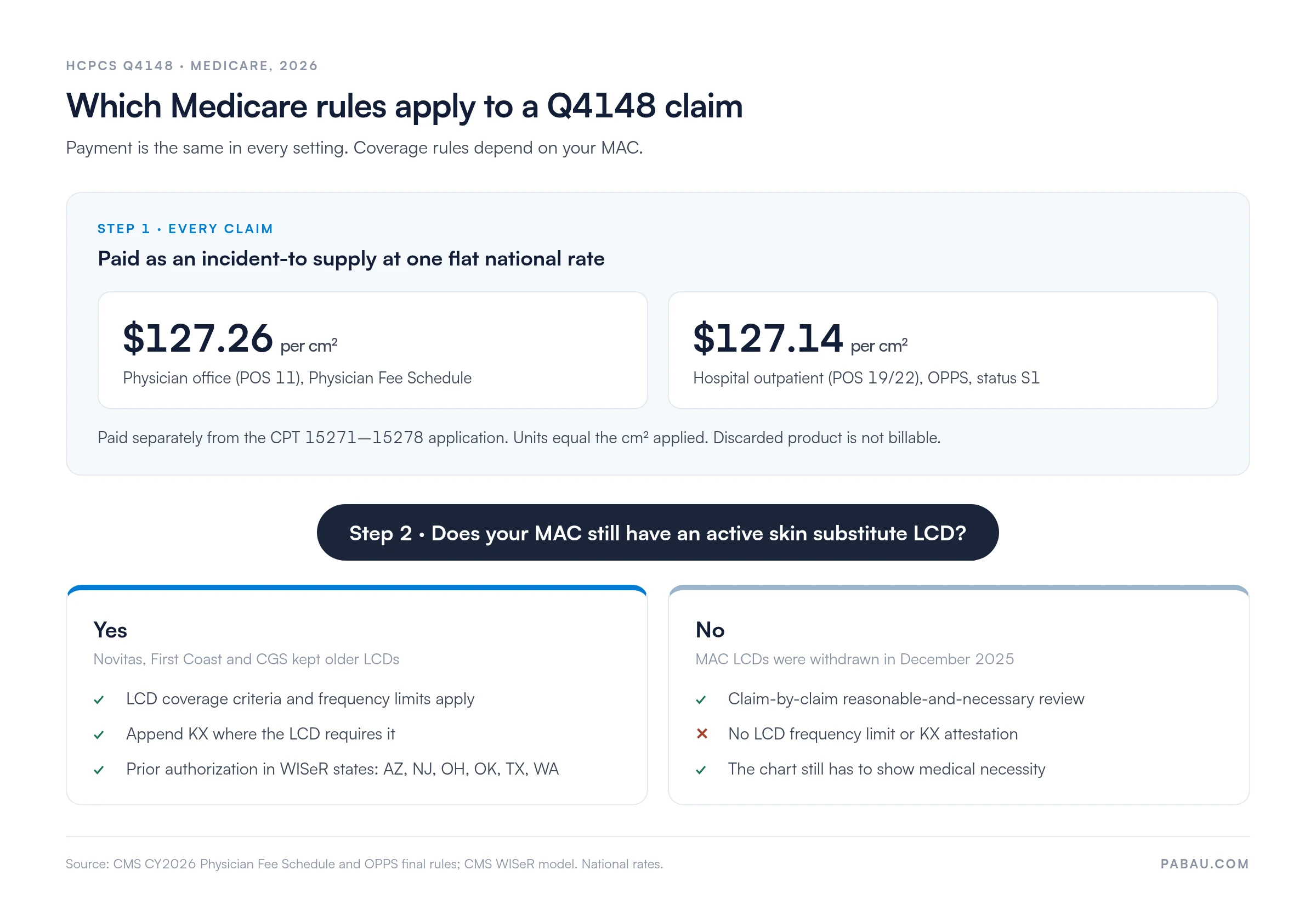
LCD frequency limits and the KX modifier apply only where your MAC still has an active skin substitute LCD.
Most commercial payers and Medicare Advantage plans require prior authorization, and CMS’s WISeR model adds it for some Medicare claims in six states.
Pabau’s claims management software keeps the application note, billed units and claim status on one patient record.
HCPCS code Q4148 is the HCPCS Level II code for Neox Cord 1K, Neox Cord RT or Clarix Cord 1K, per square centimeter. CMS classes it as an add-on code, listed separately in addition to the primary procedure.
All three products are amniotic umbilical cord allografts, regulated as 361 HCT/Ps rather than bioengineered grafts. The application itself is billed with a CPT skin substitute graft code from 15271 to 15278, such as CPT code 15271. Q4148 then carries the product on its own claim line, in square centimeters.
Q codes are temporary national codes within the CMS HCPCS code system, and each Q4100-series code names specific products. The table below collects the reference data billers need before submitting a Q4148 claim.
Check the current descriptor and status in the CMS HCPCS quarterly update before billing. Q codes can be revised, replaced or deleted from one quarter to the next. The same product-to-code check applies across our library of HCPCS codes.
Q4148 applies only when Neox Cord 1K, Neox Cord RT or Clarix Cord 1K is applied to a wound that meets the payer’s clinical criteria. Coverage is not automatic for every wound type.
Covered indications (subject to medical necessity):
Not covered under Q4148:
Billing Q4148 for a different graft is a coding error that invites audit, because each Q4100-series code names its own products. Check the product label against the code at the point of care, before the claim is built.
Units for Q4148 equal the square centimeters of product applied to the wound. The wound measurement supports the claim, but the billed figure is the product area placed, not the number of pieces or sessions.
For example, 12 square centimeters applied in a physician office bills as 12 units. At the national PFS rate of $127.26, that line is worth about $1,527.
Over-reporting units is a frequent audit trigger for skin substitute codes. Wound photographs, measurements and the application note must all match what is billed.
Frequency limits now depend on your MAC. Most MAC skin substitute LCDs were withdrawn in December 2025. Novitas, First Coast and CGS kept older LCDs, and their limits on applications per wound still apply.
Other MACs review each claim for reasonable and necessary use instead. Commercial payers set their own limits in their medical policies, so check each plan separately.
Since January 1, 2026, Medicare pays Q4148 as an incident-to supply at one flat national rate. The rate is about $127.26 per square centimeter under the Physician Fee Schedule and $127.14 under OPPS.
The CY2026 PFS final rule made this change for skin substitutes without a biologics license, and the OPPS final rule matched it. Both rules were published in November 2025 and set one rate for the calendar year.
The supply rate no longer follows product-level sales price data, so there is no quarterly price file to check for Q4148. Your MAC’s fee schedule shows the amount it pays in your locality. Commercial rates are set by contract and can differ from the Medicare figure.
The ICD-10-CM diagnosis code submitted with Q4148 must reflect the wound type and etiology. A diagnosis code that does not match the covered clinical indication reliably produces an automatic denial. The table below lists the most commonly paired codes.
Verify ICD-10 pairings against the applicable payer LCD or commercial policy before each claim, since some diagnoses trigger automatic medical necessity review. Using an unspecified code such as L98.9 when a more specific code exists is a documentation error that often results in denial.
Prior authorization (PA) is the heaviest administrative task when billing Q4148. Most commercial payers and Medicare Advantage plans require it before the product is applied. Strong insurance eligibility verification catches PA requirements at scheduling, before the claim is submitted.
Traditional Medicare usually needs no PA for Q4148. The exception is CMS’s WISeR model, which runs in Arizona, New Jersey, Ohio, Oklahoma, Texas and Washington from 2026. There, PA is required for some skin substitutes where an LCD applies.
The diagram below shows how the flat payment rule and your MAC’s LCD status combine on a Medicare claim.
Always consult the current version of each payer’s policy document before billing. PA criteria and clinical thresholds change periodically, so record the policy version you checked in your billing notes.
Weak documentation is a leading cause of Q4148 denials, alongside missing prior authorization. The medical record must support medical necessity on its own, because post-payment auditors judge the claim only by what the chart records. Building medical billing compliance into wound care workflows from the first visit heads off problems at claim review.
Required documentation elements for Q4148:
The qualified healthcare professional who performs the application must complete the note. Unsigned or incomplete notes are an immediate audit flag. When generating a superbill for wound care, tie each line to a documented procedure note, not only a billing summary. Before a claim leaves the practice, check every element above against the guidance for submitting a clean claim.
Modifiers tell the payer about the circumstances of the service. A missing required modifier leads to denial or reduced payment, and so does one that no longer applies.
KX now depends on your MAC. Where Novitas, First Coast or CGS keep an LCD that requires it, append KX only when the chart meets that LCD’s criteria. Appending it without that support creates false attestation risk.
Run a modifier audit each quarter. Pull every Q4148 claim from the past 90 days, and confirm each KX modifier matches an active LCD and a signed note meeting its criteria. Modifier errors are easy to catch internally before payers find them.
Most Q4148 denials fall into a predictable set of categories, so tracing each one to its root cause makes prevention straightforward. Effective denial management workflows start with tracking denial reason codes by category, so patterns become visible quickly.
For claims denied on medical necessity, send a clinical narrative with the medical record. A bare chart copy with no cover letter linking the documentation to the payer’s criteria is the most common appeal error. Track denial reason codes by category to find the errors that keep recurring.
The Q4100 series holds dozens of skin substitute codes, and each one names specific products. Billing the wrong code for the product applied is a coding error, and repeated misuse can trigger a payer audit. Use the AAPC HCPCS code lookup to confirm the current descriptor for any Q-series code.
Buying one product and billing another product’s code is a false claim risk. When a supplier substitutes a product, look up the replacement’s own Q code and update the claim.
Place of service (POS) decides which Medicare payment system processes Q4148. The 2026 flat supply rate applies in both office and hospital outpatient settings. A wrong POS code can still send the claim down the wrong path or trigger a denial.
Inpatient settings (POS 21) are not appropriate for billing Q4148 on the professional claim, because inpatient wound care is bundled into the DRG payment. Bill Q4148 only in the office or outpatient settings where the professional claim applies.
Review your POS assignment whenever wound care services change setting. Incorrect POS is common when a service moves from a physician office to a hospital outpatient department and billing workflows are not updated.
Many wound care practices still build a Q4148 claim by hand. Staff copy the wound size, product lot and units from the procedure note into a claim form. Then they chase its status in the payer portal, and every copy step lets the units drift from the chart.
Pabau, the practice management and EHR platform we build, keeps the application note, consent form and invoice on one patient record. Its claims management software pulls that record into a pre-filled claim and sends it through Claim.MD for US practices. Claim status and remittances then come back to the same record.
The billed units match the note because they come from it. Denials also show up on the patient record while there is still time to correct and resubmit.

Pabau helps wound care and skin practices track HCPCS codes, generate superbills, and manage claim submissions in one place. See how it works for your practice.

Q4148 billing got simpler on payment and stricter on precision in 2026. One flat rate replaced the old product-level pricing, so the money on each line now rests on the units you report.
That puts the weight on the chart. Measure the wound, record the square centimeters applied, and check whether your MAC still runs an LCD before you append KX or schedule another application.
A practice that settles those checks at the point of care spends far less time arguing denials afterward. Book a demo to see how Pabau keeps Q4148 notes, units and claims on one record.

Need to understand how denials move through your billing cycle? Denial management in healthcare covers the full workflow from CARC identification to appeal resolution.
Looking to tighten up your pre-submission process? Clean claim submission guidelines walks through the elements every claim needs to clear the payer’s front-end edits.
Want to understand how eligibility verification fits into wound care billing? Insurance eligibility verification explains how to catch PA requirements and coverage limits before the appointment.
Billing another amniotic graft? HCPCS code Q4159 covers Affinity under the same 2026 flat supply rate.
Coding the application procedure? CPT code 15271 explains the first 25 square centimeters of skin substitute graft on the trunk, arms or legs.
HCPCS code Q4148 covers Neox Cord 1K, Neox Cord RT and Clarix Cord 1K, which are amniotic umbilical cord allografts. It applies when the product is placed on a covered wound, such as a diabetic foot ulcer, venous leg ulcer or pressure ulcer. Each unit is one square centimeter applied. Coverage requires documented failure of standard wound care first.
Since January 1, 2026, Medicare pays Q4148 as an incident-to supply at a flat national rate. It is about $127.26 per square centimeter under the Physician Fee Schedule and $127.14 under OPPS. The PFS and OPPS final rules published in November 2025 set this single rate for the whole calendar year.
Units equal the square centimeters of product applied, following your MAC’s or payer’s instructions. Bill each wound on its own claim line. Discarded product is not billable under the 2026 supply policy, and JW/JZ modifiers no longer apply. The billed units must match the application note in the medical record.
The top reasons are missing prior authorization (CARC 15, 197) and incorrect unit counts (CARC 16, 96). Others are non-covered diagnoses (CARC 4, 50, 96), thin medical necessity documentation (CARC 50, 252) and exceeded frequency limits (CARC 119, 151). Missing or incorrect modifiers, such as RT/LT or KX where an LCD requires it, round out the list (CARC 4, 16). Tracking denials by category shows which error keeps recurring.



