HCPCS Code G0163: Skilled nursing observation and assessment
What is HCPCS Code G0163? HCPCS Code G0163 is a deleted Level II code for skille...

Last Updated: Oct 15, 2026
HCPCS code P9020 is the Level II code for platelet rich plasma, each unit. It bills autologous PRP transfused to treat a coagulopathy for which PRP is indicated. Medicare contractors state plainly that it must not describe a PRP injection into a specific site.
So the code you report depends on what was done with the PRP. An injection into a tendon, ligament, or joint is reported with CPT 0232T alone. PRP applied to a chronic non-healing wound is reported with HCPCS G0465 or G0460 under NCD 270.3.
Let Pabau's smart automation suggest the right codes, reduce claim denials, and keep your practice compliant—effortlessly.
Automate repetitive tasks and focus on what matters most—your patients.
Reduce coding errors and ensure compliance with the latest regulations.
Clean claims, fewer denials, and faster reimbursements.
Powerful insights and reporting to help your practice thrive.
HIPAA compliant SOC 2 certified GDPR-compliant Trusted by 4,000+ clinics worldwide

HCPCS code P9020 bills autologous platelet rich plasma, each unit, transfused to treat an indicated coagulopathy.
Medicare contractors state that P9020 must not describe the injection of PRP into a specific site.
A PRP injection into a tendon, ligament, or joint is billed with CPT 0232T alone, because 0232T already includes harvesting and preparation.
PRP for chronic non-healing wounds is covered nationally under NCD 270.3 and billed with G0465 or G0460, with no separate supply line.
Pabau pre-fills claims from the patient record, offers a searchable code library, and validates required fields before submission.
HCPCS code P9020 is the Level II code that CMS maintains for platelet rich plasma, each unit. The official descriptor reads: “Platelet rich plasma, each unit.” It sits in the P9010-P9100 range, which covers blood and blood products with their associated procedures.
The code bills autologous PRP transfused to treat a coagulopathy for which PRP is indicated. It is not the code for injecting PRP into a joint, a tendon, or a wound. That single distinction drives almost every P9020 billing decision you will make.
The P-series is separate from J-codes, which cover drugs given by injection. It is separate again from G-codes, which cover procedural services CMS has defined itself.
P9020 sits with the transfusion products, so it describes a unit of PRP supplied for transfusion. Placing that PRP into a body site is a clinical act, and it belongs to a different code.
P9020 applies when autologous PRP is prepared from the patient’s own blood and then transfused for an indicated coagulopathy. Medicare Administrative Contractors set this out plainly.
Noridian’s billing and coding article for PRP injections expects the code to be billed for units transfused in treating those conditions.
It then adds a warning in capitals: “This code MUST NOT be used to describe the injection of PRP into a specific site.” Other contractors publish the same instruction word for word.
Coders sometimes reach for CPT 86965 instead, which covers pooling of platelets and other blood products. That is a blood banking service rather than a product code, and it does not describe PRP. The two are not interchangeable.
One unit of P9020 is one unit of PRP transfused, and the transfusion record supports the count. CMS has published no volume definition for a single unit, so payer policies vary. Confirm the payer’s own policy before billing more than one unit for a single encounter.
Preparation itself starts with a venipuncture draw, usually 10 to 60 mL of whole blood, depending on how much concentrate is needed. The blood is centrifuged, often in two spins, to separate red cells from the platelet-rich layer. That concentrate is then collected and used during the same encounter.
Most PRP performed in an outpatient practice is not billed with P9020 at all. The code you report depends on what was done with the PRP, not on how it was prepared. Get that decision right and the rest of the claim usually follows.
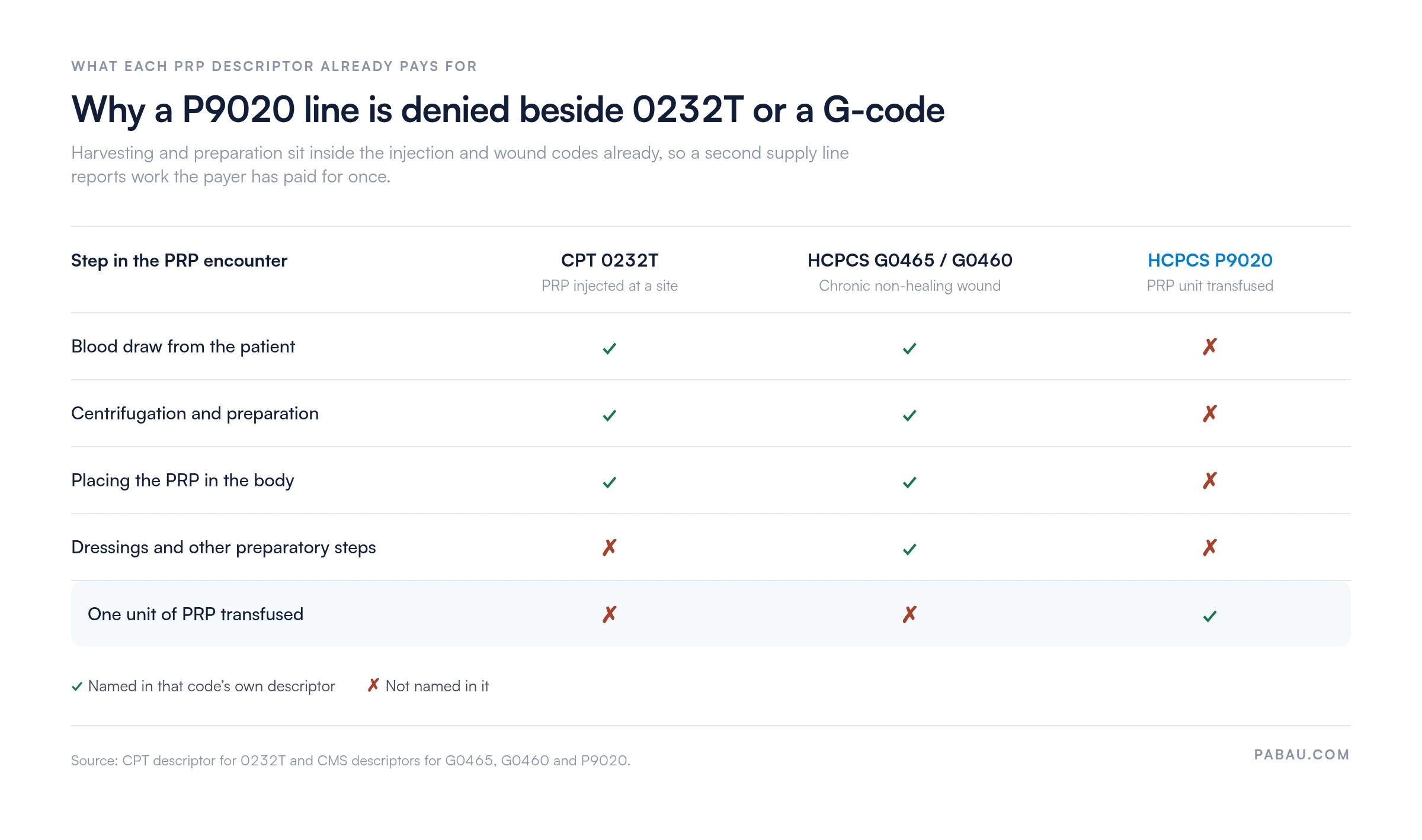
The descriptor for 0232T reads: “Injection(s), platelet rich plasma, any site, including image guidance, harvesting and preparation when performed.” Harvesting and preparation already sit inside it. CPT also instructs that 0232T is not reported with any of the following:
Adding P9020 to a 0232T claim does not recover the preparation cost a second time. It reports a transfusion product that was never transfused, which is why those lines are denied. Read the descriptors side by side and the overlap is obvious.
Here is how that plays out on a typical claim. A patient has blood drawn, spun twice, and the concentrate injected into the common extensor tendon under ultrasound. One line goes out: 0232T. No P9020 for the product, no 76942 for the guidance, and no 86965 for the spin.
Medicare does not cover PRP injections for musculoskeletal indications. Several contractors have published Local Coverage Determinations saying so, including L38745, L38937, L39023, L39058, L39060, L39068, and L39071.
Those LCDs address non-wound PRP and defer wound indications to the national determination below. None of them creates a jurisdiction-specific wound care exception.
Coverage of PRP for chronic non-healing wounds is national rather than jurisdictional. NCD 270.3, Blood-Derived Products for Chronic, Non-Healing Wounds, was implemented through CMS transmittal MM12403 and CR 12403.
For dates of service on or after April 13, 2021, CMS covers autologous PRP for chronic non-healing diabetic wounds for 20 weeks.
That coverage applies when the device used carries an FDA-cleared indication that includes management of exuding cutaneous wounds. Beyond 20 weeks, the contractor decides, and those claims carry G0465 with the KX modifier. Chronic non-healing wounds that are not diabetic also fall to contractor discretion, billed with G0460.
A diabetic wound claim should also carry two ICD-10-CM diagnosis codes, one for diabetes mellitus and one for the chronic ulcer.
Both G-codes are all-inclusive per treatment, covering administration, dressings, phlebotomy, centrifugation, and every other preparatory procedure. So no separate P9020 supply line exists under NCD 270.3, and adding one invites an unbundling denial.
When a Medicare beneficiary asks for PRP for a non-covered indication, issue a signed Advance Beneficiary Notice (ABN) before the procedure. Without that signed form, the practice carries the cost and cannot bill the patient afterwards.
Which modifier goes on the claim depends on what happened:
For any Medicare patient receiving PRP outside the NCD 270.3 wound care pathway, the ABN step is not optional. Collect the signed form before the service date and file it against the patient record. The billing team can then see it while the claim is being built.
Run a payer check on every Medicare patient scheduled for PRP before the appointment. Record their coverage status against the patient file and attach the signed ABN the same day it is collected. A retroactive ABN is not valid, so the signature has to precede the service.
Commercial coverage for PRP is inconsistent and plan-specific. Where a plan does cover PRP injections, the claim is built on 0232T rather than P9020. Some Blue Cross Blue Shield plans, certain Aetna policies, and selected regional payers cover it.
Their policies name narrow orthopedic indications such as lateral epicondylitis or Achilles tendinopathy. Coverage usually turns on failed conservative treatment and documented clinical criteria. Running insurance eligibility verification before you schedule is the most effective step against a surprise denial.
Medicaid programs vary even more widely. Most state programs do not cover PRP at all. A small number publish wound care policies that follow the national Medicare determination. Verify the state fee schedule and the policy document before billing any PRP code to a Medicaid plan.
Before you submit a commercial PRP claim, work through this:
CMS publishes no national allowed amount for P9020 in the Medicare Physician Fee Schedule. The code describes a blood product rather than a physician service.
The CMS Physician Fee Schedule lookup tool returns no payment rate for it. Where the contractor prices the code, that rate is set locally, so confirm it with your MAC.
PRP injections for Medicare patients raise a different question. Those are non-covered, so the practice bills its established charge and collects from the patient under a signed ABN.
Set that charge against the cost of preparation, which covers consumables, centrifuge time, draw supplies, and clinical staff time.
Non-covered services carry more write-off risk than paid ones, because the money has to come from the patient. Financial counseling before the appointment, a clear charge on the day, and a short collection cycle afterwards are what protect it.
Audits on PRP are more common than on routine procedure billing, because non-coverage is the default and coding errors are frequent. So a defensible P9020 record has to show more than the charge.
Every record supporting a submission should carry these elements:
A clean claim populates every required field and links the diagnosis logically to the service. It also carries the code that matches what was done with the PRP. Miss any one of those and denial probability rises sharply.
P9020 claims carry a higher-than-average denial rate, largely because the code gets used for services it does not describe. The reason code on the remittance usually says which mistake was made.
Tracking denials across 90 days of PRP claims usually exposes one root cause behind most of the rejections. Map the reason codes on those remittances against the full list of medical billing denial codes to see which pattern your practice keeps hitting.
Coders unfamiliar with blood product billing reach for the wrong code more often than not. The table below sets the scope of each one against P9020.
The authoritative source for P9020’s descriptor and status is the HCPCS Level II release file. CMS publishes it on the HCPCS quarterly update page, alongside the annual release. Check the current file rather than a third-party lookup tool, which can lag a quarterly change by months.
Before each new billing year, verify P9020 against the CMS HCPCS Level II release file. Status and descriptor changes are not always publicized widely. Billing a revised or inactive code is an avoidable compliance risk, and it delays payment on legitimate claims.
Prior authorization applies to PRP as a therapy rather than to P9020 as a line item. Among the commercial payers that do cover PRP, the clinical criteria are fairly consistent.
Plans ask for a diagnosis drawn from their own list of covered indications. They also want evidence of failed conservative treatment over six to twelve weeks, plus the planned protocol.
No universal standard exists, though. Some plans require authorization for all PRP regardless of indication. Others apply it only to musculoskeletal use, and a few that cover wound care PRP run a streamlined pathway for diabetic ulcers. Build the request into scheduling and most last-minute claim holds disappear.
PRP billing goes wrong where the clinical note and the claim stop matching. The clinician documents an injection into a tendon, and the claim goes out carrying a transfusion product code. Nobody notices until the remittance arrives weeks later.
Practice management software like Pabau shortens that distance. Claims are pre-filled from the patient record rather than retyped, so the treatment, the date, and the provider carry across as documented. Billing staff search the built-in code lookup library for the code they need and attach it to the line.
Required-field validation then holds back any claim that is missing information, before it leaves the practice. Coverage judgment stays with your billing team, where it belongs. What claims software for practices removes is the retyping, the missing field, and the line that describes something other than what was performed.
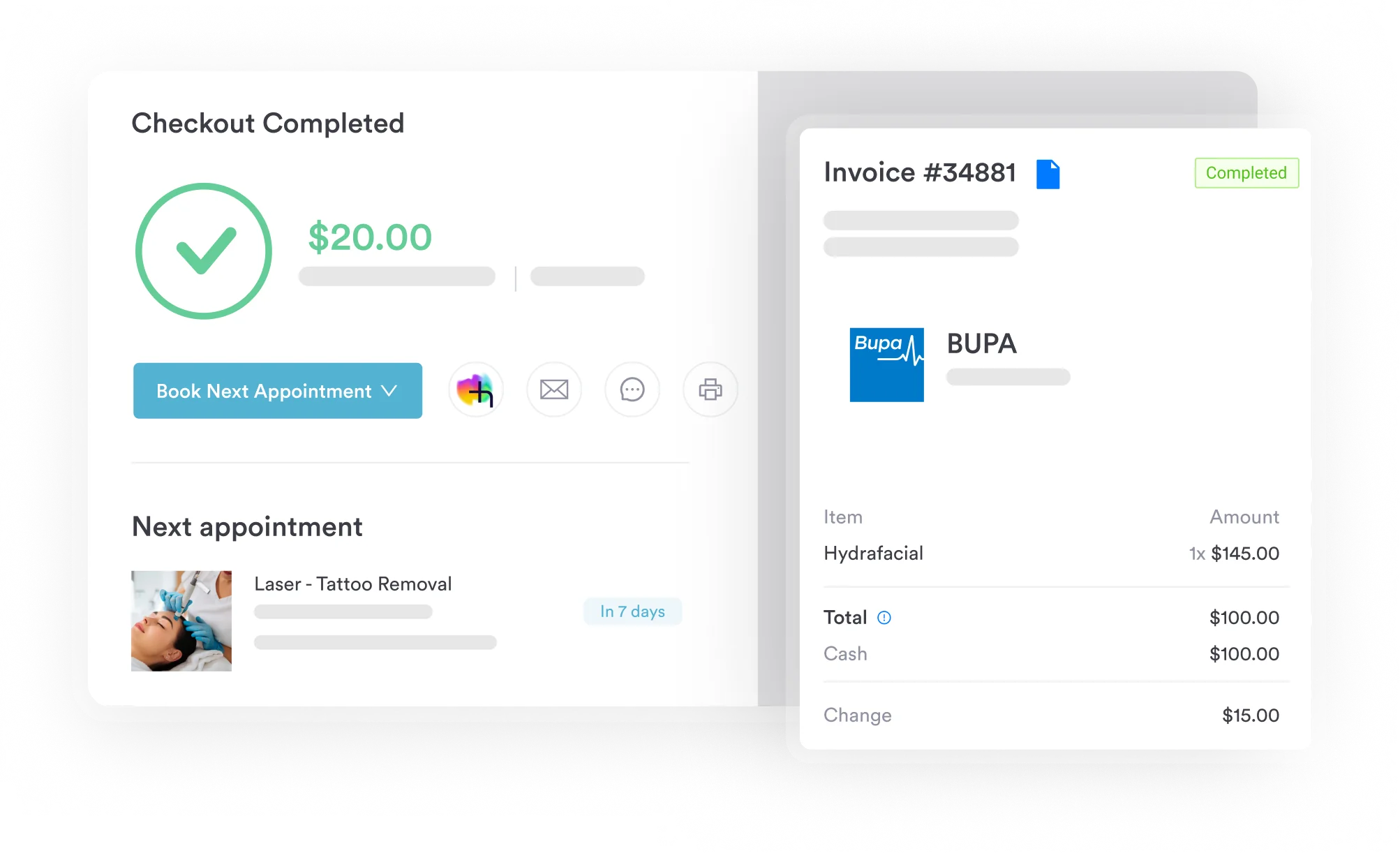

Pabau pre-fills claims from the patient record and gives billing staff a searchable code library. Required fields are validated before the claim is submitted.

P9020 is a narrow code with a wide reputation. It bills a unit of autologous PRP transfused to treat a coagulopathy, and nothing beyond that. The PRP work that fills most appointment books is an injection or a wound application, which carries 0232T, G0465, or G0460 instead.
Practices that get P9020 wrong are rarely misreading the descriptor. They are billing a supply line for a service that never involved a transfusion, and the clinical note said so all along.
Book a demo to see how Pabau builds a PRP claim from the note that documented it. Missing fields get flagged before the claim ever goes out.

Want a system for the denials PRP claims keep producing? Denial management in healthcare covers tracking, appealing, and preventing rejections across the whole billing operation.
Worried about audit exposure on non-covered procedures? Medical billing compliance explains the regulatory framework coders and billing staff work inside.
Need to read the reason code on a PRP remittance? Denial codes in medical billing maps CARC codes to the corrective actions that clear them.
Not sure what makes a claim clean on the first pass? Clean claim sets out the fields and checks that stop a submission bouncing back.
Billing PRP as self-pay? Superbill shows how to itemize the procedure, the supplies, and the diagnosis for the patient’s own claim.
No. Cosmetic PRP is not covered by Medicare, Medicaid, or commercial plans, so those treatments are self-pay. P9020 does not apply either way, because no transfusion takes place. Collect payment at the time of service and itemize the charge on the patient’s receipt.
No ICD-10-CM code describes PRP itself. The diagnosis codes describe the condition being treated, so they come from the documented indication. A diabetic wound claim under NCD 270.3 should carry two of them, one for diabetes mellitus and one for the chronic ulcer.
No. An Advance Beneficiary Notice is a Medicare form and carries no standing with a commercial payer. Use your practice’s own financial responsibility form instead, signed before the service. It should name the treatment, the expected charge, and why the plan may not pay.
It depends on why it was denied. Where the coding was right and the record supports the transfusion, appeal with the transfusion record and the indication attached. Where P9020 described the wrong service, an appeal will not succeed. Submit a corrected claim carrying 0232T, G0465, or G0460 instead.